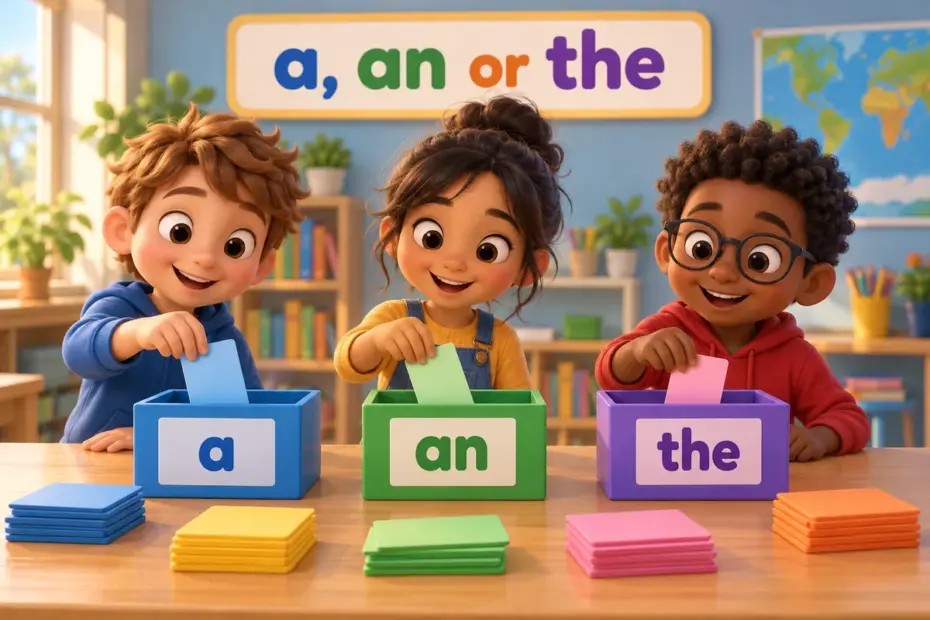
Articles a an the with uses cover the three small words that sit before nouns and tell a reader whether the noun is new, known or general. Use a or an for one unspecific item, the for something already identified, and no article for plurals and abstractions. A short contrast shows the shift: “a book, the book, books.”
Articles a an the with uses at a glance
- A and an are the indefinite articles; the is the definite article.
- A precedes a consonant sound and an precedes a vowel sound.
- The marks a noun the listener can already identify.
- The zero article means no word is used, as with general plurals.
- The commonest learner error is adding the before a general abstract noun.
What are articles a an the with uses?
An article is a short word that signals how a noun relates to the reader, not what the noun means. English has two forms of the indefinite article, a and an, one definite article, the, and a zero article that leaves a general noun bare. The article sentence at the link shows each form in a full line.
| Article | When to use it | Example |
|---|---|---|
| a | one unspecific countable noun after a consonant sound | I bought a pen. |
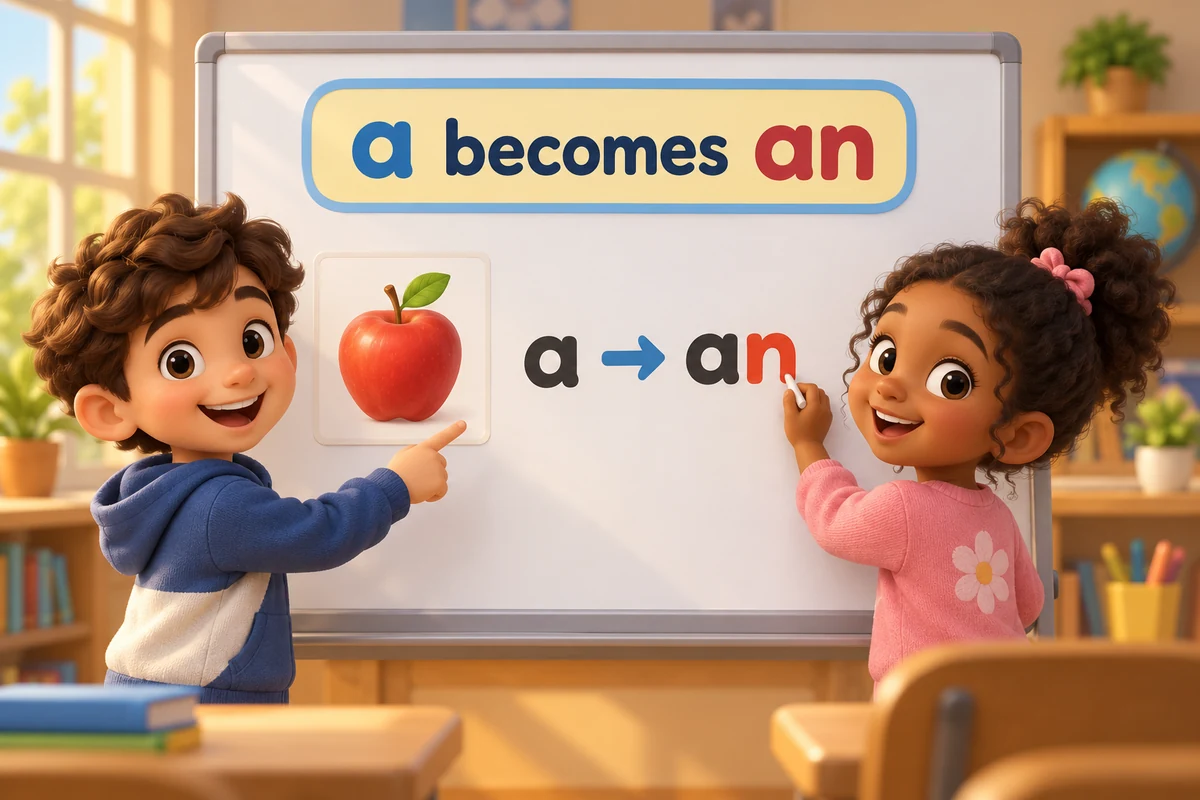
| an | one unspecific countable noun after a vowel sound | She ate an apple. |
| the | a specific noun the reader already knows | The pen on my desk is blue. |
| zero article | general plurals and uncountable or abstract nouns | Pens are useful. |
Countability decides half the work. A singular countable noun can take a or an, as in a chair, but an uncountable noun such as furniture takes none, and neither does a plural such as chairs. The definite article is freer, because it can sit before a singular, a plural or an uncountable noun as long as the reader can identify which one is meant.
How do you use articles in a sentence?
Two questions settle most choices: is the noun countable, and is it already known? A single new countable noun takes a or an, a known noun takes the, and a general noun takes nothing. The finer rules follow the same logic.
| Pattern | Example | What it signals |
|---|---|---|
| first mention | I saw a cat in the yard. | The noun is new to the listener. |
| later mention | The cat was asleep. | The same noun is now identifiable. |
| unique noun | The sun rose early. | There is only one of the thing. |
| general plural | Cats sleep a lot. | The statement covers every cat. |
| quality with the | The best answer wins. | A superlative names one clear case. |
Articles a an the with uses across contexts
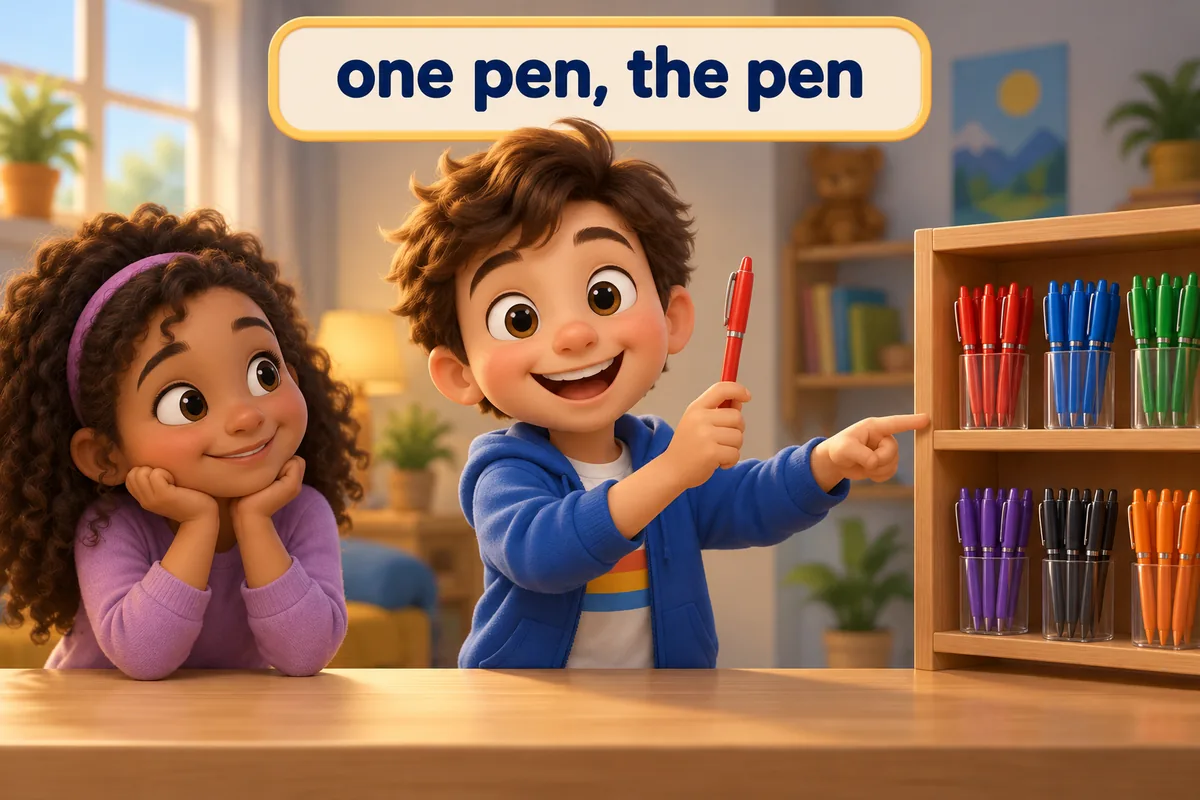
The choice changes with the job the noun does in each setting. The table below shows the same three little words in ten real situations.
| Context | Example sentence | Why this works |
|---|---|---|
| Classroom | Please open a book at page ten. | The instruction names one unspecific book. |
| Lab report | Heat the sample to boiling point. | The known sample was named earlier. |
| Shopping | I need an umbrella today. | An precedes a vowel sound. |
| Travel | The train leaves at six. | Both speaker and listener share the timetable. |
| News report | A witness described the crash. | One unspecified witness is the source. |
| Recipe | Beat an egg, then add the flour. | First mention takes an, later the. |
| Everyday chat | Music helps me think. | An abstract noun takes the zero article. |
| Academic prose | The data support the claim. | A specific set is referred to. |
| Sports talk | She plays tennis on Sundays. | Games and days often take no article. |
| Instructions | Press the button twice. | There is one button in view. |
| Weather note | An icy wind blew all night. | An precedes a vowel sound. |
| Story opening | A stranger knocked once. | A introduces a new character. |
Definite and indefinite articles compared
The two kinds of article answer different questions. The indefinite forms ask the reader to picture any one item, while the definite form points to a particular one.
| Point | a or an | the |
|---|---|---|
| Signal | one, not yet known | one, already known |
| Countability | only with a singular countable noun | with singular, plural and uncountable nouns |
| Second mention | replaced on the next mention | used for the repeat mention |
| Unique nouns | not used for the sun or the moon | used for the sun and the moon |
| Sound rule | depends on the first sound, not the letter | no sound rule applies |
The comparison matters most at the second mention. A writer introduces the noun with a or an, then switches to the for every later reference, which keeps a long text tied together. Dropping that switch, or repeating a, makes a paragraph sound like a list of unrelated things.
Articles in fixed time and place phrases
Some phrases keep a fixed article that the general rules do not predict, so they are learned as whole units. The table lists common ones and the pattern each follows.
| Phrase | Pattern | Example |
|---|---|---|
| at the moment | the with a point in time | She is busy at the moment. |
| in the morning | the with a part of the day | We meet in the morning. |
| at night | zero article with night | The stars appear at night. |
| on the bus | the with a known vehicle | He read on the bus. |
| go to school | zero article for an institution in general | The children go to school. |
| go to the school | the for one particular building | She drove to the school. |
| in bed | zero article in a fixed phrase | He stayed in bed all morning. |
| on the radio | the with a known medium | The song played on the radio. |
Word forms and grammar of articles
Articles do not change shape for number or gender, and they take no ending. Their grammar lies in what follows them rather than in the article itself. For more on describing words that sit beside them, read adjectives and articles a an the usage rules.
| Form | Part of speech | Example |
|---|---|---|
| a | indefinite article | A dog barked. |
| an | indefinite article | An owl called. |
| the | definite article | The dog ran home. |
| zero article | no word used | Dogs are loyal. |
| a + adjective + noun | article plus modifier | a small dog |
| an + vowel-sound adjective | article plus modifier | an old owl |
Common mistakes with articles
Most errors come from the sound rule, from the first and second mention, and from abstract nouns that need no article at all.
- Incorrect:
I saw a elephant.Correct: I saw an elephant. Rule: an comes before a vowel sound. - Incorrect:
He is an university student.Correct: He is a university student. Rule: the choice follows the sound, and university begins with a y sound. - Incorrect:
The honesty is always best.Correct: Honesty is always best. Rule: a general abstract noun takes no article. - Incorrect:
I play the football on Fridays.Correct: I play football on Fridays. Rule: team games usually take the zero article. - Incorrect:
I met a man. A man was friendly.Correct: I met a man. The man was friendly. Rule: a second mention of the same noun takes the. - Incorrect:
Please pass a salt.Correct: Please pass the salt. Rule: an uncountable noun at a shared table takes the, not a.
Practice using articles a an the
Try each item, then read the reason next to the answer. A related set of lines at the adjectives for article page shows more modifiers in place.
- Fill in the blank: I bought ________ apple at the market.
- Fill in the blank: ________ moon was bright last night.
- Choose the better word: She studies at (a / an) university.
- Correct the error: The water boils at one hundred degrees, so water is common.
- Build a sentence: introduce one new noun with a, then repeat it with the.
- Spot the register: which fits a lab report, “Heat the sample” or “Heat a sample thing”?
- Fill in the blank: He stayed in ________ bed until noon yesterday.
Answers
- an: apple begins with a vowel sound, so an precedes it.
- The: there is only one moon, so the definite article applies.
- a: university begins with a y sound, so a precedes it.
- Water boils at one hundred degrees, so water is common: a general noun takes the zero article.
- Sample: I saw a fox. The fox ran away. First mention takes a, the repeat takes the.
- The first: a lab report keeps the specific sample known from earlier in the text.
- bed: the phrase in bed is fixed and takes the zero article.
The bottom line
Articles a an the with uses come down to one test: is the noun countable, and is it already known? Give a new countable noun a or an, give a shared or unique noun the, and leave general plurals and abstracts bare. Listen to the first sound, not the first letter, and the sound rule takes care of a and an.
Frequently asked questions about articles
When do you use a and when do you use an?
Use a before a word that begins with a consonant sound and an before a word that begins with a vowel sound, as in a book and an hour. The test is the sound, so a university and an honest answer follow the spoken form rather than the written letter.
Why does English use the with some nouns and nothing with others?
The definite article the marks a noun the listener can already identify, while the zero article covers general plurals and abstract nouns. So the report points to one known report, but reports in general takes no article at all in the plural.
Are articles used before country names?
Most country names take no article, as in France and Japan. A small set of names keeps the, including the United States and the Netherlands, and plural names such as the Philippines also take it. The rule follows the fixed name rather than a general pattern.
What is the zero article?
The zero article is the choice to place no word before a noun. It appears with general plurals such as dogs, with uncountable nouns such as water, and with abstract qualities such as honesty. Naming it helps learners notice that the omission is deliberate.