Asterisk rules uses and examples all centre on one small star-shaped mark that sits above the number eight on a keyboard. The mark does several jobs, from marking a footnote to signalling a correction, and it always sits after the word it points to. One example is “Free entry*”.
Asterisk rules uses and examples at a glance
- The asterisk is the star symbol typed with Shift and the number eight.
- As a footnote marker it follows the word it points to, with no space.
- In computing it acts as a wildcard that stands for any characters.
- In maths it is spoken as times or multiplied by.
- The commonest learner error is writing asterix instead of asterisk.
What is an asterisk and what does it mean?
An asterisk is a typographic mark shaped like a small star, and it has no fixed meaning of its own; the setting supplies the meaning. A star after a word points to a note, a star between numbers marks multiplication, and a star inside a word hides letters. Full lines using the mark sit at the asterisk sentence page.
| Use | Example | Where it appears |
|---|---|---|
| footnote marker | Free entry* | academic and reference writing |
| correction in chat | I am *not coming. | informal messaging |
| multiplication | 3 * 4 = 12 | maths and programming |
| wildcard | file*.txt | computing and search boxes |
| censored letters | s*** | informal writing and print |
| required field | *Required | forms and websites |
| scene divider | * * * | between scenes in a book |
| wrong-form marker | *He goed | linguistics and language teaching |
The mark is old and plain, so it adapts easily. A single star after a word sends the reader to a note, while the same star between digits does arithmetic, and a reader rarely confuses the two because the surrounding text decides the sense. That flexibility is why one symbol serves so many settings without change.
How do you place an asterisk in a sentence?
Placement follows the job. As a note marker the star hugs the word, in maths it stands alone between spaces, and in chat it precedes the corrected word. Getting the spacing right is what separates a clear note from a stray character.
| Pattern | Example | Rule |
|---|---|---|
| note after a word | Free entry* | The star follows the word it refers to, with no space. |
| note at the foot of the page | * See terms. | The matching star opens the note below. |
| correction in chat | *a student | The star precedes the corrected word. |
| multiplication | 3 * 4 = 12 | Operators take a space on each side. |
| divider | * * * | Three spaced stars form a section break. |
Spacing carries meaning here. A writer who leaves a space before a footnote star, as in word *, creates a floating mark that can be mistaken for a stray character, so the house habit is to attach it to the word. In maths the opposite applies, and the operator needs air on both sides.
Asterisk uses and examples across contexts
One symbol serves many settings, and each setting has its own habit. The table below shows nine of them.
| Context | Example | Why this works |
|---|---|---|
| Academic essay | Smith (2019)* argues the point. | A star points to a note at the foot. |
| Messaging | See you at *six, not seven. | The star flags a quick correction. |
| Spreadsheet | =B2 * C2 | The star multiplies two cell values. |
| Search box | report*.pdf | The wildcard matches any file name. |
| News style | a s***storm of criticism | Stars hide letters in a quoted word. |
| Web form | Full name * | The star marks a required field. |
| Novel | * * * | Three stars divide two scenes. |
| Language class | *I have went | A star marks a form the teacher rejects. |
| Sports results | Player of the match* | The star links to a note about the award. |
| Recipe card | Simmer for 10 minutes* | The star points to a safety note. |
| Price list | Student price* | The star explains a condition. |
Asterisk in code and search patterns
In computing the star is a wildcard, so one character stands for any run of characters. This makes it useful in file names, search boxes and spreadsheets, where a fixed list would be far too long. The table shows common patterns and what each one matches.
| Pattern | Matches | Example |
|---|---|---|
| *.txt | any file ending in .txt | notes.txt, list.txt |
| file* | any name starting with file | file1, file-report |
| *cat* | any name containing cat | catalog, wildcat |
| B2 * C2 | the product of two cells | a spreadsheet total |
| 3 * 4 | the multiplication of numbers | a result of twelve |
| total* | any label beginning with total | total, total_cost |
A wildcard is not the same as a note. The two uses share the character but not the logic, and a reader in a search box expects the star to match text rather than to point at a footnote. Keeping the setting in mind settles the meaning before the mark is even read.
Asterisk compared with dagger and asterism
Reference writing uses a fixed order of note marks, and a related star symbol does a different job again. Keeping the three apart prevents a muddled footnote.
| Point | asterisk (*) | dagger (†) | asterism (⁂) |
|---|---|---|---|
| Order | the first note | the second note | not a note at all |
| Job | marks a footnote | marks a later footnote | divides scenes or sections |
| Position | after the word | after the word | on a line of its own |
| Plural | asterisks | daggers | asterisms |
| Seen in | essays and code | older and legal notes | novels and poems |
Footnotes rarely need more than three marks. When an asterisk, a dagger and a double dagger are all used, the order is fixed, and any further note returns to the asterisk doubled, so a reader follows a clear sequence down the page rather than guessing at the symbols.
Word forms and grammar of asterisk
The word is a noun that also works as a verb meaning to mark with a star. The plural and the verb forms follow regular patterns, which is why a spelling slip is the main error. Punctuation nearby follows the same habits as the comma rules used across a page.
| Form | Part of speech | Example |
|---|---|---|
| asterisk | noun | Add an asterisk after the word. |
| asterisks | plural noun | Two asterisks mark the second note. |
| asterisked | verb, past tense | She asterisked the key figure. |
| asterisking | verb, -ing form | He is asterisking each source. |
| asterisked | adjective | The asterisked entry has a note. |
| asterisk | verb, base form | Please asterisk the required rows. |
| star | noun | Some readers call the mark a star. |
Common mistakes with the asterisk
Most errors come from the spelling of the word, from the space before the note star, and from the article that precedes it.
- Incorrect:
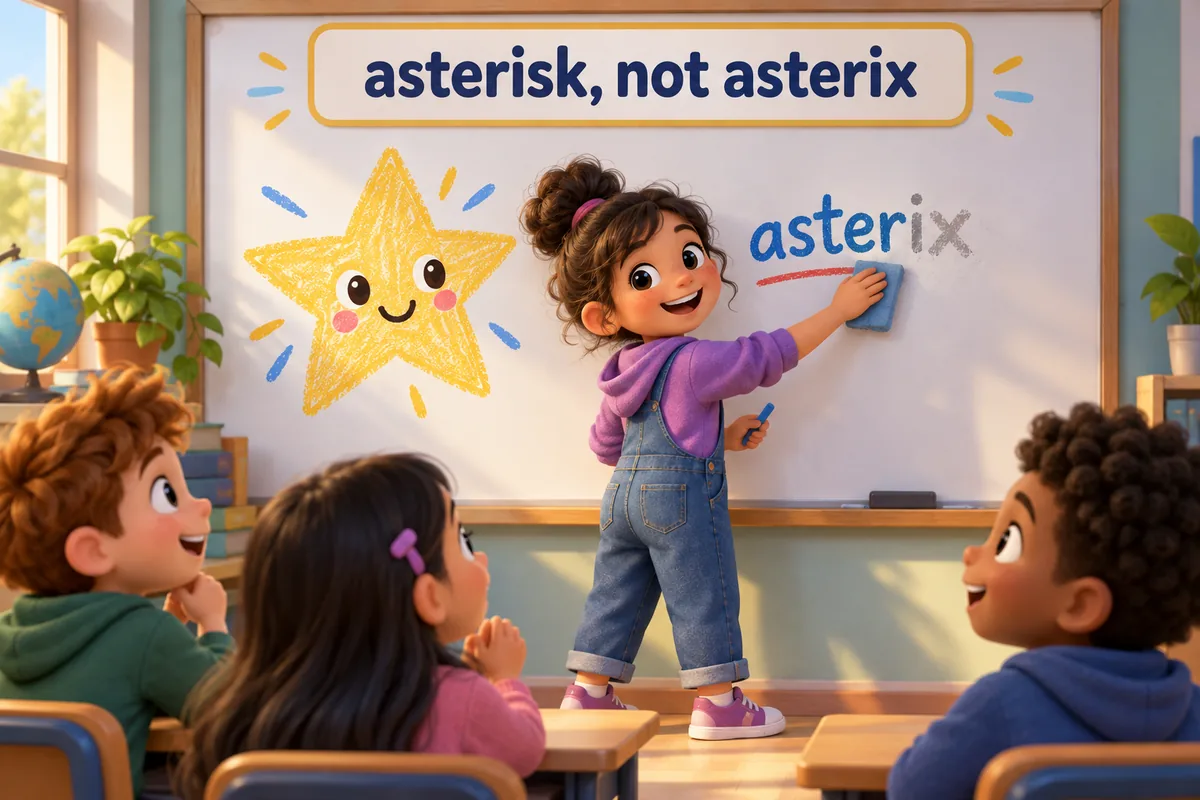
asterixCorrect: asterisk. Rule: the word ends in -isk, and the -ix form is a common misspelling. - Incorrect:
a asteriskCorrect: an asterisk. Rule: the word begins with a vowel sound, so it takes an. - Incorrect:
Free entry *Correct: Free entry*. Rule: a note star hugs the word it marks, with no space before it. - Incorrect:
3*4Correct: 3 * 4. Rule: a maths operator takes a space on each side. - Incorrect:
Please sign the asterisk field.Correct: Please sign the field marked with an asterisk. Rule: the mark is named, not turned into an adjective for the field. - Incorrect:
The total is four asterisk three.Correct: The total is four times three. Rule: the symbol has a spoken name, times, in speech.
Practice using the asterisk
Try each item, then read the reason beside the answer. For word-order habits nearby, read adjectives and articles a an the usage rules.
- Fill in the blank: Add ________ asterisk after the word free.
- Fill in the blank: Type three spaced stars, ________, to divide the scenes.
- Choose the better word: The word ends in -isk, so write (asterisk / asterix).
- Correct the error: Free entry *
- Build a sentence: mark a footnote on the word deadline in a short line.
- Spot the register: which fits an essay, “Smith (2019)* argues” or “Smith said stuff*”?
- Fill in the blank: In maths, 3 ________ 4 equals twelve.
Answers
- an: asterisk begins with a vowel sound.
- * * *: three spaced stars form a section divider.
- asterisk: the correct spelling ends in -isk.
- Free entry*: the note star hugs the word it marks.
- Sample: The deadline* is Friday, with a note below. The star follows the word and points to the note.
- The first: an essay keeps a formal source and a tidy note star.
- *: the star is the multiplication operator between numbers.
The bottom line
Asterisk rules uses and examples come down to context and spacing. As a note marker the star hugs the word and points to a matching note below; in maths it stands alone between spaces; and in chat it flags a correction before the fixed word. Spell the word with -isk and give it the article an, and the symbol will read cleanly.
Frequently asked questions about the asterisk
What does an asterisk mean?
An asterisk has no single meaning. After a word it marks a footnote, between numbers it means multiplied by, in a search box it stands for any characters, and inside a word it hides letters. The surrounding text supplies the exact sense.
How do you type an asterisk?
On most keyboards hold Shift and press the number eight key, which shares the position with the star. On a phone, open the symbols page of the number keyboard and tap the star. The key is usually printed on the eight, above the digit.
When do you use an asterisk for a footnote?
Use a star as the first footnote mark, placed right after the word it notes, with the matching star opening the note at the foot of the page. If a second note is needed, the dagger follows the asterisk in the standard order.
Is it asterisk or asterix?
The correct spelling is asterisk, ending in -isk. Asterix is a common misspelling, and it also names a well-known comic character, which keeps the wrong form alive. The mark on the keyboard is an asterisk, and the plural is asterisks.