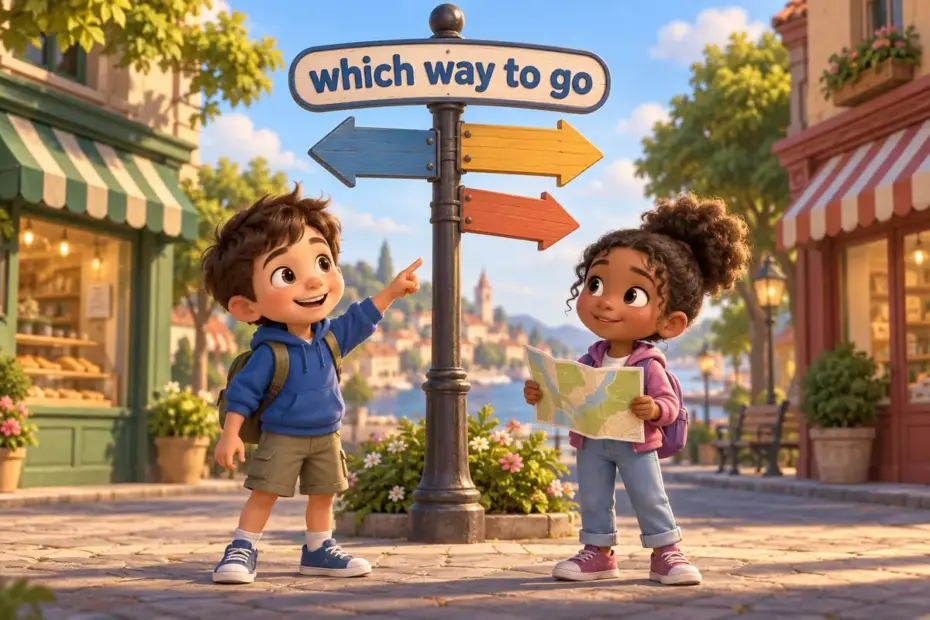
Asking and giving directions is the everyday skill of finding a place and helping someone else reach one, and it runs on a small set of fixed phrases. A polite request opens with excuse me, an answer names turns and landmarks, and a short check keeps both people sure. The exchange “Turn left at the lights” shows the pattern.
Asking and giving directions at a glance
- Ask with a polite opener such as excuse me, then name the place.
- Give directions as a short ordered list: go, turn, take, then arrive.
- Landmarks make directions clear because they are easier to see than distances.
- Use at for a turn point and on for a continuing line of travel.
- The commonest learner error is the word order in a polite question.
What are asking and giving directions phrases?
These phrases form two groups: questions that request help, and instructions that supply it. Each one does a single job, so a learner can swap phrases inside the same frame. A set of full lines at the direction sentence page shows how they read in context.
| Phrase | Job | When to use it |
|---|---|---|
| Excuse me, how do I get to the station? | asks the route | opening a request to a stranger |
| Is there a bank near here? | asks about a nearby place | when the exact address is unknown |
| Which way is the market? | asks for a direction | a short, common question |
| Could you tell me the way to the museum? | asks politely | a formal or careful setting |
| Go straight on for two blocks. | gives the first move | starting a set of directions |
| Turn left at the traffic lights. | gives a turn and its point | naming where the turn happens |
| Take the second turning on the right. | counts the turns | a route with several side streets |
| It is opposite the post office. | names a facing landmark | ending the route at the goal |
| Am I going the right way for the market? | checks a route | when part way along a journey |
| It is on your left. | names a side | when the place is close at hand |
How do you ask for directions politely?
A polite question puts the request inside a longer sentence, so could or would carries the politeness and the place name sits at the end. Direct questions are shorter and suit a friend rather than a stranger. The word order stays in the statement pattern after the opening phrase.
| Pattern | Example | What it signals |
|---|---|---|
| excuse me + direct question | Excuse me, where is the station? | A friendly opener softens a plain question. |
| could you tell me + place | Could you tell me where the bank is? | A formal frame keeps the request gentle. |
| how do I get to + place | How do I get to the park? | The most common route question. |
| is there + place + near here | Is there a cafe near here? | Asks about anything close by. |
| which way + is + place | Which way is the market? | A short question for a clear direction. |
The route question how do I get to is the workhorse, because it fits a bus stop, a museum or a friend’s house without any change. When the place is unknown, the frame is there a plus the place plus near here. Both questions work on foot and in a car, and both accept a landmark in the reply.
Asking and giving directions across contexts
The same phrases shift in tone and detail with the setting. The table shows nine places they appear, from a school trip to a phone call.
| Context | Example sentence | Why this works |
|---|---|---|
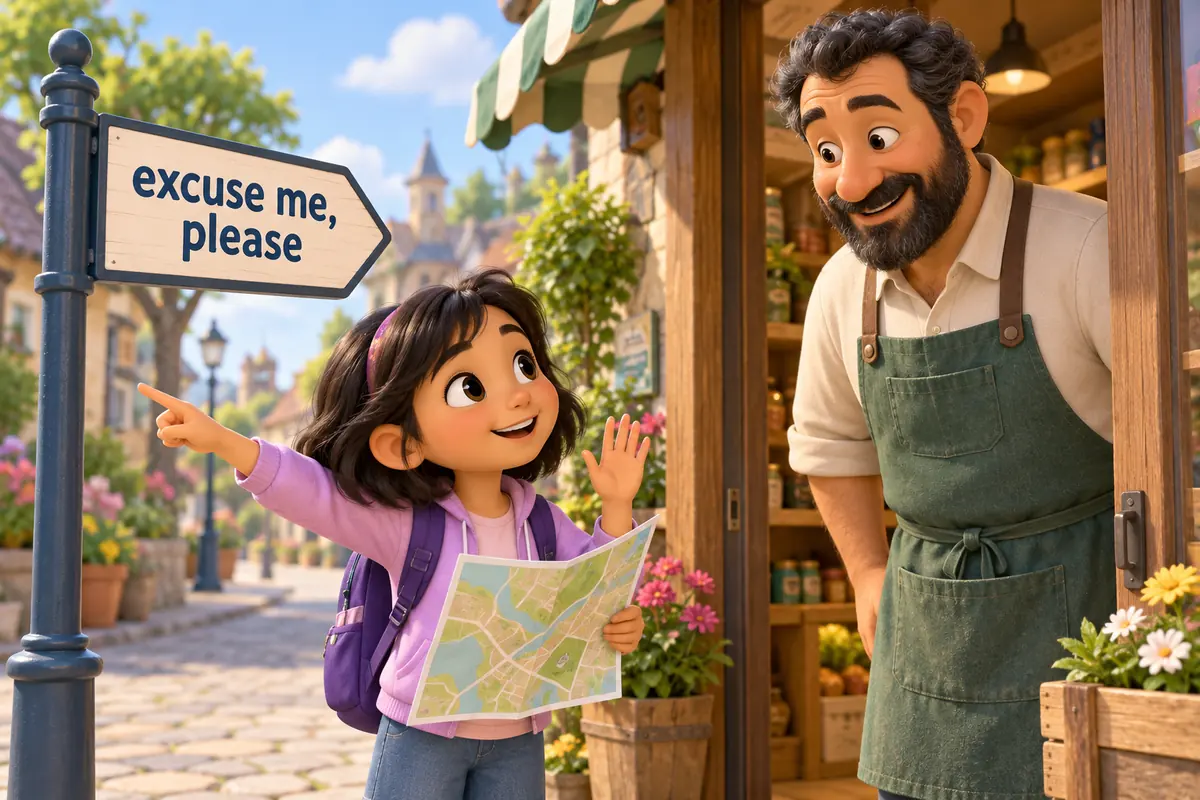
| Street | Excuse me, how do I get to the library? | A stranger needs a polite opener. |
| School trip | Stay together and take the first left. | An instruction keeps the group safe. |
| Phone call | Which way do I turn after the bridge? | No landmarks can be seen, so the turn is named. |
| Hotel desk | Could you tell me the way to the castle? | Formal service settings reward a full frame. |
| Driving | Take the second turning on the right. | A driver needs counted turns. |
| Walking tour | Go straight on until you reach the fountain. | A visible landmark ends the leg. |
| Maps app | Turn right in two hundred metres. | A distance suits a device that measures it. |
| Giving help | It is opposite the post office. | A facing landmark confirms the goal. |
| Checking | So I turn left at the lights, right? | A repeat question prevents a wrong turn. |
| Airport | Follow the signs to the departure gate. | A long building suits sign-based directions. |
Polite and direct requests compared
The choice between a polite frame and a direct question depends on who is asked. A stranger, a clerk or a teacher takes the longer form; a friend or a classmate takes the short one.
| Point | polite request | direct question |
|---|---|---|
| Length | a full sentence with could or would | a short question |
| Listener | strangers and officials | friends and classmates |
| Opener | excuse me or sorry to bother you | none needed |
| Word order | statement order after the opener | question order from the start |
| Effect | formal and considerate | quick and casual |
Tone is not only about length. A short question spoken with a smile still sounds friendly, and a long question spoken flatly can sound cold, so a rising, open tone matters as much as the wording. In writing, where tone is invisible, the polite frame carries the whole burden.
Word forms and grammar of directions
One root gives a noun, an adjective, an adverb and a verb, and the ending shows which job the word does. A set of lines at the giving sentence page shows the verb in use.
| Form | Part of speech | Example |
|---|---|---|
| direction | noun | Check the direction of the arrow. |
| directions | plural noun | Please read the directions twice. |
| direct | adjective | Take the direct route to the station. |
| directly | adverb | Turn directly after the bridge. |
| directional | adjective | A directional sign points the way. |
| redirect | verb | They redirected us to the back gate. |
| misdirect | verb | The old sign misdirected the crowd. |
| give | verb | Could you give me directions? |
Common mistakes with directions
Most errors come from question word order, from the prepositions at and on, and from a direct tone used with a stranger.
- Incorrect:
Where is the station is?Correct: Where is the station? Rule: a question takes one verb order, not two. - Incorrect:
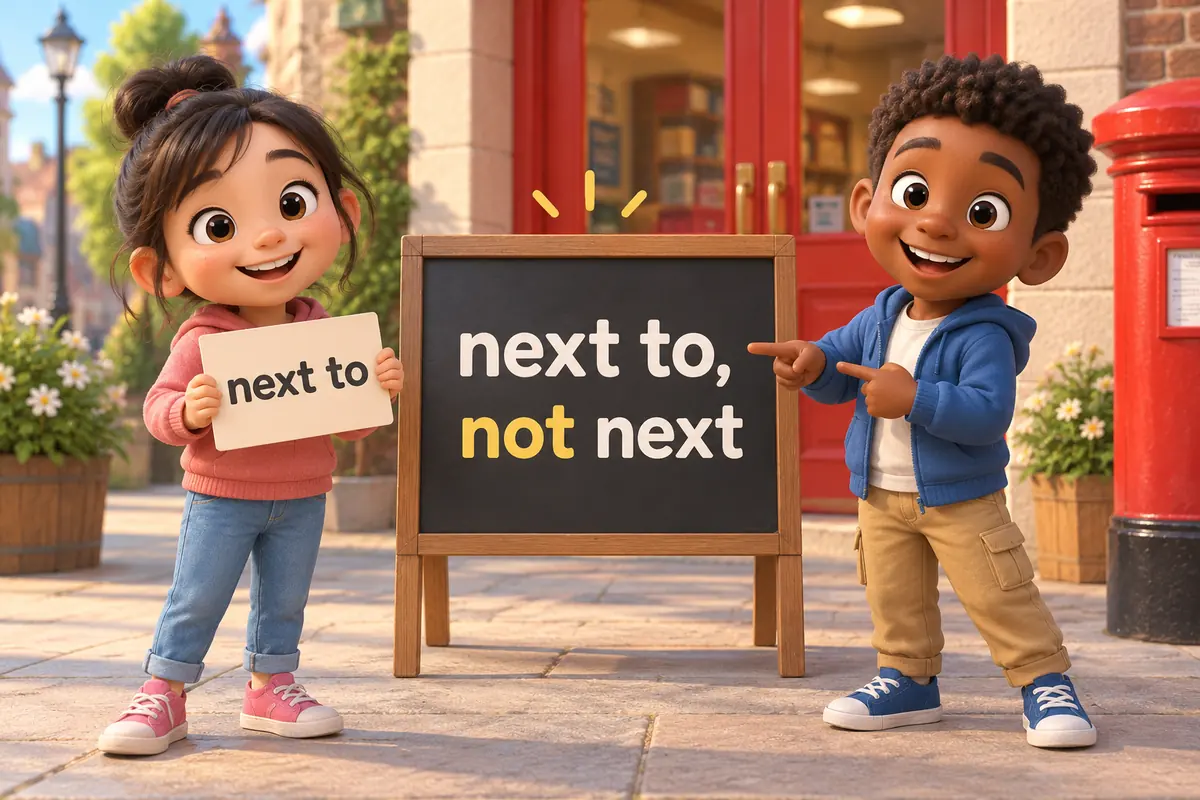
It is next the post office.Correct: It is next to the post office. Rule: next takes the preposition to. - Incorrect:
Turn right in the traffic lights.Correct: Turn right at the traffic lights. Rule: at marks the point where the turn happens. - Incorrect:
Could you tell me where is the bank?Correct: Could you tell me where the bank is? Rule: the polite frame keeps statement order. - Incorrect:
Go straight on the corner.Correct: Turn left at the corner. Rule: go straight describes travel, so a corner needs turn. - Incorrect:
How I get to the bank?Correct: How do I get to the bank? Rule: a question places the helping verb before the subject.
Practice asking and giving directions
Try each item, then read the reason beside the answer. A set of lines about a sense of place sits at the sense of direction sentence page.
- Fill in the blank: Excuse me, how do I ________ to the museum?
- Fill in the blank: Go ________ on for two blocks, then turn left.
- Choose the better word: Turn left (at / on) the corner.
- Correct the error: It is next the post office.
- Build a sentence: give directions from a school gate to a park using two landmarks.
- Spot the register: which fits a stranger, “Where’s the bank?” or “Excuse me, could you tell me where the bank is?”
- Fill in the blank: Take the second ________ on the right.
Answers
- get: how do I get to is the fixed route question.
- straight: go straight on means keep moving forward.
- at: at marks the corner as the point of the turn.
- It is next to the post office: next takes the preposition to.
- Sample: Go straight past the gate, turn left at the shop, and the park is opposite the school. Two landmarks fix the route.
- The second: the polite frame suits a stranger, while the short form sounds abrupt.
- turning: take the second turning counts the side streets on one side.
The bottom line
Asking and giving directions rests on a handful of frames that stay the same while the place name changes. Open a request with excuse me, then use how do I get to or could you tell me where. Give directions as a short ordered list, name a landmark at each turn, and use at for the turn itself. A final check question saves a wrong turn.
Frequently asked questions about directions
How do you ask for directions politely in English?
Start with excuse me, then use a full frame such as could you tell me the way to the station or how do I get to the station. The longer wording signals respect, and it keeps the word order of a statement after the opening phrase.
What are the most common direction words?
The commonest are left, right, straight, past, opposite, next to and near. Turn words combine with a point, as in turn left at the lights, while straight describes continued travel. Landmark words such as opposite and next to fix the final position.
How do you give directions step by step?
Give one move at a time, in order: go straight, turn, take the next turning, then name the landmark at the goal. Keep each stage short, and use a visible landmark such as a bank or a bridge so the listener can check progress.
What does go straight on mean?
Go straight on means keep moving forward without turning. It often comes with a distance or a landmark, as in go straight on for two blocks or go straight on until the fountain. The phrase takes on or until, never in.