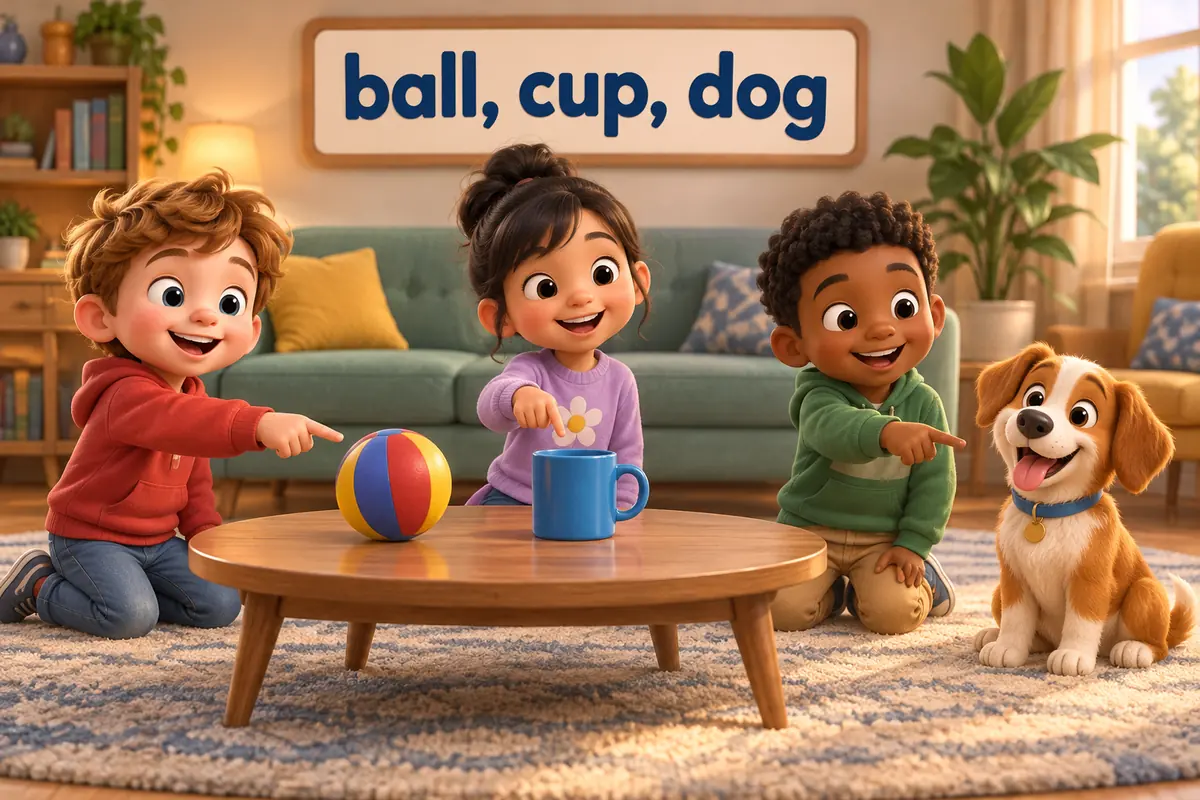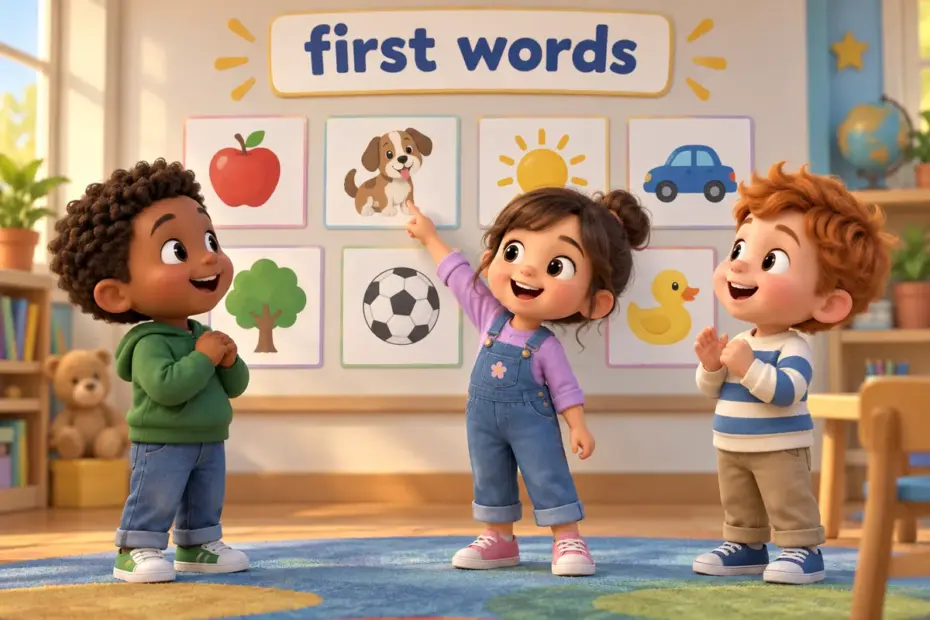
Basic English words meanings for beginners are the short, high-frequency words that cover everyday needs, such as go, big, water and friend. Learning a small set well lets a beginner build simple sentences straight away. A first pattern is “I drink water,” with a pronoun, a verb and a noun.
Basic English words meanings for beginners at a glance
- Beginners need a few hundred high-frequency words, not thousands.
- Every word belongs to a class, such as noun, verb or adjective.
- Simple sentences follow a small set of patterns.
- Many basic words change form, as go becomes went and going.
- The commonest beginner error is mixing up pairs such as your and you’re.
What are the basic English words for beginners?
These are the words that appear most often in everyday speech, and a learner meets them in the first weeks. Each entry below gives the word, a plain meaning and one short line, so a beginner can read the whole list aloud. A set of easy lines at the basic sentence page uses the same words.
| Word | Meaning | Example |
|---|---|---|
| the / a | point to a noun | The cup is on the table. |
| I / you | name the speaker and listener | I see you. |
| he / she | name another person | She is my friend. |
| it / they | name a thing or a group | They are here. |
| is / are | link a subject to a word | The sky is blue. |
| go / come | move away or toward | Come here and sit. |
| eat / drink | take in food or liquid | We eat rice and drink water. |
| see / look | notice with the eyes | Look at the big bird. |
| make / take | create or pick up | Make a cake, then take one slice. |
| give / get | hand over or receive | Give me the book, please. |
| big / small | describe size | A small cat sleeps on a big chair. |
| good / bad | describe quality | This is a good idea. |
| happy / sad | describe feelings | He is happy today. |
| hot / cold | describe temperature | The soup is hot. |
| new / old | describe age or condition | She has a new bag. |
| house / room | a home and a space inside it | The room is in the house. |
| water / food | what we drink and eat | Water and food are on the table. |
| day / night | times of light and dark | We read at night. |
| friend / family | people we know and love | My family meets my friend. |
| book / pen | things we read and write with | Open the book and hold the pen. |
| school / class | a place to learn and a group | Our class starts at school. |
| mother / father | a child’s parents | My mother and father cook. |
| child / baby | a young person | The child helps the baby. |
| hand / head | parts of the body | Raise your hand and nod your head. |
| sun / rain | weather and sky | The sun came after the rain. |
| work / play | doing a task or having fun | We work first, then play. |
What word classes do beginners learn first?
Every basic word belongs to a class that tells you its job in a sentence. A beginner who knows the class can place the word correctly even before the meaning is fully learned. A set of starter lines at the beginner sentence page shows the classes at work.
| Class | Job | Example word | Example sentence |
|---|---|---|---|
| noun | names a person, place or thing | water | I drink water. |
| pronoun | replaces a noun | she | She is happy. |
| verb | shows an action or state | eat | We eat rice. |
| adjective | describes a noun | big | A big dog runs. |
| adverb | describes a verb | slowly | He walks slowly. |
| preposition | shows a relation | in | The key is in the bag. |
| conjunction | joins words | and | Tea and bread, please. |
| article | points to a noun | the | The book is here. |
How do you use basic words in a sentence?
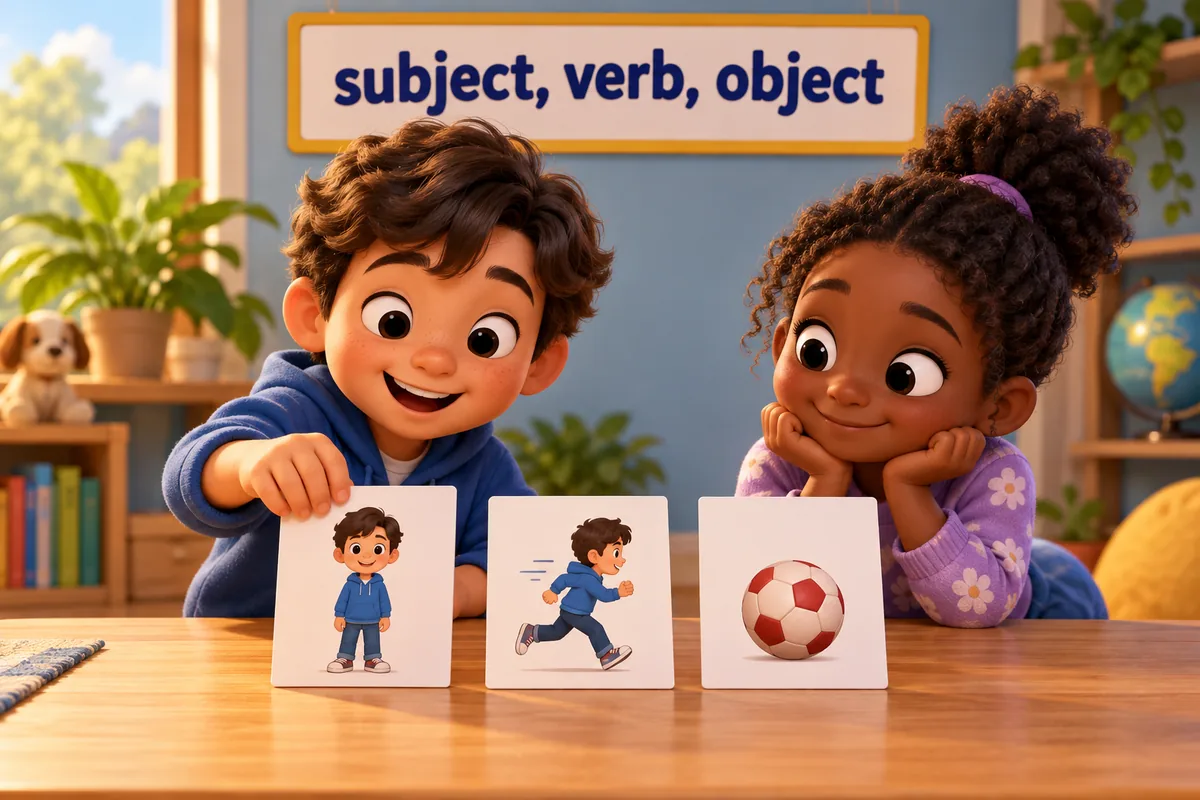
A beginner needs only a few patterns to say a great deal. Each pattern fixes the order of the classes, so the sentence stays clear even when the vocabulary is small.
| Pattern | Example | What it does |
|---|---|---|
| subject + verb | Birds sing. | The shortest complete sentence. |
| subject + verb + object | I read books. | The verb needs something. |
| subject + linking verb + adjective | She is happy. | The adjective describes the subject. |
| subject + verb + place | We play outside. | The phrase says where. |
| subject + verb + object + place | He puts the cup on the table. | The object and place complete the idea. |
Basic English words across contexts
The same short words work in every room of daily life. The table shows nine settings where a beginner uses them on the first day.
| Context | Example sentence | Why this works |
|---|---|---|
| Home | Please close the door. | A polite instruction uses basic words. |
| School | I have a new book. | Possession is an early pattern. |
| Shop | How much is this? | A fixed question for buying. |
| Kitchen | We eat soup at night. | Time and food join easily. |
| Playground | Come and play with us. | And links two actions. |
| Bus stop | The bus is late. | The linking verb describes a thing. |
| Doctor | My head hurts. | Body words name the problem. |
| Phone | Can you hear me? | A short question checks the line. |
| Bedtime | Turn off the light. | A daily routine uses set words. |
Confusing pairs for beginners
A few common words sound alike and cause early errors. Learning the pairs together, with one example each, keeps them apart. More spelling notes live at the basically sentence page.
| Pair | Meaning | Example |
|---|---|---|
| your / you’re | belonging / you are | Your bag is here. You’re early. |
| to / too / two | toward / also / the number | Go to school. I am too. Two cats. |
| their / there / they’re | belongs to them / a place / they are | Their car. Over there. They’re here. |
| its / it’s | belongs to it / it is | The cat licks its paw. It’s cold. |
| then / than | next / compared with | Eat, then rest. Bigger than me. |
Word forms beginners should notice
Many basic words change shape, and the ending tells a beginner which job the word does. Learning three forms of each verb early prevents many errors later.
| Form | Part of speech | Example |
|---|---|---|
| go | base verb | I go to school. |
| went | past tense | We went home. |
| going | -ing form | They are going now. |
| big | adjective | A big house stands there. |
| bigger | comparative | This room is bigger. |
| friend | noun | She is my friend. |
| friendly | adjective | Our teacher is friendly. |
| happy | adjective | He looks happy. |
| happily | adverb | She smiled happily. |
Common mistakes for beginners
Most early errors come from word order, from word endings and from the confusing pairs above.
- Incorrect:
I have a book new.Correct: I have a new book. Rule: an adjective sits before its noun in English. - Incorrect:
She are my friend.Correct: She is my friend. Rule: a singular subject takes is. - Incorrect:
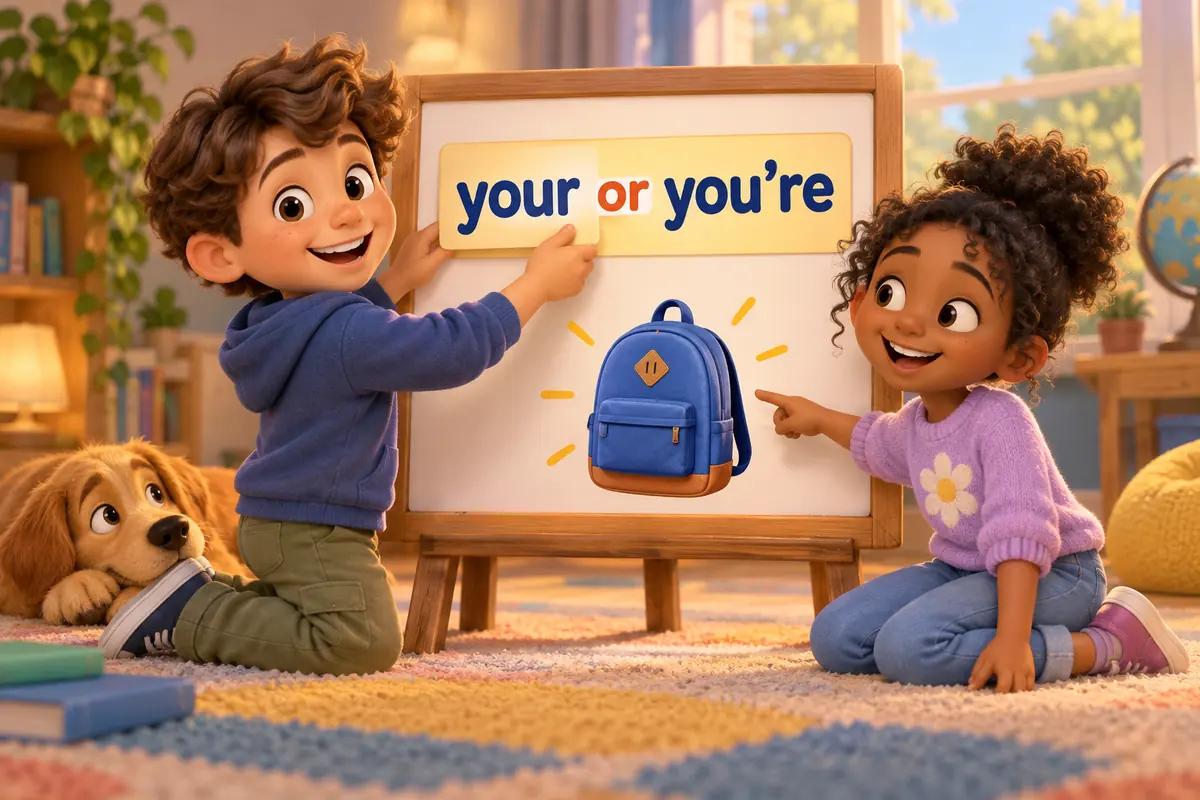
Your early today.Correct: You’re early today. Rule: you’re means you are, while your shows belonging. - Incorrect:
I go to school yesterday.Correct: I went to school yesterday. Rule: a past time needs the past form. - Incorrect:
He drink water.Correct: He drinks water. Rule: a third-person singular subject adds -s to the verb.
Practice using basic English words
Try each item, then read the reason beside the answer.
- Fill in the blank: I ________ water every morning. (drink / drinks)
- Fill in the blank: She ________ happy today. (is / are)
- Choose the better word: ________ bag is on the chair. (Your / You’re)
- Correct the error: I have a bag new.
- Build a sentence: use the pattern subject + verb + object about food.
- Spot the register: which fits a shop, “How much is this?” or “State the price immediately”?
- Fill in the blank: We ________ to the park yesterday. (go / went)
Answers
- drink: the subject I takes the base verb.
- is: a singular subject takes is.
- Your: the word shows belonging, so your fits before the noun bag.
- I have a new bag: an adjective sits before its noun.
- Sample: We eat rice. The subject, verb and object give a complete idea.
- The first: a shop uses a short, friendly question.
- went: yesterday needs the past form of go.
The bottom line
Basic English words meanings for beginners fit into a small set of classes and patterns, so a learner can speak on the first day. Start with high-frequency nouns, verbs and adjectives, then join them with subject, verb and object. Notice word endings and the sound-alike pairs, and the first hundred words will carry a long way.
Frequently asked questions about beginner words
What are the first English words a beginner should learn?
Start with pronouns such as I and you, common verbs such as go, eat and see, and everyday nouns such as water, house and friend. These cover most early needs. Add the linking verbs is and are, then build a few full sentences before learning the next group.
How many words does a beginner need to speak?
A few hundred high-frequency words cover a great deal of everyday talk, because the commonest words repeat constantly. Aim to use the words in speech rather than only recognise them. Depth with a small set is more useful early than a long, unused list.
What is the difference between a noun and a verb?
A noun names a person, place or thing, such as teacher or school, while a verb shows an action or a state, such as run or is. In a sentence the noun usually acts as the subject and the verb follows it, which is why the pair forms the base of every simple sentence.
How do beginners remember word meanings?
Attach each word to a picture, an object or a short personal line, and review it after a day and then a week. Using the word in speech fixes it faster than reading alone. A meaning learned with an example survives much longer than a bare translation.