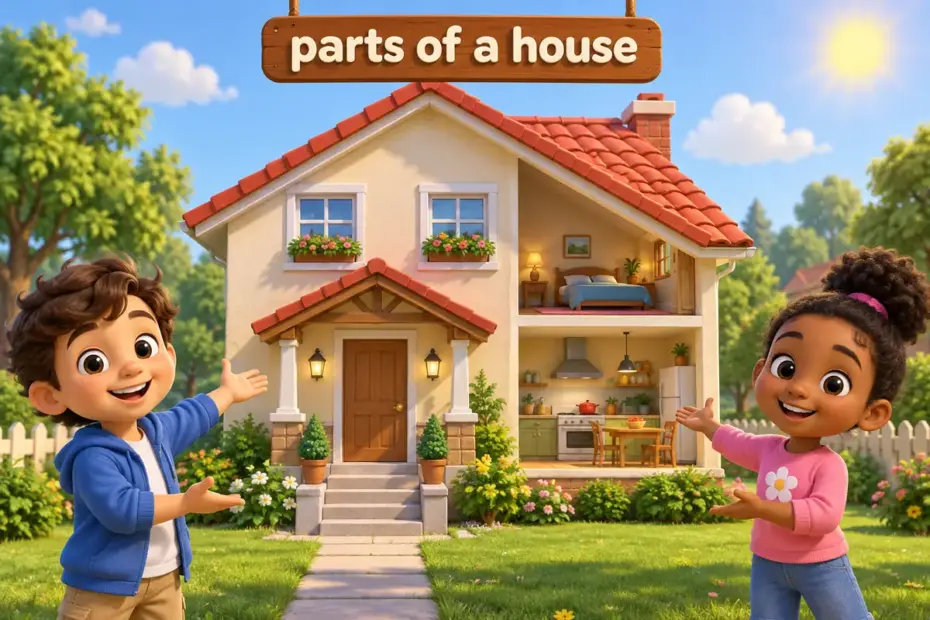
Basic parts of the house are the pieces you name when you describe a home, from the roof and walls outside to the rooms and stairs inside. The list covers structure words such as roof, wall and floor, room words such as kitchen and bedroom, and outside words such as porch and garden.
Basic parts of the house at a glance
- Structure words describe the shell of a building: roof, wall, floor, ceiling and foundation.
- Room words name the spaces: kitchen, bathroom, bedroom, living room, hallway and attic.
- Outside words cover the land and entrance: porch, garage, garden and fence.
- Position words such as in, on and from carry meaning, so the lamp hangs from the ceiling, not in it.
- The commonest error is mixing roof with ceiling, because one sits outside and the other inside.
What are the basic parts of the house?
Basic parts of the house are the named pieces that make up a home, split into the structure that holds the building up, the rooms that fill it, and the outside space around it. A quick set of descriptive words for a house sits in adjectives for house, and a home that stands on its own appears in examples of detached house in a sentence. For mood words that describe a spooky building, see haunted house adjectives.
| Part | What it is | Example sentence |
|---|---|---|
| Roof | the top cover of the building | Rain ran off the roof. |
| Wall | a side of a room or building | We painted the wall blue. |
| Floor | the surface you walk on inside | The floor creaked near the door. |
| Ceiling | the top inside surface of a room | A lamp hung from the ceiling. |
| Door | the entrance panel that opens | He closed the door quietly. |
| Window | a glass opening for light | Light came through the window. |
| Foundation | the base below the building | The foundation sits below ground. |
| Hallway | a passage between rooms | Shoes lined the hallway. |
| Kitchen | the room for cooking | Dinner simmered in the kitchen. |
| Bathroom | the room with a bath or shower | The bathroom is at the top of the stairs. |
| Bedroom | the room for sleeping | Her bedroom faces the garden. |
| Living room | the room for sitting together | We watched a film in the living room. |
| Stairs | steps that join two floors | The stairs lead to the attic. |
| Attic | the space under the roof | Boxes are stored in the attic. |
| Basement | the room below ground level | The basement stays cool in summer. |
| Chimney | the tall pipe that carries smoke | Smoke rose from the chimney. |
| Garage | the shelter for a car | The car is in the garage. |
| Porch | a covered area at the entrance | We drank tea on the porch. |
| Garden | the land around the building | The garden is full of roses. |
| Fence | a barrier around the land | A low fence marks the boundary. |
One honest limit belongs here. Not every building has every part: a flat may have no attic, basement or garden, so the list describes a typical house rather than a rule for all homes.
How do you use house parts in a sentence?
The part names are ordinary nouns, and the small prepositions around them carry most of the meaning.
| Pattern | Example | What it signals |
|---|---|---|
| there is / there are | There are three bedrooms upstairs. | saying what exists |
| the + part + of the house | The roof of the house needs repair. | one specific part |
| in the + room | Dinner is in the kitchen. | location inside a room |
| on the + surface | A picture hangs on the wall. | position on a surface |
| at the + part | We waited at the front door. | position at a point |
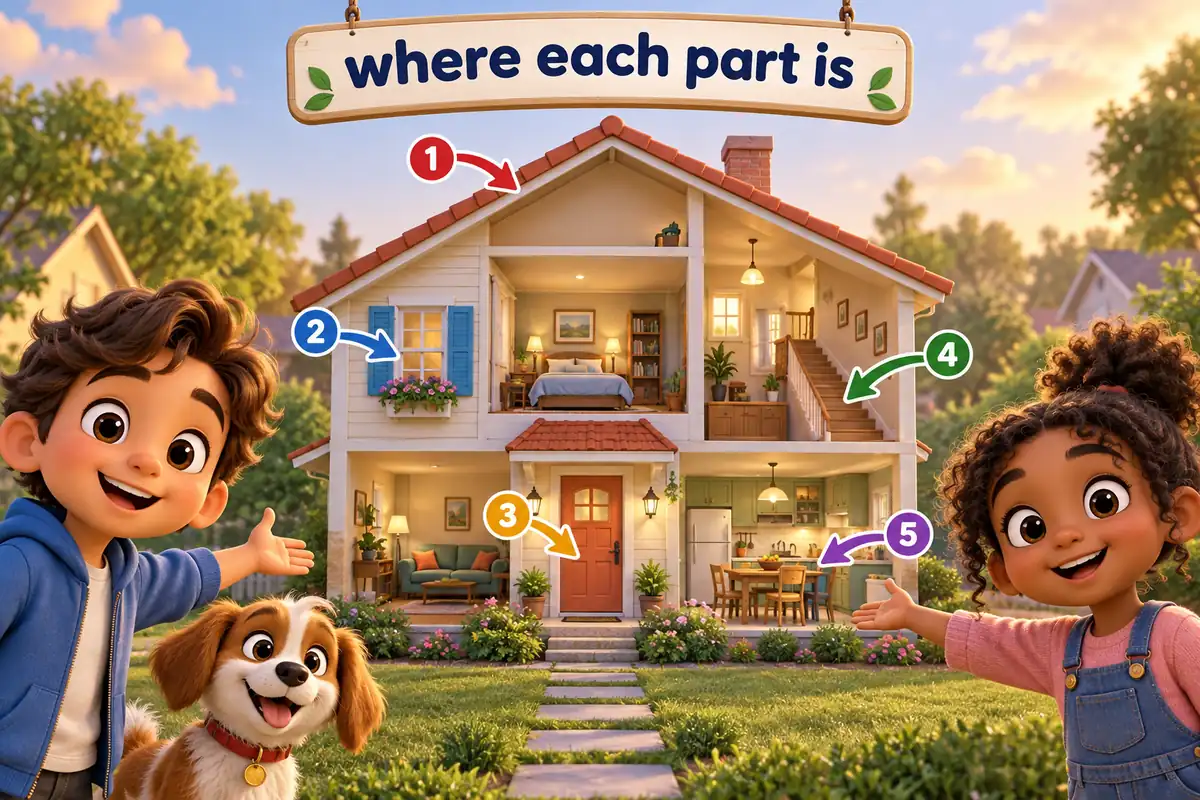
Basic parts of the house: examples across contexts
House words move from a drawing task to an estate agent listing, and each setting frames the same nouns differently.
| Context | Example sentence | Why this works |
|---|---|---|
| Classroom | Draw a house and label the roof, door and windows. | a labelling task |
| Estate listing | The house has three bedrooms and a large garden. | a property description |
| Home repair | The ceiling in the hallway needs a fresh coat of paint. | a specific job |
| Conversation | Is the bathroom upstairs or downstairs? | an everyday question |
| Story | A cold draught crept under the front door. | atmosphere |
| Safety notice | Keep the hallway clear and the stairs well lit. | an instruction |
| Rental advert | Quiet flat with a shared porch and a small garage. | a compact summary |
| Survey report | The roof and the foundation both need attention. | a technical note |
| Cultural note | The old boarding house kept a lamp on every porch. | a historical detail |
| Architecture text | Large windows on the south wall warm the living room. | a design claim |
Which house words are easy to confuse?
Several part names sit close together in meaning, and the confusions come in tidy pairs.
| Confusable pair | Difference | Example |
|---|---|---|
| house / home | a building / the place you live | A house can stand empty; a home is where you live. |
| roof / ceiling | outside top / inside top | Rain hits the roof; a lamp hangs from the ceiling. |
| floor / ground | inside surface / outside land | The floor is tiled; the ground is wet. |
| wall / fence | part of a building / boundary outside | Paint the wall; mend the fence. |
| stairs / steps | inside set / short outdoor set | The stairs have a rail; the steps lead to the gate. |
| room / bedroom | any space / a room for sleeping | The house has five rooms and three bedrooms. |
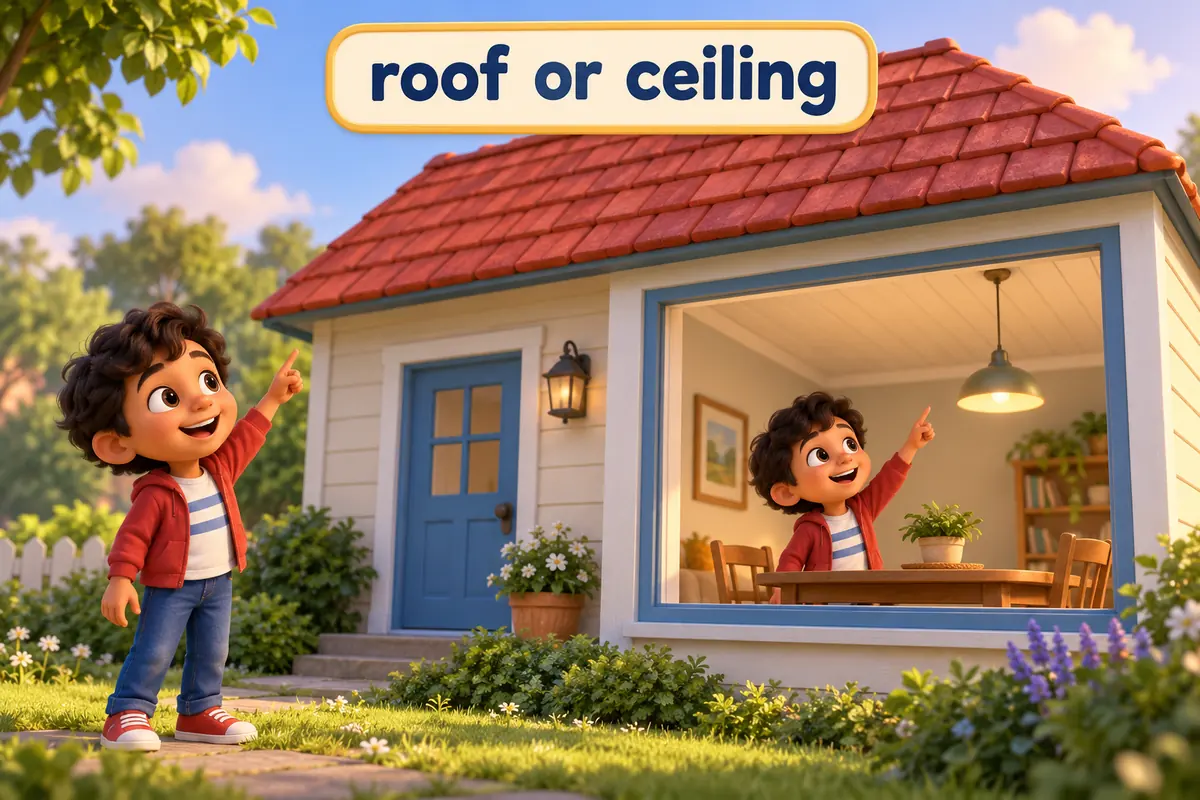
The pair to learn first is roof and ceiling: a roof is seen from the street and a ceiling from inside the room, so a sentence that names the outside top of a house always uses roof.
Word forms and grammar of house parts
Most of these words are plain countable nouns, but a few derived forms are worth knowing.
| Form | Part of speech | Example |
|---|---|---|
| house | noun | They bought a small house. |
| home | noun | Home is where the family lives. |
| roof / roofs | noun singular / plural | Both roofs need new tiles. |
| upstairs / downstairs | adverb or adjective | The bedrooms are upstairs. |
| indoor / outdoor | adjective | An indoor pool stays warm in winter. |
| housing | uncountable noun | Housing in the city is expensive. |
| household | noun | A household of four uses this bin. |
Common mistakes with house parts
Mistake 1: hanging a lamp in the ceiling. Incorrect: The lamp hangs in the ceiling. Correct: The lamp hangs from the ceiling. Rule: use from for something fixed to a surface above.
Mistake 2: a singular verb with a plural count. Incorrect: There is three bedrooms. Correct: There are three bedrooms. Rule: there are comes before a plural noun.
Mistake 3: in home instead of at home. Incorrect: I am in home. Correct: I am at home. Rule: the fixed phrase is at home, with no article and no in.
Mistake 4: calling the outside top a ceiling. Incorrect: The ceiling of the house is red. Correct: The roof of the house is red. Rule: the roof is outside and the ceiling is inside, so only the roof is seen from the street.
Mistake 5: standing in the porch. Incorrect: We waited in the porch. Correct: We waited on the porch. Rule: a porch is a flat surface you stand on, so it takes on.
Practice using house parts
- Fill in the blank: We had breakfast in the ___.
- Choose the better word: Rain ran off the (ceiling / roof).
- Correct the error: There is two windows in the bedroom.
- Build a sentence: use from to say where a lamp is fixed.
- Spot the register: which line suits a rental advert, (a) Nice pad, loads of rooms, or (b) Bright flat with two bedrooms and a balcony?
- Fill in the blank: The ___ leads from the hall up to the attic.
Answers
- kitchen, because the kitchen is the room for cooking and eating.
- roof, because rain falls on the outside top, not the inside ceiling.
- There are two windows in the bedroom; a plural noun takes there are.
- A lamp hangs from the ceiling above the table.
- (b), because a rental advert is written in clear, plain English.
- stairs, because the stairs join one floor to another.
The bottom line
Basic parts of the house divide neatly into structure, rooms and the outside space, and once you know the group each word belongs to, the right noun is easy to choose. Keep roof outside and ceiling inside, use there are before a plural, and remember at home as a fixed phrase. For machine parts instead, see car parts that start with A to Z.
Frequently asked questions about basic parts of the house
What are the main rooms in a house?
The main rooms are the kitchen, the living room, the bedroom and the bathroom, joined by a hallway and often a separate dining room. Larger houses add a study, a utility room, an attic and a basement, but the four everyday rooms appear in almost every home and make up the core of the list.
What is the difference between a house and a home?
A house is the building itself, with a roof, walls and rooms, while a home is the place where you live and feel settled. Every house can be a home, but people also call a flat, a room or even a town a home, so the two words overlap without being identical.
Is a garage part of the house?
A garage can be attached to the house or stand apart in the garden, and either way it counts as part of the property. People often list it with the outside features such as the porch, the garden and the fence rather than with the indoor rooms, because you usually reach it from outside.
What is the outside top of a house called?
The outside top of a house is the roof, which keeps rain and snow out, while the matching surface inside a room is the ceiling. A related structure, the chimney, rises above the roof to carry smoke away from a fireplace, and it is often named alongside the roof in surveys.