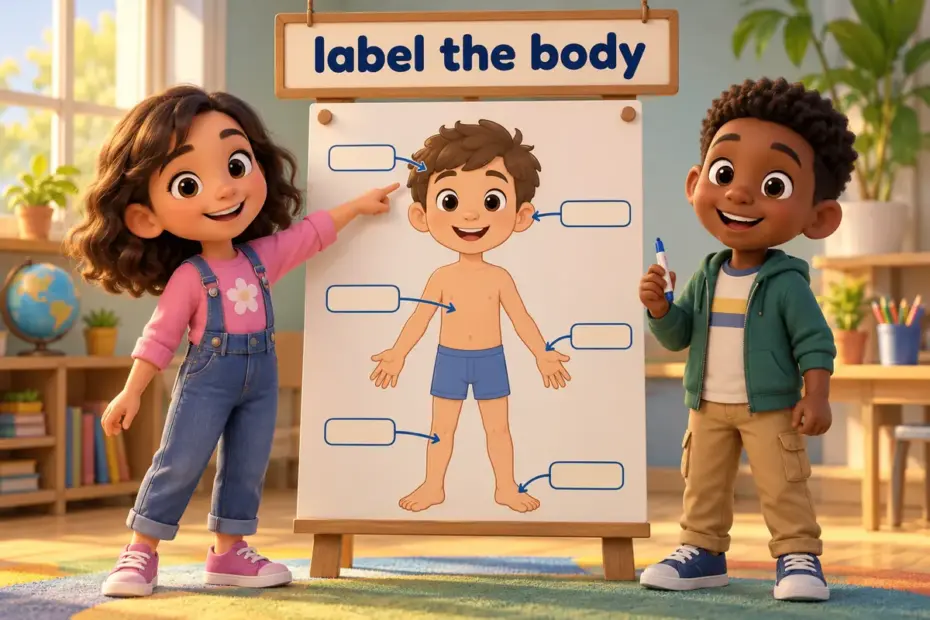
Body parts for kids with diagram are the named parts of the body shown on a simple, labelled picture. A diagram lets a child point to a part and say its name. A simple example is the label hand for the part that holds a pencil.
Body parts for kids with diagram at a glance
- A body diagram is a labelled picture of the human body.
- Parts are grouped by area: head, arm, trunk and leg.
- Some parts sit on the outside; others, like the heart, sit inside.
- Several parts come in pairs, such as hands, ears and feet.
- The commonest mistake is mixing up the thumb and the other fingers.
What are the main body parts for kids?
The main body parts for kids are the head, neck, arms, hands, chest, back, legs and feet, together with the senses of the face. Each part has a simple job that a child can see in daily life, such as the hand for holding or the leg for walking. A diagram shows where each part sits.
| Part | Where it is | Simple job |
|---|---|---|
| Head | Top of the body | Holds the brain and the face. |
| Neck | Between head and shoulders | Turns and supports the head. |
| Arm | From shoulder to wrist | Reaches, lifts and carries. |
| Hand | End of the arm | Holds, grips and feels. |
| Chest | Front of the trunk | Shields the heart and lungs. |
| Leg | From hip to ankle | Stands, walks and runs. |
| Foot | End of the leg | Carries weight and balances. |
Body parts by group
A diagram reads best when the parts are grouped. The table below lists twenty-five parts, marks whether each sits on the outside or the inside, and gives one plain job for each. Joints such as the wrist and the knee are included because a child feels them move every day.
| Body part | Inside or outside | Simple job |
|---|---|---|
| Head | outer | holds the brain and the face |
| Hair | outer | covers and warms the head |
| Eye | outer | lets you see colour and shape |
| Ear | outer | catches sound and keeps balance |
| Nose | outer | smells and warms the air you breathe |
| Mouth | outer | eats, drinks and speaks |
| Neck | outer | turns and holds up the head |
| Shoulder | outer | lets the arm move in a circle |
| Arm | outer | reaches and lifts |
| Hand | outer | holds, grips and feels |
| Finger | outer | points and picks up small things |
| Chest | outer | shields the heart and lungs |
| Back | outer | supports the whole body |
| Leg | outer | stands and walks |
| Foot | outer | carries weight and keeps balance |
| Toe | outer | helps push off when walking |
| Heart | inner | pumps blood around the body |
| Lungs | inner | fill with air for breathing |
| Brain | inner | thinks and controls movement |
| Stomach | inner | breaks down the food you eat |
| Wrist | outer | bends the hand up and down |
| Elbow | outer | lets the arm fold |
| Knee | outer | bends the leg to walk and kneel |
| Ankle | outer | lets the foot tip and turn |
| Thumb | outer | grips and holds against fingers |
How do you label a body diagram?
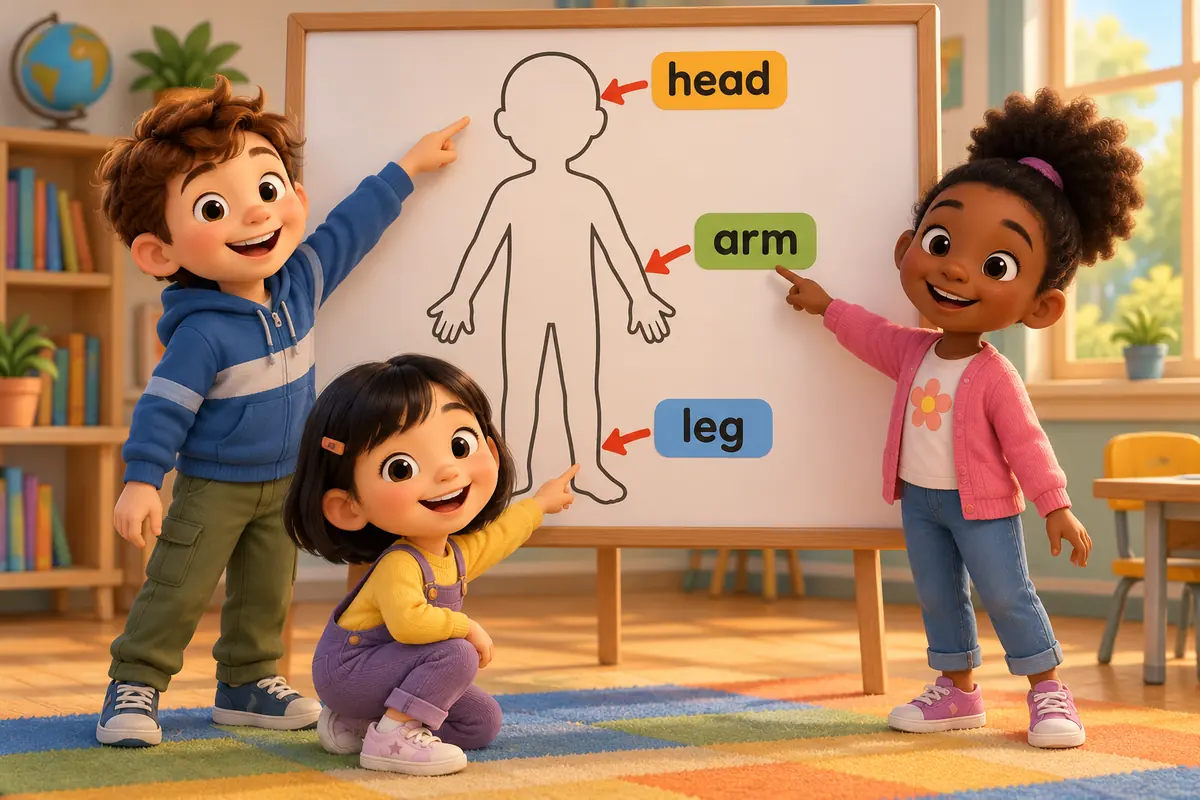
Start with the biggest areas, then add the smaller parts. Draw a line or an arrow from each label to the right part, and keep the words to one or two each. Grouping the labels by area stops the diagram from looking crowded.
| Step | What to do | Why it helps |
|---|---|---|
| Draw the outline | Sketch one simple body shape. | A plain shape is easy to label. |
| Mark the areas | Add the head, arm, trunk and leg. | Large areas give the eye an order. |
| Add the parts | Fill in hands, ears, eyes and knees. | Small parts complete the picture. |
| Draw the lines | Join each label to its part. | Clear lines avoid confusion. |
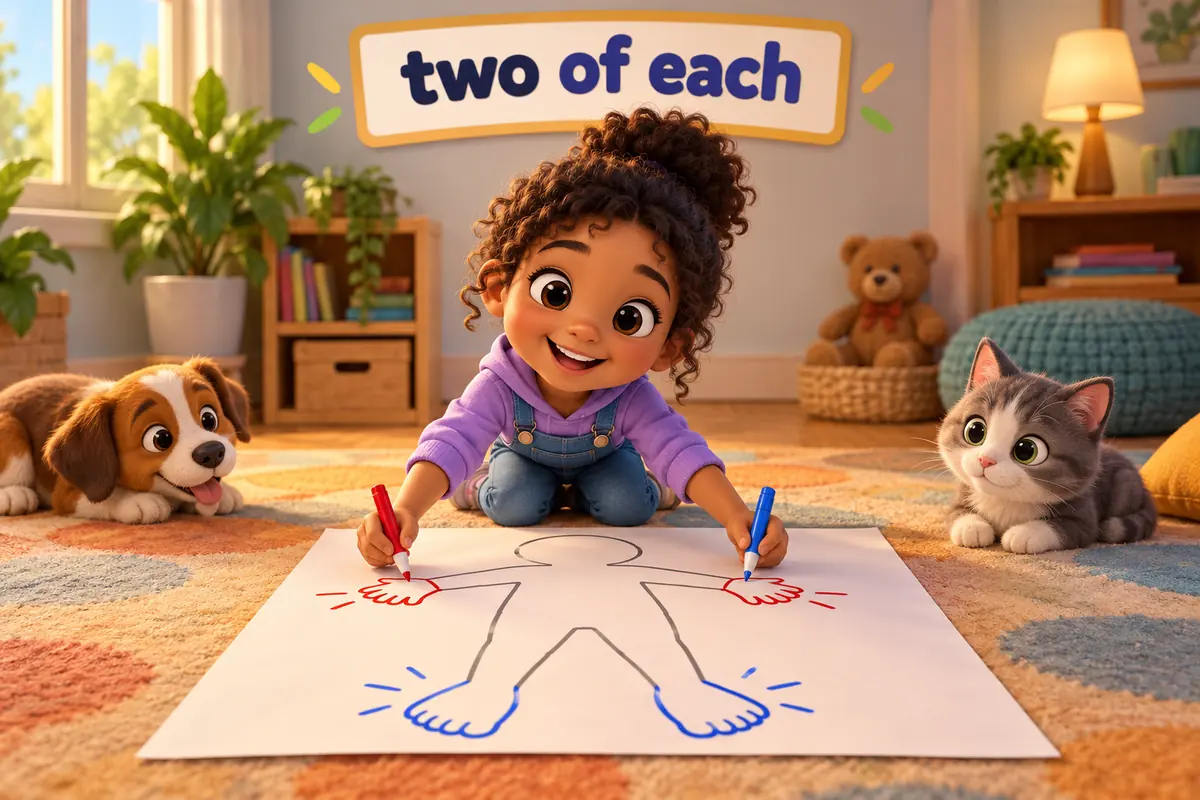
| Check the pairs | Label both hands and both feet. | Pairs teach left and right. |
The letter lists help children spell each new label, from body parts that start with a, such as arm, to parts that start with b, such as back and brain. Children can continue with parts that start with c, such as chest, and parts that start with d, such as ear in the everyday sense of the drum inside it.
Outside and inside parts compared
A diagram looks different depending on whether it shows the surface of the body or what lies beneath. The two views teach different words, so it helps to keep them apart.
| Point | Outside parts | Inside parts |
|---|---|---|
| Examples | hand, ear, knee, nose | heart, lungs, brain, stomach |
| Can you see them? | Yes, in a mirror | No, only on a diagram |
| Job | movement and the senses | keeping the body alive |
| Diagram style | a labelled outline | a cut-away picture |
| Common word | hand | heart |
Which body words do children confuse?
A few pairs of body words sound alike or sit close together, so a child swaps them on a diagram. Naming the difference with one plain test fixes the mix-up quickly.
| Confused pair | Why they mix | Quick test |
|---|---|---|
| hand / arm | The two are joined | The hand has fingers; the arm reaches. |
| foot / feet | Singular and plural | One is foot, two are feet. |
| ear / eye | Both are on the face | The ear hears; the eye sees. |
| knee / elbow | Both are joints | The knee is on the leg; the elbow is on the arm. |
| thumb / finger | Both are on the hand | The thumb is shorter and stands apart. |
Words for the body
A few plain words help a child talk about a diagram and about their own body.
| Word | Part of speech | Example |
|---|---|---|
| part | noun | Each part has a name on the diagram. |
| label | noun | Write one label for each part. |
| pair | noun | Hands and feet come as a pair. |
| joint | noun | A joint such as the knee bends. |
| bend | verb | Your elbow can bend and straighten. |
Common mistakes with body-part words
Most errors in body-word work share one of a few faults, and each fault has a quick fix.
- Incorrect:
I have two foots.Correct: I have two feet. Rule: the plural of foot is feet. - Incorrect:
My hairs is long.Correct: My hair is long. Rule: hair is usually uncountable. - Incorrect:
The head have a brain.Correct: The head has a brain. Rule: a singular subject takes has. - Incorrect:
Point to your hand’s.Correct: Point to your hands. Rule: a plural noun takes no apostrophe. - Incorrect:
My leg are hurting.Correct: My leg is hurting. Rule: a singular subject takes a singular verb.
Practice with a body diagram
Try each task, then read the reason beside the answer to check your thinking.
- Fill in the blank: Write one ________ for each part on the diagram.
- Fill in the blank: I have two ________ at the end of my legs.
- Choose the better label: the part that pumps blood is the heart or the stomach?
- Correct the error: I have two foots.
- Build a label set: name three parts that come in pairs.
- Spot the view: does the brain belong on an outside or an inside diagram?
- Build a sentence: write one sentence naming a part and its job.
Answers
- label, because a label is the word beside each part.
- feet, because the plural of foot is feet.
- The heart, because the heart pumps blood while the stomach breaks down food.
- I have two feet: the plural of foot is feet.
- Sample: hands, ears and feet all come in pairs.
- An inside diagram, because the brain sits beneath the skull.
- Sample: The hand holds a pencil, while the eye sees the page.
The bottom line
Use body parts for kids with diagram to turn a plain list of words into a clear, labelled map. Group the parts by area, mark which sit outside and which sit inside, and label the pairs together. A child who can point to a part and name it has learned the word for good.
Frequently asked questions about body parts for kids
How many body parts should a child learn first?
Begin with about ten easy parts that a child can point to, such as head, eye, ear, nose, mouth, hand, arm, leg, foot and knee. Add the inside parts later, once the outside names are secure. Learning a small set well beats rushing through a long list.
What is the difference between a limb and a joint?
A limb is a whole arm or leg, while a joint is the place where two bones meet and bend, such as the elbow, knee or shoulder. So the arm is a limb and the elbow is a joint inside it. The diagram can mark limbs with large labels and joints with small dots.
Why do some body words come in pairs?
Parts that appear on both sides of the body come in pairs, such as hands, ears, eyes, arms, legs and feet. Labelling both sides on a diagram teaches left and right. A few parts, such as the nose and the head, appear only once.
Should children learn inside body parts too?
Yes, but keep it simple. A few inside parts such as the heart, lungs, brain and stomach are easy to show with a cut-away picture and one plain job each. Children enjoy knowing that the heart pumps and the lungs fill with air, even before they learn the details.