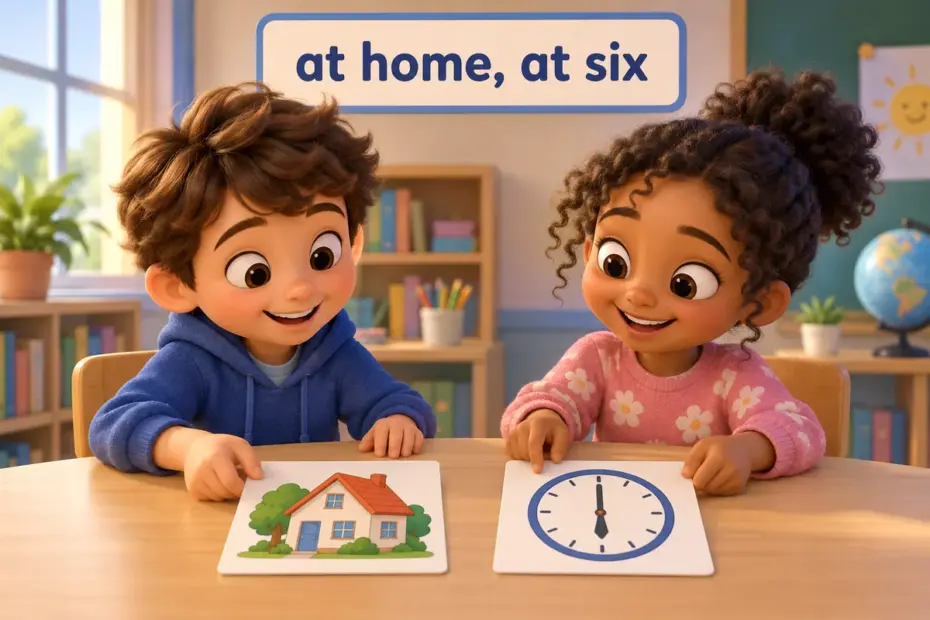
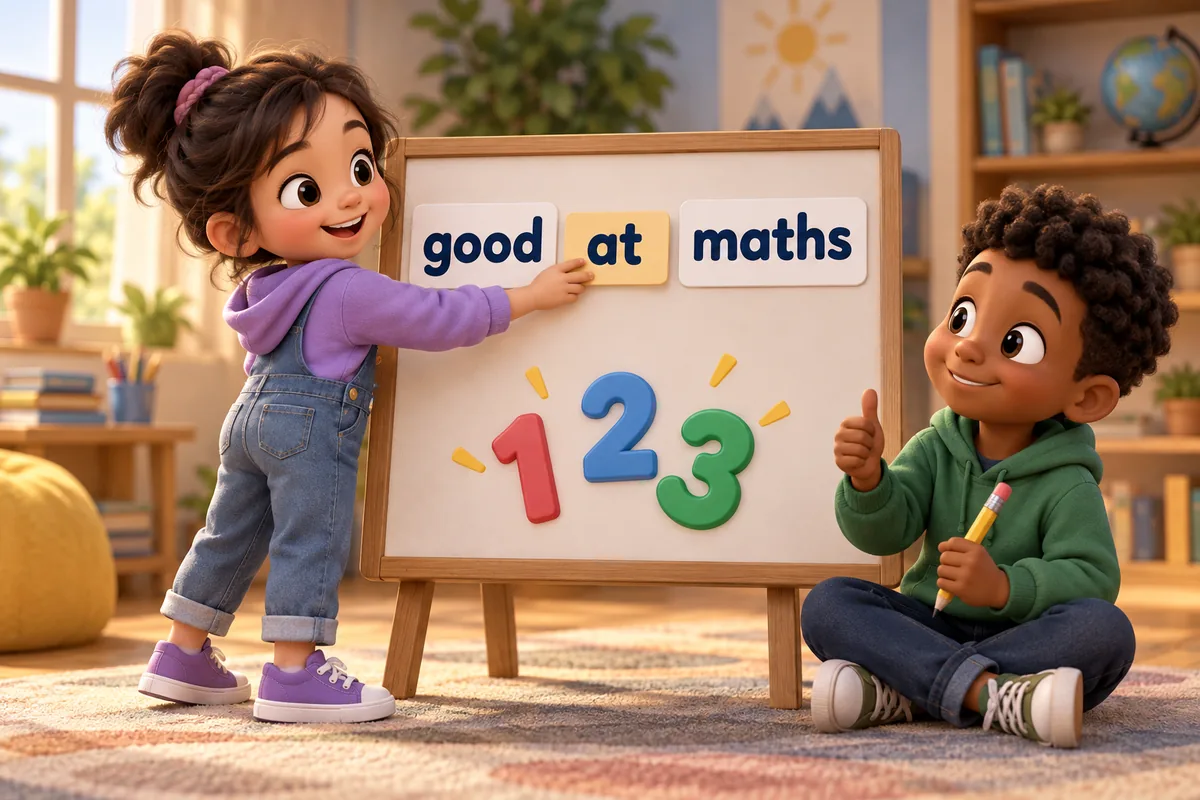
Collocations and expressions with at are the fixed word pairs, such as at home, good at and at last, that English speakers reuse instead of inventing new ones. Learning them whole is faster than learning at on its own, because the preposition rarely makes sense in isolation. A common example is “She is good at maths.”
Collocations and expressions with at at a glance
- At usually marks a point in place or time, not a space or a surface.
- Many fixed phrases keep at with no article, as in at home and at night.
- Several verbs select at, including arrive at, look at and laugh at.
- Adjectives of skill take at, as in good at and bad at.
- The commonest error is choosing in where the fixed phrase needs at.
What are common expressions with at?
These phrases behave as single units, so the meaning belongs to the whole expression rather than to the words inside it. The table gives each expression a plain meaning and one line, and a set of related frames sits at the at a distance sentence page.
| Expression | Meaning | Example |
|---|---|---|
| at home | in one’s own house | She stays at home on Sundays. |
| at work | at the place of work | He is at work until five. |
| at school | attending school | The children are at school. |
| at night | during the night | Owls hunt at night. |
| at noon | at twelve o’clock | We eat at noon. |
| at the moment | now | She is busy at the moment. |
| at first | at the beginning | At first the task seemed hard. |
| at last | finally | At last the rain stopped. |
| at once | immediately, or all together | Come here at once. |
| at least | not less than | It costs at least ten pounds. |
| at most | no more than | Wait ten minutes at most. |
| at times | sometimes | At times the road is quiet. |
| at all | in any way | I do not mind at all. |
| at a loss | unsure what to do | He was at a loss for words. |
| at a glance | with one quick look | You can see it at a glance. |
| at a discount | at a lower price | The coats are at a discount. |
| at a distance | far away | Keep the fire at a distance. |
| at any rate | whatever happens | At any rate, we will try. |
Several of these phrases describe a state rather than a place. At a loss and at ease name a feeling, at once and at last mark time, and at least and at most set a limit. Grouping them by meaning helps a learner recall the right one under pressure.
How do you choose between at, in and on?
The three prepositions split by shape: at marks a point, in marks an enclosed space or a period, and on marks a surface or a named day. Many fixed phrases follow the same logic, so learning the reason keeps the phrases together.
| Point | at | in | on |
|---|---|---|---|
| Core idea | a point | an enclosed space or period | a surface or a day |
| Place | at the door | in the room | on the table |
| Time | at six o’clock | in the morning | on Monday |
| Fixed phrases | at home, at night | in bed, in the end | on time, on holiday |
Which verbs take at?
A small group of verbs selects at, and the choice is fixed rather than free. The star frame arrives at, aims at and looks at, and each one pairs with a particular kind of object. A set of lines at the arrive at sentence page shows the first of them in use.
| Collocation | Meaning | Example |
|---|---|---|
| good at + skill | skilled in something | She is good at drawing. |
| bad at + skill | weak in something | He is bad at chess. |
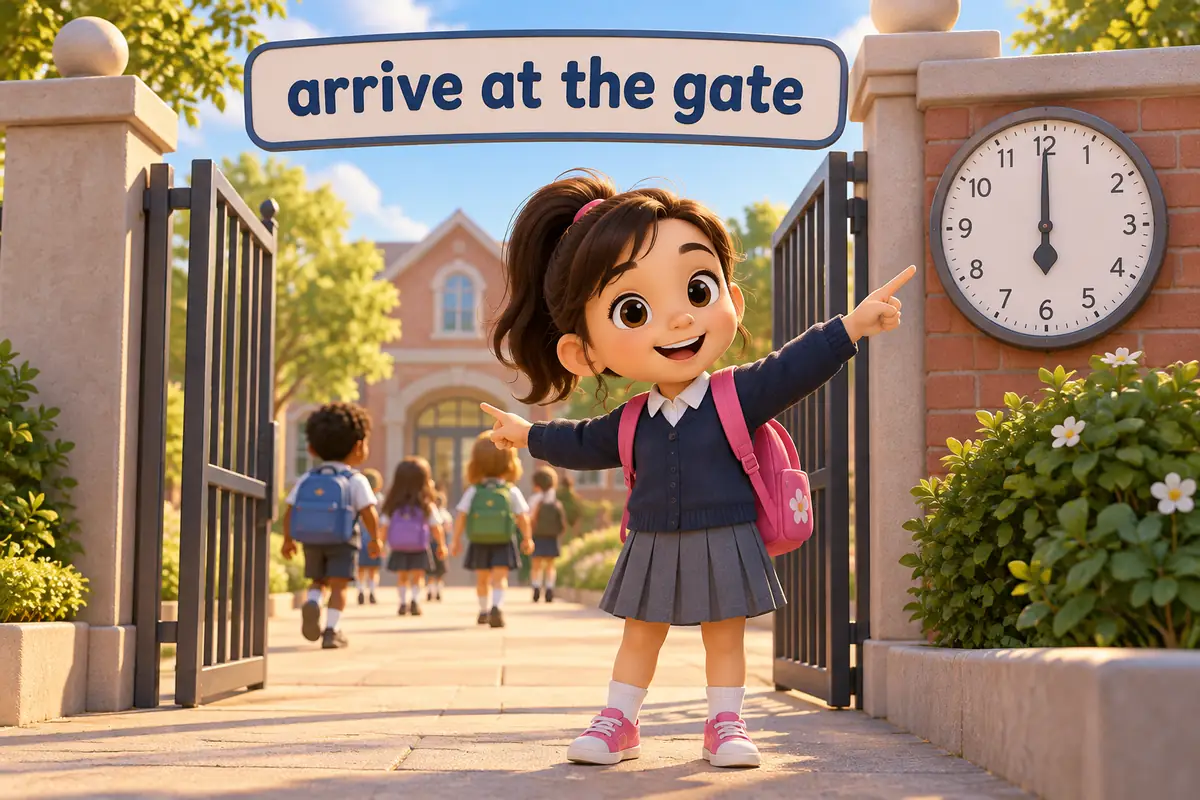
| arrive at + place | reach a point | We arrived at the hall. |
| aim at + target | intend for | The course aims at beginners. |
| look at + object | direct the eyes | Look at the board. |
| laugh at + person | mock someone | Do not laugh at him. |
| stare at + object | look long and fixed | She stared at the painting. |
| smile at + person | smile toward someone | He smiled at the child. |
A learner who remembers the verb and its preposition as one unit avoids the commonest slip. The same holds for adjectives of skill, where good, bad and excellent all take at before a skill, and for the phrase aim at, which points a plan toward a target.
Collocations and expressions with at across contexts
The same phrases appear in every setting, from a timetable to a friendly note. The table shows nine of them.
| Context | Example sentence | Why this works |
|---|---|---|
| Timetable | The train leaves at six. | A clock time takes at. |
| Home note | I will be at home all evening. | The fixed phrase keeps no article. |
| Work email | She is at a meeting at the moment. | The fixed phrase means now. |
| School report | He is good at science. | A skill takes at after the adjective. |
| Story | At last the door opened. | The phrase marks a turning point. |
| Warning | Keep the fire at a distance. | The phrase means far away. |
| Shop sign | Winter coats at a discount. | The phrase means a lower price. |
| Diary | At times the week feels long. | The phrase means sometimes. |
| Polite reply | I do not mind at all. | The phrase means in any way. |
| Sports fixture | The match starts at three. | A kick-off time takes at. |
| Reunion | At first, nobody spoke. | The phrase marks the opening moment. |
Grammar of at phrases
The article inside an at phrase is fixed, so a beginner cannot choose it freely. Some phrases take no article, some take the, and some take a, and each one is learned as a whole.
| Form | Rule | Example |
|---|---|---|
| at home | no article in a fixed place | She stayed at home. |
| at the moment | the before a specific point in time | He is busy at the moment. |
| at a loss | a for one state or instance | She was at a loss. |
| at night | no article in a fixed time | Owls hunt at night. |
| at six | no article before a clock time | The film starts at six. |
| at the end | the before a named point | Turn left at the end. |
| at work | no article in a fixed workplace phrase | He is at work. |
| at a glance | a for one quick action | See it at a glance. |
Common mistakes with at
Most errors come from swapping in for at, from adding an article to a fixed phrase, and from the wrong verb preposition.
- Incorrect:
I am good in maths.Correct: I am good at maths. Rule: good takes at for a skill. - Incorrect:
We arrived to the station.Correct: We arrived at the station. Rule: arrive takes at for a place. - Incorrect:
At the night, I read.Correct: At night, I read. Rule: the fixed phrase at night keeps no article. - Incorrect:
He laughed on me.Correct: He laughed at me. Rule: laugh takes the preposition at. - Incorrect:
She is at the home.Correct: She is at home. Rule: at home is a fixed phrase with no article. - Incorrect:
Please call me at the morning.Correct: Please call me in the morning. Rule: the fixed phrase uses in, not at, before morning.
Practice using expressions with at
Try each item, then read the reason beside the answer. A related frame sits at the aim at sentence page.
- Fill in the blank: She is good ________ maths.
- Fill in the blank: We arrived ________ the station early.
- Choose the better word: The film starts (at / in) six.
- Correct the error: He laughed on me.
- Build a sentence: use at last about a long wait.
- Spot the register: which fits a shop sign, “Coats at a discount” or “Coats cheaper-ish”?
- Fill in the blank: Do not worry, I do not mind ________ all.
Answers
- at: good takes at before a skill.
- at: arrive at is the fixed phrase for a place.
- at: a clock time takes at.
- He laughed at me: laugh selects the preposition at.
- Sample: At last the bus came. The phrase marks a moment that was long awaited.
- The first: at a discount is the standard shop phrase.
- at: the fixed phrase at all means in any way.
The bottom line
Collocations and expressions with at work best as whole units, so learn each one with its meaning and its fixed article. Use at for a point in place or time, in for a space or a period, and on for a surface or a named day. The verbs arrive at, look at and laugh at never change their preposition, and good at keeps at before every skill.
Frequently asked questions about at expressions
What are collocations with at?
Common collocations include at home, at work, at night, at last, at once and at a loss, together with the verb pairs arrive at, look at and laugh at. Each is a fixed unit, so the preposition and any article stay the same whenever the phrase is used.
When do you use at, in or on?
Use at for a point, as in at the door or at six; in for an enclosed space or a period, as in in the room or in the morning; and on for a surface or a named day, as in on the table or on Monday. Fixed phrases keep their own habit.
What does at a loss mean?
At a loss means unsure what to do, as in he was at a loss for words. It describes a state of confusion rather than a place. The phrase is fixed with the article a, so it never appears as at loss without it.
Is it good at or good in?
The standard form is good at before a skill, as in good at maths or good at drawing. Good in appears occasionally before a subject area, but good at is the common collocation and the safer choice. The same pattern holds for bad at and excellent at.