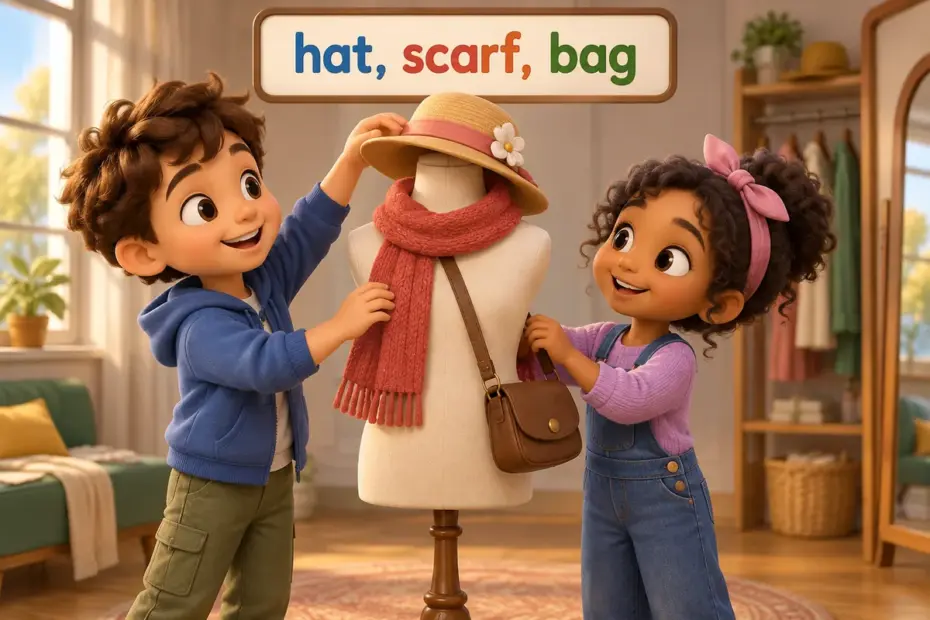
Clothing accessories vocabulary names the small items worn with an outfit, such as hats, scarves, belts and bags. The set splits into headwear, eyewear, neckwear and jewellery, and each group has its own everyday words. A single line like “She wore a silk scarf and a leather bag” already shows the pattern.
Clothing accessories vocabulary at a glance
- Accessories are the small items that complete an outfit.
- Headwear, eyewear, neckwear, bags, belts and jewellery are the main groups.
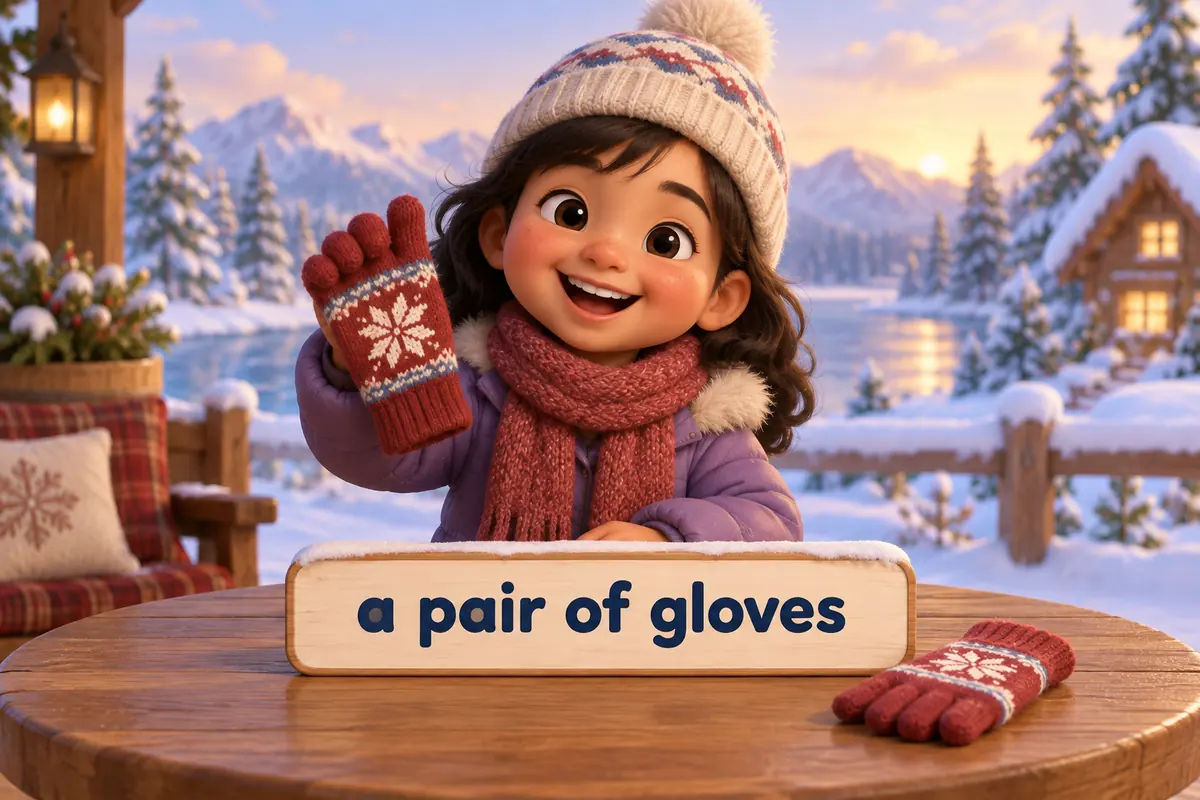
- Items worn in twos take a pair of and a plural noun: a pair of gloves.
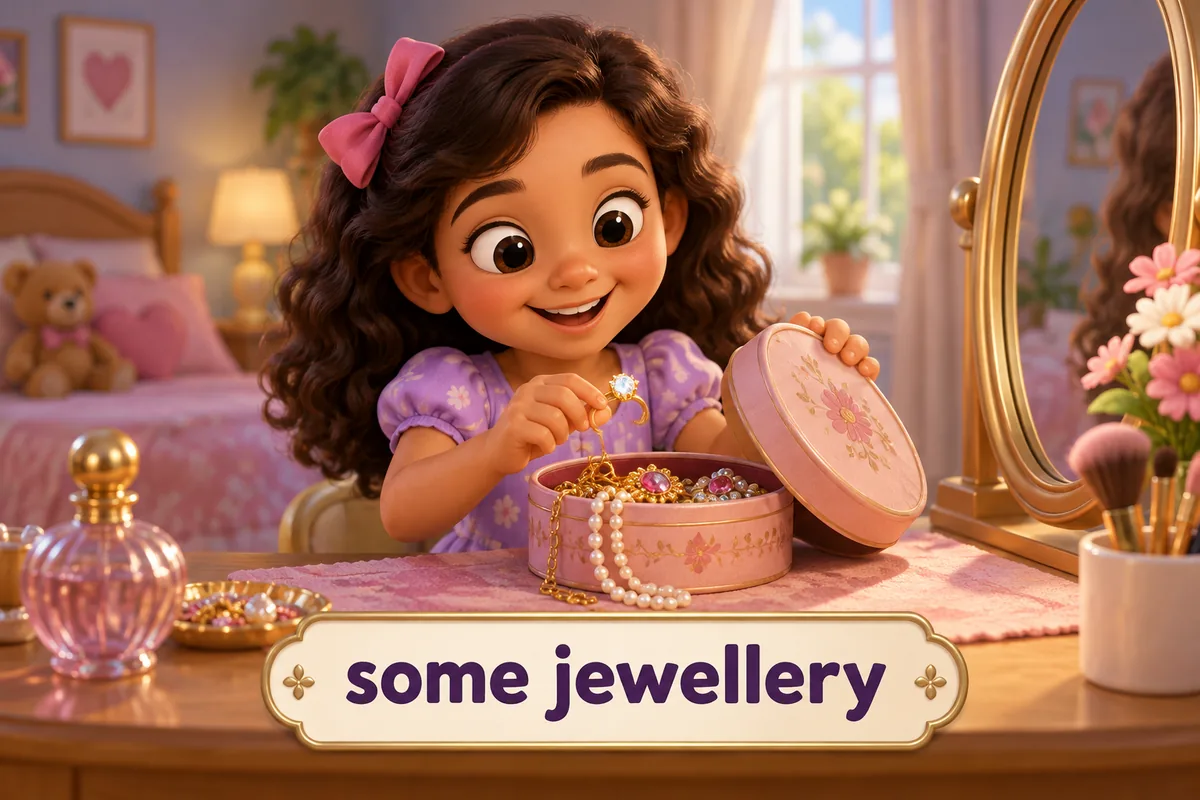
- Jewellery and clothing are uncountable, so they never take a plural s.
- Most accessory words combine with wear, carry, match or go with.
What are clothing accessories?
Clothing accessories are the items worn or carried with clothes to finish a look, from a cap to a watch; a wider word bank for the same field sits in clothing sentence examples.
| Group | Examples | What it names |
|---|---|---|
| Headwear | hat, cap, beanie | what goes on the head |
| Eyewear | glasses, sunglasses, goggles | what sits on the eyes |
| Neckwear | scarf, tie, necklace | what sits at the neck |
| Bags | handbag, backpack, tote | what carries things |
| Belts and bands | belt, bracelet, watch | what wraps a waist or wrist |
| Jewellery | ring, earring, brooch | decoration worn on the body |
Each group answers where the item sits, which is the fastest way to recall the word: head, eyes, neck, hand, waist or body. An accessory is rarely essential, which is exactly why the set is small and the words are common. Choosing the exact word matters more than a long list, because a hat and a cap are different items and a scarf and a tie sit in different places.
How do you use accessory words in a sentence?
Each pattern below pairs an accessory with the verb that suits it, and describing words are collected in adjectives for accessories; ready-made lines sit in accessories sentence examples.
| Pattern | Example | What it signals |
|---|---|---|
| wear + accessory | She wears silver earrings. | an item on the body |
| carry + bag | He carries a leather satchel. | an item held in the hand |
| a pair of + plural noun | a pair of gloves | counts an item in twos |
| accessory + made of + material | a belt made of leather | names the material |
| match + accessory + with + garment | match the scarf with the coat | combining two items |
| go with | The watch goes with anything. | compatibility |
The verb is the part learners get wrong, because a bag is carried rather than worn and a scarf is worn rather than carried. Choose the verb that matches how the item is used, and the rest of the sentence follows without effort. A describing word usually comes first, so a silver necklace and a wide leather belt both read naturally.
Clothing accessories vocabulary across contexts
Each setting below shows an accessory word doing real work, from a shop counter to a chat with a friend.
| Context | Example sentence | Why this works |
|---|---|---|
| Shop | Do you have these sunglasses in another colour? | a plural-only item |
| Weather report | Take an umbrella and a warm hat. | two weather accessories |
| Party invite | Wear your favourite necklace tonight. | wear plus jewellery |
| Online listing | A leather belt with a silver buckle. | material plus detail |
| Packing list | Bring a scarf, a cap and a pair of gloves. | groups and a pair of |
| School | Hang your backpack on the hook. | carry item in a routine |
| Swimming pool | Remember your goggles and towel. | eyewear for sport |
| Style advice | A slim watch matches the plain outfit. | matching two items |
| Gift idea | Some jewellery makes a thoughtful present. | jewellery stays uncountable |
| Repair | My umbrella has a broken handle. | naming a fault on an accessory |
| Cafe | She hung her bag on the chair. | a carried item in a routine |
| Winter walk | Wrap a thick scarf around your neck. | a garment action |
Reading the set across settings shows how narrow the vocabulary really is: a dozen common words cover nearly every accessory a learner will need, and the rarer names can wait until they appear in a shop window. The same dozen words also travel between seasons, since a scarf and a hat serve winter while sunglasses and sandals serve summer.
Which accessory words are plural or uncountable?
The grammar of each word decides its verb, and a few common accessories follow a fixed shape.
| Word | Grammar | Example |
|---|---|---|
| glasses, sunglasses, goggles | plural only | These glasses are new. |
| gloves, earrings | usually plural | a pair of gloves |
| jewellery | uncountable | some jewellery |
| clothing | uncountable | an item of clothing |
| belt, scarf, hat | countable | a wide belt, two scarves |
A countable accessory takes a or an and a plural s, while an uncountable one takes some and no plural, and an item in twos takes a pair of. Sorting a new accessory word into one of those three shapes is enough to use it in a sentence. Once the shape is known, the verb agrees without a second thought, and a learner who tags each word by number rarely pauses over a sentence again.
Word forms and grammar of accessories
Plurals and verb agreement cause most of the trouble, so the forms below are worth learning as pairs; clothing words from a to z extend the same set.
| Form | Note | Example |
|---|---|---|
| scarf to scarves | f becomes ves | two woollen scarves |
| glasses | no singular for the set | Where are my glasses? |
| jewellery | no plural form | She wears little jewellery. |
| wear | irregular past wore | He wore a red cap. |
| carry | y becomes ies | She carries a bag. |
| accessorise | verb meaning to add accessories | She accessorised with a scarf. |
Adding accessories to a look even has a verb of its own, accessorise, which keeps a fashion sentence short. Used with with, it names the extra item without listing the whole outfit. Knowing the base form also helps with spelling, since plural accessories such as scarves rarely follow the rule a learner expects.
Common mistakes with accessory words
The slips below come from grammar rather than meaning, so each fix is a small change in form.
- Incorrect: I need a new
glassfor the sun. Correct: I need new sunglasses. Rule: the eyewear word is plural only. - Incorrect: She bought many
jewelleries. Correct: She bought a lot of jewellery. Rule: jewellery is uncountable. - Incorrect: a
pairsof gloves. Correct: a pair of gloves. Rule: pair of plus a plural noun, with no extra s on pair. - Incorrect: He
wearsa backpack to school. Correct: He carries a backpack to school. Rule: a bag is carried, not worn. - Incorrect: two
scarfs. Correct: two scarves. Rule: scarf changes to scarves in the plural.
Almost every slip here is a question of number rather than meaning, so checking whether the word is plural, uncountable or countable settles it before the sentence is written. A quick look at the number on each noun prevents all five of them.
Practice using accessory words
- Fill in the blank: She put on a ___ of gloves before the walk.
- Choose the better word: a box of (jewellery / jewelleries).
- Correct the error: My sunglasses is broken.
- Build a sentence: describe a belt with one material and one colour word.
- Spot the verb: do we wear a backpack or carry it?
- Fill in the blank: These ___ are for the swimming pool.
Answers
- pair, because gloves come in twos.
- jewellery, because the word is uncountable.
- My sunglasses are broken; the plural takes are.
- A wide brown leather belt, joining size, colour and material.
- We carry it, because a backpack is held rather than worn.
- goggles, because pool eyewear is plural.
The bottom line
Clothing accessories vocabulary covers hats, eyewear, neckwear, bags, belts and jewellery, and each group works with a matching verb such as wear, carry or match. Watch the grammar: items in twos take a pair of, plural-only words take a plural verb, and jewellery stays uncountable. Choose the right verb for the item, and a short description of any outfit reads clearly. With those habits, the accessory set stays easy to use. Because the words are common and the groups are small, a learner can put the whole set into practice in a single shopping trip.
Frequently asked questions about accessory vocabulary
Is jewellery a countable or uncountable noun?
Jewellery is uncountable, so it takes a singular verb and words such as some or much, as in some jewellery is missing. To count single pieces, name them directly, as in three rings and two necklaces. Adding an s to jewellery is the error that most clearly marks a learner.
Why do glasses and gloves take a plural verb?
Both name items that come in twos, so the word itself is plural and takes are, as in my glasses are clean. To count them, use a pair of, as in a pair of gloves. The singular form glass means the material or a drinking glass, not the eyewear.
What is the difference between wear and carry an accessory?
Wear is for something on the body, such as a hat, a scarf or a necklace. Carry is for something held in the hand, such as a bag or an umbrella. A few items can go either way depending on use, but the default is to wear jewellery and carry a bag.
How is the plural of scarf spelled?
Most words ending in f change to ves in the plural, so one scarf becomes two scarves. A small number, such as roof, keep the f and add s, but scarf is not among them. When in doubt, check the plural of the exact noun rather than assuming one rule.