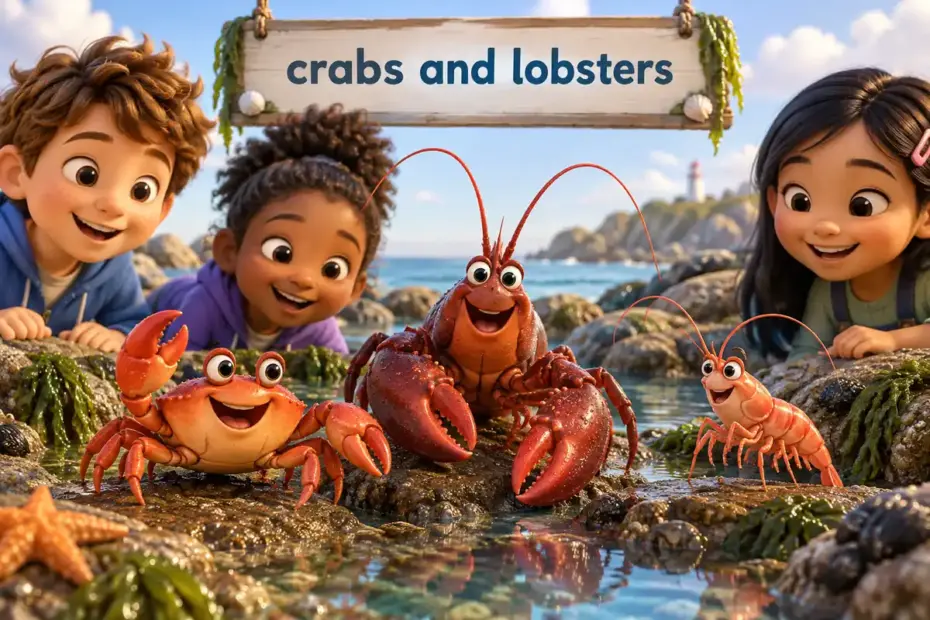
Crustaceans names are the words English uses for a large group of hard-shelled water animals, from crabs and lobsters to shrimp and barnacles. This guide lists the main names, explains the shared features that tie them together, and shows each word working in a clear sentence.
Crustaceans Names at a glance
- A crustacean is an animal with a hard outer shell and jointed legs.
- Common crustaceans include crab, lobster, shrimp, prawn, crayfish and barnacle.
- Most crustaceans live in water, though a few, such as woodlice, live on land.
- Crustaceans have two pairs of antennae and breathe through gills.
- The commonest error is calling an octopus a crustacean; it is a mollusc.
What are crustaceans?
Crustaceans are a large group of animals in the phylum Arthropoda, defined by a hard exoskeleton, jointed limbs and two pairs of antennae. They range from the familiar crab and lobster to tiny drifting krill that feed whales. The hard casing is also called a crust, and a page of crust sentence examples shows that shorter word in use.
| Group | Members | How it works |
|---|---|---|
| Decapods | crab, lobster, shrimp, crayfish | Ten legs and a hard shell; the largest group. |
| Barnacles | acorn barnacle, goose barnacle | Fixed to rocks and ships; a crustacean, not a shell. |
| Krill | Antarctic krill | Tiny, abundant, and food for whales. |
| Isopods | woodlouse, sea slater | The land dwellers of the group. |
Because the shell cannot stretch, a crustacean must moult to grow, and it is most vulnerable to predators just after shedding the old casing. This page stays with the names a reader meets at a market or in a science lesson, so specialist names for small deep-sea species are left out.
The main crustaceans names in one list
Each name below is a common crustacean, with a short note on how it looks and where it lives. Some of these claws can crush a shell, and a crush sentence page shows that verb in action.
| Name | What it looks like | Key fact |
|---|---|---|
| Crab | Wide shell and strong front claws | Walks sideways on ten legs. |
| Lobster | Long body and two large claws | Lives on the sea floor. |
| Shrimp | Small, curved and translucent | Swims and is eaten worldwide. |
| Prawn | Like a larger shrimp | Closely related to shrimp. |
| Crayfish | A small lobster in fresh water | Found in rivers and streams. |
| Barnacle | A chalky cone fixed to rock | A crustacean, not a mollusc. |
| Krill | Tiny and shrimp-like | Food for many ocean animals. |
| Hermit crab | Soft body in a borrowed shell | Moves house as it grows. |
| King crab | Very large, spiny legs | A large cold-water crab. |
| Langoustine | Slender, pale orange claws | A small lobster-like crustacean. |
| Woodlouse | Grey, many-segmented, on land | A crustacean that lives on land. |
| Copepod | Minute and drifting | A tiny sea crustacean. |
| Sea slater | Grey, many-legged, on rocky shores | A land-dwelling isopod. |
| Goose barnacle | Pale and stalked, on driftwood | A barnacle with a long stalk. |
How do you use crustacean names in a sentence?
The names are ordinary countable nouns. The frames below cover the uses a learner needs most, from the singular to the group word.
| Pattern | Example | What it signals |
|---|---|---|
| a + name | I saw a crab on the sand. | One countable animal |
| plural name | Lobsters live on rocky sea floors. | The whole kind |
| name + shell | The crab shell was pale. | A part of the animal |
| name as adjective | We ordered a shrimp salad. | The name describes a dish |
| group word | A barnacle is a crustacean. | A member of the group |
Crustacean names in a sentence: examples across contexts
The names work the same way in a market, a classroom and a news report, which makes them easy to reuse.
| Context | Example sentence | Why this works |
|---|---|---|
| Classroom | Our teacher explained that a crab is a crustacean. | The name joins a group word. |
| Market | The stall sold fresh prawns and crab. | The names label food. |
| News report | Warming seas are pushing lobster stocks north. | The name modifies a noun. |
| Science lesson | Krill form the base of the Antarctic food web. | The name works as a group noun. |
| Conversation | I have never eaten crayfish before. | The name follows a verb. |
| Rock pool guide | Look under the ledge for a small hermit crab. | The name has an article. |
| Story | A barnacle crusted the old boat. | The name becomes a verb. |
| Menu | The dish pairs langoustine with lemon. | The name names an ingredient. |
| Coastal walk | The tide pools were full of tiny crabs. | The name follows a quantity word. |
| Fishing news | The catch was mostly prawn this season. | The name works as a mass noun. |
Which crustacean is which?
Match the name to the feature you can see, and the choice becomes obvious.
| Feature | Name | Example |
|---|---|---|
| Big claws, walks sideways | Crab | A shore crab scuttled past. |
| Large claws, sea floor | Lobster | The lobster hid in a crevice. |
| Fresh water, lobster shape | Crayfish | We caught a crayfish in the stream. |
| Fixed to rock, chalky cone | Barnacle | Barnacles covered the pier. |
| Tiny and drifting in swarms | Krill | Krill rose toward the surface. |
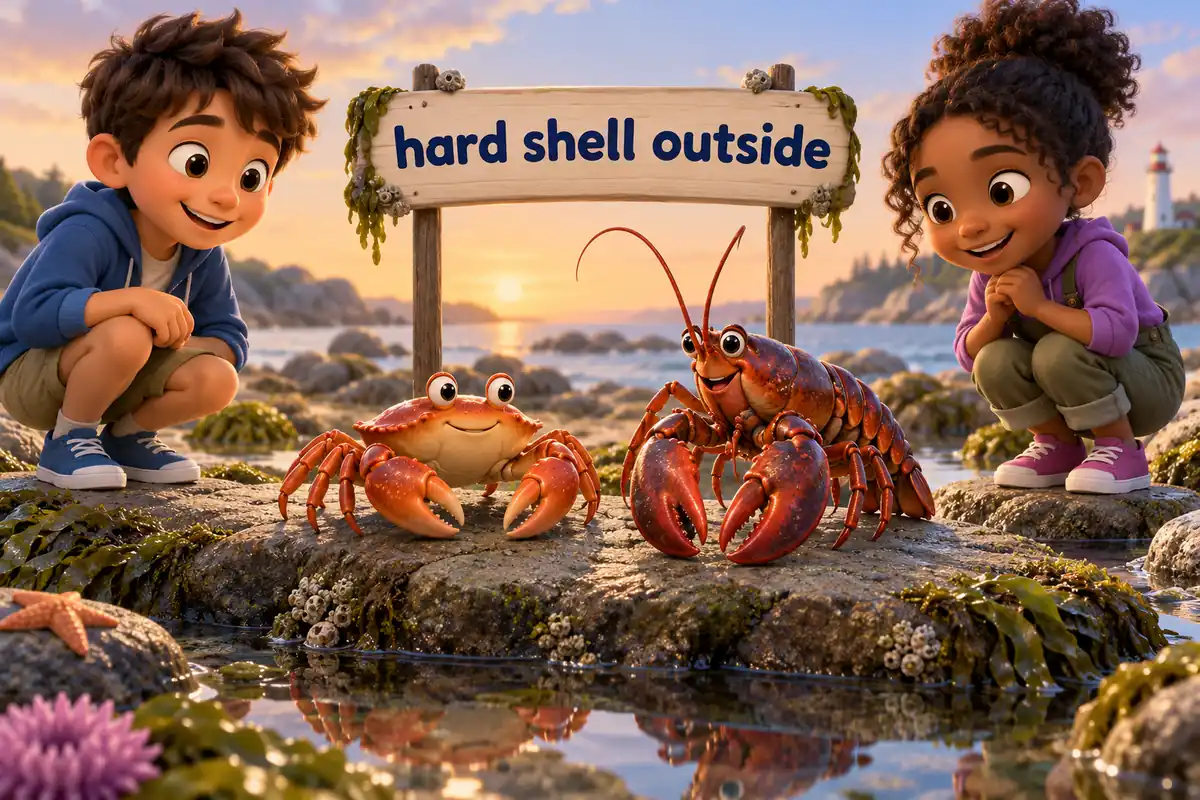
The clearest clue is the body. A wide shell points to a crab, while an elongated body points to a lobster or a crayfish, and the antennae confirm the group either way.
Spelling and word forms of crustacean names
Most names change only for the plural, and a related adjective, crusty, appears in crusty sentence examples about dried or hardened surfaces.
| Form | Part of speech | Example |
|---|---|---|
| crab | noun | A crab hid under the stone. |
| crabs | plural noun | Crabs crowded the rock pool. |
| crab | verb | He crabbed about the noise. |
| lobster | noun | The lobster was deep blue. |
| shrimp | noun or verb | Shrimp swim in the shallows. |
| crustacean | noun | This crustacean has ten legs. |
| crusty | adjective | The old shell was crusty. |
Common mistakes with crustacean names
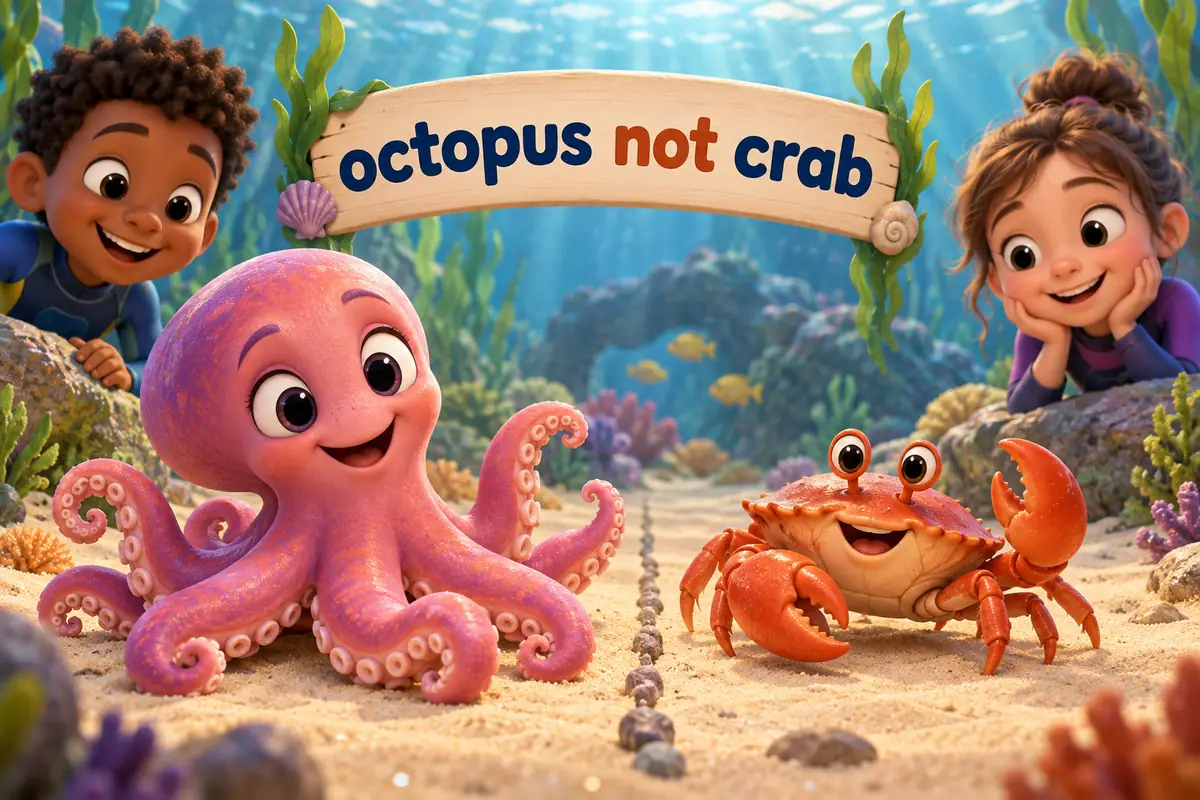
Mistake 1: an octopus is called a crustacean. Incorrect: An octopus is a crustacean. Correct: An octopus is a mollusc. Rule: crustaceans have jointed legs and a shell; octopuses are molluscs.
Mistake 2: the wrong article before crustacean. Incorrect: an crustacean. Correct: a crustacean. Rule: crustacean begins with a consonant sound, so it takes a, not an.
Mistake 3: a countable name loses its plural. Incorrect: I saw two lobster. Correct: I saw two lobsters. Rule: these names are countable and add -s after a number.
Mistake 4: a barnacle is called a shellfish. Incorrect: A barnacle is a shellfish like a clam. Correct: A barnacle is a crustacean. Rule: barnacles are crustaceans, not molluscs.
Mistake 5: krill takes a plural -s. Incorrect: The whales fed on krills. Correct: The whales fed on krill. Rule: krill is usually treated as a group noun.
Practice using crustacean names
- Fill in the blank: A ___ walks sideways on the beach.
- Choose the better word: A barnacle is a (crustacean / mollusc).
- Correct the error: We caught two crayfishs in the stream.
- Build a sentence: use the group word to describe a lobster.
- Spot the register: which line suits a museum label, (a) It is a crab, or (b) Species: shore crab, family Decapoda?
- Fill in the blank: Tiny ___ feed the whales of the Southern Ocean.
Answers
- crab, because crabs walk sideways on ten legs.
- crustacean, because barnacles belong to that group.
- We caught two crayfish in the stream; the plural stays crayfish.
- A lobster is a crustacean with ten legs and two large claws.
- (b), because a museum label needs precise classification.
- krill, because krill is the group food source.
The bottom line
Crustaceans names cover a large family of shelled water animals, from crab and lobster to shrimp, krill and barnacle. Remember the two clues that define the group: a hard outer shell and jointed legs. Keep the names countable, treat barnacles as crustaceans rather than shellfish, and the vocabulary stays easy to use.
Frequently asked questions about crustaceans
Is a lobster a crustacean?
Yes, a lobster is a crustacean. It has a hard exoskeleton, jointed legs and two pairs of antennae, which are the shared features of the group. Lobsters belong to the decapods, the same subgroup as crabs, shrimp and crayfish, all of which have ten legs.
Are shrimp and prawns the same animal?
They are closely related but not identical. Shrimp and prawns both belong to the decapods, and in shops the two names often overlap. In biology the branch pattern of the gills differs, and prawns tend to be larger. For everyday cooking, many people use the words interchangeably.
Do crustaceans have bones?
No, crustaceans have no bones. Instead, they wear a hard outer skeleton called an exoskeleton that supports and protects the body. As the animal grows, it sheds the old shell and hardens a larger one in a process called moulting, which happens several times in a lifetime.
How many legs does a crustacean have?
The number varies by group. Decapods, the largest group, have ten legs, which is why the name means ten-footed. Barnacles have feathery legs used for feeding, and krill have many pairs of swimming legs. Counting the legs is a quick way to tell the main groups apart.