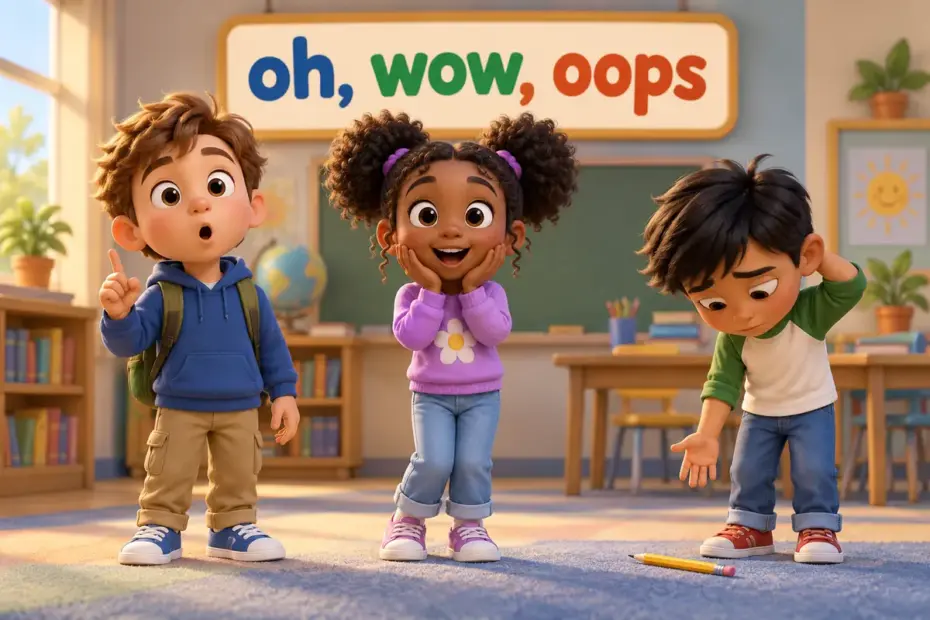
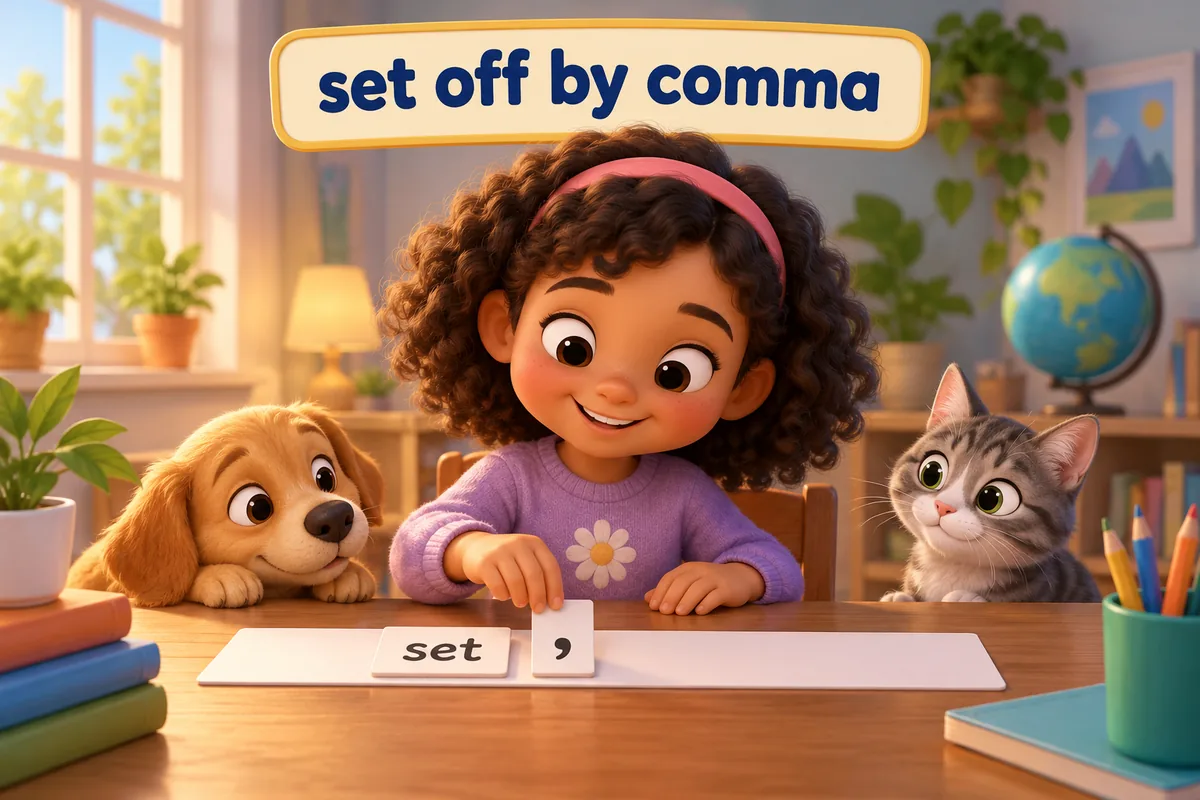
Interjection definition types and examples all describe a short word that shows feeling rather than naming it, such as oh, wow, oops or hooray. An interjection usually stands alone and is set off by a comma or a strong mark, as in oh, that makes sense now.
Interjections at a glance
- An interjection is a short word that shows a feeling or a reaction.
- It rarely fits the grammar of the sentence around it.
- It is set off by a comma or a strong punctuation mark.
- Common interjections include oh, wow, oops, ouch and hooray.
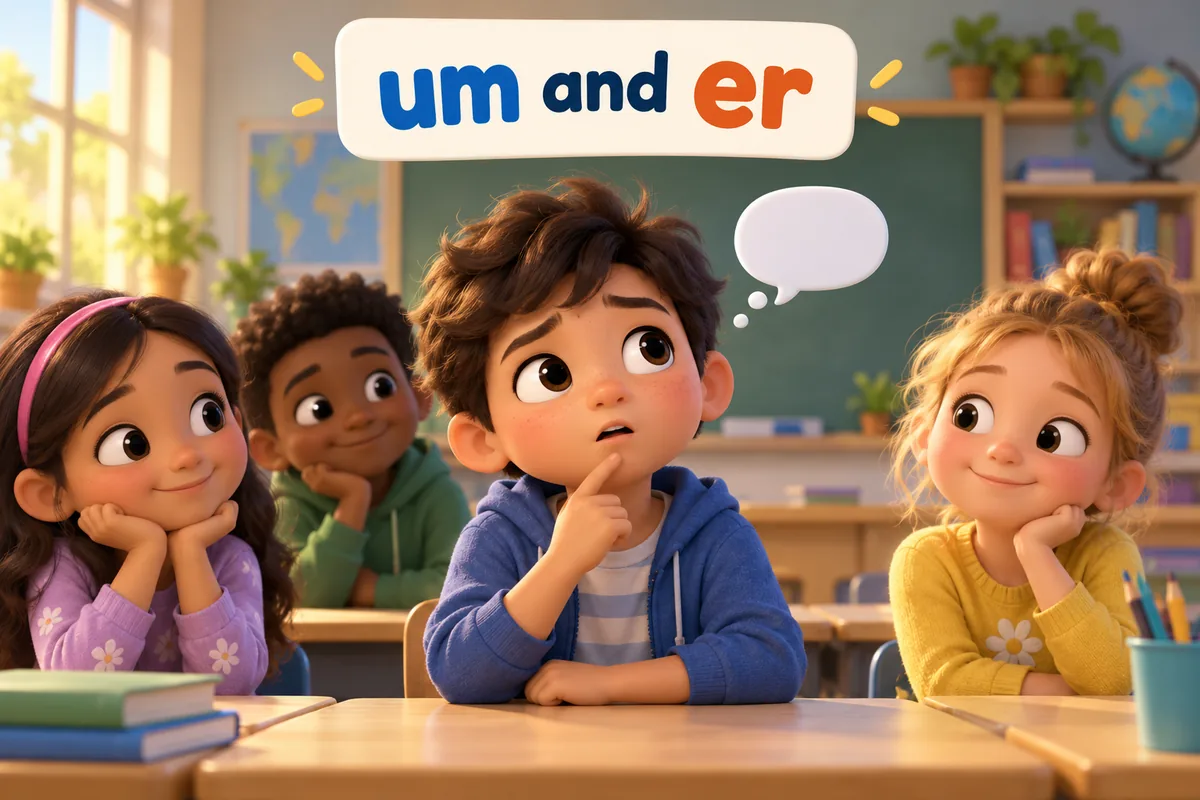
- Some interjections fill a pause, such as um, er and well.
- The commonest slip is using too many of them in formal writing.
What is an interjection?
An interjection is a short word or phrase that expresses a sudden feeling, such as surprise, joy, pain or doubt, without becoming part of the sentence’s grammar. It usually stands at the start and is separated by a comma or a strong mark.
| Interjection | Feeling it shows | Example |
|---|---|---|
| oh | surprise or realisation | Oh, I see the mistake now. |
| wow | amazement | Wow, that is a fast train. |
| oops | a small mistake | Oops, I dropped the lid. |
| hooray | joy or success | Hooray, the team won at last. |
| ouch | pain | Ouch, that step is steep. |
| hmm | thinking or doubt | Hmm, that does not sound right. |
What are the types of interjections?
Interjections fall into a few groups by the job they do, from showing emotion to holding a turn in conversation. The table lists the main types with everyday examples.
| Type | Examples | Use |
|---|---|---|
| Emotion | wow, yay, ugh | Express a strong feeling. |
| Greeting or parting | hi, hey, bye | Open or close an exchange. |
| Agreement | yes, uh-huh, right | Show that you agree. |
| Surprise or realisation | oh, ah, oops | Mark something sudden. |
| Filling a pause | um, er, well | Hold the turn while thinking. |
Interjection definition types and examples in context
The same interjection changes weight with the setting, and the table shows when each one fits. More lines that open with a short cry sit in these interjection sentence examples.
| Context | Sentence | Why this works |
|---|---|---|
| Conversation | Oh, that is a good point. | A mild interjection opens a reply. |
| Classroom | Wow, that experiment worked well. | It shows genuine surprise. |
| Comic story | Ouch, the branch caught my arm. | It reports a quick pain. |
| Sports report | Hooray, the final whistle blew. | It matches a public celebration. |
| Phone call | Hey, it is good to hear you. | A friendly greeting opener. |
| Careful email | Well, the figures need one more check. | A soft opener that hedges. |
| Diary | Ugh, the whole plan fell apart. | It carries the writer’s mood. |
| Report | The result, alas, was lower than hoped. | A formal aside inside a sentence. |
How do interjections differ from other word classes?
An interjection sits outside the grammar that holds a sentence together, while other classes take a defined role. A warm phrase such as it means a lot often opens a reply, and a short interjection can carry the same warmth.
| Feature | Interjection | Other word classes |
|---|---|---|
| Job | Shows a feeling | Names, describes or joins |
| Grammar link | Stands apart | Fits a sentence slot |
| Position | Usually first, set off | Fixed by the role |
| Removable | Sentence survives without it | Often cannot be removed |
| Example | Oops, I forgot. | The noun and the verb remain. |
Word forms and grammar of interjections
Interjections take very little grammar, and the punctuation carries the tone. A longer piece of writing about an intervention uses many full sentences, which shows how little space an interjection takes.
| Punctuation | Example | What it signals |
|---|---|---|
| Comma after a mild one | Oh, I see the point. | Keeps the tone calm. |
| Full stop after a strong one | Wow. That was quick. | Adds emphasis without noise. |
| Between dashes | The plan, hmm, is unclear. | Marks hesitation. |
| Inside the sentence | The result, alas, was wrong. | A formal aside. |
| With a name | Yes, Priya, that works. | Softens agreement. |
Interjections carry meaning through tone rather than grammar, so the same word can express opposite feelings depending on delivery. A flat oh can signal disappointment, while a bright oh signals surprise, and nothing in the spelling changes. That is why interjections are hard to translate: another language may use a different sound for the same feeling, and a literal swap can sound odd. Writers who report an interjection in indirect speech often describe the tone instead, writing that she said oh in surprise rather than leaning on the word alone to do the work.
Interjections also mark the boundary between spoken and written English. They are natural in dialogue, messages and dialogue tags, where they imitate speech, but they thin out quickly in essays and reports, where a stray wow or oops can undercut a careful argument. The safest habit is to treat them as seasoning: one at the start of a spoken-style line reads well, while several in one paragraph make the writing sound weightless. When in doubt, cut the interjection and keep the sentence that carries the meaning.
A final point concerns form. Interjections rarely change shape, because they take no endings for tense or number, so oh stays oh and oops stays oops in every sentence. This fixed form is part of what makes them feel immediate, and it also explains why a learner cannot build a new interjection by adding a suffix. The small group simply has to be learned as a list, and the list is short enough to master quickly. The list also reminds a learner that a whole conversational turn can rest on one short word, which is why the group rewards careful listening.
Common mistakes with interjections
Each pair shows a weak line, a repair, and the rule behind the fix.
- Incorrect:
Ouch that hurt. - Incorrect:
I was very oops about it. - Incorrect:
Wow wow wow, the results are in, it is amazing, wow. - Incorrect:
The report was oh so weak, oops. - Incorrect:
hmm I think that maybe we might consider
Practice using interjections
Six short tasks cover the meaning, the punctuation and the register.
- Fill the gap with surprise: “______, the bus is early today.” (Wow / Oops)
- Choose the mild realisation: “We show mild realisation with (oh / ouch).”
- Correct the error: “Ouch that hurt”.
- Build a sentence using oops for a small mistake.
- Spot the register: which fits a formal report, (a) The rate, alas, fell again, or (b) Oops, the rate fell?
- Write one sentence where hmm shows hesitation.
Answers
- Wow, because it marks surprise at something unexpected.
- oh, because oh signals gentle realisation, while ouch signals pain.
- Ouch, that hurt, because a comma sets off the interjection.
- Oops, I sent the draft too early, because oops marks a small slip.
- (a) The rate, alas, fell again, because a formal aside stays restrained.
- Hmm, I am not sure that answer works, because hmm marks doubt.
The bottom line
Interjection definition types and examples come down to one small word class that shows feeling rather than naming it. Keep interjections short, set them off with the right punctuation, and use them sparingly in formal writing. A single oh or wow does more than a string of them.
Frequently asked questions about interjections
Is an interjection a part of speech?
Yes, interjections are one of the traditional parts of speech, alongside nouns, verbs and adjectives. They differ from the others by standing apart from the sentence’s grammar, so they can usually be removed without breaking the structure that remains around them.
What punctuation goes after an interjection?
A mild interjection takes a comma, as in oh, that makes sense, while a strong one may take a full stop or a strong mark, as in wow. That was quick. The choice depends on the tone you want, not on a fixed rule.
Are um and er real interjections?
Um, er and well are interjections that fill a pause and hold the speaker’s turn while they think. They carry little meaning on their own, but in conversation they signal that a reply is still coming, so they are treated as a type of interjection.
Should I use interjections in formal writing?
Use them rarely in formal writing, and choose restrained ones such as alas inside a sentence. Strong interjections like wow or oops belong in conversation and informal notes, where they add warmth, but they can make a report or an essay sound casual and unclear.