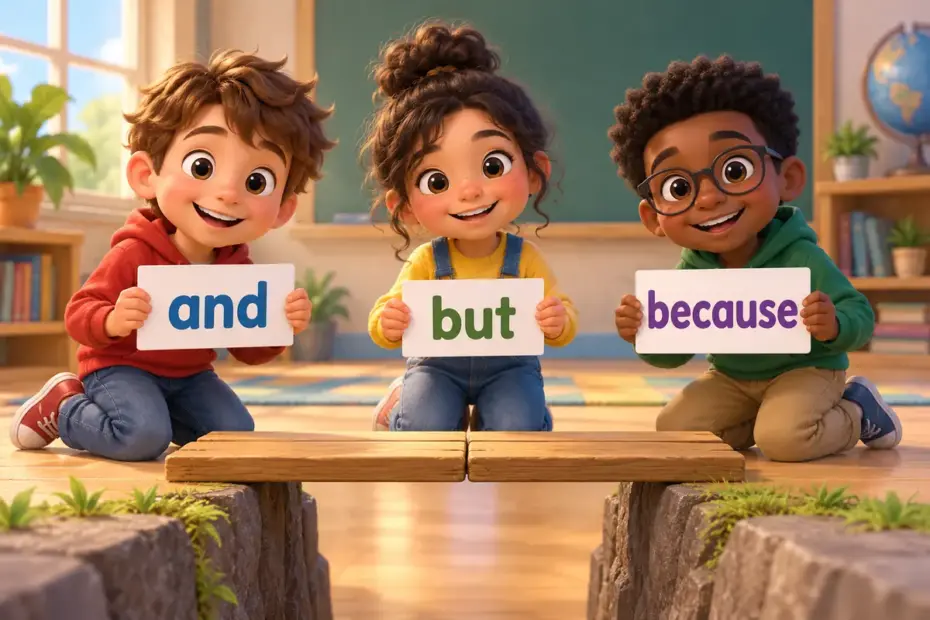
A list of conjunction words in English groups the words that join parts of a sentence, such as and, but, because and unless. The main families are coordinating conjunctions, which link equal parts, subordinating conjunctions, which attach a dependent clause, and correlative pairs such as either or, and one example shows the job: bread and butter.
List of conjunction words in English at a glance
- Conjunctions join words, phrases or clauses inside one sentence.
- Coordinating conjunctions link equal parts: for, and, nor, but, or, yet, so.
- Subordinating conjunctions attach a dependent clause: because, although, unless, while.
- Correlative conjunctions work in pairs: either or, neither nor, both and, not only but also.
- The commonest error is a comma splice, two full clauses joined by only a comma.
What are conjunction words?
A conjunction is a word that connects two or more parts of a sentence, and it never changes its form. The joining habit shows clearly in conjunction in a sentence, where two short clauses lean on one small word. Conjunctions split into three families, and the family decides both the meaning and the punctuation, so the first step with any unfamiliar joining word is to place it in one of the three groups.
| Family | Job in the sentence | Common words |
|---|---|---|
| Coordinating | join two equal words, phrases or clauses | for, and, nor, but, or, yet, so |
| Subordinating | attach a clause that cannot stand alone | because, although, since, unless, while, if, when, after, before |
| Correlative | join equal parts as a fixed pair | either or, neither nor, both and, not only but also, whether or |
| Multi-word | act as a single joining unit | as long as, even though, as if, in case |
How do conjunction words work in a sentence?
The position and the punctuation matter as much as the meaning, and each pattern carries its own rule. A longer browse of single joining words sits in conjunctions from A to Z.
| Pattern | Example | What it signals |
|---|---|---|
| clause, + and/but + clause | She read the note, but she did not reply. | two equal clauses with a comma |
| subordinator + clause, + clause | Although it rained, the match went ahead. | the dependent clause comes first |
| clause + subordinator + clause | The match went ahead although it rained. | no comma when the main clause leads |
| word + and + word | hot and sweet | two single items joined |
| either + A + or + B | Either call me or send a message. | a fixed correlative pair |
| not only + A + but also + B | She not only sang but also danced. | two balanced, emphasised parts |

List of conjunction words in English across contexts
The same small words do different work in speech, school writing and formal prose, and the register usually decides which one fits. Two more joining patterns for describing words appear in joining adjectives with and, but or yet.
| Context | Example sentence | Why this works |
|---|---|---|
| Everyday speech | I wanted tea but ordered coffee instead. | but marks a contrast |
| Classroom | Water boils when it reaches a hundred degrees. | when attaches a condition |
| Essay writing | The plan was costly, yet it saved time later. | yet gives a measured contrast |
| Instructions | Press the button and hold it for a second. | and joins two steps |
| Workplace email | I will attend unless the meeting moves. | unless sets a condition |
| Narration | She smiled because she knew the answer. | because gives a reason |
| Academic writing | Although the sample was small, the trend was clear. | although concedes a point |
| News report | The road closed, so drivers took a longer route. | so shows a result |
| Persuasive writing | You can either pay now or settle later. | either or offers a choice |
| Formal notice | Neither cash nor cards are accepted here. | neither nor excludes both |
Which conjunction should you use?
Pick the family that matches the relationship between the two parts, because the wrong family changes the meaning or breaks the punctuation. A phrase that looks like a conjunction but behaves differently appears in in conjunction with in a sentence.
| Situation | Use | Example |
|---|---|---|
| Add one item to another | and | We bought bread and cheese. |
| Show a contrast | but or yet | It was late, but we stayed. |
| Show a choice | or | Tea or coffee? |
| Give a reason | because or since | She left because the shop closed. |
| Set a condition | unless or if | Come unless you are unwell. |
The word but is the one learners overuse, because it can carry a contrast, a mild objection or an afterthought. Reach for though, although or even so when the contrast is gentle, and keep but for a direct turn within one sentence.
Word forms and grammar of conjunctions
Conjunctions never take an s, an ed or an ing, so the grammar is about position and punctuation rather than form.
| Point | Rule | Example |
|---|---|---|
| Fixed form | a conjunction does not inflect | and stays and in every sentence |
| Comma with and | no comma before and in a short list of two | salt and pepper |
| Comma with but | a comma before but joining two clauses | It rained, but we walked. |
| Leading subordinator | a comma after an opening dependent clause | When it rained, we walked. |
| Correlative balance | each half joins the same kind of unit | either the pen or the pencil |
| Run-on risk | one comma cannot join two full clauses | fix by adding and, but or a semicolon |
The comma rule follows the clause, not the word. When a subordinating conjunction opens the sentence, put a comma after its clause and none before the main clause. When the main clause comes first, drop the comma and let the subordinator do the work.
Common mistakes with conjunction words
Mistake 1: comma splice. Incorrect: The train was late, we missed the start. Correct: The train was late, so we missed the start. Rule: two full clauses need a conjunction or a semicolon, not a bare comma.
Mistake 2: correlative pair mismatched. Incorrect: Neither the keys or the map were there. Correct: Neither the keys nor the map was there. Rule: neither always pairs with nor, and the verb agrees with the nearer subject.
Mistake 3: both halves of a pair not balanced. Incorrect: She likes either reading and to swim. Correct: She likes either reading or swimming. Rule: a correlative pair joins the same kind of unit on each side.
Mistake 4: although and but used together. Incorrect: Although it was cold, but we went out. Correct: Although it was cold, we went out. Rule: one conjunction does the joining, so keep only one.
Mistake 5: so used as a subordinator only. Incorrect: So that it was raining, we stayed in. Correct: Because it was raining, we stayed in. Rule: so shows a result, while because gives the reason, and the two move in opposite directions.
Practice using conjunction words
- Fill in the blank: I finished the report ___ the deadline was tight.
- Choose the better word: She is quick (but / because) careful.
- Correct the error: The soup was hot, we ate it slowly.
- Build a sentence: use either or to offer two weekend plans.
- Spot the register: which suits a formal notice, (a) Bring money or a card, or (b) Neither cash nor cards are accepted?
- Fill in the blank: ___ the rain stopped, the game began.
Answers
- although, because the second clause concedes a difficulty.
- but, because the two adjectives contrast rather than cause each other.
- The soup was hot, so we ate it slowly; a bare comma cannot join two clauses.
- We can either hike on Saturday or visit the market on Sunday.
- (b), because a formal notice uses a precise correlative pair.
- When, because a subordinator opens the clause and a comma follows it.
The bottom line
A list of conjunction words in English comes down to three families that each do a different job. Coordinating conjunctions link equal parts, subordinating conjunctions attach a dependent clause, and correlative pairs work only as a matched set. Choose the family by the relationship you mean, then check the comma, and the sentence holds together.
Frequently asked questions about conjunction words
What are the seven coordinating conjunctions?
The seven coordinating conjunctions are for, and, nor, but, or, yet and so, often remembered by their first letters. They join two equal parts of a sentence and can stand between two full clauses. A comma usually appears before one when it links two independent clauses.
Is because a conjunction or a preposition?
Because is a subordinating conjunction, because it introduces a clause with its own subject and verb, as in because it rained. The related phrase because of is a preposition that takes a noun instead, as in because of the rain. The following word decides which one you need.
Can I start a sentence with and or but?
Yes, in modern writing a sentence can open with and or but for emphasis, and skilled writers do it deliberately. Keep the habit for short, punchy sentences and avoid it in dense formal prose, where a clearer connector such as however or in addition usually reads better.
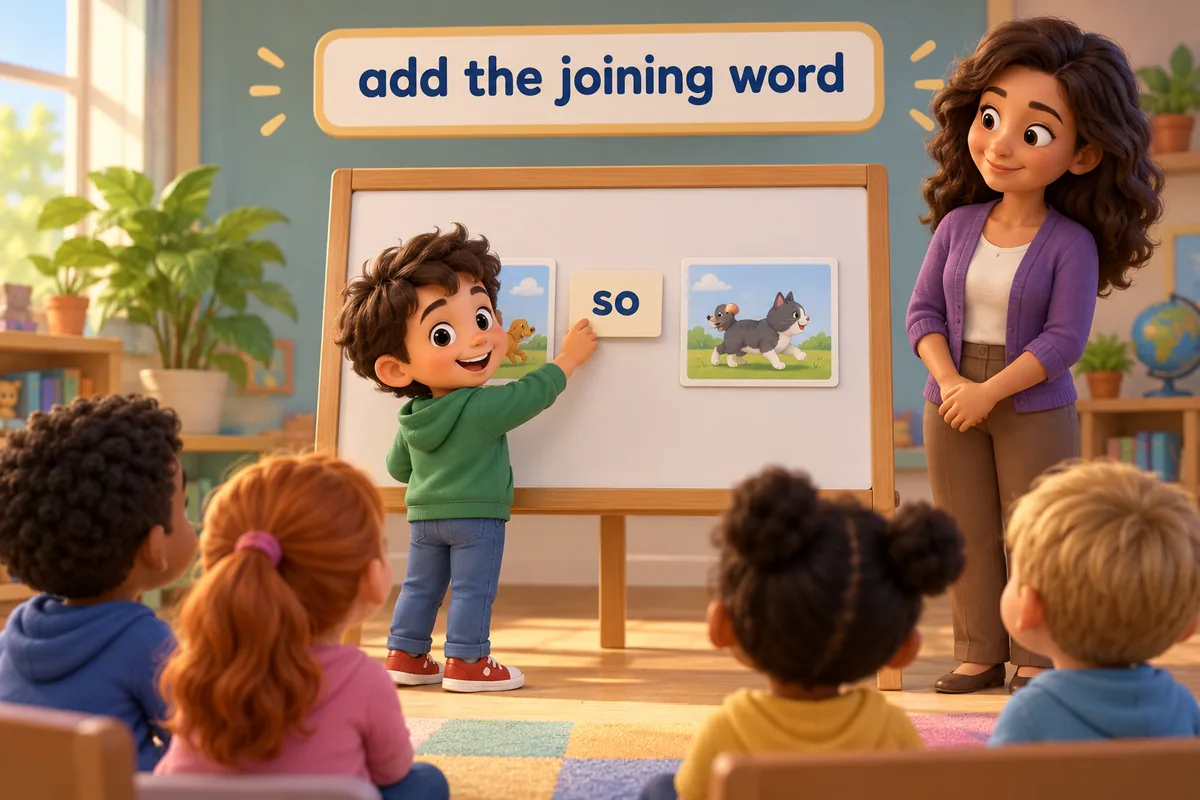
What is the difference between so and because?
So introduces a result and because introduces a reason, so the two clauses swap direction. In I stayed because it rained, the rain is the cause; in It rained, so I stayed, the staying is the result. Choose the word that matches the direction of your logic.