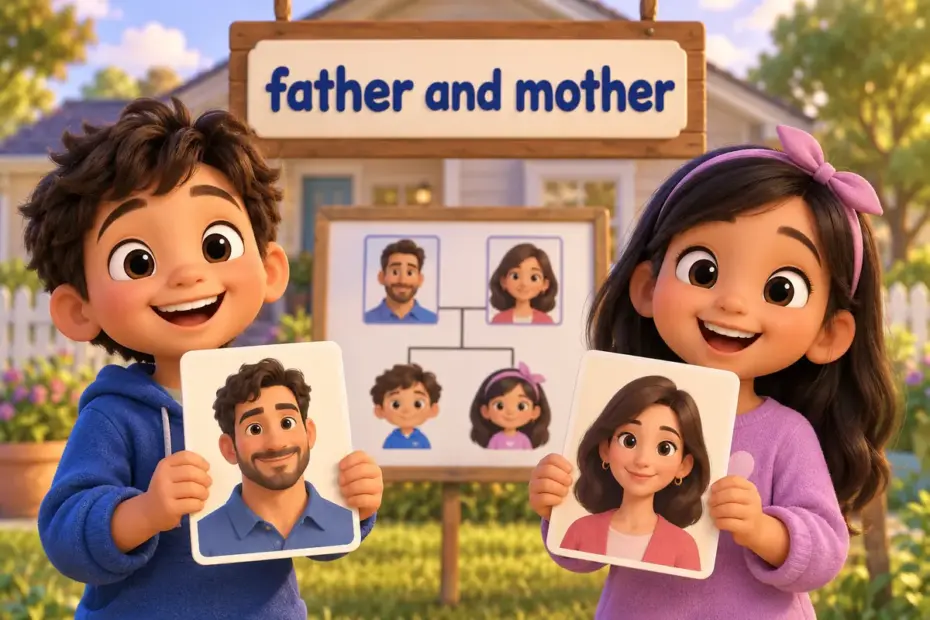
Masculine and feminine of family members are the word pairs that name a male and a female relative, such as father and mother, brother and sister, and uncle and aunt. English builds most of these from two separate words, and only a few, such as widower and widow, change inside the word itself.
Masculine and feminine of family members at a glance
- Most family pairs use two separate words, such as father and mother.
- A few pairs change inside the word, such as widower and widow.
- Nephew and niece, and uncle and aunt, share no ending at all.
- The general words parent and sibling cover both sexes.
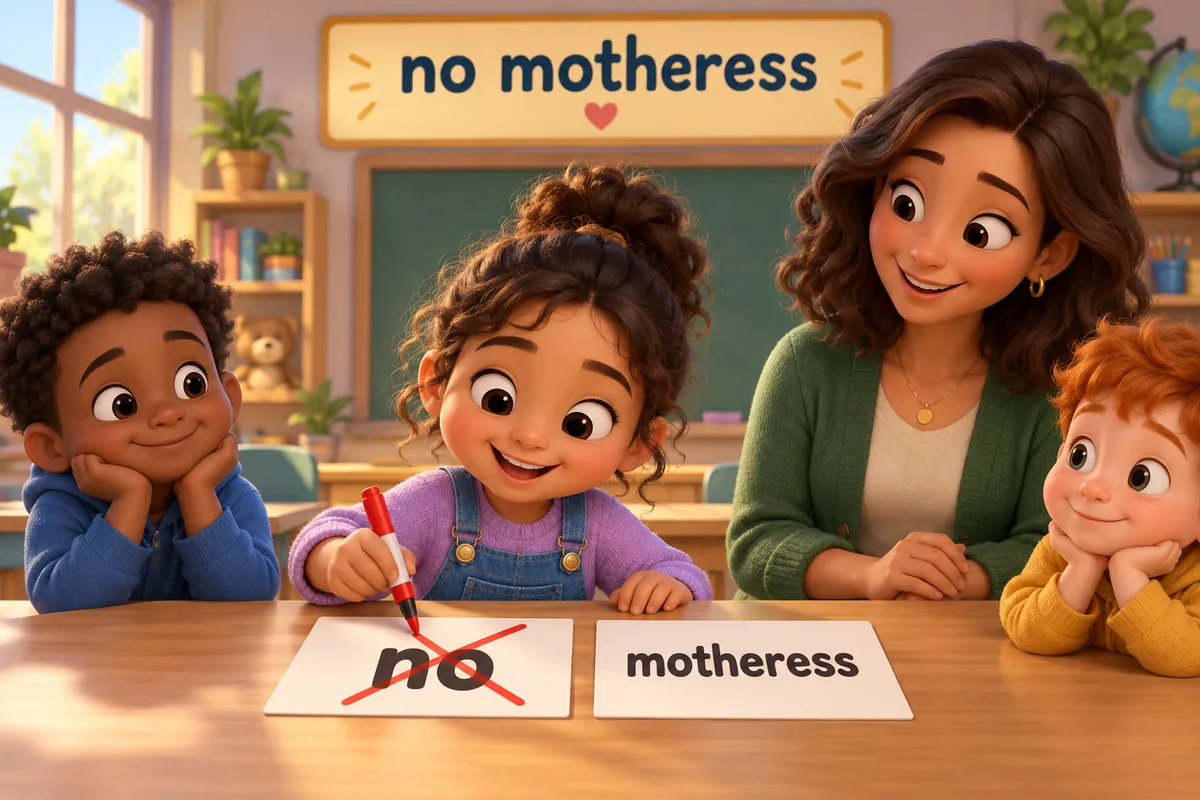
- The commonest error is inventing an -ess form such as motheress.
What are the masculine and feminine of family members?
The masculine and feminine of family members are gendered nouns that label a male and a female relative of the same kind. The plain word for a whole household appears in family in a sentence, and the adjective side of the same topic appears in feminine in a sentence. The table pairs the commonest relatives and shows how each set is built.
Two patterns run through the whole set. The larger group takes two unrelated words such as son and daughter, and the smaller group keeps one base word and changes a single part of it, as grandfather and grandmother do. A reader who recognises the pattern can predict most of the pairs without a dictionary.
| Masculine | Feminine | Note |
|---|---|---|
| father | mother | two separate words |
| son | daughter | two separate words |
| brother | sister | two separate words |
| uncle | aunt | two separate words |
| nephew | niece | two separate words |
| husband | wife | two separate words |
| grandfather | grandmother | one compound with a different second half |
| grandson | granddaughter | one compound with a different second half |
| godfather | godmother | the base word is kept |
| widower | widow | the ending changes, not the whole word |
| stepfather | stepmother | the base word is kept |
| cousin | cousin | one common word covers both sexes |
How do you use family pairs in a sentence?
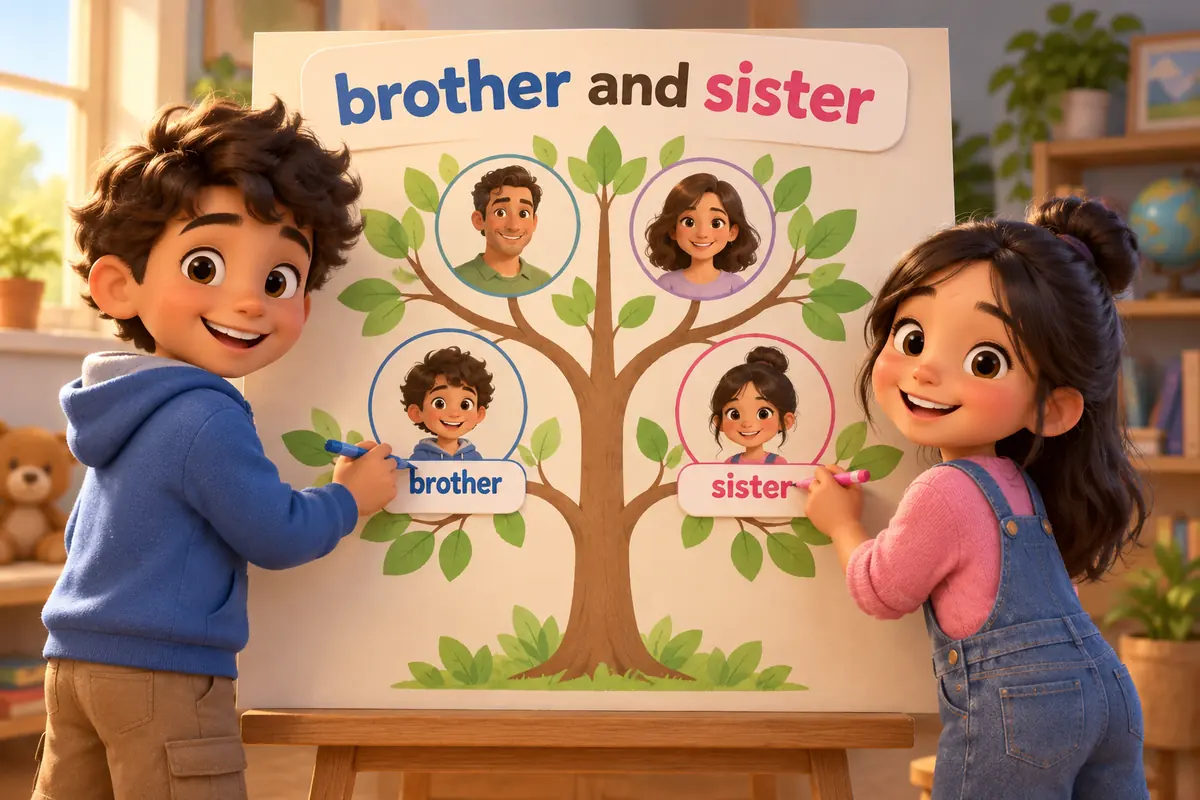
A family pair works as two ordinary count nouns, and a writer either names both or picks the one that fits the sex of the person described. The pattern often shows up on a family tree in a sentence, where each branch holds a matched pair.
| Pattern | Example | What it signals |
|---|---|---|
| two unrelated words | father and mother | the pair is learned as two nouns |
| compound with a changed half | grandfather and grandmother | only one half of the word changes |
| ending change | widower and widow | an internal ending marks the female form |
| common noun | cousin and cousin | one word covers either sex |
| general term | parent and sibling | covers both sexes in one noun |
Masculine and feminine of family members across contexts
The pairs appear in classrooms, official forms, stories and legal writing, and the context decides whether the writer names one relative or both. A legal sentence usually names both, while a story follows the single person on stage.
| Context | Example sentence | Why this works |
|---|---|---|
| Classroom | The pair uncle and aunt names a male and a female relative. | defines the category |
| Family tree | My grandfather and grandmother sit at the top of the chart. | places a compound pair in a diagram |
| Story | The widower raised his children with help from his sister. | uses a single-word pair |
| Greeting card | Dear nephew and niece, welcome to the family dinner. | addresses both forms |
| Official form | List each parent, brother, sister, son and daughter. | lists both forms in one line |
| Conversation | My brother called, and my sister sent a message. | two plain everyday nouns |
| Job reference | She is the daughter of the company founder. | uses the feminine noun alone |
| Biography | The grandson inherited the house from his grandmother. | pairs a compound form |
| Legal text | The widow and widower each hold a share of the estate. | uses the ending-change pair |
| Exam question | Give the feminine form of nephew. | asks for one correct noun |
Which word should you use?
The choice usually turns on whether the sex is known and whether a compound relative needs both halves named. Adjectives that describe a household sit alongside these nouns in adjectives for family.
| Situation | Better choice | Why |
|---|---|---|
| Everyday family talk | the plain pair, brother and sister | the words are familiar and clear |
| A relative of unknown sex | cousin | cousin covers either sex with one word |
| A compound relative | grandfather and grandmother | each half keeps the base word |
| A bereaved spouse | widow or widower | the pair changes the ending, not the root |
| A formal list | son and daughter | the pair reads clearly on a form |
When the sex is genuinely unknown or irrelevant, a common noun such as cousin or a general term such as parent does the work of a pair and keeps the sentence accurate without guessing. The same rule lets a form use parent for one person and parents for two, with no gendered word in sight.
Word forms and grammar of family pairs
These nouns behave like ordinary count nouns, and the general terms replace a pair when the writer does not know or need the sex.
| Form | Part of speech | Example |
|---|---|---|
| father | count noun | Her father works nearby. |
| mother | count noun | His mother called today. |
| parent | count noun | A parent signed the form. |
| parents | plural noun | Both parents attended the meeting. |
| sibling | count noun | She has one sibling. |
| widow | count noun | The widow lives alone. |
| widower | count noun | The widower moved house last year. |
| cousin | common-gender noun | My cousin visits each summer. |
Common mistakes with family pairs
Mistake 1: inventing an -ess form. Incorrect: She is my motheress. Correct: She is my mother. Rule: mother is already the feminine noun, so no ending is added.
Mistake 2: using a masculine noun for a female. Incorrect: My aunt is my masculine relative. Correct: My aunt is my feminine relative. Rule: feminine names a female relative.
Mistake 3: calling a female relative a nephew. Incorrect: My niece is my brother’s son. Correct: My niece is my brother’s daughter. Rule: nephew is male and niece is female.
Mistake 4: using widow for a man. Incorrect: After his wife died, he became a widow. Correct: After his wife died, he became a widower. Rule: a widower is a man, and the -er ending marks the male form.
Mistake 5: treating cousin as feminine. Incorrect: Cousin is a feminine noun. Correct: Cousin is a common-gender noun. Rule: cousin names either sex.
Practice using family pairs
- Fill in the blank: The feminine of nephew is ___.
- Choose the better word: A man whose wife has died is a (widow / widower).
- Correct the error: My motheress cooks on Sundays.
- Build a sentence: use uncle and aunt about two relatives.
- Spot the register: which suits a formal form, (a) my bro, or (b) my brother?
- Fill in the blank: A word that covers both sexes, such as cousin, is ___ gender.
Answers
- niece, because niece is the feminine of nephew.
- widower, because the -er form names a man.
- My mother cooks on Sundays; mother is already feminine.
- My uncle lives in the city and my aunt visits every month.
- (b), because a formal form uses the full noun brother.
- common, because a common-gender noun names either sex.
The bottom line
Masculine and feminine of family members mostly pair two separate words, such as father and mother, while a smaller set changes the ending, as widower and widow show. Common nouns such as cousin cover either sex, so no pair is needed there. A household that includes several branches is described in extended family in a sentence, where the same pairs recur across the tree.
Frequently asked questions about family pairs
What is the feminine of nephew?
The feminine of nephew is niece. A nephew is a brother’s or sister’s son, and a niece is a brother’s or sister’s daughter. The two words are separate nouns, so neither one adds an ending to the other. Both are learned as a fixed pair.
Is father or mother the masculine noun?
Father is the masculine noun and mother is the feminine noun. Each word is a separate noun, so the pair is father and mother rather than one word with an ending. The general term parent covers either one, and parents covers both together.
What is the difference between widow and widower?
A widow is a woman whose spouse has died, and a widower is a man whose spouse has died. The pair changes the ending rather than the whole word, so a writer marks the male form with -er and the female form without it. This is the reverse of the usual -ess pattern.
Does English have an -ess form for mother?
No. Mother is already the feminine noun, so a form such as motheress does not exist. The -ess ending attaches only to words such as host or prince, which begin as masculine nouns and then gain a feminine partner with the added ending.