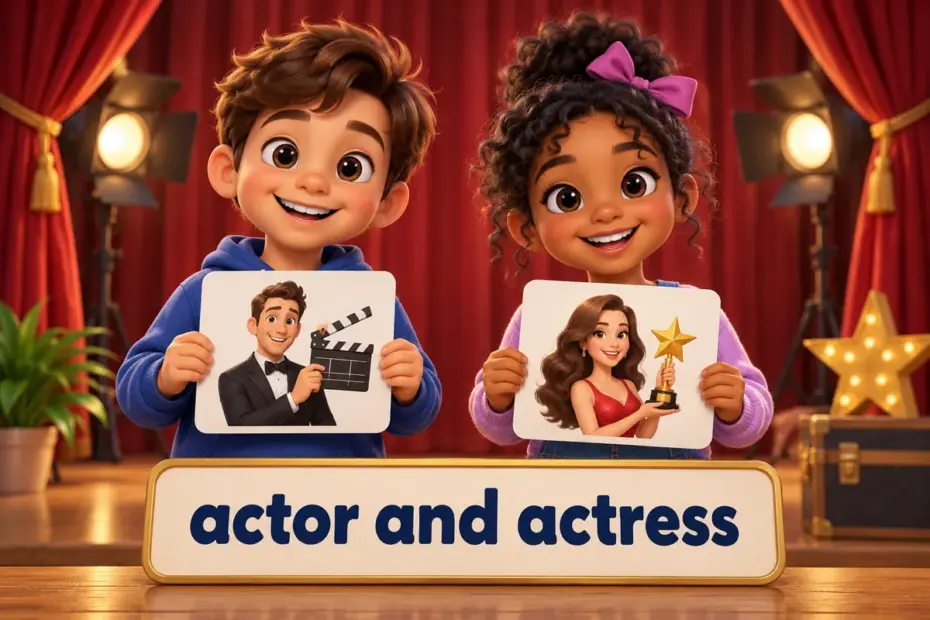
Masculine and feminine of professions and jobs are the word pairs that name a male and a female worker, such as actor and actress, waiter and waitress, and steward and stewardess. English once built many of these with the ending -ess, but most modern job titles now use one neutral noun for everyone.
Masculine and feminine of professions and jobs at a glance
- Many traditional job pairs add -ess, as in host and hostess.
- A smaller group uses two separate words, such as monk and nun.
- Most modern jobs now use one neutral noun, such as server or flight attendant.
- The -ess forms sound dated in adverts, though they remain in history writing.
- The commonest error is using a -man or -ess title for a worker whose sex is unknown.
What are the masculine and feminine of professions and jobs?
The masculine and feminine of professions and jobs are pairs of nouns that mark a male and a female worker in the same role. The two adjectives that label them appear in masculine in a sentence and feminine in a sentence. Traditional titles often add -ess, while a smaller set, such as monk and nun, uses two unrelated words.
| Masculine | Feminine | Note |
|---|---|---|
| actor | actress | the feminine takes -ess |
| waiter | waitress | -er changes to -ress |
| host | hostess | -ess is added |
| steward | stewardess | -ess is added, now dated |
| prince | princess | -ess is added, a royal title |
| emperor | empress | -or changes to -ress |
| monk | nun | two separate words |
| headmaster | headmistress | -er changes to -ress |
| policeman | policewoman | the compound changes its first part |
| fireman | firewoman | the compound changes its first part, now dated |
| barman | barmaid | a separate feminine word |
| businessman | businesswoman | the compound changes its first part |
How do you build a gendered job title?
Notice that the -ess ending attaches to a whole noun, so host gains an extra syllable in hostess, while monk and nun share no letters at all. The pair always keeps the same job meaning, which is why actor and actress describe one profession, and the same rule explains why the feminine form is predictable once a reader knows the pattern.
Only a few patterns cover the whole set, and each one tells a reader how the feminine form is made. The general word for the field appears in profession in a sentence, and the titles themselves sit beside it.
| Pattern | Example | What it signals |
|---|---|---|
| add -ess to the male noun | host and hostess | a feminine ending marks the female |
| change -er or -or to -ress | waiter and waitress | the agent ending changes too |
| two separate words | monk and nun | the pair shares no letters |
| change the first part of a compound | policeman and policewoman | the man part becomes woman |
| one neutral noun | server or flight attendant | a single word covers everyone |
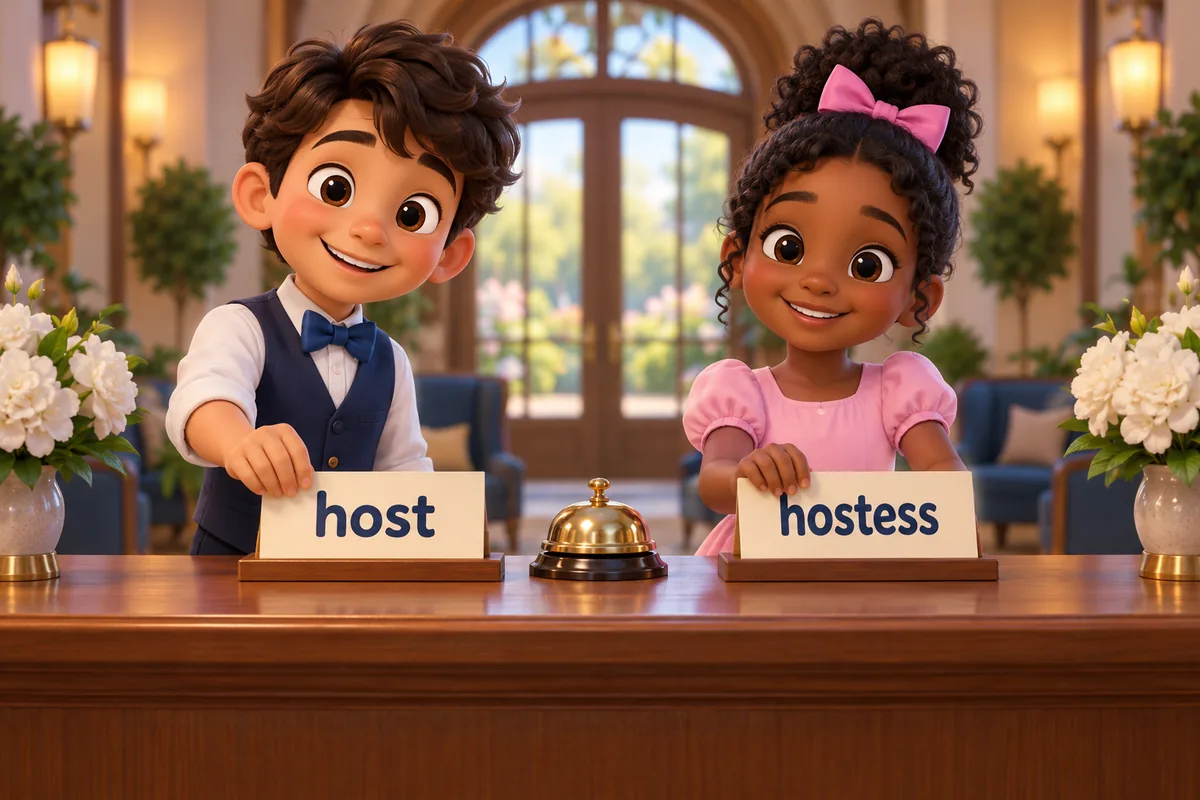
Masculine and feminine of professions and jobs across contexts
These titles appear in adverts, history books, classrooms and manuals, and the context decides whether the writer keeps the older pair or moves to a neutral noun. A single role is described in job in a sentence.
| Context | Example sentence | Why this works |
|---|---|---|
| Job advert | The restaurant is hiring servers for the summer. | uses a neutral title |
| History book | In 1900 a stewardess served passengers on the new liner. | uses the dated form correctly |
| Classroom | Actor is the masculine and actress the feminine of the same job. | labels the pair |
| News report | The waitress said the shift began at noon. | names a woman in the role |
| Résumé | I worked as a hostess at a large hotel. | records a traditional title |
| Legal text | The headmaster and headmistress share the same duties. | names both office-holders |
| Story | The monk copied books and the nun taught the children. | pairs two separate words |
| Airline manual | Each flight attendant completes safety training. | uses the neutral title |
| Conversation | My aunt was a policewoman for twenty years. | uses a compound feminine form |
| Style guide | Prefer firefighter to fireman in professional writing. | argues for a neutral noun |
Which title should you use?
The choice turns on the period and the audience. A neutral noun fits a live advert, while the older pair suits history and literature. Descriptive words for a role appear in adjectives for job.
| Situation | Better choice | Why |
|---|---|---|
| A modern job advert | a neutral noun, such as server | neutral titles suit any worker |
| A historical account | the traditional pair, such as waiter and waitress | the dated forms fit the period |
| An unknown worker | a neutral noun | the writer does not know the sex |
| A religious office | the separate pair, monk and nun | the two words are fixed |
| A compound title in an old text | policewoman or firewoman | the compound marks the female form |
A mixed team described in a report reads more cleanly with one neutral term, so a line such as three servers and two cooks stays accurate without naming anyone’s sex. Keep the older pairs for quotation, history and fiction, where the dated form carries its own information.
Word forms and grammar of job titles
Job nouns are usually count nouns, so they take a determiner and a plural. The neutral term for a whole field appears in job and occupation word list.
| Form | Part of speech | Example |
|---|---|---|
| job | count noun | The job starts on Monday. |
| profession | count noun | Teaching is a demanding profession. |
| actor | count noun | The actor joined the cast. |
| actress | count noun | The actress won an award. |
| worker | common-gender noun | Each worker wears a badge. |
| -ess | suffix | hostess, stewardess |
| -ress | suffix | actress, waitress, empress |
Common mistakes with job titles
Mistake 1: using a -man title for a woman. Incorrect: She works as a fireman in the city. Correct: She works as a firefighter in the city. Rule: a neutral noun covers a worker of any sex.
Mistake 2: using an -ess title in a modern advert. Incorrect: We need a waitress for the evening shift. Correct: We need a server for the evening shift. Rule: -ess titles sound dated in job adverts.
Mistake 3: inventing a gendered form that does not exist. Incorrect: He is a teacheress. Correct: He is a teacher. Rule: teacher is a common-gender noun, so no ending is added.
Mistake 4: reversing a pair. Incorrect: The hostess is the male and the host is the female. Correct: The host is the male and the hostess is the female. Rule: the -ess form is always the feminine one.
Mistake 5: forcing a pair onto a neutral job. Incorrect: The nurse is a man, so he is a matron. Correct: The nurse is a man, so he is a nurse. Rule: nurse has no gendered pair in modern use.
Practice using job titles
- Fill in the blank: The feminine of waiter is ___.
- Choose the better word: A neutral title for a flight worker is (stewardess / flight attendant).
- Correct the error: She works as a fireman in the city.
- Build a sentence: use actor and actress about two performers.
- Spot the register: which suits a modern job advert, (a) We need a waitress, or (b) We need a server?
- Fill in the blank: A job noun that covers any sex, such as teacher, is ___ gender.
Answers
- waitress, because -er changes to -ress in the feminine form.
- flight attendant, because a neutral title suits any worker.
- She works as a firefighter in the city; firefighter covers any sex.
- The actor took the lead and the actress played his sister.
- (b), because a neutral noun suits a modern advert.
- common, because a common-gender noun such as teacher names either sex.

The bottom line
Masculine and feminine of professions and jobs mostly follow the -ess pattern, as host and hostess show, while a few pairs such as monk and nun use two separate words. Most modern writing now prefers one neutral noun, so server, firefighter and flight attendant are the safer choices in an advert or a manual. Keep the older pairs for history and fiction, where the period calls for them.
Frequently asked questions about job titles
What is the feminine of waiter?
The feminine of waiter is waitress. The ending -er changes to -ress, so the male form names a man and the female form names a woman. Many modern workplaces now use server for either, which avoids the gendered pair altogether.
Are -ess job titles still correct?
Yes, the -ess forms remain grammatical and appear in history and literature. Modern style guides often prefer a neutral noun, so writer replaces authoress and flight attendant replaces stewardess. The older forms are understood everywhere, but they can sound dated in a current advert.
What is a neutral job title?
A neutral job title names the role without marking the worker’s sex. Words such as server, firefighter, chair and flight attendant fit this group, and each one covers a man or a woman. A neutral title also avoids a guess when the sex is unknown.
Why do some jobs have no gendered pair?
Many jobs never had a separate feminine word, so nurse, teacher and engineer name either sex without a pair. Writers once invented endings such as teacheress, but those forms did not last. Modern usage simply keeps the single common-gender noun.