Multiple questions in a sentence are handled by giving each independent question its own question mark, so two separate queries become two sentences joined in speech but kept apart on the page. A single question that offers a choice keeps one mark, as in tea or coffee. A question folded inside a statement takes no mark at all.
Multiple questions in a sentence at a glance
- Two independent questions each take their own question mark.
- A single question with a choice keeps one question mark.
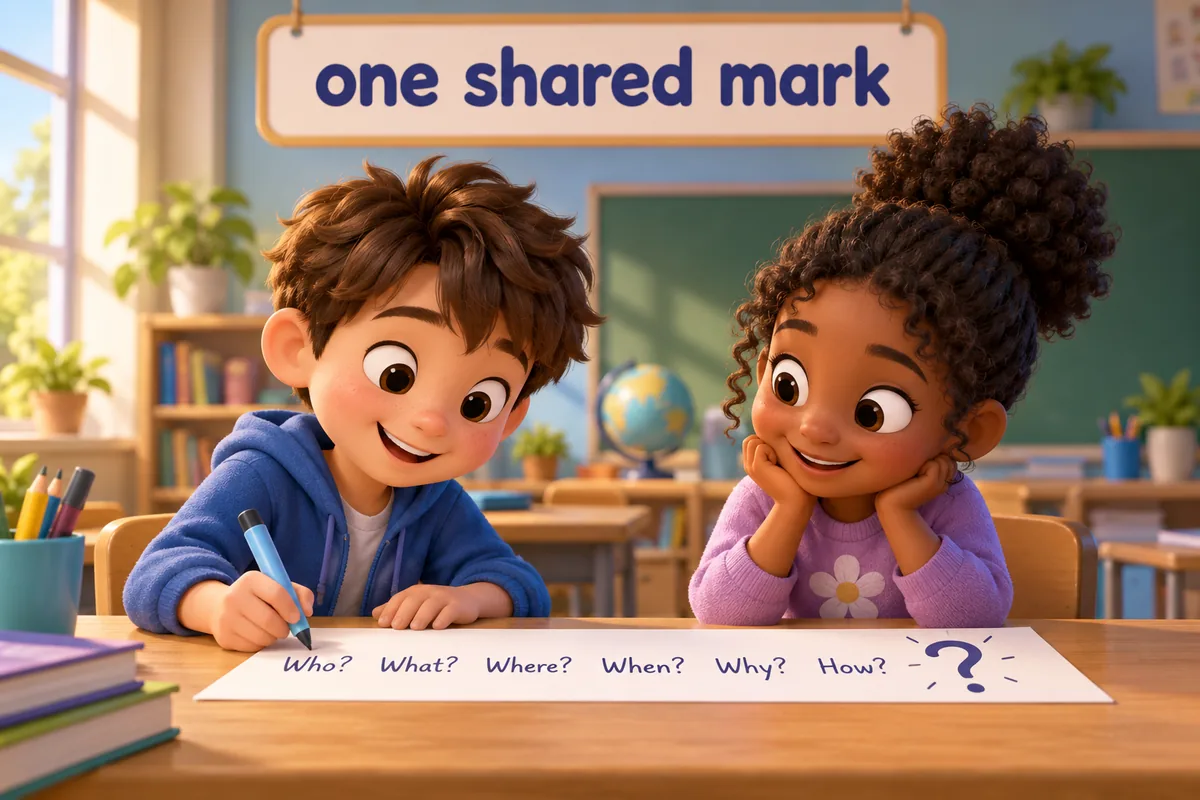
- A short series of question words can share one mark, as in who, what, and why.
- An indirect question inside a statement takes no question mark.
- The commonest error is writing two question marks together.
What does multiple questions in a sentence mean?
The phrase covers several ways of asking more than one thing, and the punctuation depends on whether the questions stand alone or fold together. When two questions are independent, each keeps its own mark; when they form one question with a choice, the mark comes once. A question that sits inside a larger statement turns into a clause and loses the mark. The line between one question and two often depends on whether the second clause repeats the helping verb, since did you call and did you write can be read as one question or as two.
| Structure | Question marks | Example |
|---|---|---|
| Two independent questions | two | Did you eat? Did you sleep? |
| One choice question | one | Tea or coffee? |
| A shared list of question words | one | Who, what, when, and why? |
| An indirect question | none | I asked whether he was coming. |
| A statement with a tag | one | You are coming, aren’t you? |
How do you punctuate two questions?
Punctuation follows the grammar rather than the length. If each part could stand alone as a question, it takes its own mark; if the parts depend on each other, one mark closes the whole. The table below shows the common frames, and ordinary sentence patterns sit in a big shot sentence.
| Pattern | Example | What it signals |
|---|---|---|
| two full questions | Are you ready? Should we start? | two independent marks |
| one question, two objects | Did you call and leave a message? | a single question, one mark |
| a question plus a follow-up | Where were you, and why so late? | two clauses in one question |
| a choice | Shall we walk or drive? | one question, one mark |
| a list of interrogatives | Who, what, and where? | one mark for the set |
Length is no guide to the number of marks, because a long sentence with one main question still closes with a single mark. The test is whether the second part can stand alone: if it can, it takes its own mark, and if it cannot, the two parts share one.
Multiple questions in a sentence: examples across contexts
The same rules hold in a classroom, a courtroom, and a text message, and the setting changes only the tone. Each row names a place, gives a line, and explains the punctuation, and more familiar phrases sit in a bird in the hand sentence.
| Context | Sentence | Punctuation at work |
|---|---|---|
| Classroom | Did you finish the work? Did you check it? | two independent questions, two marks |
| Interview | Why did you apply, and what drew you here? | one question with two clauses |
| Customer service | Could you confirm your name and address? | one request, one mark |
| News report | How did it start, and who was involved? | partners in one question |
| Text message | Are you home? Need anything? | two short questions, two marks |
| Quiz card | Who, what, when, and where? | a list sharing one mark |
| Meeting | Is the budget fixed? Can it move at all? | two separate questions |
| Parent to child | Have you packed? Have you eaten? | two quick checks |
| Academic writing | The study asks whether the effect persists. | an indirect question, no mark |
| Everyday speech | Tea or coffee? | a choice, one mark |
Which form should you choose?
The choice rests on whether the questions are truly separate. Two separate queries read best as two sentences with two marks, while a single query that happens to contain two clauses reads best with one. For a short list of question words, one mark closes the set.
| Situation | Best form | Example |
|---|---|---|
| Two unrelated queries | two sentences | Did you call? Did you write? |
| One query, two parts | one sentence, one mark | Did you call and write? |
| A list of question words | one sentence, one mark | How, when, and why? |
| A question reported by someone | a clause, no mark | She asked if it was ready. |
| A statement needing agreement | a tag, one mark | It works, doesn’t it? |
Quoting a spoken question keeps its mark, while reporting the same words turns them into a clause and removes it. That single difference explains why the same content can end with a question mark in a transcript and a full stop in a report.
Word forms and grammar of questions
Question types carry different punctuation, so naming the type answers the question of how many marks to use. A direct question takes a mark, an indirect question becomes a noun clause and takes none, and a tag question adds a short check to a statement. A short everyday phrase is shown in a bad egg sentence. The table sets out the types.
| Type | Question mark? | Example |
|---|---|---|
| direct question | yes | Where is the station? |
| indirect question | no | I wonder where the station is. |
| tag question | yes | You know the way, don’t you? |
| choice question | yes, once | Left or right? |
| compound question | one per clause | Did you call? Did you leave a note? |
Common mistakes with multiple questions
Each error below shows the wrong line, the corrected one, and the rule that explains the fix.
Mistake 1: stacked question marks. Incorrect: Where are you ?? Correct: Where are you? Rule: one question mark closes one question.
Mistake 2: a mark on an indirect question. Incorrect: I asked where he was going? Correct: I asked where he was going. Rule: a reported question is a clause, not a question.
Mistake 3: one mark for two separate questions. Incorrect: Did you call, did you write? Correct: Did you call? Did you write? Rule: independent questions each take a mark.
Mistake 4: a missing mark on a choice. Incorrect: Tea or coffee. Correct: Tea or coffee? Rule: a choice offered as a question ends with a mark.
Mistake 5: a comma splice between questions. Incorrect: Are you ready, should we start? Correct: Are you ready? Should we start? Rule: two independent questions are separated, not spliced.
Practice using multiple questions
Each item tests one rule from above, and the answers give the reason.
- Punctuate: Did you eat did you sleep
- Choose the better line: (a) Tea or coffee. or (b) Tea or coffee?
- Correct the error: I asked where he was going
? - Build a line: ask two separate questions about a journey.
- Spot the type: is I wonder if it will rain a direct or an indirect question?
- Punctuate: Who what and why
Answers
- Did you eat? Did you sleep? because two independent questions each take a mark.
- (b), because a choice offered as a question ends with a question mark.
- I asked where he was going, because a reported question is a clause and takes no mark.
- Are we leaving today? Have you packed? two separate questions with two marks.
- indirect, because it reports a question inside a statement without a mark.
- Who, what, and why? because a short list of question words shares one mark.
The bottom line
Multiple questions in a sentence are punctuated by grammar rather than guesswork: independent questions each take a mark, a single choice takes one, and a reported question takes none. Keep two questions as two sentences when they stand alone, and never stack question marks. Match the type of question to its punctuation and the line reads correctly.
Frequently asked questions about questions in a sentence
Can one sentence contain two questions?
Yes, when the two clauses belong to one question, as in where were you and why so late. If each part could stand alone as a full question, they are best written as two sentences with two marks rather than forced into one. The grammar of the clauses decides.
Do indirect questions take a question mark?
No. When a question is reported inside a statement, it becomes a noun clause and ends with a full stop, as in I asked where he was going. The words ask or wonder signal the clause, and no question mark follows. Only a direct question takes the mark.
Is it ever correct to write two question marks?
Standard writing uses a single question mark for one question, so stacking two is treated as an error. A very strong emotion is usually shown by the words rather than by repeated marks. One question, one mark is the safe rule.
How should I punctuate a list of questions?
If the items are full questions, give each its own mark, as in who is coming? when? and where do we meet. If they are single question words listed together, one mark closes the set, as in who, what, and why. The choice depends on whether each item is a complete question.