Old vs new is a choice about time and about change, and each word carries a different judgement. Old means having existed for a long time, while new means recently made, found or introduced. One points to the past and to age, the other to freshness and change.
Old vs New at a glance
- Old and new are both adjectives that describe how long something has existed.
- Old means having existed for a long time, or belonging to the past.
- New means recently made, discovered or put into use.
- Both change form in the comparison: older and oldest, newer and newest.
- The commonest error is using old for something merely out of date, or new for something merely different.
What does old mean and what does new mean?
Old is an adjective meaning having existed for a long time or belonging to the past, and it also works as a group noun for elderly people. New is an adjective meaning recently made, found or introduced, and it can act as a noun for the latest thing. The Cambridge entry for old and the Cambridge entry for new confirm the split, and one line shows it: an old road has stood for centuries, while a new road opened last month.
| Sense | Word | Plain meaning | Example |
|---|---|---|---|
| Having existed long | old | Aged, not recent | An old bridge spans the river. |
| Belonging to the past | old | Former or earlier | She met an old colleague at the fair. |
| Elderly people | old | Older people as a group | The centre cares for the old. |
| Recently made | new | Just created or bought | He bought a new coat for winter. |
| Unfamiliar | new | Not known before | This routine is new to me. |
| Replacing an earlier one | new | The latest version | The new timetable starts on Monday. |
Old and new sit at opposite ends of a single scale of time, so they can describe the same object from different moments. A chair is new when it is bought and old after fifty years, which is why the pair describes a stage rather than a fixed quality.
What is the difference between old and new?
The difference is the direction of time and the judgement attached to it. Old looks back to a long existence and can signal either value or decline, while new looks forward to a recent change and can signal either freshness or inexperience. A one-letter trap such as abel vs able changes meaning the same way, and a near-miss pair such as addition vs edition fails for a similar reason.
| Test | Old | New |
|---|---|---|
| Core meaning | existing a long time | recently made or found |
| Time it points to | the past | the present or future |
| Opposite | new | old |
| Comparison forms | older, oldest | newer, newest |
| Common collocations | an old friend, old age | a new start, brand new |
| Common error | old for merely out of date | new for merely different |
Choose old when a long span of time is the point, and choose new when recent making or unfamiliarity is the point.
How do you use old and new in a sentence?
Both adjectives follow fixed patterns, and the phrases they gather are a faster test than the definition. To watch the first adjective behave, read old in a sentence.
| Pattern | Example | What it signals |
|---|---|---|
| an old + noun | She keeps an old map in the drawer. | long existence |
| an old + person noun | He ran into an old colleague at the fair. | a long-standing relationship |
| the old (as a group) | The club looks after the old. | elderly people as a class |
| how old + be | How old is the building? | asking about age |
| a new + noun | They moved into a new flat. | recently obtained |
| new to + noun | This routine is new to me. | unfamiliarity |
| brand new | The notebook is brand new. | completely unused |
| the new (as a noun) | The new replaces the old each spring. | the latest thing |
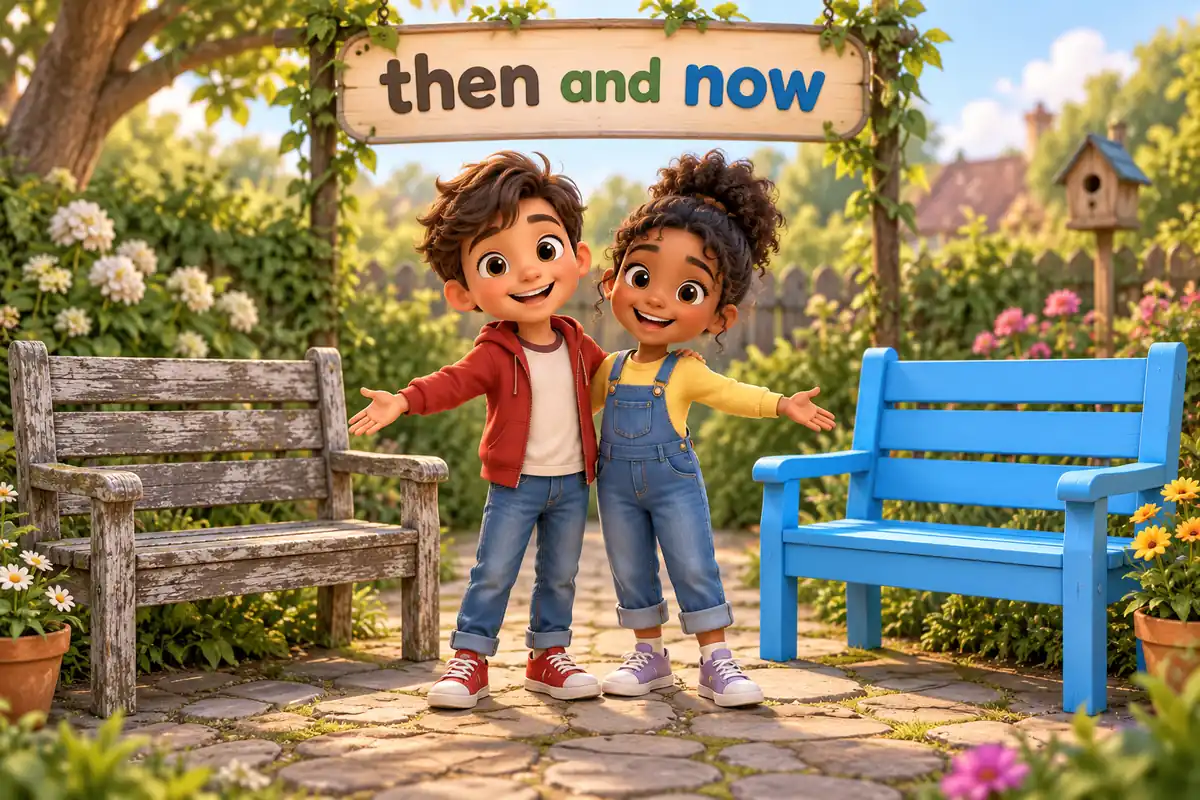
Old and new in a sentence: examples across contexts
Reading the pair in different registers makes the choice automatic, and more fresh-start frames sit in new in everyday sentences.
| Context | Example sentence | Why this works |
|---|---|---|
| Classroom | The class studied an old map of the town. | old marks a long existence |
| News report | The council opened a new library on the high street. | new marks a recent opening |
| Workplace email | Please save the file under the new naming rule. | new marks the latest version |
| Conversation | I ran into an old schoolfriend at the market. | a long-standing relationship |
| Community writing | The charity cares for the old in the village. | old as a group noun |
| Product review | The new model is lighter than the old one. | the pair compared directly |
| History writing | The old walls date from the fourteenth century. | a dated structure |
| Everyday talk | This app is new to me, so be patient. | new to signals unfamiliarity |
| Advertising | A new season brings a new collection. | freshness and change |
| Storytelling | An old sailor told us about the storm. | age and experience |
| Home advice | Replace the old filter before winter. | worn after long use |
| Planning | The town needs a new bridge to replace the old. | both words in one line |
Which should you use?
Match the word to the point you are making: a long span of time takes old, and a recent change takes new.
| Situation | Use | Example |
|---|---|---|
| Something has lasted a long time | old | An old oak stands at the gate. |
| Something was made recently | new | She bought a new phone. |
| A long-standing relationship | old | He is an old friend. |
| Something unfamiliar to you | new | The process is new to me. |
The judgement is the second test. Old can imply wisdom and value, as in an old friendship, or decline and wear, as in an old machine, so the surrounding words decide the tone. New can imply freshness and opportunity, as in a new start, or inexperience, as in a new hand at the job. When neither judgement is wanted, name the actual age or date instead of leaning on old or new.
Word forms and grammar of old and new
| Form | Part of speech | Example |
|---|---|---|
| old | adjective | An old clock ticks on the wall. |
| older | adjective, comparative | My older bike needs a repair. |
| oldest | adjective, superlative | It is the oldest house in the lane. |
| elder | adjective, of people | My elder brother lives nearby. |
| olden | adjective, fixed phrase | In olden days the road was mud. |
| new | adjective | A new coat hangs by the door. |
| newer | adjective, comparative | This printer is newer than that one. |
| newly | adverb | The room was newly painted. |
| renew | verb | They agreed to renew the contract. |
Common mistakes with old and new
Mistake 1: elder for a thing. Incorrect: My elder bicycle needs a new tyre. Correct: My older bicycle needs a new tyre. Rule: elder is used of people, chiefly in fixed family roles, while older suits things and general comparison.
Mistake 2: new for instead of new to. Incorrect: The routine is new for the team. Correct: The routine is new to the team. Rule: the unfamiliarity pattern is new to a person or group.
Mistake 3: old as a group noun without the. Incorrect: The charity supports old in the village. Correct: The charity supports the old in the village. Rule: an adjective used as a group noun keeps the article the.
Mistake 4: a doubled comparison. Incorrect: The replacement is more newer than the original. Correct: The replacement is newer than the original. Rule: newer already marks the comparison, so more is not added.
Mistake 5: newer for a sibling. Incorrect: She is my newer sister. Correct: She is my younger sister. Rule: for people born into a family, use younger or older rather than newer.
Practice using old and new
- Fill in the blank: The museum bought an ___ painting from 1850.
- Choose the better word: My (older / elder) laptop is slower than before.
- Correct the error: This phone is more newer than mine.
- Build a sentence: use brand new about a notebook.
- Spot the register: which line suits a news report, (a) The bridge is super old, or (b) The bridge is the oldest in the county?
- Fill in the blank: The charity looks after ___ old in the town.
Answers
- old, because the painting has existed since 1850.
- older, because elder is used of people, not things.
- This phone is newer than mine; newer already compares, so more is dropped.
- The notebook on the desk is brand new and still unopened.
- (b), because the superlative and clear phrasing suit a report.
- the, because old works as a group noun with the article.
The bottom line
The old vs new choice is decided by time and by the judgement the sentence wants. Old points to a long existence and can signal value or wear, while new points to a recent change and can signal freshness or inexperience. Name the age when the judgement is unclear, and the pair stays accurate.
Frequently asked questions about old and new
Should I write elder or older?
Use older for things and for general comparison, as in my older laptop. Use elder mainly for people in fixed family roles, as in my elder sister, and only before the noun. In most everyday sentences older is the safer and more common choice.
Why does English ask how old are you for a young child?
English measures age on a scale that runs from new to old, and the question how old fixes a point on that scale for anyone, whatever their age. There is no matching how new question about age, so a child and an adult are both asked how old they are.
What does an old friend mean?
An old friend is someone known for a long time, not necessarily someone elderly, so the phrase describes the friendship rather than the person’s age. That is why a young person can have an old friend. The context usually makes clear which sense of old is meant.
Can new be used as a noun?
Yes. New can work as a noun meaning the latest thing, often with the article the, as in the new replaces the old. The same pattern gives us phrases such as out with the old, in with the new. As a modifier it stays an adjective in front of a noun.