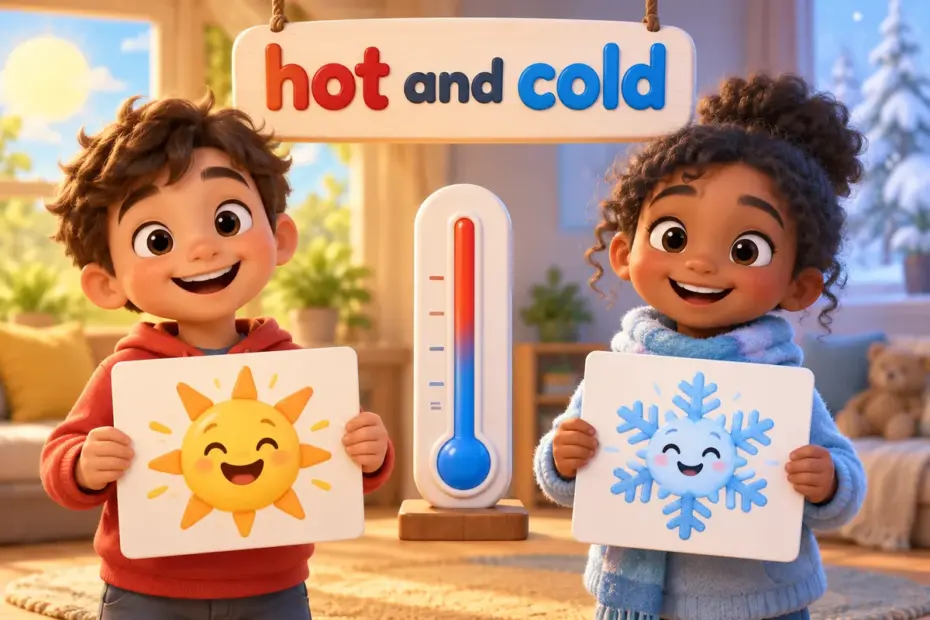
An opposite words list with pdf makes the pairs easy to copy, print and practise, and the commonest ones run hot and cold, happy and sad, and big and small. Some opposites are two separate words, while others build from a prefix such as un- or in-. The tables below gather the pairs and the rules behind them.
Opposite words at a glance
- Many opposites are two separate words, such as hot and cold.
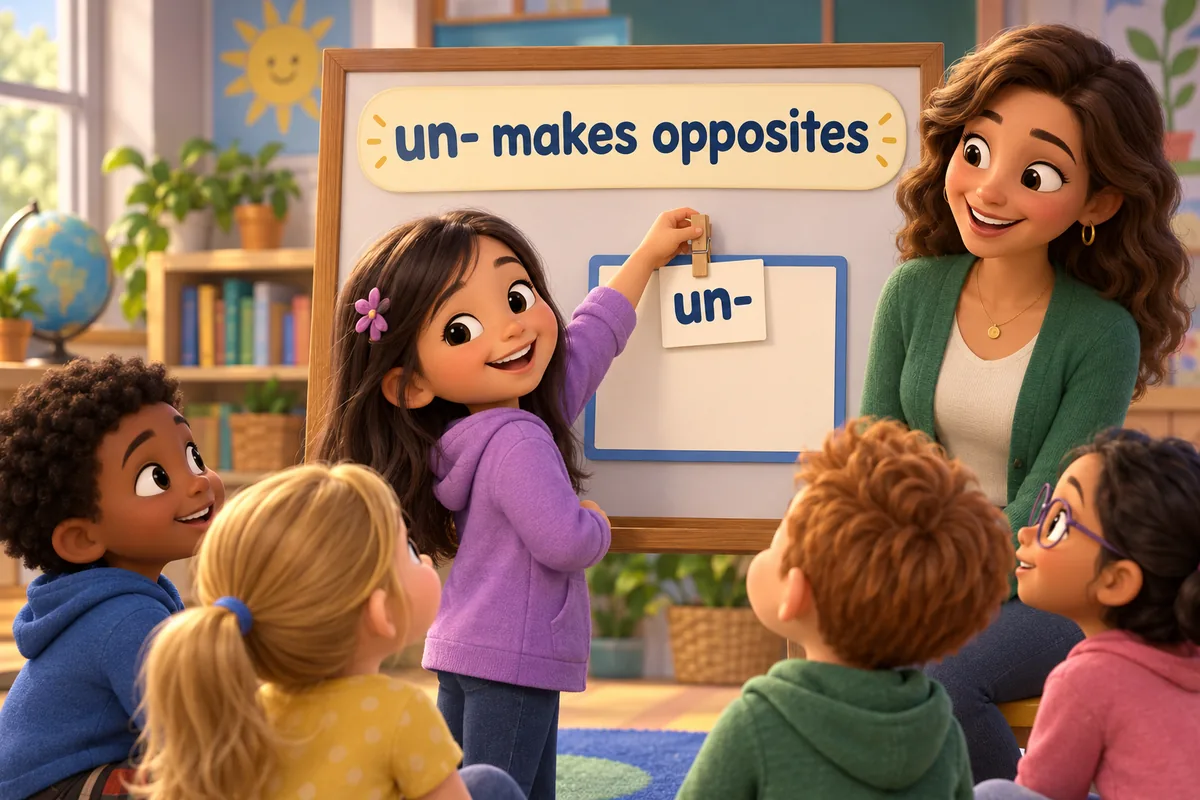
- Others build from a prefix, as happy becomes unhappy.
- The prefix varies with the first letter, giving in-, im-, il- and ir-.
- Gradable adjectives sit on a scale, so their opposite is the far end.
- The commonest error is using un- before a word that takes im-.
What are opposite words?
Opposite words are pairs that name the two ends of one meaning, and they are often called antonyms. A simple pair appears in opposite in a sentence, and a classroom set for younger learners sits in opposite words for kids. The table lists twelve pairs and shows how each one is built.
| Word | Opposite | How it is built |
|---|---|---|
| hot | cold | two separate words |
| big | small | two separate words |
| happy | sad | two separate words |
| fast | slow | two separate words |
| old | young | two separate words |
| open | closed | two separate words |
| possible | impossible | the prefix im- is added |
| correct | incorrect | the prefix in- is added |
| legal | illegal | the prefix il- is added |
| regular | irregular | the prefix ir- is added |
| agree | disagree | the prefix dis- is added |
| tie | untie | the prefix un- is added |
The twelve pairs show both routes side by side, and a learner can sort them into the separate-word group and the prefix group. That sorting habit makes the prefix words far easier to recall, because the base word stays visible inside each pair.
How are opposite words formed?
Only a few patterns cover the whole set, and the pattern tells a reader which prefix fits. The adverb form of the idea appears in oppositely in a sentence.
| Pattern | Example | What it signals |
|---|---|---|
| a separate word | hot and cold | the opposite is learned as a new word |
| prefix un- | happy and unhappy | the prefix negates the adjective |
| prefix in- | correct and incorrect | a common negating prefix |
| prefix im- before p and m | possible and impossible | the sound shapes the prefix |
| prefix il- before l | legal and illegal | the prefix matches the first letter |
| prefix ir- before r | regular and irregular | the prefix matches the first letter |
| prefix dis- | agree and disagree | often used with verbs |
A quick test settles most of the prefix cases: look at the first letter of the base word and match it with the prefix that shares the sound. The same idea appears as in-, im-, il- and ir-, so the spelling follows the mouth rather than a fixed list.
Opposite words across contexts
The pairs appear in early reading, grammar charts, writing lessons and vocabulary games, and each setting uses them in a different way.
| Context | Example sentence | Why this works |
|---|---|---|
| Early reading | Hot and cold are opposites, said the teacher. | names the pair plainly |
| Vocabulary game | Match each word with its opposite card. | sets a matching task |
| Grammar chart | The prefix im- turns possible into impossible. | shows the prefix rule |
| Writing lesson | A sharp contrast needs a clear pair of opposites. | ties the pair to style |
| Question paper | Give the opposite of legal. | asks for one word |
| Conversation | The shop was open, not closed, after all. | uses the pair in a remark |
| Dictionary note | The entry lists irregular as the opposite of regular. | records the pair |
| Printable sheet | Copy the pairs into a PDF for the class. | turns the list into a handout |
| Poetry | The big and small of it, he wrote, are one story. | uses the pair for effect |
| Exam task | Write the opposite of agree. | asks for the prefix form |
Which opposite should you use?
The right choice depends on the scale and the part of speech, and on whether a prefix or a new word fits. The noun form of the idea appears in opposition in a sentence.
| Situation | Better choice | Why |
|---|---|---|
| A pair of separate words | hot and cold | no prefix fits either word |
| A word before p | the prefix im- | im- matches the sound of p |
| A word before l | the prefix il- | il- matches the sound of l |
| A verb such as agree | the prefix dis- | dis- often marks a verb opposite |
| A gradable adjective | the word at the far end of the scale | the scale sets the pair |
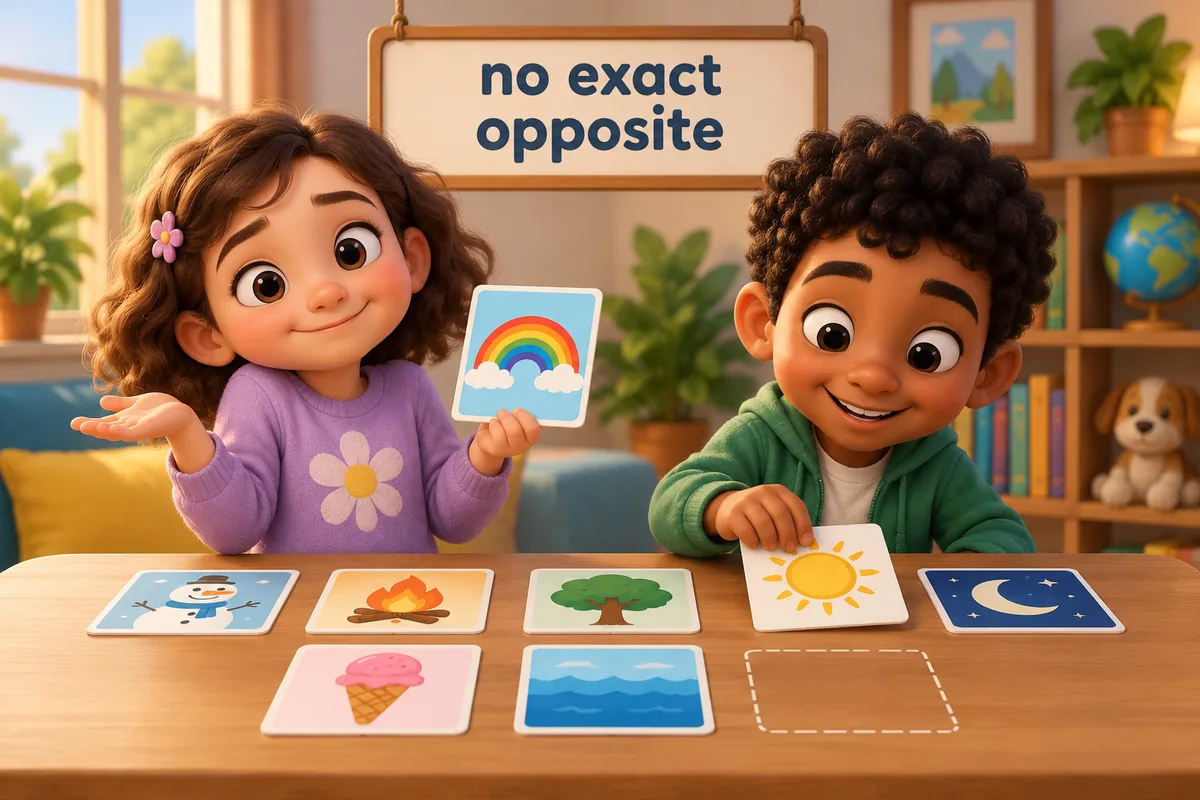
| A concrete noun | no single opposite | many nouns have no antonym |
A teacher can copy these tables into a printable PDF and cut the pairs into cards, which turns the list into a matching game. A learner who plays the game twice usually recalls the prefix forms without a chart.
Word forms and grammar of opposites
A prefix does not change the part of speech, so an adjective stays an adjective after un- or in-. The verb form of the idea appears in oppose in a sentence.
| Form | Part of speech | Example |
|---|---|---|
| happy, unhappy | adjective | She felt unhappy at the news. |
| possible, impossible | adjective | The plan is impossible to finish today. |
| agree, disagree | verb | They disagree about the date. |
| tie, untie | verb | He untied the knot. |
| opposite | noun or adjective | The opposite is quite different. |
| opposition | noun | The opposition grew over time. |
Common mistakes with opposite words
Mistake 1: the wrong prefix. Incorrect: That idea is unpossible. Correct: That idea is impossible. Rule: the prefix im- is used before p and m.
Mistake 2: using un- for a word that takes in-. Incorrect: That answer is uncorrect. Correct: That answer is incorrect. Rule: correct takes the prefix in-.
Mistake 3: choosing a word from another scale. Incorrect: The opposite of hot is freezing. Correct: The opposite of hot is cold. Rule: pick the word at the far end of the same scale.
Mistake 4: forcing an opposite onto a noun. Incorrect: The word table has the opposite chair. Correct: The noun table has no single opposite. Rule: concrete nouns often have no antonym.
Mistake 5: treating a prefix as plain not. Incorrect: Not happy and unhappy mean exactly the same. Correct: Unhappy is usually stronger than not happy. Rule: a prefix often carries a firmer sense than plain not.
Practice using opposite words
- Fill in the blank: The opposite of legal is ___.
- Choose the better word: The opposite of possible is (unpossible / impossible).
- Correct the error: That answer is uncorrect.
- Build a sentence: use open and closed in one sentence.
- Spot the register: which suits a question paper, (a) give the opposite of hot, or (b) what is the other word for hot?
- Fill in the blank: The prefix dis- turns agree into ___.
Answers
- illegal, because the prefix il- is used before l.
- impossible, because im- is used before p.
- That answer is incorrect; correct takes the prefix in-.
- The shop was open all morning and closed after lunch.
- (a), because a question paper asks for the opposite.
- disagree, because dis- builds the opposite of agree.
The bottom line
An opposite words list with pdf comes down to two kinds of pair: separate words such as hot and cold, and prefix forms such as possible and impossible. The prefix changes to match the first letter, giving in-, im-, il- and ir-. Keep the pair on the same scale, and copy the tables for a class handout whenever a set of cards is useful.
Frequently asked questions about opposite words
How do I find the opposite of a word?
Start with the part of speech and the scale. An adjective usually has a word at the other end of its scale, while a verb may take a prefix such as dis-. A dictionary entry often lists the opposite, so a reader can check rather than guess.
When do I use un- and when do I use in-?
The choice depends on the word and its sound, and no single rule settles every case. Many common adjectives take un-, as unhappy does, while others take in-, im-, il- or ir-. The safest habit is to learn each prefix with its word.
Does every word have an opposite?
No. Concrete nouns such as table or spoon usually have no single opposite, and some abstract words have none either. A useful test is to ask whether the word sits on a scale. If it does not, the word probably has no clear antonym.
Can a word have more than one opposite?
Yes. A word such as old can pair with young for people and with new for things, so the context decides which opposite fits. When a word has more than one sense, each sense may take its own opposite, and the scale settles the choice.