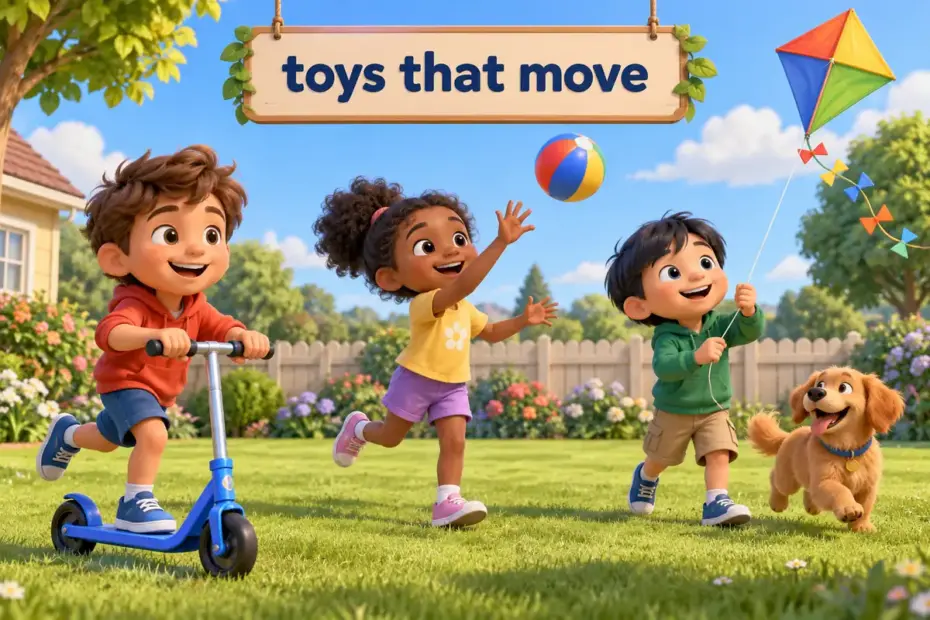
Outdoor toys for kids are the playthings built for use outside, such as a ball, a scooter, a sand bucket and a skipping rope. They encourage running, pushing and building while children stay in the open air. “Let us take the kite to the park,” a child can say on a windy day.
Outdoor toys for kids at a glance
- An outdoor toy is a plaything made for use outside, often one that moves or builds.
- The usual patterns are ride a, push a and throw a plus the toy name.
- Balls, scooters, skipping ropes and sand toys are the ones children meet first.
- Most outdoor toys build balance, strength or coordination as the child plays.
- The commonest mistake is leaving wheels and ropes where someone can trip.
What are outdoor toys for kids?
Outdoor toys for kids are playthings designed for gardens, parks and beaches, where space and fresh air allow movement. They fall into a few simple groups: rolling toys, riding toys, building toys and flying toys. Each group uses the body in a different way, and each needs its own small safety thought.
| Toy | What it does | Example sentence |
|---|---|---|
| ball | is thrown, kicked or caught | We threw the ball across the grass. |
| scooter | is pushed along on wheels | She rode her scooter to the gate. |
| skipping rope | is turned while the child jumps | He skipped for a whole minute. |
| sand bucket | holds sand and water for building | We filled the bucket with wet sand. |
| kite | flies on the wind at the end of a line | The kite rose above the trees. |
| bicycle | is pedalled along on two wheels | She learned to ride her bicycle. |
One honest caution is worth stating: an outdoor toy is only as safe as the space around it. A scooter needs a clear path, a ball needs room to roll, and a kite needs open sky away from power lines. Choosing the right toy for the space matters more than the price of the toy, because a good toy in a bad space still causes trouble.
How do you talk about outdoor toys?
Talking about outdoor toys uses short action patterns that name the toy and the movement. These frames sound natural during play, when instructions are quick.
| Pattern | Example | What it signals |
|---|---|---|
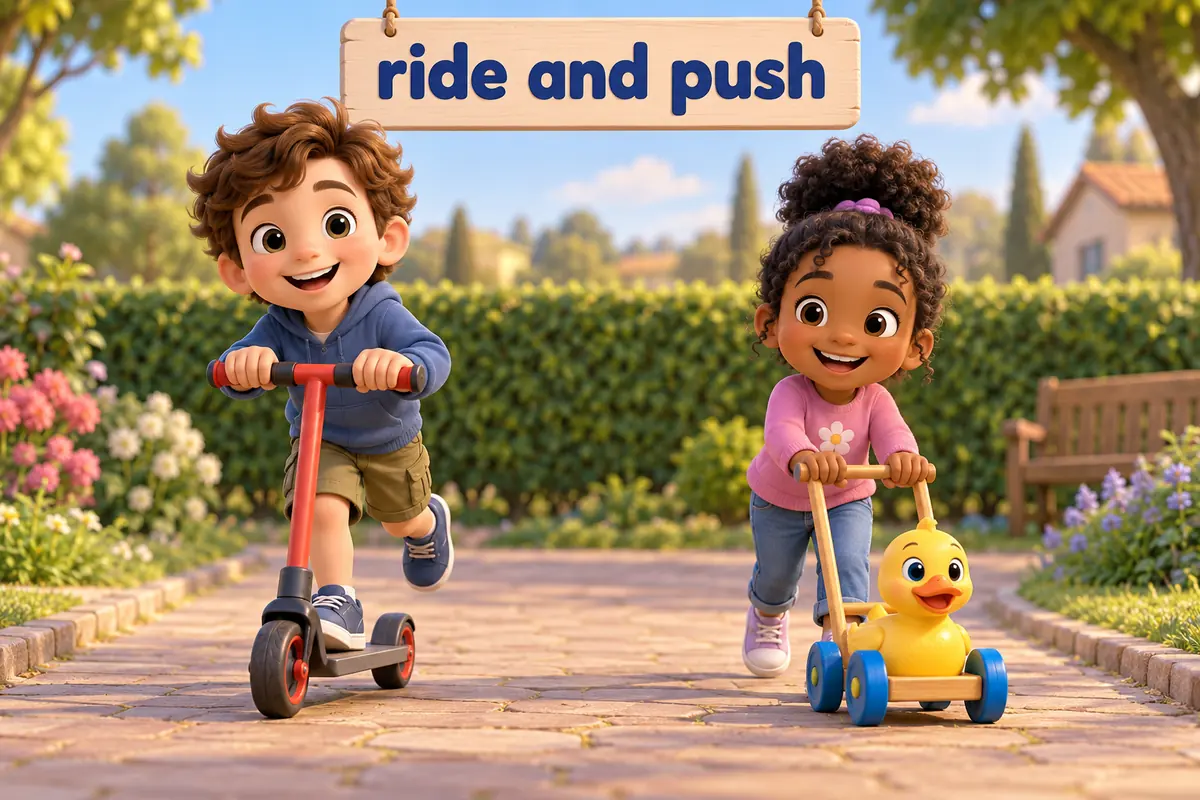
| ride a + toy | I ride a scooter. | a toy with wheels |
| push a + toy | Push the pram gently. | a toy moved by hand |
| throw a + toy | Throw the ball to me. | a toy used in a game |
| fill the + toy | Fill the bucket with sand. | a building toy |
| share the + toy | Share the scooter with your sister. | a fair-play reminder |
Outdoor toys across contexts
The same toys suit a back garden, a beach and a park, and each place adds its own words and its own care. Children learn the names fastest while they play, and pages such as adjectives for toys and a words for kids add describing and naming words a child can use outdoors.
| Context | Example sentence | Why this works |
|---|---|---|
| Back garden | We kicked the ball at the wall. | uses a safe, clear surface |
| Park | She rode her scooter along the path. | names a toy and a place |
| Beach | We built a castle with the bucket. | links a toy to an activity |
| Windy hill | The kite pulled hard on the line. | describes how a toy behaves |
| Skipping club | She turned the rope while I jumped. | shows two children sharing one toy |
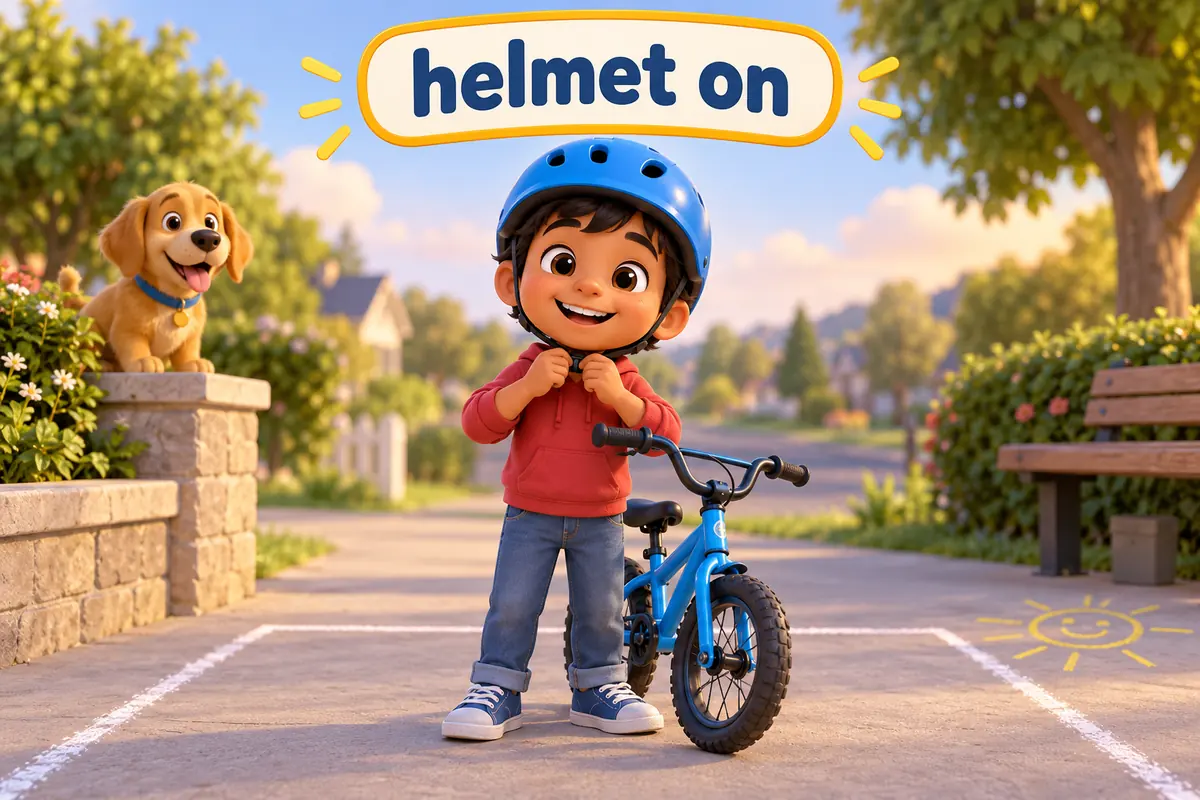
| Cycle path | Always wear a helmet on your bicycle. | adds a simple safety rule |
| Playground | Please share the slide and the ball. | teaches fair play |
| Family picnic | The children played catch after lunch. | a light game for mixed ages |
| Rainy garden | We left the scooter under cover. | shows care for a toy |
| Toy shop | May I try the blue scooter? | a polite request to test |
| Tidy-up time | Put the bucket and spade away. | a clear instruction |
Which outdoor toy suits which child?
The right toy depends on the child’s age, balance and the space at home, not on what looks most exciting in a shop. A short comparison helps a family choose well.
| Child | Good first toy | Harder start | Reason |
|---|---|---|---|
| A toddler | a soft ball | a two-wheel bicycle | a soft ball needs no balance |
| A child learning balance | a scooter | roller skates | a scooter keeps both feet near the ground |
| A child who loves building | a sand bucket and spade | a kite | building shows an instant result |
| A child who loves running | a skipping rope | a heavy bat | a rope uses the child’s own energy |
| An older child | a bicycle | a small trike | an older child outgrows a trike quickly |
A helmet and a clear boundary belong with any toy that rolls, and the boundary should be said before the wheels start moving. Renting or borrowing a scooter or bicycle first shows whether the child enjoys it before money is spent. Sharing rules also matter, because two children and one scooter is the quickest route to an argument.
Words and phrases linked to toys
Toy words sit inside a playful family that helps a child describe play and care. Young readers can pair playtime and wheelbarrow with compound words for kids, then add detail with c words for kids such as colourful and clean.
| Word | Type | Example |
|---|---|---|
| toy | noun | Every toy was packed away. |
| play | verb and noun | They play outside each day. |
| ride | verb and noun | She rode her scooter home. |
| wheel | noun | The front wheel was muddy. |
| safe | adjective | A helmet keeps the rider safe. |
Common mistakes with toy words
Mistake 1: leaving wheels where someone can trip. Incorrect: Leave the scooter on the path. Correct: Put the scooter at the side of the path. Rule: a rolling toy belongs out of the way.
Mistake 2: using ride for every toy. Incorrect: I ride the ball. Correct: I bounce the ball. Rule: ride suits toys with wheels or seats.
Mistake 3: confusing a and an. Incorrect: a outdoor toy. Correct: an outdoor toy. Rule: an comes before a vowel sound.
Mistake 4: writing skipping rope as one word. Incorrect: skippingrope. Correct: skipping rope. Rule: this toy name keeps two words apart.
Mistake 5: dropping the third person s. Incorrect: She ride her bike fast. Correct: She rides her bike fast. Rule: a singular subject takes a verb ending in s.
Mistake 6: saying lend when you mean borrow. Incorrect: Can I lend your scooter? Correct: Can I borrow your scooter? Rule: borrow means to take; lend means to give.
Practice using toy words
- Fill in the blank: Fill the ___ with wet sand to build a castle.
- Choose the better toy: (a skipping rope / a kite) for a child who loves running.
- Correct the error: She ride her bicycle to the park.
- Build a sentence: name an outdoor toy and one safety rule for it.
- Spot the register: which sentence suits a toy shop, (a) May I try the blue scooter? or (b) Give me scooter?
- Fill in the blank: Always wear a helmet when you ride a ___ .
Answers
- bucket, because it holds the sand for building.
- a skipping rope, because it uses the child’s own running energy.
- She rides her bicycle to the park; a singular subject takes rides.
- Put on a helmet before you ride a bicycle.
- (a), because a shop request uses may and please.
- bicycle, because a helmet belongs with a wheeled toy.
The bottom line
Outdoor toys for kids are the playthings made for gardens, parks and beaches, from a ball and a scooter to a kite and a bucket. The useful patterns are ride a, push a and throw a plus the toy name, and each rolling toy needs a helmet and a clear boundary. Match the toy to the child and the space, and outdoor play stays active and safe.
Frequently asked questions about outdoor toys for kids
What outdoor toys are best for a toddler?
A soft ball, a small bucket and spade and a low push-along toy suit a toddler best. These need little balance and cause few knocks. Close supervision matters most, because a toddler explores the world by putting things in a mouth.
How do I keep outdoor toys safe?
Choose the toy for the space, keep a helmet with any wheeled toy and store ropes and scooters out of walkways. Check for sharp edges and loose wheels before play. Teaching one simple rule, such as stop at the gate, prevents most accidents.
Should children share their outdoor toys?
Sharing is easier when there are two of the popular item or a clear turn order, so a timer works well with one scooter. A short rule such as three turns each keeps the play fair. Children share more willingly when an adult models turn taking and accepts losing calmly.
What outdoor toys help a child learn?
A ball builds coordination through throwing and catching, a scooter builds balance and a skipping rope builds rhythm and stamina. A bucket and spade encourage building, measuring and pouring. Play with a purpose teaches these skills without a lesson or a worksheet.