Paragraph writing for kids begins with one clear topic sentence, then adds supporting details, and ends with a closing line. A strong paragraph holds a single idea, keeps every sentence on that idea, and uses simple linking words so a young writer can follow the shape from start to finish.
Paragraph Writing for Kids at a Glance
- A paragraph for kids holds one main idea in three to six sentences.
- It opens with a topic sentence that names that idea.
- Supporting sentences add a reason, a detail, or an example.
- A closing sentence finishes the idea or points to the next one.
- The commonest mistake is folding two ideas into one paragraph.
What Is a Paragraph for Kids?
A paragraph is a group of sentences built around one main idea and written as a single block, usually with the first line indented. For a young writer the idea is the easy part; the skill is holding every sentence to that one idea until the block is finished. A paragraph that keeps that promise of one idea is easy to read aloud.
Every paragraph is made of a few reusable parts, and naming them helps a child see the shape before writing.
| Part | Its job | Example |
|---|---|---|
| Topic sentence | Name the one idea | My dog Max is a helpful friend. |
| Supporting detail | Give a reason or fact | He carries my bag up the stairs. |
| Example | Show the detail in action | Last week he fetched my missing shoe. |
| Linking word | Join one sentence to the next | Also, he waits by the door. |
| Closing sentence | Round the idea off | That is why Max is my best friend. |
A paragraph is not the right shape for every task: a single instruction or a one-line answer is clearer on its own, and stretching it into three sentences only hides the answer.
How Paragraphs Help Young Writers
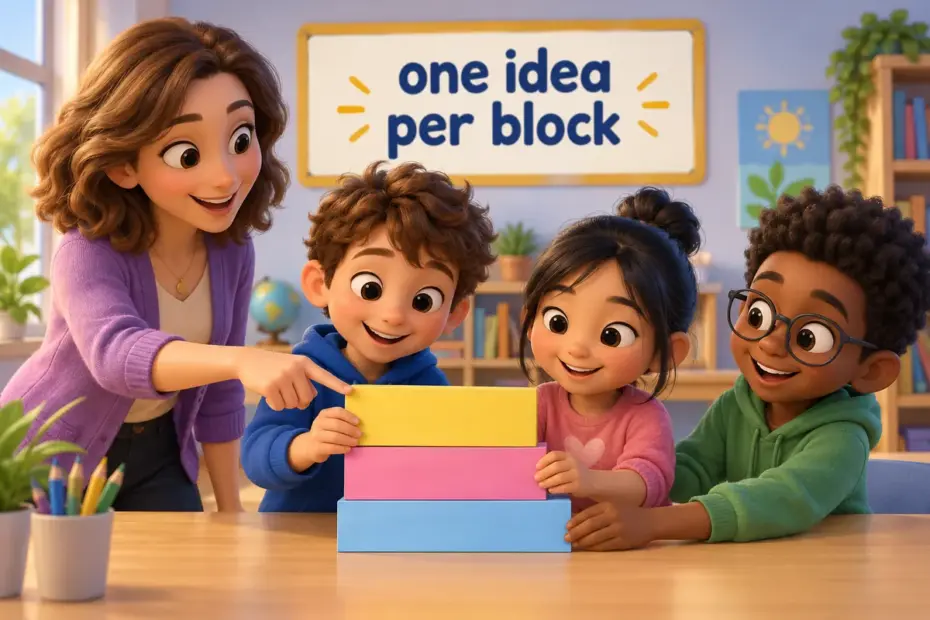
Writing in paragraphs trains a child to think in units. Instead of a wall of sentences, the page becomes a set of labelled boxes, each holding one thought. A teacher can then see exactly which idea needs help, and the child can move a whole box without rewriting the page.
Paragraphs also give a reader a place to rest. The white space between blocks signals that a new idea is coming, so a long piece of writing stops feeling like one endless run of words. Descriptive words carry a paragraph further, and the examples in adjectives for writing show how a young writer chooses one strong word instead of three weak ones.
How Do You Build a Paragraph Step by Step?
Teach the build as a short routine a child can repeat: pick one idea, write the topic sentence, add two or three details, then close. The steps below turn that routine into something a child can say out loud before writing.
| Step | What to do | Mini example |
|---|---|---|
| 1. Choose one idea | Say the idea in a single line | My garden is fun. |
| 2. Write the topic sentence | Put that line first | My garden is a busy place. |
| 3. Add details | Give two or three reasons | Bees visit the flowers. Birds splash in the bath. |
| 4. Join the details | Use a linking word | Also, a cat naps on the wall. |
| 5. Close the idea | End with a rounding sentence | Everyone finds something to do there. |
Paragraph Writing for Kids: Examples Across Contexts
A topic sentence changes with the task, but the shape of the paragraph does not. The openers below fit different school and home writing jobs, and the reason beside each one shows why it works.
| Context | Topic sentence | Why it works |
|---|---|---|
| Story | The old gate creaked open. | starts a story with one sound and one clear idea. |
| Letter | Thank you for the birthday book. | names the purpose of the letter at once. |
| Book report | This book is about a brave mouse. | states the subject without retelling the plot. |
| Science | Plants need three things to grow. | promises a short, countable list. |
| Instructions | First, wash your hands. | opens a sequence with the first step. |
| Diary | Today was the best day of the term. | names the feeling before the reasons. |
| Opinion | Our school should build a new playground. | states the view plainly. |
| Invitation | Please come to my party on Saturday. | gives the key fact first. |
| Weather note | Heavy rain will reach the coast by noon. | leads with the main fact. |
| Recipe | This soup is quick to make. | sets a promise the paragraph keeps. |
| Sports report | Our team played its best match yet. | names the result that follows. |
| Nature journal | The pond changes with the seasons. | sets out the idea the details will prove. |
Story paragraphs lean on mood words, and the choices collected in adjectives for story writing give a child a ready set to borrow.
Which Paragraph Type Should a Child Write First?
Beginners do best with paragraphs that follow one simple pattern. The table pairs a common type with the stage that handles it comfortably, so practice starts where success is likely.
| Type | Best for | Sample topic sentence |
|---|---|---|
| Telling | ages six to eight | My bicycle is red and shiny. |
| Naming a favourite | ages six to eight | Pizza is my favourite food. |
| Explaining why | ages eight to ten | We should recycle more paper. |
| Comparing two things | ages nine to eleven | A city is busier than a village. |
| Persuading a reader | ages ten to twelve | Every class needs a reading corner. |
Too many describing words flatten a paragraph, and the practical fixes in avoiding adjective overuse help a young writer trim without losing detail.
Word Forms and Grammar in Paragraph Writing
The language a child needs to talk about paragraphs is small but specific, and using the right name for each part makes feedback faster.
| Term | Type | Example in use |
|---|---|---|
| topic sentence | noun phrase | The topic sentence comes first. |
| supporting sentence | noun phrase | Each supporting sentence adds a detail. |
| indent | verb | Indent the first line once. |
| paragraph break | noun phrase | A paragraph break marks a new idea. |
| cohesion | noun | Linking words build cohesion. |
Simple describing words from adjectives for kids drop into supporting sentences without long clauses, so the grammar stays easy while the detail grows.
Common Mistakes With Paragraph Writing for Kids
My dog is fun. My cat is fun too. My fish is fun as well. Write My pets are fun in different ways. Rule: give a paragraph one idea, not a list of separate ones.
My garden is fun I like it. Write My garden is fun, and I like it. Rule: join two complete sentences with a linking word or a full stop.
First I woke up. Then I ate. Then I went to school. Then I read. Write I had a busy morning before school. Rule: keep the topic sentence first and group the details under it.
I am going to tell you about my favourite sport. Write Hockey is my favourite sport because it is fast. Rule: name the idea instead of announcing that you will name it.
The book was good. It was nice. It was fine. Write The book was exciting because the hero never gave up. Rule: one specific detail beats three empty describing words.
Practice Paragraph Writing for Kids
- Fill in the blank: Every good paragraph begins with a ______ sentence that names the main idea.
- Choose the better sentence: (Our class should plant a garden. / Our class should do the garden thing.)
- Correct the error: My cat is soft my cat is lazy.
- Build a sentence: write a topic sentence about a rainy day, and use the word because.
- Fill in the blank: Add the linking word ______ to join a second detail to the first.
- Spot the register: which opener suits a book report, This book tells the story of a lost dog or So there is this dog, right?
Answers
- topic – the topic sentence names the single idea the rest of the paragraph supports.
- Our class should plant a garden. – it names one clear, specific idea.
- My cat is soft and lazy. – a linking word joins the two details where the full stop was missing.
- Sample: The rainy day was fun because we jumped in puddles. – because gives a reason inside one sentence.
- Also – Also signals an added detail within the same idea.
- This book tells the story of a lost dog. – it matches the formal tone a book report needs.
The Bottom Line
Paragraph writing for kids comes down to one idea, clearly stated, then supported, then closed. A topic sentence names the idea, two or three details explain it, and a short closing line finishes it. Keep each block short enough to hold one thought, and reach for longer paragraphs only once the short ones read smoothly.
Frequently asked questions about Paragraph Writing for Kids
How many sentences should a kid’s paragraph have?
For a young writer, three to six sentences is a comfortable target: one topic sentence, two or three supporting sentences, and a closing line. Shorter paragraphs suit a list or a quick answer, but a paragraph that runs past six sentences usually holds more than one idea and reads better when it is split in two.
What is a topic sentence in a child’s paragraph?
A topic sentence is the first sentence of a paragraph, and it names the one idea the rest will explain. It tells the reader what to expect, so every sentence after it can be checked against that promise. For kids, the simplest topic sentence states the idea plainly, as in My garden is a busy place.
Should a child indent the first line of a paragraph?
Indenting the first line is a neat habit, and many teachers ask for it in handwritten work. When a child types on a computer, a blank line between paragraphs does the same job. The important part is the visible break that marks a new idea, so follow the style the classroom uses.
How do you fix a paragraph that drifts off topic?
Read the paragraph one sentence at a time and ask whether each sentence supports the topic sentence. Move any sentence that belongs to a different idea into its own paragraph, and remove any sentence that supports neither. One idea per block keeps the writing easy to follow.