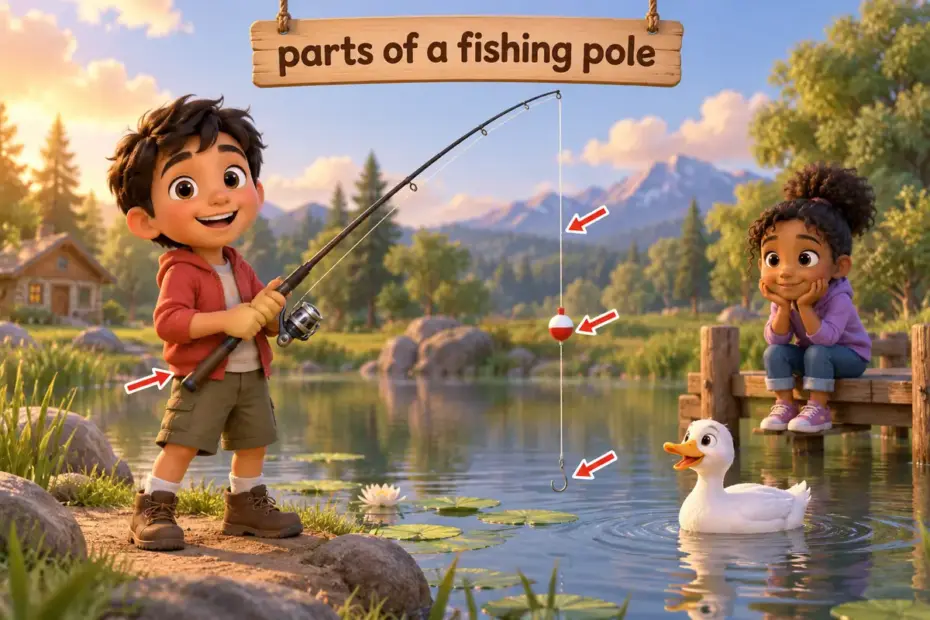
The parts of a fishing pole are the butt, handle, line, float, sinker, and hook that run in one line from the hand to the water. A pole has no reel, so the angler swings the baited hook out and lifts the fish by hand.
Parts of a fishing pole at a glance
- A fishing pole is a long rod with no reel, unlike a fishing rod.
- The line runs from the tip down to the hook.
- The float shows when a fish takes the bait, and the sinker pulls the bait down.
- The handle and butt are where the angler holds the pole steady.
- The commonest error is calling a pole a rod, or the reverse.
What are the parts of a fishing pole?
The parts of a fishing pole are the structures of a simple, reel-less rod and the tackle it carries. The butt and handle form the grip, the tip is the narrow end that the line leaves, and the line, float, sinker, and hook make up the rig that reaches the fish. Some poles hold a length of elastic inside the tip to cushion a strong pull.
| Part | Where it is | What it does | Example sentence |
|---|---|---|---|
| Butt | Bottom of the pole | Rests against the hand | The butt of a fishing pole is held steady. |
| Handle | Lower section | Where you grip | The handle of a fishing pole is often cork. |
| Tip | Narrow top end | Holds the line | The tip of a fishing pole bends when a fish bites. |
| Line | From tip to hook | Connects pole to hook | The line of a fishing pole is fine and strong. |
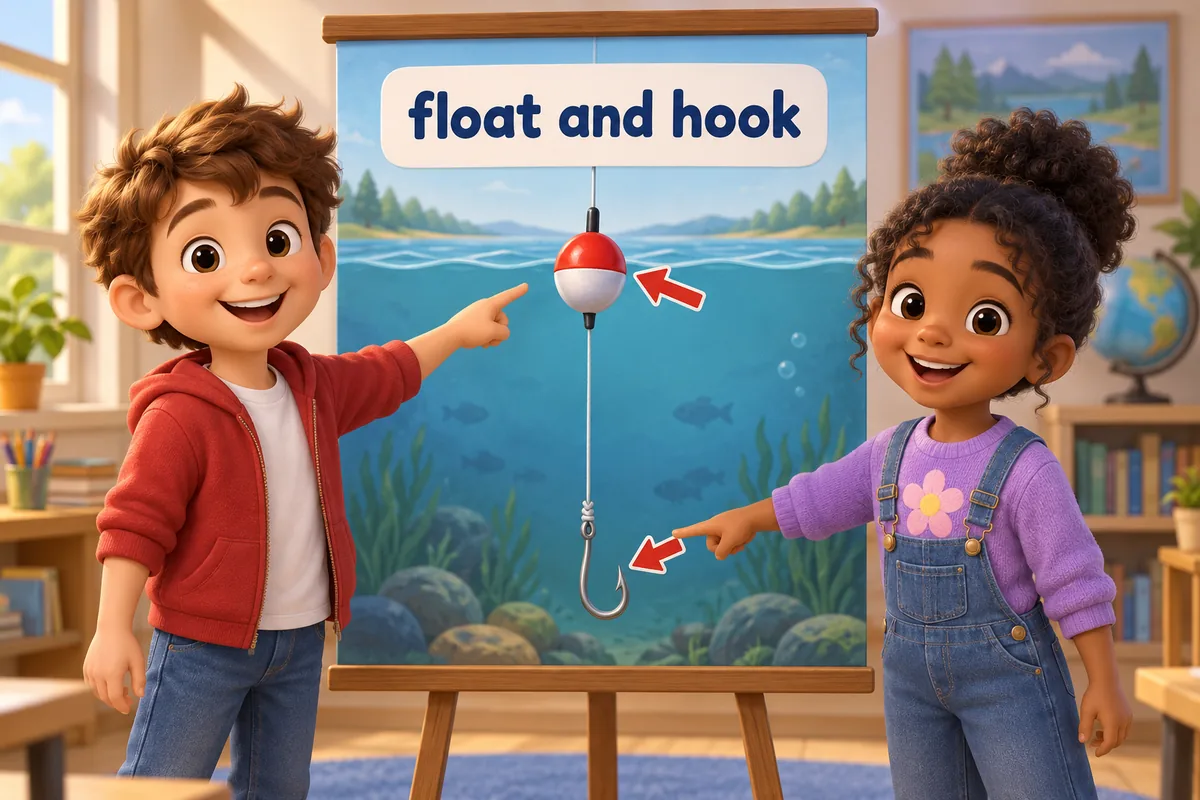
| Float | On the line | Shows when a fish bites | The float of a fishing pole dips under the water. |
| Sinker | Above the hook | Pulls the bait down | The sinker of a fishing pole keeps the bait low. |
| Hook | End of the line | Catches the fish | The hook of a fishing pole carries the bait. |
| Guide | Along the pole | Keeps the line close | The guide of a fishing pole holds the line in place. |
| Joint | Between sections | Lets the pole fold | The joint of a fishing pole slides together. |
| Elastic | Inside some tips | Absorbs a fish pull | The elastic of a fishing pole cushions the fight. |
| Bait | On the hook | Attracts the fish | The bait on the hook tempts the fish. |
How do you use the parts of a fishing pole in a sentence?
The naming phrase works like any other: put the part before of a fishing pole, or let the pole own it with an apostrophe. A beginner who needs more tackle words can browse fishing gear in a sentence.
| Pattern | Example | What it signals |
|---|---|---|
| the + part + of a fishing pole | The tip of a fishing pole bends under a pull. | names one structure |
| a fishing pole’s + part | A fishing pole’s handle is usually cork. | shows possession |
| plural part + of a fishing pole | The joints of a fishing pole slide apart. | talks about sections |
| part + verb | The float signals a bite. | describes a job |
| label + part | Pupils labelled each part of a fishing pole. | school and diagram use |
| part + is made of + material | The handle is made of cork. | describes a material |
Parts of a fishing pole in context: examples across contexts
The same names appear in a classroom, a tackle shop, and a holiday story, and the sentence around them changes with the setting. A familiar mix-up such as fishing vs phishing fails in the same way.
| Context | Example sentence | Why this works |
|---|---|---|
| Classroom | The teacher asked us to name each part of a fishing pole on the worksheet. | a school task about labelling |
| Tackle shop | This pole comes with a spare tip section. | a short sales note |
| Instruction guide | Thread the line through the guide before you tie the hook. | a step-by-step direction |
| Holiday story | He lifted the pole as the float sank out of sight. | vivid narrative wording |
| Fishing diary | The butt of my pole rested on the wooden rail. | a personal record |
| Children’s story | The little boy carried his pole to the river. | simple narrative wording |
| Nature club | A float helps you see the bite in choppy water. | a practical tip |
| Exam question | Label the parts of a fishing pole shown in the diagram. | a clear instruction |
| Safety notice | Keep the hook away from your fingers. | a firm warning |
| Repair note | The joint had worn, so the pole rattled. | a fault description |
Fishing pole and fishing rod: how they differ
Grouping the two by their parts makes the choice easy, because the presence of a reel is the single clearest difference. To see the word used in real frames, read fishing line in a sentence.
| Feature | Fishing pole | Fishing rod |
|---|---|---|
| Reel | usually none | fitted with one |
| Length | often long | usually shorter |
| Sections | telescopic or jointed | two or more pieces |
| Line control | by hand | through the reel |
| Typical use | float fishing for small fish | casting for larger fish |
| Diagram label | pole | rod |
Word forms and grammar of the parts of a fishing pole
Most part names are nouns, and a few can also be verbs. The noun tackle names the whole kit, and the verb to cast describes sending the line out. To see the base noun used in real frames, read fishing in a sentence.
| Form | Part of speech | Example |
|---|---|---|
| pole | noun | The pole was light in the hand. |
| poles | noun, plural | Two poles leaned on the wall. |
| butt | noun | The butt rested on the bank. |
| float | noun or verb | The float bobbed; the line floats on top. |
| sinker | noun | The sinker pulled the bait down. |
| hook | noun or verb | The hook is small; you hook a fish. |
| guide | noun | Each guide holds the line. |
| joint | noun | The joint was tight and firm. |
| tackle | noun | The tackle box was full. |
| cast | verb | She cast the line across the pond. |
Common mistakes with the parts of a fishing pole
Mistake 1: pole for rod. Incorrect: The reel sat on the pole. Correct: The reel sat on the rod. Rule: a pole has no reel, so a reel belongs to a rod.
Mistake 2: float called a bobber in formal writing. Incorrect: The bobber is listed on the worksheet. Correct: The float is listed on the worksheet. Rule: float is the standard term, while bobber is informal.
Mistake 3: sinker above the float. Incorrect: The sinker sits above the float. Correct: The sinker sits above the hook. Rule: the sinker weights the bait near the hook.
Mistake 4: line attached to the butt. Incorrect: The line runs from the butt to the hook. Correct: The line runs from the tip to the hook. Rule: the line leaves at the tip.
Mistake 5: a fishing pole is a fishing pole always. Incorrect: A fishing pole always has a reel. Correct: A fishing pole usually has no reel. Rule: the missing reel is the defining feature.
Practice using the parts of a fishing pole
- Fill in the blank: The ___ shows when a fish takes the bait.
- Choose the better word: The (butt / tip) is the narrow top end of the pole.
- Correct the error: The reel was fixed to the fishing pole.
- Build a sentence: use sinker to say how the bait is kept low.
- Spot the register: which line suits an instruction guide, (a) Whack the hook in the water, or (b) Thread the line through the guide before you tie the hook?
- Fill in the blank: The ___ of a fishing pole bends when a fish pulls.
Answers
- float, because the float dips when a fish bites.
- tip, because the tip is the narrow top end.
- The reel was fixed to the fishing rod; a pole has no reel.
- The sinker keeps the bait low above the hook.
- (b), because a guide needs clear step-by-step wording.
- tip, because the tip flexes under a pull.
The bottom line
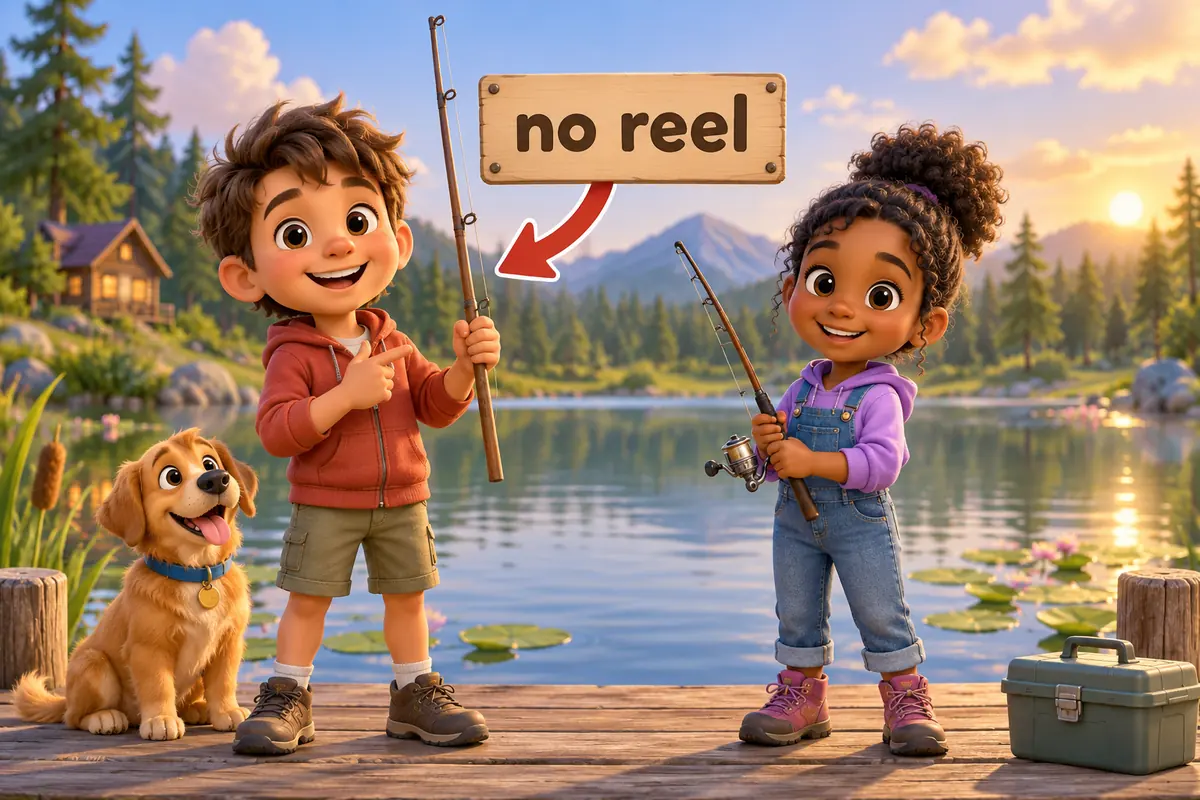
The parts of a fishing pole run in one line from the butt and handle to the tip, then down the line to the float, sinker, and hook. The single feature that defines a pole is the missing reel, which is why the line is controlled by hand. Once you can point to each part in order, the diagram stops being a memory test.
Frequently asked questions about the parts of a fishing pole
How is a fishing pole different from a rod?
A fishing pole is a long, simple rod with no reel, used to swing a baited line out and lift a fish by hand. A fishing rod is shorter and carries a reel, which stores and controls the line. The missing reel is the single clearest difference between the two.
What is the float on a fishing pole for?
The float, sometimes called a bobber, sits on the line and shows when a fish takes the bait. When the float dips or moves across the water, the angler knows to lift the pole. It also holds the bait at a set depth below the surface.
Do fishing poles have a reel?
Most fishing poles have no reel at all, which is what makes them simple to use. The line is fixed to the tip and the angler controls it by hand. A pole fitted with a reel is really a rod, so the two terms are not interchangeable.
What is the butt of a fishing pole?
The butt is the bottom end of the pole, below the handle, and it rests against the hand, the forearm, or a rail while you fish. It gives the pole a steady base and helps balance the long, light shaft. On a two-piece pole the butt is the lower section.