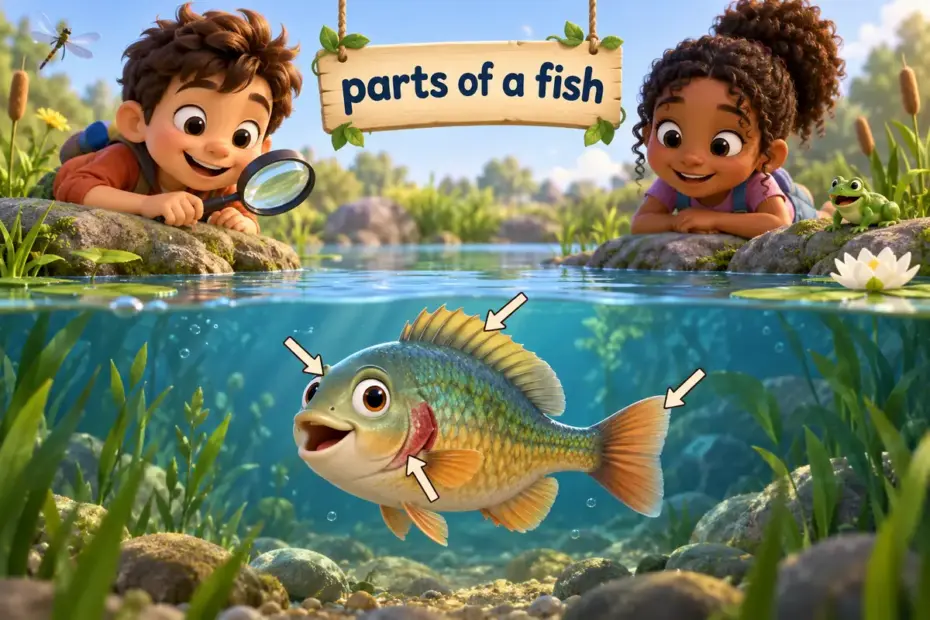
The parts of a fish are the head, body, fins, gills, scales, and tail that let it swim, breathe, and sense the water around it. A fish uses its fins to steer, its gills to take oxygen from water, and its scales for protection.
Parts of a fish at a glance
- A fish has a head, a body, and a tail, plus several paired and unpaired fins.
- Gills take oxygen from water, not from the air.
- The dorsal, pectoral, pelvic, anal, and caudal fins each do a different job.
- Scales cover the skin, and a lateral line runs along each side.
- The commonest error is calling every fin by the same name.
What are the parts of a fish?
The parts of a fish are the structures that keep it alive in water: a streamlined head and body, five kinds of fins, gills for breathing, scales for cover, and a tail fin for power. The head carries the eyes, the mouth, and the gill covers, while the fins work as a set of small paddles that push, steer, and steady the body.
| Part | Where it is | What it does | Example sentence |
|---|---|---|---|
| Head | Front of the body | Holds the mouth, eyes, and gills | The head of a fish leads it through the water. |
| Eye | On each side of the head | Sees movement in the water | A fish eye has no eyelid. |
| Mouth | At the front of the head | Takes in food and water | The mouth of a fish opens wide to feed. |
| Gill cover | Behind the head | Protects the gills | The gill cover of a fish lifts as it breathes. |
| Dorsal fin | Along the top of the back | Keeps the fish upright | The dorsal fin of a fish stands up when it is alarmed. |
| Pectoral fin | On each side behind the head | Steers and brakes | A fish uses its pectoral fins to turn. |
| Pelvic fin | Under the body | Steadies the fish | The pelvic fins of a fish sit beneath the belly. |
| Anal fin | Under the tail end | Adds balance | The anal fin of a fish helps it hold a line. |
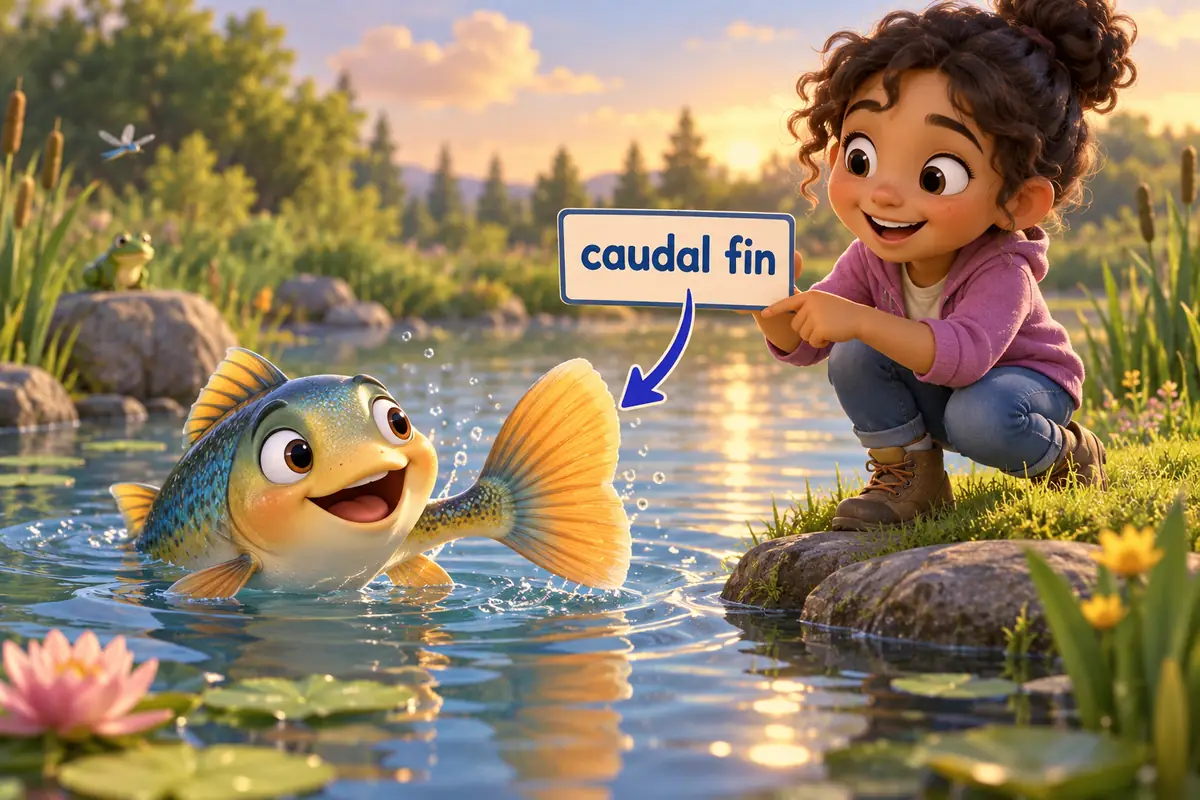
| Caudal fin | At the very back | Pushes the fish forward | The caudal fin of a fish drives it ahead. |
| Scales | Over the skin | Protect the body | The scales of a fish overlap like roof tiles. |
| Lateral line | Along each side | Senses movement and pressure | The lateral line of a fish feels a nearby swimmer. |
How do you use the parts of a fish in a sentence?
The phrase behaves like any naming phrase: put the part before of a fish, or let a fish own it with an apostrophe. Readers who want describing words for the topic can browse adjectives for fish.
| Pattern | Example | What it signals |
|---|---|---|
| the + part + of a fish | The dorsal fin of a fish sits on its back. | names one structure |
| a fish’s + part | A fish’s gills pull oxygen from the water. | shows possession |
| plural part + of a fish | The pectoral fins of a fish act as brakes. | talks about a pair |
| part + verb | The caudal fin pushes the fish forward. | describes a job |
| label + part | Pupils labelled each part of a fish. | school and diagram use |
| compare + part + with + part | Compare the gills with the lungs. | science writing |
Parts of a fish in context: examples across contexts
The same names appear in a classroom, a textbook, and a fishing magazine, and the sentence around them changes with the setting. A simple word such as bony fish names the group that has a skeleton of bone.
| Context | Example sentence | Why this works |
|---|---|---|
| Classroom | The teacher asked us to name each part of a fish on the worksheet. | a school task about labelling |
| Science textbook | The gills of a fish take oxygen from water. | a plain factual statement |
| Aquarium guide | Watch the pectoral fins of a fish as it turns near the glass. | an observation for visitors |
| Fishing magazine | A strong caudal fin helps a fish fight the current. | a practical angle for anglers |
| Lab report | The lateral line of the fish responded to a change in water pressure. | a measured observation |
| Children’s story | The little fish waved its tail and darted away. | simple narrative wording |
| Nature documentary | The dorsal fin of the fish cuts the surface like a small sail. | vivid description |
| Exam question | Label the parts of a fish shown in the diagram. | a clear instruction |
| Museum label | The scales of a fish protect it and show its age. | a short caption |
| Cooking note | Trim the fins before you cook the fish. | a kitchen instruction |
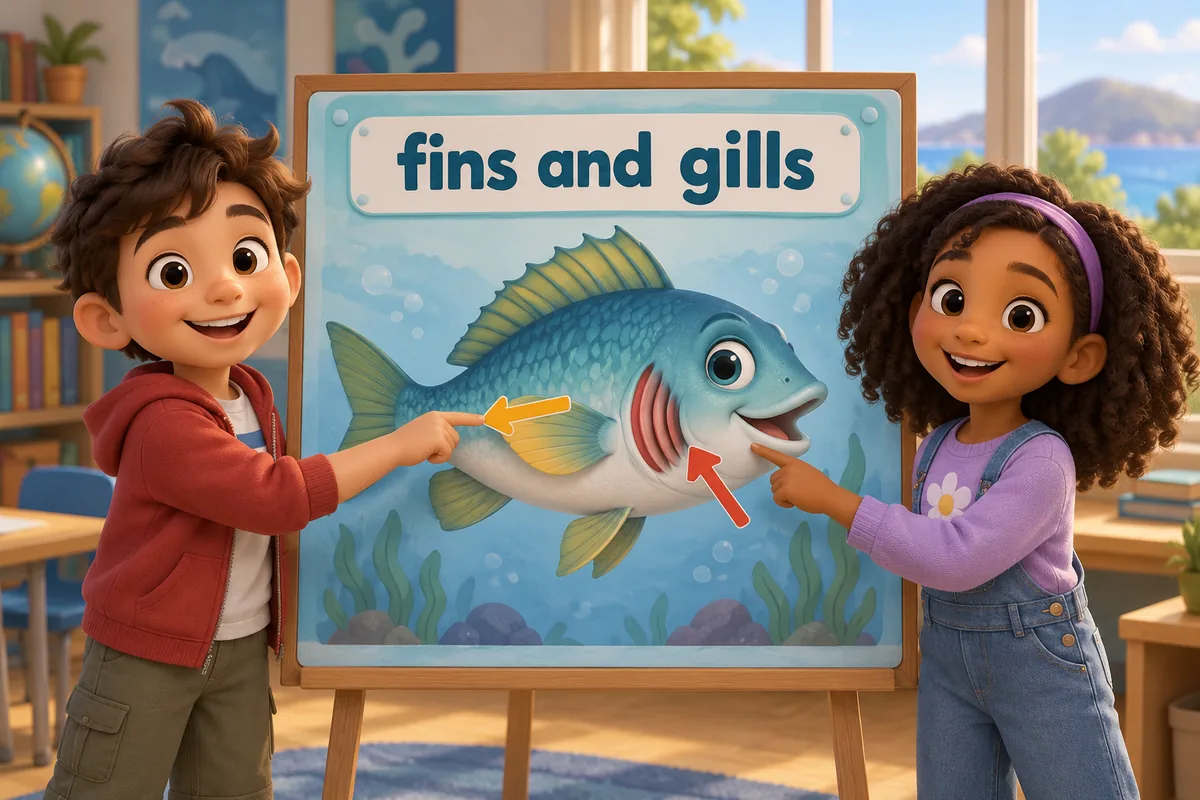
Fins, gills, and scales: how the parts differ
Grouping the parts by job makes the diagram easy to read, because movement, breathing, and protection use different structures. The same approach works for any labelled diagram, such as the parts of a car, which also split into groups by function.
| Feature | Fins | Gills | Scales |
|---|---|---|---|
| Main job | push, steer, and balance | take oxygen from water | protect the body |
| Where found | top, sides, and tail | behind the head | over the whole body |
| Typical number | five kinds | four arches on each side | hundreds |
| How you spot it | flat moving flaps | a slit or a cover | overlapping plates |
| Diagram label | fin | gill | scale |
Word forms and grammar of the parts of a fish
Most part names are nouns, and the adjectives that describe them come from Latin. The verbs that pair with them are few, so the pattern is easy to fix in memory. To see the noun used in real frames, read fish in a sentence.
| Form | Part of speech | Example |
|---|---|---|
| fish | noun, singular or plural | One fish, two fish. |
| fishes | noun, plural of species | The lake holds many fishes. |
| fin | noun | A fin steers the fish. |
| fins | noun, plural | Its fins move quickly. |
| gill | noun | A gill takes in oxygen. |
| scales | noun, plural | The scales shine in the light. |
| dorsal | adjective | The dorsal fin is on top. |
| pectoral | adjective | The pectoral fins sit behind the head. |
| caudal | adjective | The caudal fin is the tail. |
| lateral line | noun phrase | The lateral line senses movement. |
Common mistakes with the parts of a fish
Mistake 1: calling the tail the back fin. Incorrect: The back fin pushed the fish forward. Correct: The caudal fin pushed the fish forward. Rule: the tail fin has its own name, caudal.
Mistake 2: gills for lungs. Incorrect: A fish breathes with its lungs. Correct: A fish breathes with its gills. Rule: gills take oxygen straight from the water.
Mistake 3: a wrong plural. Incorrect: The lake holds many fishs. Correct: The lake holds many fish. Rule: fish serves as both singular and plural.
Mistake 4: part of fishes. Incorrect: the part of fishes shown here. Correct: the part of a fish shown here. Rule: one structure of one animal takes a fish.
Mistake 5: two dorsal fins. Incorrect: A fish has two dorsal fins. Correct: A fish has one dorsal fin. Rule: most fish carry a single dorsal fin along the back.
Practice using the parts of a fish
- Fill in the blank: A fish takes oxygen from water with its ___.
- Choose the better word: The (dorsal / caudal) fin sits along the back.
- Correct the error: The back fin pushed the fish forward.
- Build a sentence: use pectoral fins to say how a fish turns.
- Spot the register: which line suits a science worksheet, (a) That fishy has a wiggly tail, or (b) Label the caudal fin on the diagram?
- Fill in the blank: The ___ line runs along each side of the fish.
Answers
- gills, because they take oxygen from water.
- dorsal, because the dorsal fin is the one on the back.
- The caudal fin pushed the fish forward; the tail fin is the caudal fin.
- A fish turns by fanning its pectoral fins.
- (b), because a worksheet needs precise labels.
- lateral, because the lateral line senses movement and pressure.
The bottom line
The parts of a fish split into three clear groups: fins for movement, gills for breathing, and scales for protection, all attached to a head and body. Learn the five fin names by position, because dorsal means back, pectoral means beside the head, and caudal means tail. Once the position and the job are linked, the diagram stops being a memory test.
Frequently asked questions about the parts of a fish
How many fins does a fish usually have?
A typical fish has five kinds of fins: one or two dorsal fins on top, a pair of pectoral fins behind the head, a pair of pelvic fins underneath, a single anal fin near the tail, and the caudal fin at the back. Count the kinds rather than the pieces, because the paired fins come in twos.
What is the lateral line on a fish?
The lateral line is a row of sense organs that runs along each side of a fish, from the head toward the tail. It detects movement and changes in water pressure, so a fish can feel a nearby swimmer or a shifting current without seeing it. On a diagram it appears as a faint dotted line.
Why do fish have scales?
Scales form a hard, overlapping layer over the skin that protects the body from small injuries and from parasites. They also reduce drag as the fish moves, and their growth rings can show a fish age, which is why scientists sometimes read scales like a record.
Do all fish have the same parts?
Most fish share the same basic set of parts, but the shapes differ a great deal. A shark has a skeleton of cartilage instead of bone, an eel has almost no pelvic fins, and a flatfish has both eyes on one side. The names stay the same even when the shapes change.