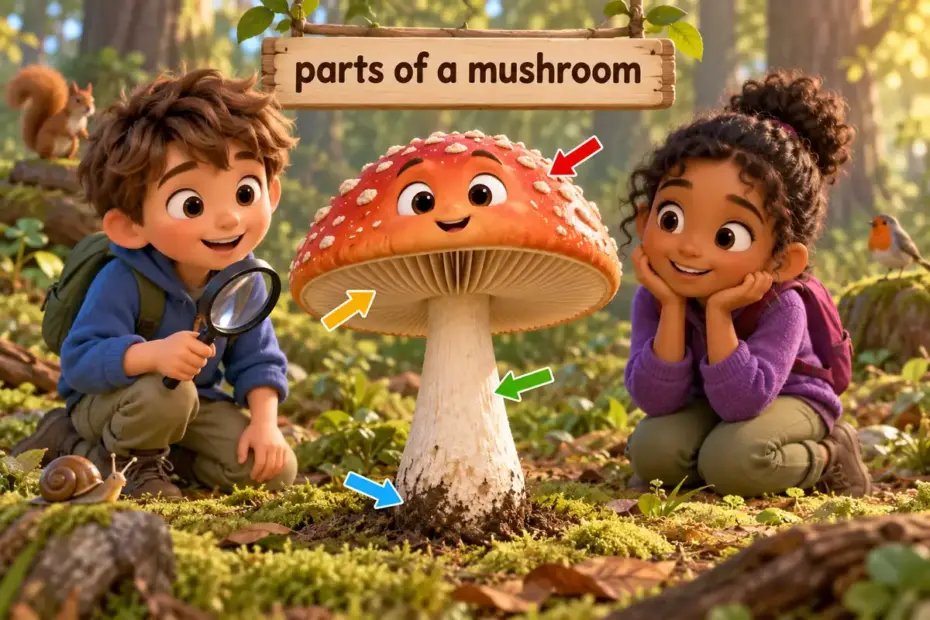
The parts of a mushroom are the cap, gills, stem, ring, and volva, plus the hidden mycelium beneath the soil. The cap protects the gills, the gills release spores, and the mycelium absorbs nutrients, so each part has one clear job.
Parts of a mushroom at a glance
- A mushroom has a cap, gills, a stem, and often a ring and a volva.
- The gills under the cap release the spores that start new mushrooms.
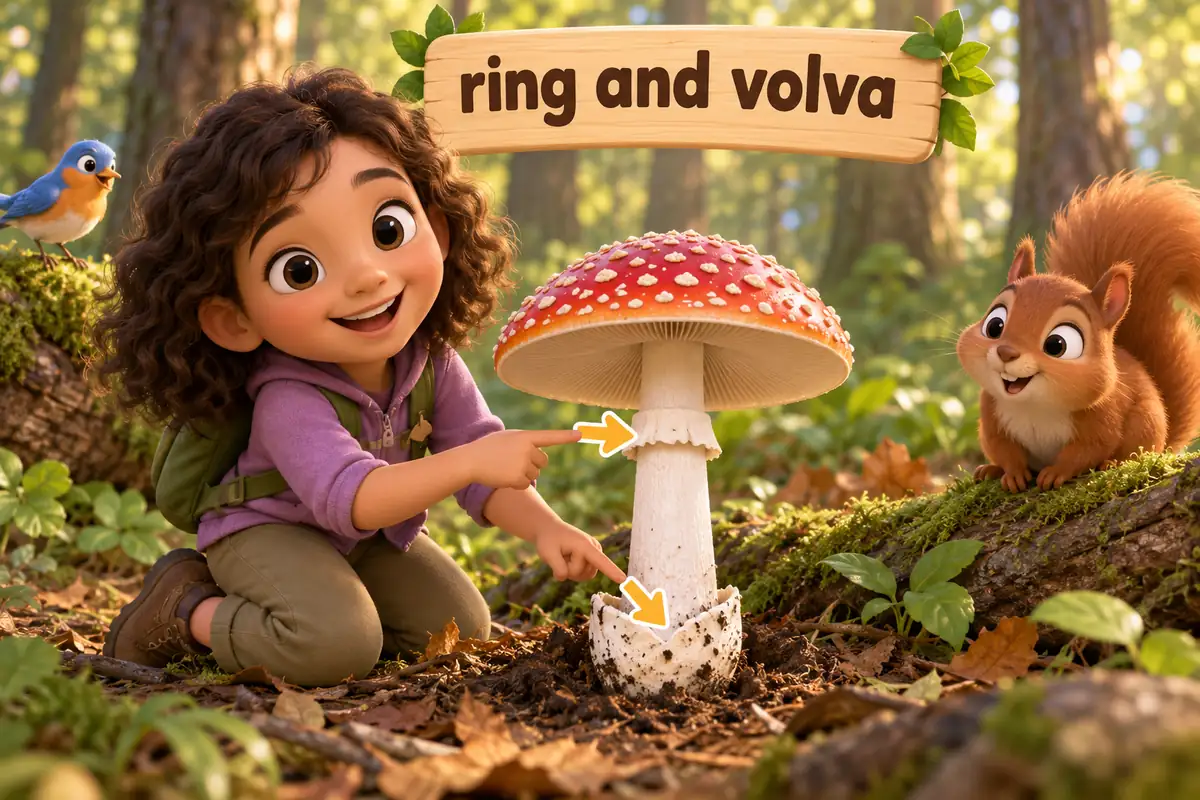
- The ring and the volva are leftover veil tissue, and either can be absent.
- The real body of the fungus is the mycelium hidden in the soil.
- The commonest error is calling the stem a root, which it is not.
What are the parts of a mushroom?
The parts of a mushroom are the structures of the visible fruiting body, together with the mycelium below ground. The cap sits on top and shields the gills, the gills make and release spores, and the stem lifts the cap so the spores can drift away. Two extra rings of tissue, the ring and the volva, remain from the veil that covered the young mushroom.
| Part | Where it is | What it does | Example sentence |
|---|---|---|---|
| Cap | Top of the mushroom | Protects the gills | The cap of a mushroom can be red or brown. |
| Gills | Under the cap | Release spores | The gills of a mushroom look like thin pages. |
| Stem | Below the cap | Holds the cap up | The stem of a mushroom is often white. |
| Ring | On the upper stem | Marks where the cap opened | The ring of a mushroom circles the stem. |
| Volva | At the base of the stem | A cup-like leftover veil | The volva of a mushroom sits in the soil. |
| Flesh | Inside cap and stem | The soft body tissue | The flesh of a mushroom may change colour when cut. |
| Mycelium | Under the ground | Absorbs nutrients | The mycelium of a mushroom spreads through the soil. |
| Spores | Made in the gills | Start new mushrooms | The spores of a mushroom drift on the wind. |
How do you use the parts of a mushroom in a sentence?
The naming phrase works like any other: put the part before of a mushroom, or let the mushroom own it with an apostrophe. The same grouping idea appears in other labelled diagrams, such as the parts of a car.
| Pattern | Example | What it signals |
|---|---|---|
| the + part + of a mushroom | The cap of a mushroom shields the gills. | names one structure |
| a mushroom’s + part | A mushroom’s gills release its spores. | shows possession |
| plural part + of a mushroom | The gills of a mushroom sit in neat rows. | talks about a group |
| part + verb | The stem lifts the cap clear of the ground. | describes a job |
| label + part | Children labelled each part of a mushroom. | school and diagram use |
| part + can be + adjective | The ring can be faint or missing. | notes a variation |

Parts of a mushroom in context: examples across contexts
The same names appear in a classroom, a foraging guide, and a recipe, and the sentence around them changes with the setting. Learners who enjoy body vocabulary can start with human body parts that start with A.
| Context | Example sentence | Why this works |
|---|---|---|
| Classroom | The teacher asked us to name each part of a mushroom on the worksheet. | a school task about labelling |
| Science textbook | The gills of a mushroom release tiny spores. | a plain factual statement |
| Foraging guide | Check the volva at the base before you pick the mushroom. | a practical safety instruction |
| Recipe | Slice the mushroom cap and discard the tough stem. | a kitchen instruction |
| Lab report | The flesh of the mushroom turned blue within a minute. | a measured observation |
| Children’s story | A tiny mushroom stood under the big oak tree. | simple narrative wording |
| Nature documentary | The mycelium of the mushroom spreads for metres under the leaves. | a hidden-process description |
| Exam question | Label the parts of a mushroom shown in the diagram. | a clear instruction |
| Museum label | The ring marks where the veil of the mushroom once joined the cap. | a short caption |
| Garden note | Leave the mushroom cap to release its spores. | a gardening instruction |
Cap, gills, and stem: how the parts differ
Grouping the parts by job makes the diagram easy to read, because protection, reproduction, and support use different structures. A similar list continues with human body parts that start with B.
| Feature | Cap | Gills | Stem |
|---|---|---|---|
| Main job | protect the gills | release spores | hold the cap up |
| Position | on top | under the cap | below the cap |
| Typical shape | dome or flat plate | thin radiating blades | a slim column |
| Seen above ground | yes | yes, when lifted | yes |
| Diagram label | cap | gills | stem |
Word forms and grammar of the parts of a mushroom
Most part names are nouns, and the adjective forms come from Latin. The verb to fruit describes the stage when the mushroom appears, and the series carries on with human body parts that start with C.
| Form | Part of speech | Example |
|---|---|---|
| mushroom | noun | The mushroom appeared overnight. |
| mushrooms | noun, plural | The mushrooms grew in a ring. |
| cap | noun | The cap was wide and flat. |
| gills | noun, plural | The gills were pale cream. |
| stem | noun | The stem snapped easily. |
| stipe | noun | The stipe is the scientific name for the stem. |
| ring | noun | The ring circled the upper stem. |
| volva | noun | The volva cupped the base. |
| mycelium | noun | The mycelium spread under the log. |
| fruit | verb | These mushrooms fruit after rain. |
Common mistakes with the parts of a mushroom
Mistake 1: calling the stem a root. Incorrect: The root holds the cap up. Correct: The stem holds the cap up. Rule: a mushroom has a stem, not a root; the mycelium is the hidden part.
Mistake 2: gills on top of the cap. Incorrect: The gills on the cap catch the rain. Correct: The gills sit under the cap. Rule: gills always lie on the underside.
Mistake 3: a ring on every mushroom. Incorrect: Every mushroom has a ring. Correct: Many mushrooms have a ring, but some have none. Rule: the ring is a leftover veil and can be missing.
Mistake 4: spores made by the cap. Incorrect: The cap makes the spores. Correct: The gills make the spores. Rule: spores form in the gills, which the cap protects.
Mistake 5: mushroom is a plant. Incorrect: A mushroom is a plant without leaves. Correct: A mushroom is the fruiting body of a fungus. Rule: fungi form their own group, not the plant kingdom.
Practice using the parts of a mushroom
- Fill in the blank: The ___ under the cap release the spores.
- Choose the better word: The (cap / stem) protects the gills.
- Correct the error: The root of the mushroom holds it upright.
- Build a sentence: use volva to describe the base of a mushroom.
- Spot the register: which line suits a science worksheet, (a) That mushroom is icky, or (b) Label the gills on the diagram?
- Fill in the blank: The ___ spreads through the soil and absorbs nutrients.
Answers
- gills, because spores form and release there.
- cap, because the cap shields the gills.
- The stem of the mushroom holds it upright; a mushroom has no root.
- The volva is the cup of veil tissue at the base of the stem.
- (b), because a worksheet needs precise labels.
- mycelium, because it absorbs nutrients underground.
The bottom line
The parts of a mushroom split into three clear groups: the cap for cover, the gills for spores, and the stem for support, with a ring and volva as leftover veil tissue. Remember that the real body is the mycelium hidden below ground, and the mushroom you see is only the fruiting part. Once position and job are linked, the diagram stops being a memory test.
Frequently asked questions about the parts of a mushroom
What are the main parts of a mushroom?
The visible parts are the cap, the gills beneath it, and the stem, sometimes with a ring on the upper stem and a volva at the base. Below ground, the mycelium is the main body of the fungus. The cap, gills, and stem are the fruiting body that produces spores.
What are mushroom gills for?
The gills are thin blades on the underside of the cap that make and release spores, which are the tiny cells that grow into new fungi. Their large surface area lets a single mushroom shed millions of spores. Some mushrooms have pores or ridges instead of gills, but the job is the same.
Is the ring always on a mushroom?
No. The ring is a leftover piece of the veil that once covered the young mushroom, and many species lose it or never form one. Its presence, position, and texture still help identify a mushroom, so a missing ring is a useful clue rather than a mistake.
What is the volva on a mushroom?
The volva is a cup-like remnant of the veil at the very base of the stem, often partly buried in the soil. It is a key feature in identifying some dangerous species, so foragers dig up the whole stem to check for it. Like the ring, it can be faint or absent.