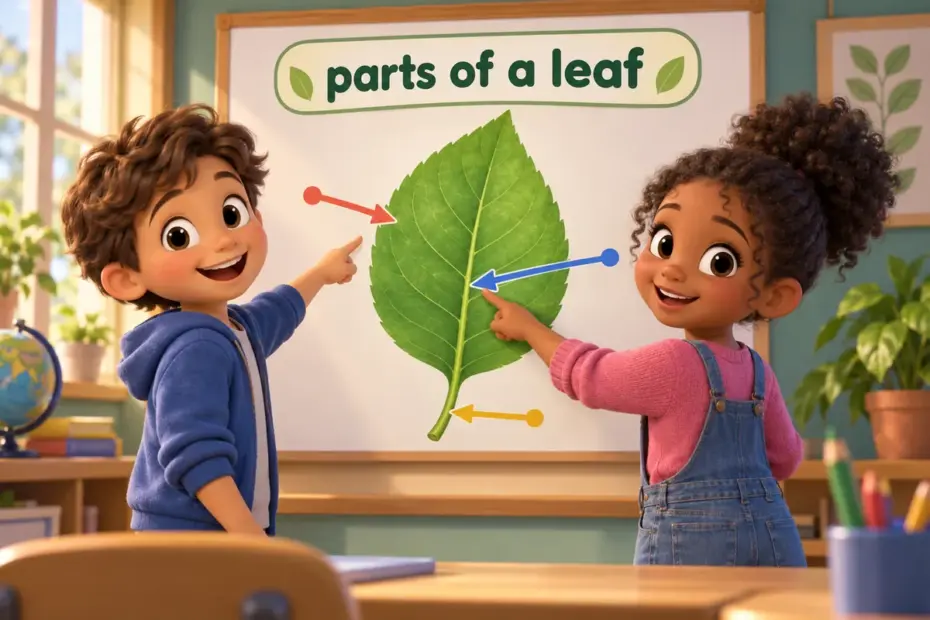
A leaf is built from a small set of named structures, and knowing the parts of a leaf helps students read plant diagrams and explain how a plant feeds itself. The blade, petiole, veins and stipules each do one specific job, and together they turn sunlight into food.
Parts of a Leaf at a Glance
- A simple leaf has four main parts: blade, petiole, veins and stipules.
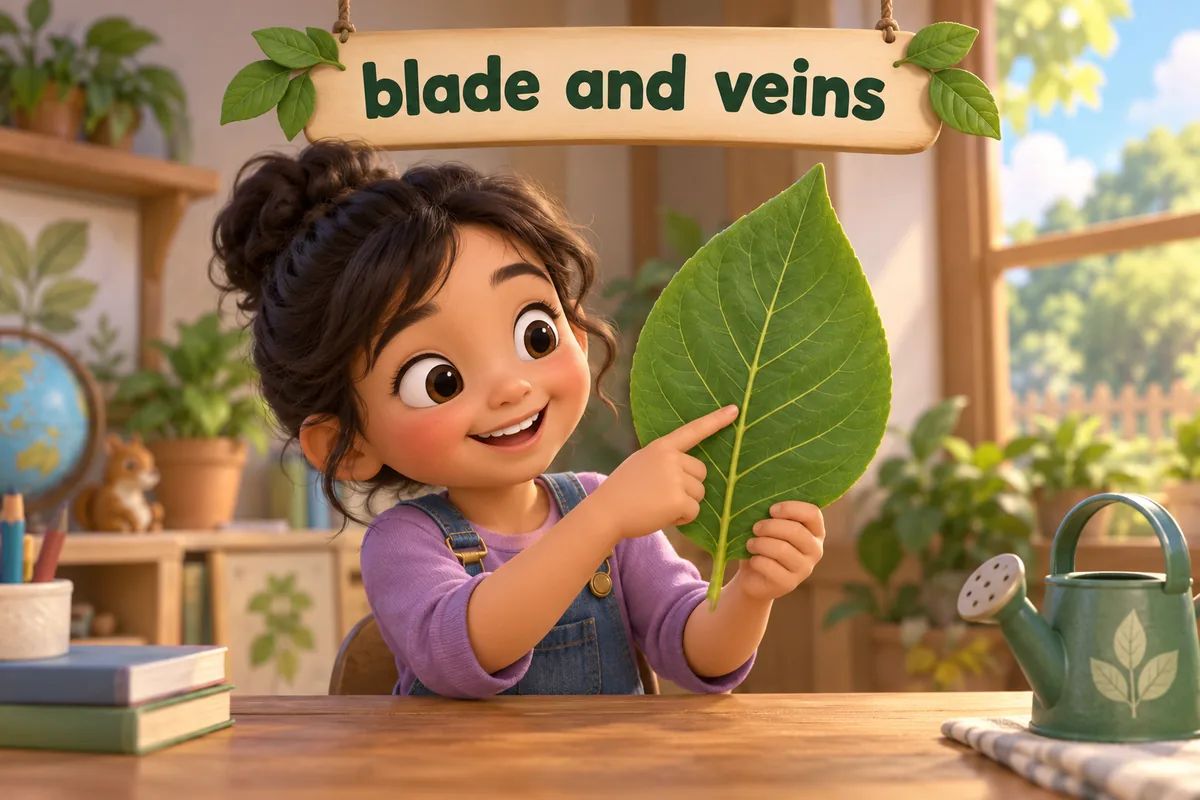
- The blade, or lamina, is the flat green surface that carries out photosynthesis.
- The petiole is the stalk that attaches the blade to the stem.
- Veins hold xylem and phloem, the tubes that move water up and sugar down.
- Stipules are small leaf-like flaps that sit in pairs at the base of the petiole.
- The margin and the apex help identify a species but do not feed the plant.
What Are the Parts of a Leaf?
The parts of a leaf are the blade, the petiole, the stipules and the veins, and each one has a fixed place on a standard botanical diagram. Naming them accurately matters in botany lessons, garden notes and exam answers, because a leaf is not one flat shape but a small assembly of structures. The table below gives every part its position and its plain-language job.
| Part | Also called | Its main job | Where it sits |
|---|---|---|---|
| blade | lamina | captures light for photosynthesis | the broad flat end of the leaf |
| petiole | leaf stalk | attaches the blade to the stem | between stem and blade |
| midrib | central vein | carries water and supports the blade | the centre line of the blade |
| lateral veins | side veins | spread water and sugar through the blade | branching from the midrib |
| stipules | leaf flaps | protect the young leaf inside the bud | a pair at the base of the petiole |
| margin | leaf edge | shapes the outline used for identification | the outer rim of the blade |
| apex | leaf tip | points the blade away from the stem | the far end from the petiole |
| epidermis | leaf skin | seals the surface and holds the stomata | the outer layer of the blade |
What Does Each Part of a Leaf Do?
Every structure of a leaf performs one task, and the list is easier to remember when each task is tied to something a learner can see. This table pairs a part with its function and with the quick test that identifies it on a fresh specimen.
| Part | Function | How to spot it |
|---|---|---|
| blade | absorbs sunlight for photosynthesis | the wide green surface |
| petiole | holds the blade clear of the stem | the thin stalk you pinch |
| veins | move water, minerals and sugar | raised lines across the blade |
| stipules | shield the bud, then often fall early | small flaps where stalk meets stem |
| cuticle | stops the leaf drying out | the shiny film on the top side |
| stomata | let carbon dioxide in and oxygen out | tiny pores, mostly underneath |
| palisade tissue | packs cells full of chloroplasts | the tight layer under the top skin |
| spongy tissue | lets gases move between cells | the loose layer near the bottom |
How Do the Parts of a Leaf Work Together?
A leaf stays alive because its parts hand work to one another in a fixed order. Follow water, gas and sugar through the structure and the diagram stops looking like a list of labels and starts looking like a system.
| Step | Parts involved | What happens |
|---|---|---|
| water arrives | midrib, lateral veins, xylem | roots push water up the veins to every cell |
| gas exchange | stomata, spongy tissue | carbon dioxide enters and oxygen leaves |
| light capture | blade, palisade tissue | chlorophyll traps energy from the sun |
| sugar made | blade | photosynthesis builds glucose from water and carbon dioxide |
| sugar moved | phloem, veins, petiole | sugar travels out to the stem and roots |
| support | petiole, midrib | stalk and central vein keep the blade facing the light |
| protection | stipules, cuticle | the bud is shielded and the surface is sealed |
Parts of a Leaf in Sentences Across Contexts
A term is learned once a writer can drop it into a real sentence. The eight frames below show the same vocabulary working in a classroom, a science report and a garden note. Writers who need a colour name can borrow the descriptive words gathered under adjectives for leaf.
| Context | Example sentence | Why it works |
|---|---|---|
| classroom | The teacher asked us to label the petiole on the diagram. | names one part precisely for a task |
| science report | Water reached the blade through the midrib and lateral veins. | links a part to a process |
| garden guide | Cut just above the petiole so the plant keeps its shape. | gives pruning advice with the right term |
| exam answer | The stipules protect the leaf inside the bud. | states a function in one line |
| field note | Its margin is serrated and the apex is pointed. | describes shape for identification |
| home talk | The leaves on this path have broad blades and long stalks. | uses plainer words but the same parts |
| museum label | A waxy cuticle reduces water loss on the upper surface. | connects a part to its purpose |
| news article | Damage to the blade slowed photosynthesis across the crop. | reports a cause and an effect |
Blade vs Leaflet: Which Term Fits?
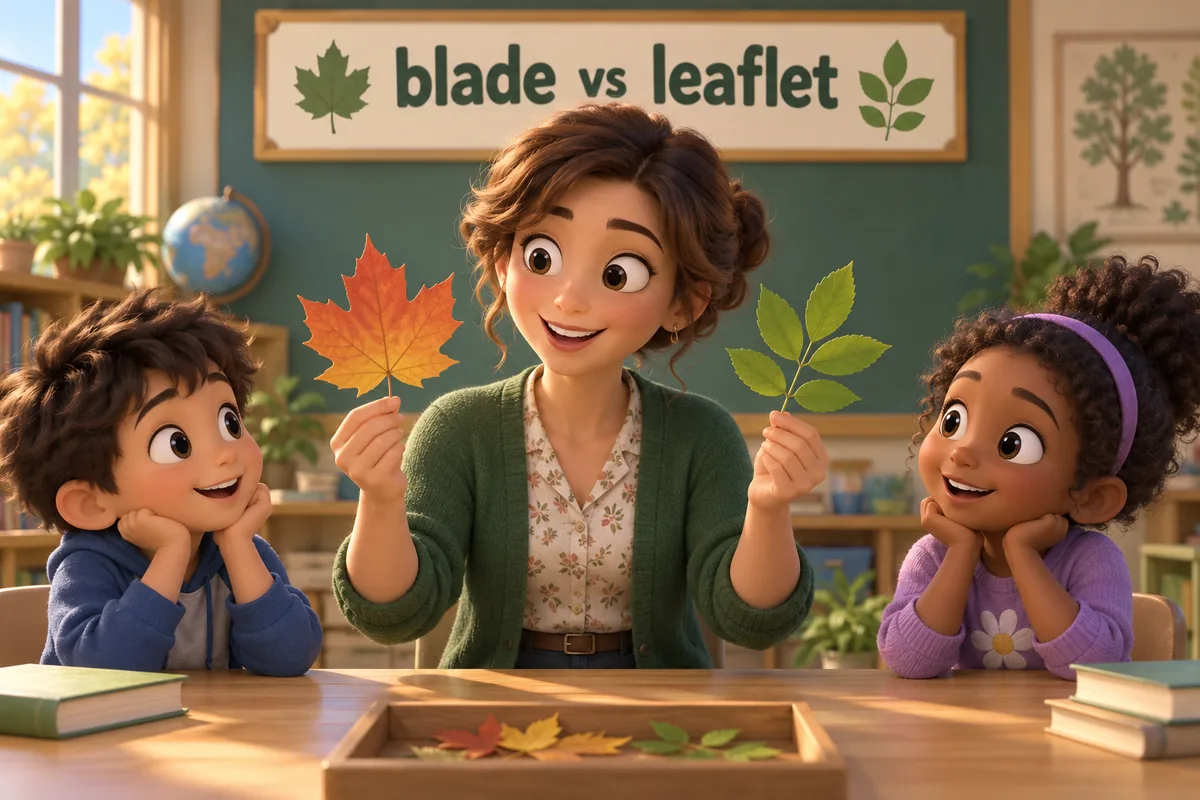
The blade is the single flat surface of a simple leaf, while a leaflet is one small division of a compound leaf. The two look alike, so a writer has to check the base of each piece before choosing the word.
| Attribute | Blade | Leaflet |
|---|---|---|
| what it is | the flat part of one leaf | one division of a compound leaf |
| base attachment | joins the petiole | joins a rachis, with no bud |
| typical example | a maple leaf | one part of an ash leaf |
| how many per unit | one on a simple leaf | several on a compound leaf |
| key test | a bud sits at its base | no bud sits at its base |
The verdict is simple: if a bud grows where the flat part meets the stalk, call it a blade; if there is no bud at that joint, and several similar pieces share one stalk, call each piece a leaflet. One honest limit is worth stating here. This page names the parts of a leaf in a general flowering plant, and a fir needle, a grass blade or a fern frond divides the same jobs among structures with different names, so a needle has no petiole and a frond has pinnae rather than leaflets.
Key Terms and Word Forms for Leaf Parts
Most leaf vocabulary is noun-based, but a few adjectives and plural forms cause errors in writing. The same labelling habit that names every part of a car appears in car parts from A to Z.
| Term | Part of speech | Example sentence |
|---|---|---|
| leaf | noun | One leaf fell on the path. |
| leaves | plural noun | Two leaves drifted down together. |
| leaflet | noun | Each leaflet has its own small stalk. |
| petiole | noun | The petiole twisted toward the light. |
| stipule | noun | A tiny stipule guarded the new bud. |
| serrated | adjective | The serrated margin caught the wind. |
| sessile | adjective | A sessile leaf grows right on the stem. |
The fixed phrase behind fig leaf in a sentence shows how one leaf name became an idiom, while cooking keeps the word alive in bay leaf in a sentence.
Common Mistakes When Naming Leaf Parts
The stem of the leaf turned yellow. The petiole of the leaf turned yellow. Rule: the stem is the main plant axis, and a leaf joins it through the petiole.
Water travels up the leaf. Water travels up the midrib and lateral veins. Rule: name the vein that does the work, not the whole blade.
Each leaf on a maple is actually a leaflet. A maple leaf is a single blade, while an ash leaf is divided into leaflets. Rule: a leaflet has no bud at its base.
Two leafs fell from the tree. Two leaves fell from the tree. Rule: the plural of leaf is leaves, not leafs.
Stipules make food for the leaf. The blade makes food, and the stipules protect the young leaf. Rule: photosynthesis happens in the blade, not in the flaps.
Practice Using the Parts of a Leaf
- The ____ is the flat green surface that carries out photosynthesis.
- Water rises through the ____ vessels inside the veins.
- Choose the better term: the (petiole / stem) joins the blade to the main stem.
- Correct the error: Two leafs fell from the tree.
- Build one sentence about a maple leaf that uses both blade and petiole correctly.
- Spot the register: which sentence belongs in a school science report, A or B? A: The leaf got sun. B: The blade absorbed light for photosynthesis.
Answers
- blade – it is the broad flat surface where chlorophyll traps light.
- xylem – xylem carries water upward from the roots.
- petiole – the petiole is the leaf stalk, while the stem is the main axis.
- Two leaves fell from the tree – the plural of leaf is leaves.
- A model answer is: The broad blade of the maple leaf caught the sun while its petiole held it face upward. – it names both parts and gives each a job.
- B – it uses the correct part name, blade, and the technical process, photosynthesis.
The Bottom Line
The parts of a leaf are the blade, petiole, stipules and veins, with the blade doing the photosynthesis and the veins handling transport. The petiole positions the blade, and the stipules guard the young leaf, so each structure earns its place on the diagram. Learn the bud test and the two plural forms, and both the naming and the writing fall into line.
Frequently asked questions about parts of a leaf
Is the petiole the same as the stem?
No. The stem is the main axis of the plant that carries water between roots and leaves, while the petiole is the small stalk that joins one blade to that stem. A leaf with no petiole is called sessile, and it sits directly on the stem.
What is the difference between the midrib and a vein?
The midrib is the single large vein that runs down the centre of the blade, and lateral veins branch from it toward the edges. Every vein is part of the transport system, but only the central one carries the name midrib.
Do all leaves have stipules?
No. Stipules grow in pairs where the petiole meets the stem, but many plants drop them as the leaf opens, and some species never form them at all. Absent stipules are therefore normal rather than a sure sign of damage.
Why do some leaves have no petiole?
A leaf with no petiole is called sessile, and it grows directly on the stem so the blade sits close to its support. Sessile leaves are common on grasses and in dry habitats, where a short stalk lowers the risk of water loss.