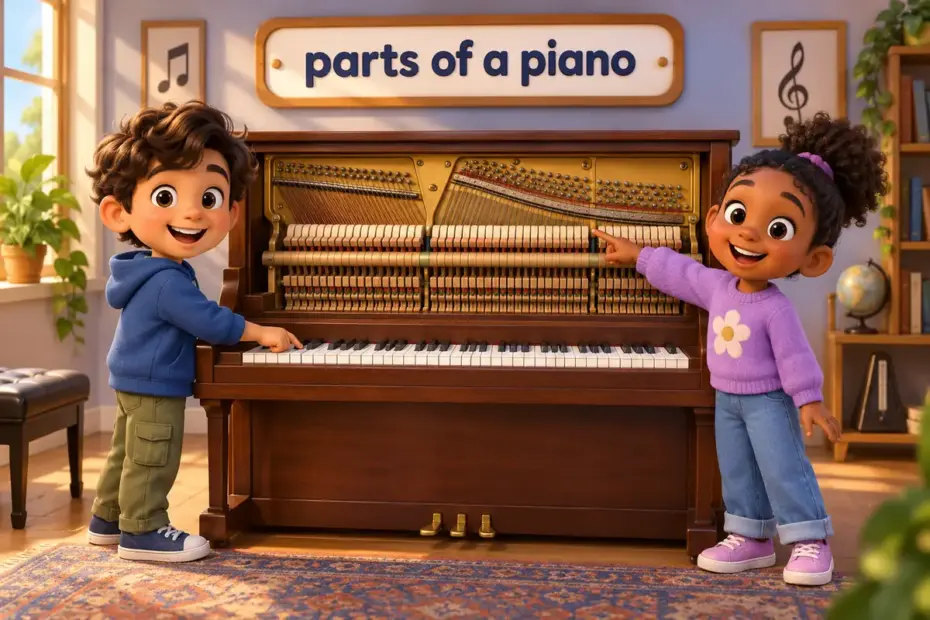
A piano looks like one solid box, yet it hides a small machine of felt, wood and wire, and knowing the parts of a piano explains why one key sounds soft and another rings on. The keys, hammers, strings, soundboard and pedals each do one job, and together they turn a finger press into music.
Parts of a Piano at a Glance
- A piano turns a key press into a hammer strike on a string.
- The strings vibrate, and the soundboard makes that vibration loud.
- A cast-iron frame holds the strings under heavy tension.
- Dampers stop a note when the key is released.
- The three pedals soften, sustain or hold selected notes.
- The action is the linked mechanism between the key and the hammer.
What Are the Parts of a Piano?
The parts of a piano are the keyboard, the action, the strings, the soundboard and the frame that carries them. Each part sits in a fixed place, so a learner can point to it on a section diagram and name it with confidence. The table below gives every part its position and its job.
| Part | Also called | Its main job | Where it sits |
|---|---|---|---|
| keyboard | keys | the player presses keys to start a note | front of the instrument |
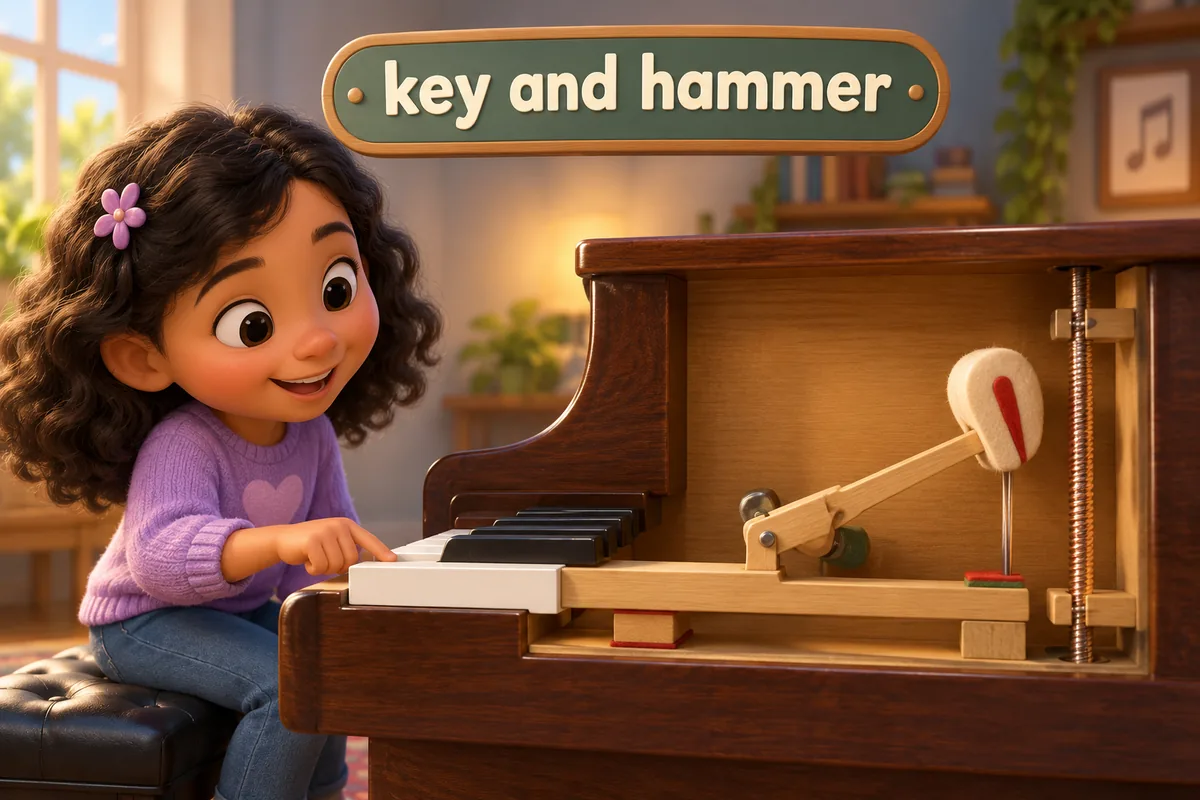
| action | key mechanism | turns a key press into a hammer strike | between keys and strings |
| hammers | felt hammers | strike the strings to make sound | inside the action |
| strings | piano wire | vibrate at set pitches | stretched across the frame |
| soundboard | belly | amplifies the string vibration | under the strings |
| cast-iron frame | plate | holds the strings under tension | over the soundboard |
| dampers | felt blocks | stop a string when the key is released | above the strings |
| pedals | foot levers | change volume and sustain | under the keyboard |
What Does Each Part of a Piano Do?
Every part of the mechanism performs one task, and the list is easier to remember when each task is tied to a sound you can hear. This table pairs a part with its function and with the quick test that identifies it when the lid is open.
| Part | Function | How to spot it |
|---|---|---|
| tuning pins | hold each string at the right tension | rows of metal pins on the pin block |
| bridges | pass string energy into the soundboard | wooden rails under the strings |
| dampers | silence a note when the key comes up | felt blocks that lift as you play |
| hammers | strike the strings | felt-covered mallets in the action |
| pedals | sustain, soften or hold notes | brass levers at the floor |
| lid | projects sound upward | the large hinged top |
| music desk | holds the sheet music | a slanted panel above the keys |
| casters | let the piano roll on a hard floor | small wheels under the legs |
How the Parts of a Piano Work Together
A piano makes sound because its parts hand work along a chain from finger to air. Follow one note through the instrument and the diagram stops looking like a list of labels and starts looking like a sequence.
| Step | Parts involved | What happens |
|---|---|---|
| key pressed | key, action | the lever lifts the hammer toward the string |
| hammer strikes | hammer, string | the felt head hits one or more strings |
| note sounds | string, bridge, soundboard | vibration passes to the board and grows loud |
| note held | damper, key | the damper stays off the string while the key is down |
| key released | damper | the felt returns and stops the sound |
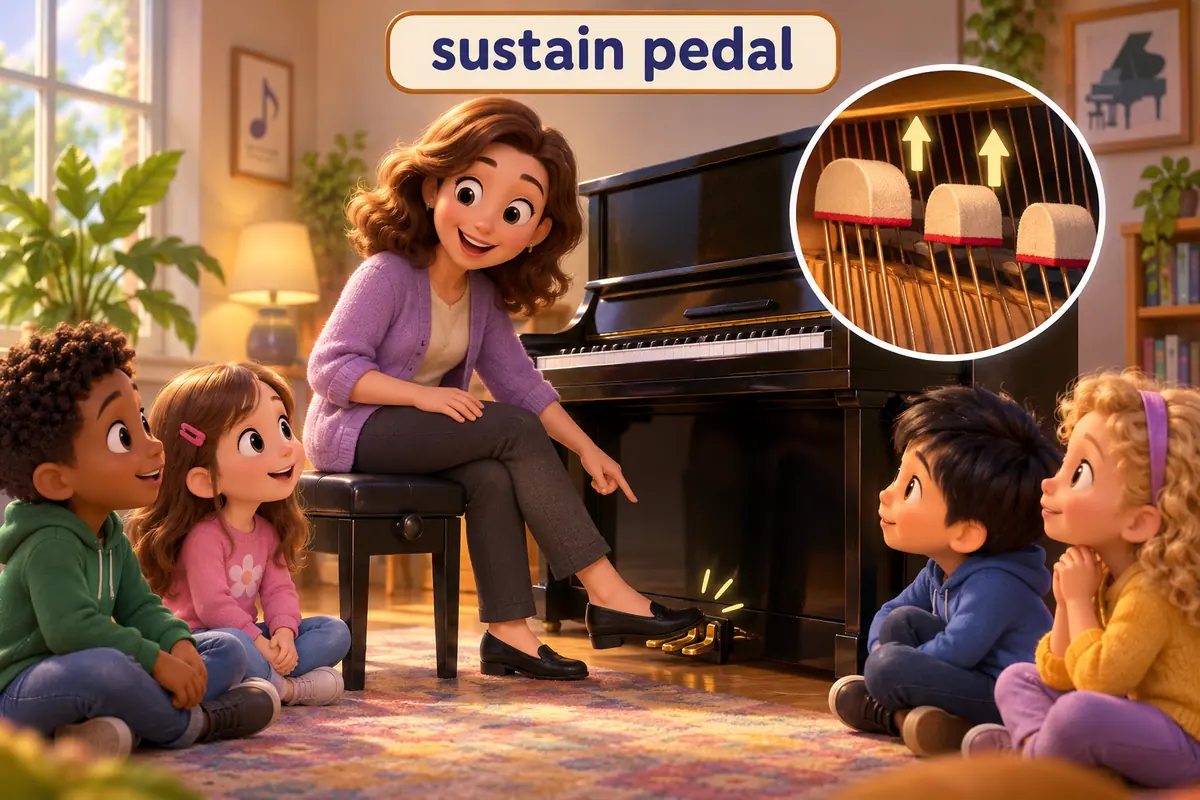
| pedal pressed | sustain pedal, dampers | all dampers lift so the notes ring on |
Parts of a Piano in Sentences Across Contexts
A term is learned once a writer can drop it into a real sentence. The eight frames below show the same vocabulary working in a lesson, a technician’s note and a concert programme. The same habit of naming every mechanism appears in car parts from A to Z.
| Context | Example sentence | Why it works |
|---|---|---|
| lesson | Hold the key down so the damper stays off the string. | ties a hand action to a part |
| technician note | The hammers need voicing where the tone turns harsh. | names the part that shapes tone |
| concert programme | The soloist held the sustain pedal through the final chord. | uses the pedal name precisely |
| exam answer | The soundboard turns a faint string vibration into a full tone. | states a function in one line |
| tuning visit | Two tuning pins had slipped, so the octave drifted flat. | links a fault to a part |
| home talk | The lid is propped open, so the piano sounds brighter. | connects a part to a sound change |
| museum label | The cast-iron frame let builders use heavier strings. | connects a part to its history |
| news article | A new action allowed faster repeated notes on stage. | reports a change and its effect |
Upright and Grand: Which Piano Fits?
An upright piano stands its strings and action vertically against a wall, while a grand lays them flat so gravity helps the hammer return. The layout changes the sound, the footprint and the feel of the keys.
| Attribute | Upright | Grand |
|---|---|---|
| string layout | vertical, running up and down | horizontal, running front to back |
| floor space | fits flat against a wall | needs room for the open lid |
| action type | vertical action | horizontal action with quicker repetition |
| sound direction | down and forward through a panel | upward from an open lid |
| usual setting | homes, schools, practice rooms | halls and recording studios |
The verdict is a matter of use: choose an upright for a small room and daily practice, and a grand when fast repetition and open projection matter on stage. One honest limit is worth stating, because the word piano now covers two different machines. A digital piano has no strings, hammers or soundboard at all, so its keys and pedals work by sensors and speakers, and the labels on this page describe an acoustic instrument.
Key Terms and Word Forms for Piano Parts
Most piano vocabulary is noun-based, though a few verbs and adjectives appear in reviews and repair notes. Compare the naming of instrument parts with human body parts that start with a.
| Term | Part of speech | Example sentence |
|---|---|---|
| piano | noun | The piano stood against the far wall. |
| pianos | plural noun | Two pianos were tuned before the recital. |
| pianist | noun | The pianist lifted the lid before playing. |
| pedal | noun | The pedal added a warm blur to the chord. |
| pedal | verb | She pedalled lightly through the slow passage. |
| damper | noun | A worn damper left a faint ring after the note. |
| upright | adjective | An upright model saves floor space. |
A parallel list of anatomical names sits in human body parts that start with b, and the pattern continues in human body parts that start with c.
Common Mistakes When Naming Piano Parts
The key hits the string directly. The key lifts a hammer, and the hammer strikes the string. Rule: the action links the key to the hammer, so the key never touches the wire.
The soundboard creates the vibration. The strings vibrate, and the soundboard amplifies that vibration. Rule: the strings are the source, so the board only makes them louder.
The left pedal makes the piano quieter by closing the lid. The soft pedal shifts the hammers so they strike fewer strings. Rule: the pedal changes how the hammers hit, not the lid.
The damper sounds the note. The damper stops the note when the key is released. Rule: felt blocks silence a string, they do not start it.
Two pianos is written as two pianoes. Two pianos is the correct plural. Rule: the plural of piano adds s, not es.
Practice Using the Parts of a Piano
- The ____ is the linked mechanism that carries a key press to the hammer.
- The ____ turns a faint string vibration into a full, loud tone.
- Choose the better word: the (hammer / damper) strikes the string to start the note.
- Correct the error: The damper starts the sound when the key goes down.
- Build one sentence that names the strings and the soundboard and explains what each does.
- Spot the register: which sentence belongs in a repair note, A or B? A: Two dampers fail to silence the treble notes. B: The squishy bits do not stop the sound.
Answers
- action – it is the mechanism between the key and the hammer.
- soundboard – it amplifies the vibration of the strings.
- hammer – the felt hammer strikes the string, while the damper stops it.
- The damper stops the sound when the key is released – its felt silences the string.
- A model answer is: The strings vibrate at a set pitch while the soundboard amplifies that vibration into a full tone. – it names both parts and gives each a job.
- A – it uses the correct term, dampers, and describes the fault clearly.
The Bottom Line
The parts of a piano are the keys, action, hammers, strings, soundboard and pedals, and each one passes energy a single step along the chain from finger to air. The strings make the vibration and the soundboard makes it loud, while the dampers decide when a note stops. Learn which part strikes and which part silences, and both the diagram and the playing make sense.
Frequently asked questions about parts of a piano
What does the sustain pedal actually do?
The right pedal lifts all the dampers away from the strings at once. Because the felt no longer touches the wire, every note keeps ringing after the key is released, which lets chords blend. Lifting the pedal drops the dampers back.
How many strings does a single note use?
Most notes sound from two or three strings that are tuned as one pitch. The heavy bass notes often use a single thick string wound with copper instead. Striking several strings together gives a fuller tone than one wire could.
Why do the keys repeat more easily on a grand?
A grand action lies flat, so gravity helps the hammer fall back under the key after each strike. An upright action must use springs to return the parts, and that return is a little slower, which limits very fast repeated notes.
Is the cast-iron frame really needed?
Yes. The strings together pull with many tonnes of tension, far more than a wooden case could survive alone. The cast-iron frame, or plate, holds that load so the wooden structure around it stays stable and in tune for many years.