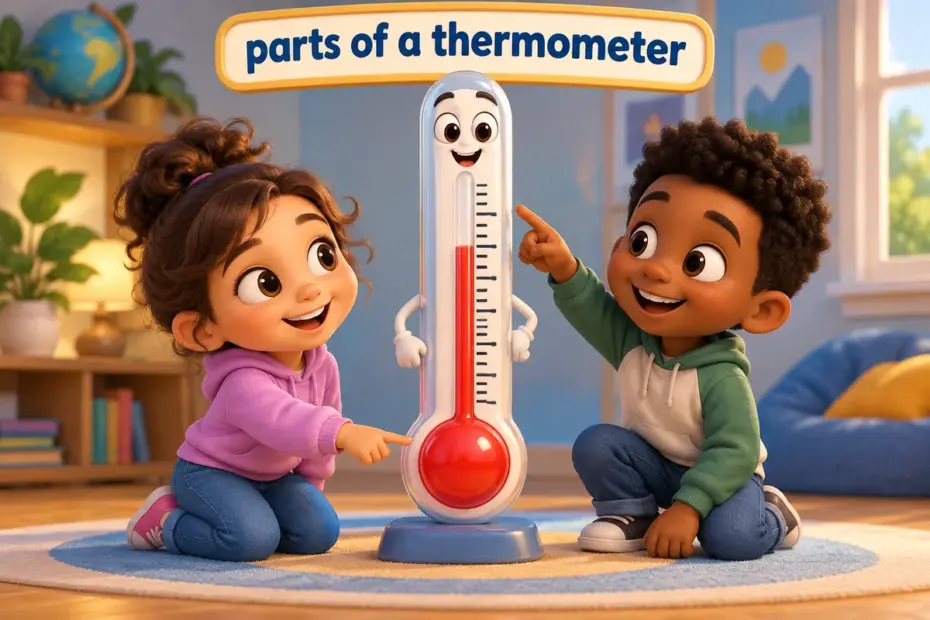
The parts of a thermometer are the bulb, the thin bore, the liquid inside, and the numbered scale along the stem. The bulb senses the heat, the liquid rises or falls in the bore, and the scale turns that movement into a readable temperature.
Parts of a thermometer at a glance
- A thermometer has five main parts: the bulb, the bore, the liquid, the stem, and the scale.
- The bulb holds the liquid that expands as it warms.
- The bore is the narrow tube the liquid moves along.
- The scale turns the liquid level into a number of degrees.
- The commonest error is writing celcius instead of Celsius.
What are the parts of a thermometer?
A thermometer is an instrument that measures temperature and shows it as a number. In a glass thermometer the bulb holds a liquid that expands when it is warm, the bore is the fine tube it rises through, and the scale prints the matching degrees on the stem. Digital thermometers replace the liquid with a sensor and a screen.
| Part | Where it is | What it does | Example sentence |
|---|---|---|---|
| Bulb | The rounded base | Holds the sensing liquid | The bulb of a thermometer touches the tongue. |
| Bore | The thin inner tube | The liquid rises here | The bore of a thermometer is very narrow. |
| Liquid | Inside bulb and bore | Expands with heat | The liquid of a thermometer climbs in the sun. |
| Stem | The glass body | Protects the bore | The stem of a thermometer is easy to break. |
| Scale | Printed along the stem | Shows the degrees | The scale of a thermometer runs up to fifty. |
| Marking | Small lines on the scale | Shows each degree | The markings of a thermometer are evenly spaced. |
| Probe | Tip of a digital one | Senses the heat | The probe of a thermometer beeped at once. |
| Sensor | Inside a digital one | Turns heat into a signal | The sensor of a thermometer reads the heat fast. |
| Display | Screen of a digital one | Shows the number | The display of a thermometer shows 37.0 degrees. |
| Battery | Inside a digital one | Powers the screen | The battery of a thermometer ran low. |
How do you use the parts of a thermometer in a sentence?
The naming phrase puts one part before of a thermometer, or lets the thermometer own that part with an apostrophe. Match the verb to the number of parts you name, because several parts, such as the markings, take a plural verb.
| Pattern | Example | What it signals |
|---|---|---|
| the + part + of a thermometer | The bulb of a thermometer is round. | names one part |
| a thermometer’s + part | A thermometer’s bore is tiny. | shows possession |
| plural part + of a thermometer | The markings of a thermometer are fine. | talks about many marks |
| part + verb | The liquid rises as it warms. | describes a job |
| label + part | The nurse read the scale carefully. | clinical use |
| part + helps + verb | The bulb helps measure the heat. | explains a function |

Parts of a thermometer in context: examples across contexts
The same names appear in a clinic, a science lab, and a weather report, and the wording around them changes with the setting. A parallel labelled list sits in car parts that starts with a to z.
| Context | Example sentence | Why this works |
|---|---|---|
| Classroom | We label the bulb and the scale of a thermometer today. | a school labelling task |
| Clinic note | A digital thermometer gave a reading of 38.2 degrees. | a short clinical record |
| Lab manual | Hold the bulb clear of the glass wall. | a practical instruction |
| Weather report | The thermometer reached thirty degrees by noon. | a public statement |
| Cooking guide | Use a probe thermometer to check the meat. | a kitchen instruction |
| Patient leaflet | Wait ten minutes before the second reading. | a reassuring note |
| Exam question | Name the part that holds the liquid. | a clear instruction |
| Science article | The bore is narrow so small changes are visible. | a technical statement |
| Story | The old thermometer hung beside the kitchen door. | simple narrative wording |
| Product listing | The display shows the temperature in one second. | a buyer note |
Bulb, bore, and scale: how the parts differ
Grouping the parts by role makes the diagram easy to read, because sensing, moving, and showing are three separate stages. A similar one-name-one-job list appears in human body parts that start with a.
| Feature | Bulb | Bore | Scale |
|---|---|---|---|
| Main job | senses the heat | guides the liquid | shows the degrees |
| Where it is | the base | inside the stem | along the stem |
| What changes | the liquid expands | the level moves | the pointer matches |
| Typical material | glass with liquid | narrow glass tube | printed glass or metal |
| Diagram label | bulb | bore | scale |
Word forms and grammar of the parts of a thermometer
Most part names are nouns, and the instrument also gives us the adjective thermal and the noun temperature. The verb measure describes what the user does. A comparable list of human body parts that start with b shows the same naming habit.
| Form | Part of speech | Example |
|---|---|---|
| thermometer | noun | The thermometer broke. |
| thermometers | noun, plural | Both thermometers agree. |
| temperature | noun | The temperature rose. |
| thermal | adjective | A thermal sensor is quick. |
| degree | noun | It fell by one degree. |
| degrees | noun, plural | The fever is 38 degrees. |
| Celsius | noun | Read it in Celsius. |
| Fahrenheit | noun | Some scales use Fahrenheit. |
| measure | verb | Measure the heat first. |
| reading | noun | Take the reading at eye level. |
Common mistakes with the parts of a thermometer
A misspelled unit and a wrong tense cause most of the trouble, so watch the words that sit next to the number.
Mistake 1: celcius for Celsius. Incorrect: The fever is 38 celcius. Correct: The fever is 38 Celsius. Rule: the unit is spelled Celsius, after Anders Celsius.
Mistake 2: degree for degrees. Incorrect: The temperature is 38 degree. Correct: The temperature is 38 degrees. Rule: numbers above one take the plural degrees.
Mistake 3: on for in. Incorrect: Put the thermometer on his mouth. Correct: Put the thermometer in his mouth. Rule: use in for a place inside the mouth.
Mistake 4: go for goes. Incorrect: The liquid of a thermometer go down when it cools. Correct: The liquid of a thermometer goes down when it cools. Rule: a singular subject takes the verb goes.
Mistake 5: temperate for temperature. Incorrect: He has a temperate of 39 degrees. Correct: He has a temperature of 39 degrees. Rule: temperature names the heat, while temperate describes mild weather.
Practice using the parts of a thermometer
- Fill in the blank: The ___ holds the liquid that expands with heat.
- Choose the better word: The numbers are printed on the (scale / bulb).
- Correct the error: The fever is 38 celcius.
- Build a sentence: use bore to say where the liquid moves.
- Spot the register: which line suits a lab manual, (a) The thermometer thingy went up, or (b) Hold the bulb clear of the glass wall?
- Fill in the blank: A digital thermometer shows its number on the ___.
Answers
- bulb, because the bulb holds the liquid that expands with heat.
- scale, because the scale prints the numbered degrees along the stem.
- The fever is 38 Celsius; the unit is spelled Celsius.
- The liquid moves along the narrow bore inside the stem of the thermometer.
- (b), because a lab manual uses precise, neutral instructions.
- display, because the display is the screen that shows the reading.

The bottom line
The parts of a thermometer split into three stages: the bulb senses the heat, the bore lets the liquid move, and the scale turns that movement into degrees. Read the number at eye level, because the level looks higher from the side. Once the three roles are clear, a thermometer is simple to read.
Frequently asked questions about the parts of a thermometer
What are the main parts of a thermometer?
A glass thermometer has five main parts: the bulb, the bore, the liquid, the stem, and the scale. The bulb holds the liquid, the bore is the tube it rises through, the stem is the glass body, and the scale prints the degrees. Digital models swap the liquid for a sensor and a display.
How does a thermometer work?
The liquid inside the bulb expands when it gets warmer, so it pushes up the narrow bore, and it contracts when it cools, so it falls. The scale next to the bore turns that height into a number of degrees. A digital thermometer does the same job with a sensor instead of a liquid.
Why is the bore of a thermometer so narrow?
A narrow bore makes even a tiny change in the liquid’s volume move the level a long way, which is why fine degrees can be read at all. A wide tube would need a huge temperature change to show a visible movement. That is why glass thermometers use a hair-thin channel.
What is a digital thermometer made of?
A digital thermometer uses a probe, a sensor, a small display, and a battery instead of glass and liquid. The sensor turns heat into an electrical signal, and a chip converts that signal into a number on the display. It reads faster and is harder to break.