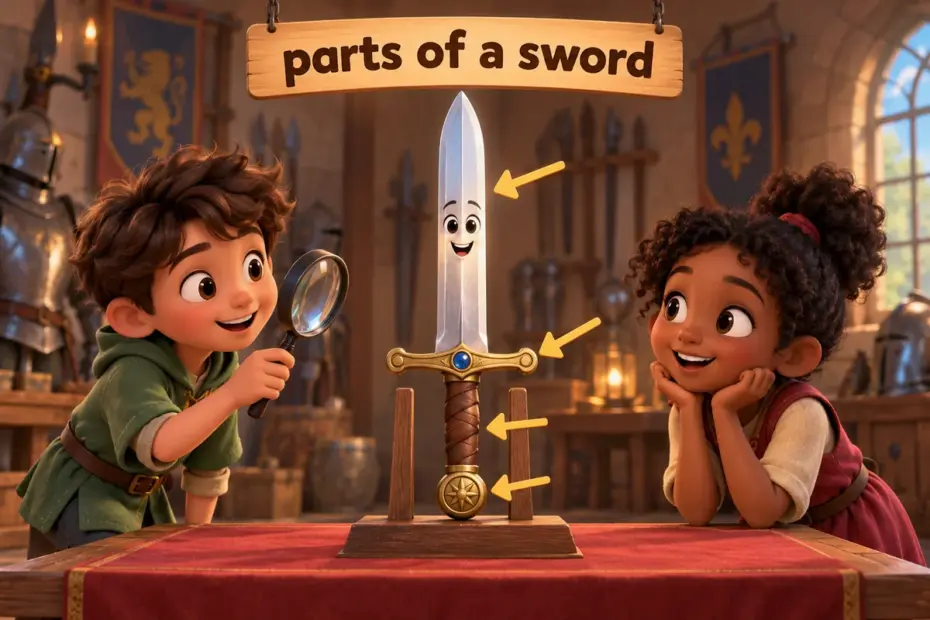
The parts of a sword names and diagram are the blade, guard, grip, pommel, and scabbard that together make a complete weapon. Each label marks one section, from the sharp edge of the blade to the weighted pommel at the end of the handle.
Parts of a sword at a glance
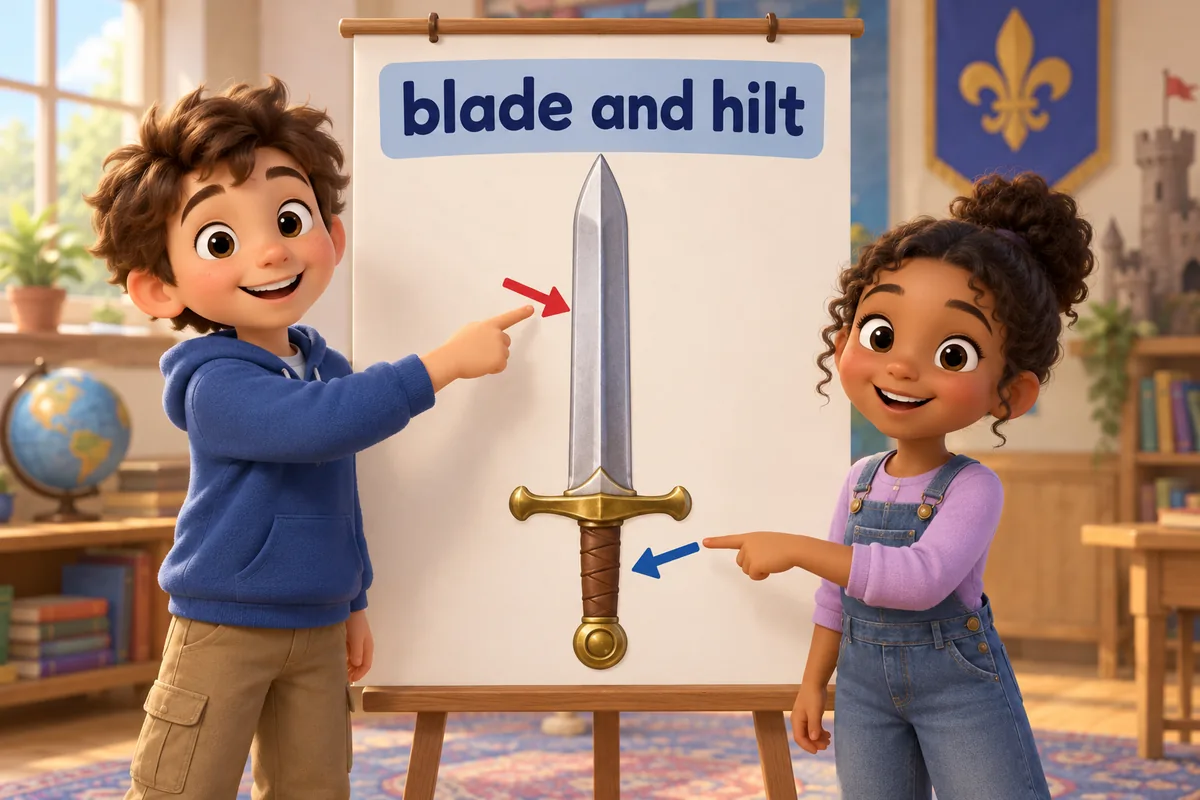
- A sword divides into three groups: the blade, the hilt, and the scabbard.
- The hilt is the whole handle assembly: guard, grip, and pommel.
- The tang runs through the grip and joins the blade to the pommel.
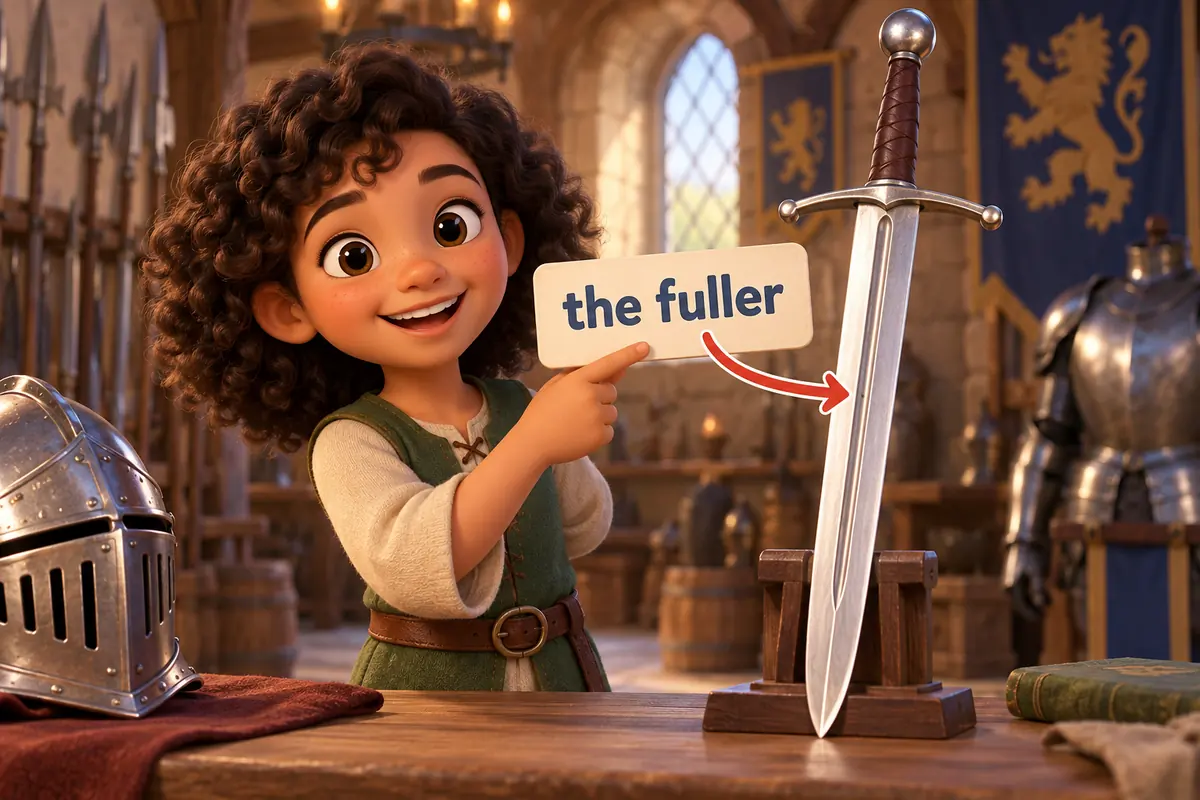
- The fuller is a groove that lightens the blade, not a blood channel.
- The commonest error is calling the whole handle a grip.
What are the parts of a sword?
The parts of a sword are the structures of the blade above the guard and the hilt below it, together with the scabbard that holds the sword when it is not in use. The blade carries the cutting edge, the point, and often a groove called the fuller. The hilt gathers the guard, grip, and pommel around the tang, which is the hidden bar that ties the whole sword together.
| Part | Where it is | What it does | Example sentence |
|---|---|---|---|
| Blade | Above the guard | The cutting and thrusting part | The blade of a sword is long and straight. |
| Edge | Along the blade | Cuts on contact | The edge of a sword is kept sharp. |
| Point | Tip of the blade | Thrusts into a target | The point of a sword is narrow and keen. |
| Fuller | Groove down the blade | Lightens the blade | The fuller of a sword runs along the middle. |
| Ricasso | Unsharpened part above the guard | Lets the hand grip near the guard | The ricasso of a sword sits just above the guard. |
| Guard | Between blade and grip | Protects the hand | The guard of a sword stops a sliding blade. |
| Tang | Inside the grip | Joins blade to pommel | The tang of a sword runs through the handle. |
| Grip | The handle | Where the hand holds | The grip of a sword is wrapped in leather. |
| Pommel | End of the grip | Balances the sword | The pommel of a sword counterweights the blade. |
| Hilt | Guard, grip, and pommel together | The whole handle assembly | The hilt of a sword fits one hand. |
| Scabbard | A sheath at the belt | Holds and covers the blade | The scabbard of a sword hangs at the belt. |
How do you use the parts of a sword in a sentence?
The naming phrase works like any other: put the part before of a sword, or let the sword own it with an apostrophe. The same grouping idea appears in other labelled diagrams, such as the parts of a car.
| Pattern | Example | What it signals |
|---|---|---|
| the + part + of a sword | The blade of a sword runs above the guard. | names one structure |
| a sword’s + part | A sword’s pommel balances the heavy blade. | shows possession |
| plural part + of a sword | The edges of a sword are ground by hand. | talks about a feature |
| part + verb | The guard shields the hand. | describes a job |
| label + part | Students labelled each part of a sword. | school and diagram use |
| part + is made of + material | The grip is made of leather. | describes a material |
Parts of a sword in context: examples across contexts
The same names appear in a classroom, a museum, and a fantasy novel, and the sentence around them changes with the setting. Learners who enjoy body vocabulary can start with human body parts that start with A.
| Context | Example sentence | Why this works |
|---|---|---|
| Classroom | The teacher asked us to name each part of a sword on the worksheet. | a school task about labelling |
| History textbook | The guard of a sword widened as armour improved. | a plain factual statement |
| Museum label | The pommel of the sword is decorated with a lion. | a short caption |
| Fantasy novel | He gripped the hilt and drew the blade from its scabbard. | vivid narrative wording |
| Smith’s guide | Draw the tang out before you fit the grip. | a practical instruction |
| Children’s story | The knight rested his sword against the wall. | simple narrative wording |
| Exam question | Label the parts of a sword shown in the diagram. | a clear instruction |
| Fencing manual | Keep the point of the sword raised. | a technical direction |
| Antique listing | The scabbard of the sword is original to the piece. | a short sales note |
| Safety rule | Never point the blade at another person. | a firm warning |
Blade, hilt, and scabbard: how the parts differ
Grouping the parts by job makes the diagram easy to read, because cutting, gripping, and storing use different structures. A similar list continues with human body parts that start with B.
| Feature | Blade | Hilt | Scabbard |
|---|---|---|---|
| Main job | cut and thrust | grip and protect the hand | cover and carry the blade |
| Position | above the guard | below the blade | around the blade |
| Typical material | steel | leather, wood, and metal | leather or metal |
| Number of parts | several | three main parts | one or two |
| Diagram label | blade | hilt | scabbard |
Word forms and grammar of the parts of a sword
Most part names are nouns, and a few take regular plurals. The adjective form describes the whole assembly, and the series carries on with human body parts that start with C.
| Form | Part of speech | Example |
|---|---|---|
| sword | noun | The sword hung on the wall. |
| swords | noun, plural | Two swords crossed above the door. |
| blade | noun | The blade was polished. |
| edge | noun | The edge was razor sharp. |
| hilt | noun | She held the hilt firmly. |
| guard | noun | The guard was made of brass. |
| pommel | noun | The pommel was set with a stone. |
| tang | noun | The tang ran through the grip. |
| scabbard | noun | The scabbard was bound in leather. |
| swordplay | noun | Swordplay needs quick footwork. |
Common mistakes with the parts of a sword
Mistake 1: grip for the whole handle. Incorrect: He grasped the grip, which includes the guard and pommel. Correct: He grasped the hilt, which includes the guard, grip, and pommel. Rule: the hilt is the whole assembly, and the grip is only the part the hand closes on.
Mistake 2: the fuller as a blood groove. Incorrect: The blood groove let blood flow out. Correct: The fuller is a groove that lightens the blade. Rule: the fuller removes weight, not blood.
Mistake 3: point and edge confused. Incorrect: The edge of the sword pierced the target. Correct: The point of the sword pierced the target. Rule: the edge cuts and the point thrusts.
Mistake 4: pommel at the tip. Incorrect: The pommel is at the sharp end. Correct: The pommel is at the end of the grip. Rule: the pommel counterweights the blade.
Mistake 5: a sword has one edge. Incorrect: Every sword has a single edge. Correct: Some swords are single-edged and some are double-edged. Rule: the number of edges depends on the type.
Practice using the parts of a sword
- Fill in the blank: The ___ protects the hand above the grip.
- Choose the better word: The (hilt / grip) includes the guard and the pommel.
- Correct the error: He drew the sword from its box.
- Build a sentence: use pommel to describe how a sword is balanced.
- Spot the register: which line suits a museum label, (a) This old sword is super cool, or (b) The pommel is decorated with a lion?
- Fill in the blank: The ___ is the hidden bar that joins the blade to the pommel.
Answers
- guard, because the guard shields the hand.
- hilt, because the hilt is the whole handle assembly.
- He drew the sword from its scabbard; a sword is carried in a scabbard.
- The heavy pommel balances the blade of the sword.
- (b), because a museum label needs precise wording.
- tang, because the tang runs through the grip.
The bottom line
The parts of a sword split into three clear groups: the blade for cutting and thrusting, the hilt for gripping and protecting the hand, and the scabbard for carrying the sword. Learn the hilt as a set, because guard, grip, and pommel work together around the hidden tang. Once position and job are linked, the diagram stops being a memory test.
Frequently asked questions about the parts of a sword
How many parts does a sword have?
A sword is usually described with about ten named parts, grouped into the blade, the hilt, and the scabbard. The blade carries the edge, point, fuller, and ricasso; the hilt carries the guard, grip, pommel, and tang. Different traditions add their own names for the same sections.
What is the tang of a sword?
The tang is the narrow extension of the blade that runs down through the grip and meets the pommel at the end. It is the hidden bar that holds the whole sword together, so a weak tang is the commonest failing of a cheap sword. A full tang runs the length of the handle.
What is the difference between the hilt and the guard?
The hilt is the entire handle assembly, made up of the guard, the grip, and the pommel. The guard is only the piece between the blade and the grip that protects the hand. So every guard is part of a hilt, but the hilt is much more than the guard.
What is the fuller on a sword?
The fuller is a shallow groove or grooves forged along the blade to remove metal and reduce weight while keeping the blade stiff. It is often wrongly called a blood groove, but its purpose is structural. A blade with a fuller is lighter and just as strong.