Proper nouns in English name one particular person, place, organisation or thing, and they always begin with a capital letter. A common noun such as city names any city, while the proper noun Paris names exactly one. Days, months, brands and titles are proper nouns too, which is why Wednesday and France take capitals.
Proper nouns in English at a glance
- A proper noun names one specific person, place or thing.
- Proper nouns always start with a capital letter.
- Common nouns name a general class and stay lowercase.
- Proper nouns include names, days, months, places and brands.
- The commonest error is leaving a proper noun in lowercase.
What is a proper noun?
A proper noun is a noun that names a single, specific member of a class rather than the class itself. The distinction shows in a single sentence: the boy is a common noun because it fits any boy, while Daniel is a proper noun because it names one. The capital letter is the visible signal, and it holds for people, places, days, months, companies and titles.
| Category | Examples | What it names |
|---|---|---|
| People | Amara, Mr Patel | A particular person and title |
| Places | Kenya, Rome, Everest | One country, city or mountain |
| Days and months | Tuesday, August | A single day or month |
| Organisations | Unicef, the Louvre | One named group or building |
| Titles | War and Peace | One named work |
| Brands | Adidas, Ford | One named company or product |
One honest limit belongs here. Not every capitalised word is a proper noun. The first word of a sentence takes a capital by position, not by type, so the dog at the start of a sentence is still a common noun. The capital alone does not settle the category.
How do you use proper nouns in a sentence?
A proper noun behaves like any other noun in the sentence, but it carries its capital everywhere, even in the middle of a line. Most take no article, though names of rivers, seas and groups do.
| Pattern | Example | What it signals |
|---|---|---|
| Bare proper noun | We visited Rome. | A city name needs no article. |
| Proper noun with a title | Doctor Reyes arrived. | The title is capitalised with the name. |
| Proper noun with the | the Pacific Ocean | Rivers, seas and oceans take the. |
| Proper noun in a phrase | the streets of Lisbon | The name keeps its capital inside the phrase. |
| Proper adjective | Italian bread | A name used to describe keeps its capital. |
Proper nouns in English examples across contexts
The rule holds in every register, and each sentence below shows a different kind of name at work.
| Context | Sentence | Why this works |
|---|---|---|
| Classroom | Ms Owusu taught us about Mars. | A person and a planet take capitals. |
| Workplace email | Please send it to Delia on Friday. | A name and a day are proper nouns. |
| News report | Heavy rain reached Manchester. | A city names one specific place. |
| Travel note | We flew to Cairo in April. | A city and a month are capitalised. |
| Story opening | Bruno opened the gate slowly. | A character name takes a capital. |
| Academic essay | The study focused on Norway. | A country name is a proper noun. |
| Recipe | Add Sicilian olive oil. | A proper adjective keeps its capital. |
| Letter | Dear Grandmother, thank you. | A title used as a name is capitalised. |
| Shop note | The shop sells Sony speakers. | A brand name is a proper noun. |
Noun lists help learners collect the common nouns that proper nouns sit beside. A page of nouns that start with c gathers common words such as city and captain. A nouns that start with d list adds day and doctor, which often appear beside a proper noun. A nouns that start with e set supplies engine and explorer, and a nouns that start with f page rounds out the set with factory and farmer.
Proper nouns vs common nouns
The two families differ in how specific they are, and that contrast drives the capital letter.
| Feature | Proper noun | Common noun |
|---|---|---|
| Specificity | Names one particular thing | Names any member of a class |
| Capital letter | Always | Only at the start of a sentence |
| Example | Nairobi | city |
| Article | Usually none | Often takes a or the |
| Plural | Rare, as in the two Amys | Common, as in cities |
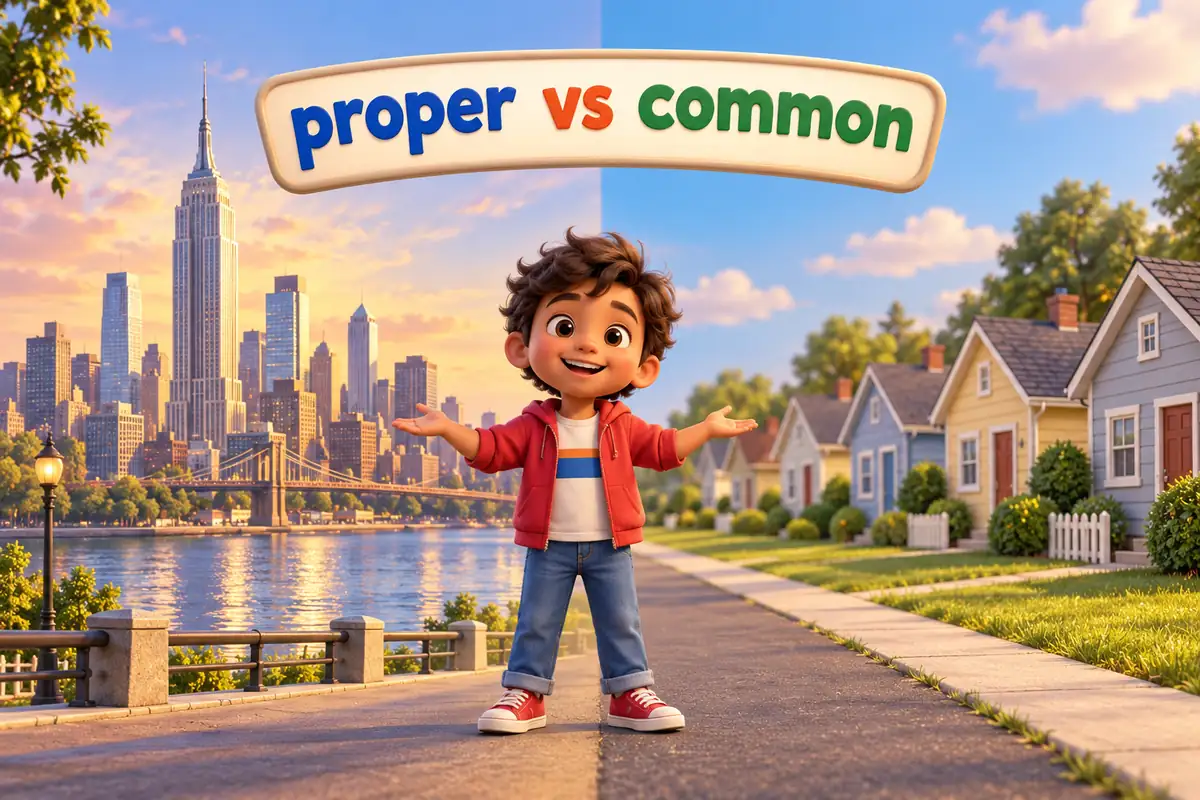
The verdict is plain: if the word names one particular thing, it is a proper noun and it takes a capital.
Word forms and grammar of proper nouns
Proper nouns rarely change form, but a few patterns are worth noting for spelling and for derived adjectives.
| Form | Part of speech | Example |
|---|---|---|
| Proper noun | noun | Canada |
| Proper adjective | adjective | Canadian |
| Proper noun with the | noun phrase | the Nile |
| Plural proper noun | noun | the Alps |
| Common noun from the same root | noun | canada goose |
Common mistakes with proper nouns
| Wrong | Right | Rule |
|---|---|---|
| We met on Monday. | Days are proper nouns and take capitals. | |
| She visited Paris. | City names are proper nouns. | |
| I ate Italian food. | A proper adjective keeps its capital. | |
| The boy asked his mother. | Only the first word of the sentence is capitalised here. | |
| He works for Adidas. | Brand names are proper nouns. |
Practice using proper nouns in English
These exercises test the capital and the category. Fix each item or answer the question, then check the reason.
- Capitalise the proper nouns: we fly to tokyo in june.
- Capitalise the proper nouns: amara met doctor lee on tuesday.
- Correct the error: The team played in madrid.
- Name the type: In The river runs deep, is river a proper or a common noun?
- Build a sentence about a school using one proper noun and one common noun.
- Correct the error: I read the book war and peace.
Answers
- We fly to Tokyo in June. City and month names are proper nouns.
- Amara met Doctor Lee on Tuesday. Names, titles and days take capitals.
- The team played in Madrid. Cities are proper nouns.
- Common. River names one class of thing, so it stays lowercase.
- Greenwood School stands beside the park. Greenwood School is proper and park is common.
- I read the book War and Peace. A title of a work keeps its capitals.
The bottom line
Proper nouns in English name one particular person, place, day or thing, and the capital letter is the mark that sets them apart. Keep the capital wherever the name appears, even inside a longer phrase or a proper adjective. Reserve lowercase for common nouns that name a whole class rather than a single member.
Frequently asked questions about proper nouns
Are the days and months proper nouns?
Yes. Monday, Saturday, January and August all name specific days and months, so they are proper nouns and take capitals in English. This differs from many other languages, where the equivalent words stay lowercase, which is why learners often drop the capital by habit.
Do proper nouns take an article?
Most take no article, so we say Paris, not the Paris. Some names require one, including rivers, seas, oceans and ranges, as in the Thames, the Pacific and the Alps. Country names vary, with the Netherlands and the United States taking the while France does not.
Can a proper noun become a common noun?
Yes. When a brand name becomes the everyday word for a product, it turns into a common noun, and it may lose its capital over time. Terms such as hoover and xerox have followed this path in some varieties of English, though spelling practice still varies.
Is a name always a proper noun?
Almost always, because a name points to one particular person, place or thing. The main exception is when a name is used generally, as in a man who wants to be a Rockefeller, where the name stands for a type of person rather than one individual, and the capital may drop.