
Allocate means to set something aside for a particular purpose or to share it out among people and uses. To use allocate in a sentence, name the resource, the receiver and usually the amount: “The school allocated two hours a week to music.” The receiver is most often introduced by to.
Allocate at a glance
- Allocate is a transitive verb; its forms are allocates, allocated and allocating.
- The usual pattern is allocate + something + to + a person or purpose.
- Allocate belongs to business, finance, public administration and project planning.
- Common collocations include allocate resources, allocate funding and allocate time.
- The commonest error is dropping to before the receiver, as in allocated the team two days.
What does allocate mean?
Allocate is a transitive verb meaning to set a resource aside for a stated use, or to divide it among several recipients. The Cambridge entry for allocate records both the reserve and the share-out sense, and the difference shows in the preposition: to names a receiver, while for names a purpose. A budgeting page on how to budget for a project often explains the same idea in plainer words.
| Sense | Plain meaning | Example sentence |
|---|---|---|
| Set aside for a purpose | Reserve something for a stated use | The council allocated land for a new clinic. |
| Share out among recipients | Divide something among several people or uses | The coach allocated the minutes evenly across the squad. |
| Assign to a named account | Put a cost or resource against a specific place | The finance team allocated the fee to the training budget. |
One limitation is worth stating. Allocate says nothing about whether the share was fair or the purpose wise, and it does not mean to spend. Money can be allocated and never spent, which is why audits keep the two verbs apart.
How do you use allocate in a sentence?
State the resource, then the receiver or purpose, then the amount if you know it. Five patterns cover almost every real sentence, and the choice between to and for changes what you are promising.
| Pattern | Example | What it signals |
|---|---|---|
| allocate + something + to + receiver | The trust allocated ten thousand pounds to the repair work. | Names the amount and where it goes. |
| allocate + somebody + something | The manager allocated each team two extra days. | Double object, common in project talk. |
| allocate + something + for + purpose | The city allocated open space for a market. | For signals the intended use, not the owner. |
| be allocated to + receiver | Each grant was allocated to a single project. | Passive voice, typical of reports. |
| allocate + something + among + group | She allocated the tickets among the four families. | Among stresses division across several parties. |
When the sender is handing out duties rather than setting aside a pool, assign a task is the tighter verb; when the point is a fixed share, allot a portion keeps the amount in view.
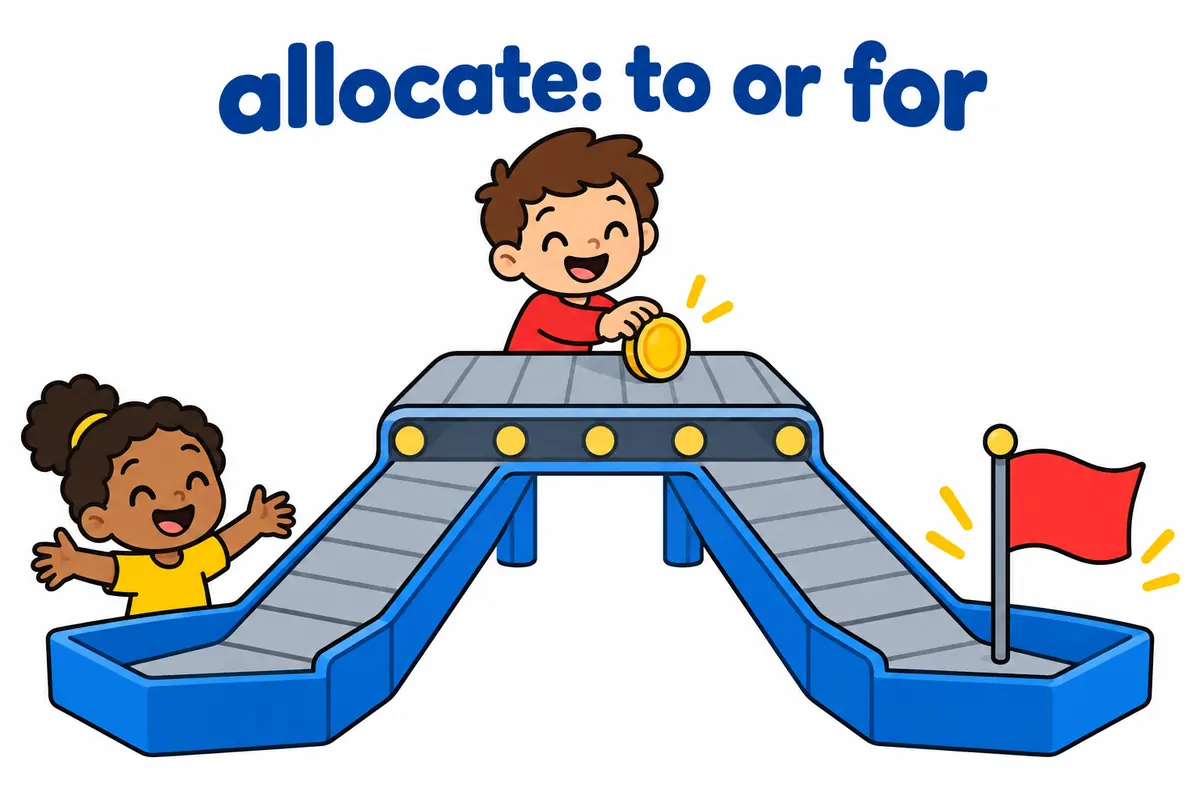
Allocate in a sentence: examples across contexts
Allocate is a planning verb, so its company is budgets and schedules. The eight sentences below move from a school office to a government report, and each one names the resource, the receiver and the amount.
| Context | Example sentence | Why this works |
|---|---|---|
| School office | The head allocated three classrooms to the examination board. | Names the resource and the temporary user. |
| Workplace email | We have allocated two engineers to the migration for six weeks. | People as the resource, with a clear duration. |
| Public finance | The ministry allocated a larger share of the budget to rural clinics. | The formal register of official documents. |
| Personal planning | I allocate an hour each morning to reading. | Everyday use with a habitual time frame. |
| Sports management | The club allocated its entire transfer fund to one defender. | The whole resource and a single receiver. |
| Academic writing | Each condition was allocated an equal number of trials. | Passive voice keeps the method impersonal. |
| Information technology | The system allocates memory to the busiest applications first. | A technical sense close to the literal meaning. |
| Charity report | Donors allocated their gifts among three relief programmes. | Among shows division across several causes. |
Allocate vs assign
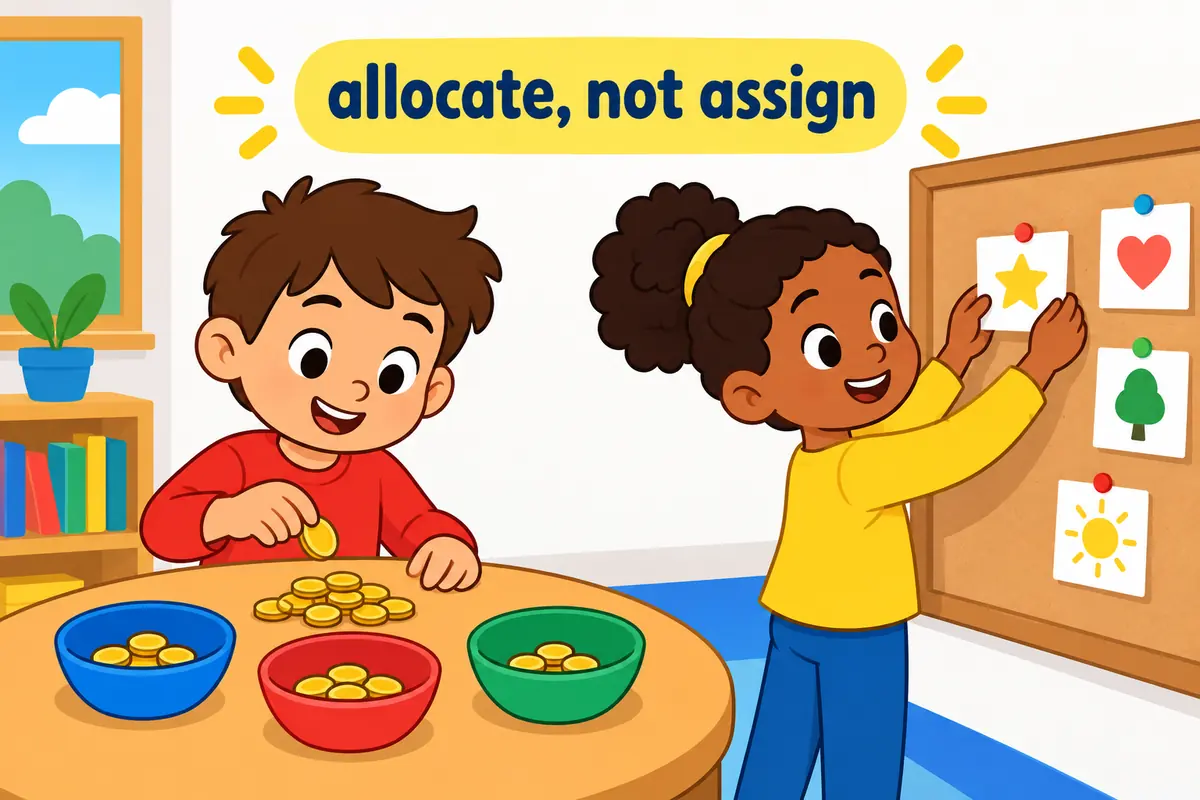
Allocate and assign both hand something to somebody, and learners mix them constantly. Allocate is about a share of a resource; assign is about naming who does what. The table separates the two by what is being handed over.
| Attribute | allocate | assign |
|---|---|---|
| What is handed over | A share of a resource | A task, duty or role |
| Typical object | Time, money, space, staff | Work, homework, a shift |
| Preposition | to a receiver, for a purpose | to a person |
| Implies an amount | Usually yes | Not necessarily |
| Register | Business, finance, planning | General and school use |
Verdict: allocate the hours and the budget, then assign the tasks, because the first word promises a measured share and the second names responsibility.
Word forms and grammar of allocate
Allocate inflects regularly, and its noun and adjective relatives are common in the same reports, which is why a page on allocation belongs beside this one.
| Form | Part of speech | Example |
|---|---|---|
| allocate | verb, base form | They will allocate the seats tomorrow. |
| allocates | verb, third person | The model allocates resources automatically. |
| allocated | verb, past and past participle | Two days were allocated to rehearsals. |
| allocating | verb, present participle | She is allocating the remaining funds. |
| allocation | noun | The allocation of seats took an hour. |
| allocated | adjective, participial | The allocated slot is Friday morning. |
Common mistakes with allocate
- Incorrect:
The director allocated the team two weekswith no preposition after a passive. Correct: Two weeks were allocated to the team. Rule: In the passive, the receiver needs to, because the double-object order is lost. - Incorrect:
We allocated for the project two million.Correct: We allocated two million to the project. Rule: The resource comes straight after allocate; for cannot sit between the verb and its object. - Incorrect:
The judge advocated funds to the repairs.Correct: The judge allocated funds to the repairs. Rule: To advocate a policy means to support it publicly, not to set money aside. - Incorrect:
The budget was allocated between the two schools equally for the year.Correct: The budget was allocated between the two schools for the year. Rule: Between already implies division, so equally repeats the idea. - Incorrect:
Please allocate to me a desk.Correct: Please allocate a desk to me. Rule: Keep the resource before the receiver unless the sentence is passive.
Practice using allocate
Work through the six items, then read the reason beside each answer.
- Fill the gap: The committee ______ half its reserve to flood defence.
- Choose the better word: The teacher (allocated / assigned) the reading task to each pair.
- Correct the error: The firm allocated for marketing a larger sum.
- Build a sentence: use allocate something to about a family dividing its holiday budget.
- Spot the register: which belongs in a council document — funds were allocated to youth services, or we gave the youth club some cash?
- Change the voice: The board allocated two seats to the union. Rewrite in the passive.
Answers
- allocated — the reserve is the resource and the receiver follows with to.
- assigned — a task is given to a person, which is the work of assign rather than allocate.
- The firm allocated a larger sum to marketing — the resource must follow the verb directly.
- Model answer: We allocated two hundred pounds to meals and the rest to travel.
- Funds were allocated to youth services — the passive suits an official record.
- Two seats were allocated to the union — the receiver keeps to in the passive.
The bottom line
Use allocate in a sentence when a measured share of something is reserved for a receiver or a purpose, and state the resource before the receiver. The two details that decide most sentences are these: to marks a receiver while for marks a purpose, and the verb promises a share rather than a completed spend. When the point is who does the work, grant a request or assign is the tighter choice.
Frequently asked questions about allocate
What does it mean to allocate resources?
To allocate resources is to decide how much of a limited supply goes to each person, team or purpose. A hospital allocates beds, a school allocates rooms and a company allocates staff time. The verb always implies a finite pool and a deliberate choice, which is why it appears so often in planning and budgeting.
Is allocate a noun or a verb?
Allocate is a verb, and its noun relative is allocation. You allocate a sum, and the result is an allocation. The adjective allocated, as in the allocated slot, is a participle doing adjectival work. Keeping verb and noun apart avoids the common slip of writing an allocate of funds instead of an allocation of funds.
What preposition follows allocate?
Both to and for follow allocate, and they do different jobs. Allocate something to a person or department names the receiver; allocate something for a purpose names the intended use. Allocate something among a group stresses that the share is divided across several parties. The verb itself never takes a bare object without one of these prepositions in careful writing.
Can allocate mean to divide?
Partly. Allocate includes dividing a pool among recipients, so the share-out sense is real. It differs from divide in carrying the idea of a purpose or an agreed share, since a quantity can be divided without anyone being allocated a part. Use divide for the arithmetic and allocate for the decision behind it.
To allocate means to assign or distribute something for a particular purpose, person, or group. In “The team allocated two hours to testing,” the verb names both the resource and its intended use. Common patterns include allocate funds to a project, allocate time for a task, and allocate duties among team members.
Key facts at a glance
- Allocate is a transitive verb meaning to assign or distribute a resource for a purpose or as someone’s share.
- Common objects include time, money, space, funding, duties, and tickets.
- Use allocate something to a person or recipient and allocate something for a purpose.
- The forms are allocate, allocates, allocated, and allocating.
What does allocate mean?
Cambridge Dictionary defines allocate as giving something to someone as a share of a total or assigning it for a particular use. The word is a transitive verb, so a sentence normally names what is being allocated: “The school allocated funds” or “The coordinator allocated seats.”
Writers often use allocate for resources that need to be divided or assigned, including money, time, staff, duties, rooms, or a limited number of tickets. The verb does not say whether the decision is fair or effective; those judgments need their own evidence.
How do you use allocate in a sentence?
Use allocate with a direct object, then add a phrase for the recipient, purpose, or group. A clear sentence tells readers both what was assigned and where it went.
| Pattern | Example | Relationship |
|---|---|---|
| allocate + resource + to + recipient | The council allocated extra funds to the library. | Names who receives the resource |
| allocate + resource + for + purpose | We allocated an hour for the review. | Names how the resource will be used |
| allocate + resource + among + group | The manager allocated the shifts among six staff members. | Shows distribution across several people |
| allocate + person + task | The teacher allocated each group a research topic. | Uses a person and an assigned item |
The two-object pattern can also be reordered: “The teacher allocated a research topic to each group.” For time, both “allocate two hours to editing” and “allocate two hours for editing” are natural, with to emphasizing the activity and for emphasizing its intended purpose.
Examples of allocate in a sentence
- The project lead allocated three afternoons to user testing.
- The school allocated new tablets to the science classes.
- Each department received funds allocated for staff training.
- The festival organizers allocated seats among the invited schools.
- Rina allocated a quiet corner of the room for reading.
- The teacher allocated each student a different research question.
- Before the trip, the family allocated a set amount for meals and transit.
How does allocate change form?
Allocate is a regular verb: its past tense and past participle are allocated, its third-person singular form is allocates, and its present participle is allocating. Keep the double l in all forms: “She allocates,” “they allocated,” and “we are allocating.”

In passive sentences, the resource receives the action: “The grants were allocated to local schools.” The agent may be named with by (“by the committee”) or omitted if it is already understood. Passive voice is useful when the distribution matters more than the decision-maker.
Allocate, assign, allot, and distribute
Allocate often highlights planned distribution of a resource for a purpose. Assign commonly gives a task, role, or responsibility to someone; allot emphasizes a share or portion; distribute focuses on spreading items to multiple recipients.
| Verb | Typical emphasis | Example |
|---|---|---|
| allocate | Planned resource or share | The board allocated money for repairs. |
| assign | Task or responsibility | The editor assigned Maya the final proofread. |
| allot | Specific portion or quota | Each speaker was allotted five minutes. |
| distribute | Delivery to recipients | Volunteers distributed the maps at the entrance. |
These verbs overlap. Choose allocate when the sentence needs to show deliberate placement of a finite resource, and name the recipient or purpose to make the assignment concrete.

Common mistakes with allocate
A sentence can sound incomplete when allocate has no clear object: “We need to allocate” leaves readers asking what should be assigned. Add the resource: “We need to allocate more staff hours to customer support.” Also avoid treating allocate as a synonym for simply putting something somewhere when no assignment or distribution is involved.
For an efficient edit, check three parts: the resource, the recipient or purpose, and the preposition that connects them. “Allocate books to classrooms” identifies recipients; “allocate money for new books” identifies a purpose. That small check usually resolves the sentence’s meaning.
Frequently asked questions about allocate
What is an example of allocate in a sentence?
“The manager allocated two extra hours to the design review” is an example. Allocated is the past-tense verb, two extra hours is the resource, and to the design review names its intended use. This states the time amount and its assigned purpose clearly.
What preposition follows allocate?
Use to for a recipient or assigned activity, for for an intended purpose, and among when dividing something across a group. For example, a school allocates grants to students, time for tutoring, or shifts among staff members for a clear distribution.
Is allocate a noun or a verb?
Allocate is a verb. The related noun is allocation, as in “the allocation of classroom space.” Use the verb for the act of assigning a resource and the noun for the decision, process, or amount assigned. The verb names the act of assigning it.
What is the difference between allocate and assign?
Allocate often describes distributing a limited resource for a purpose, such as funds or time. Assign often describes giving a person a task, role, or responsibility. Their meanings overlap, so choose the verb that best highlights the relationship your sentence needs to explain.
Original article content
Usage note: Some original examples use awkward or incomplete patterns. The updated guide shows allocate with a clear resource and recipient or purpose.
Have you ever wondered how to properly allocate resources in a project or assignment? The word “allocate” simply means to distribute or assign something for a specific purpose or use.
In various scenarios, whether it’s dividing tasks among team members, assigning funds to different departments, or determining timeframes for completing project milestones, the ability to allocate resources effectively is crucial for achieving desired outcomes and meeting objectives.
7 Examples Of Allocate Used In a Sentence For Kids
- Allocate crayons for everyone to use during drawing time.
- Let’s allocate one biscuit to each friend at snack time.
- The teacher will allocate different roles for our class play.
- We need to allocate seats on the bus for our field trip.
- Please help me allocate the toys back in their proper places.
- It’s important to allocate time for eating our lunch.
- We will allocate plant seeds in the garden for our science project.
14 Sentences with Allocate Examples
- Allocate enough time for each subject while creating a study schedule for the upcoming exams.
- Make sure to allocate different budgets for food, transportation, and other expenses during the college trip.
- Allocate specific tasks to each group member for the group project to ensure equal participation.
- It is important to allocate enough resources for your research project to make it successful.
- Allocate a dedicated study area in your room to minimize distractions while studying.
- Ensure to allocate proper time for extracurricular activities to maintain a healthy work-life balance.
- Allocate sufficient time to prepare for presentations to deliver them effectively in class.
- Allocate a specific amount of money each month for your savings to build a secure financial future.
- Properly allocate time for breaks in between study sessions to avoid burnout.
- Allocate different time slots for various college club meetings to ensure you can participate in all of them.
- Create a monthly meal plan and allocate a budget for groceries to avoid overspending on food.
- Remember to allocate time for self-care activities like exercise and meditation to reduce stress levels.
- Allocate specific days for library visits to borrow books for your assignments and projects.
- Allocate enough time to explore internship opportunities in your field of interest to gain practical experience.
How To Use Allocate in Sentences?
To allocate means to distribute or set aside for a specific purpose. When using the word allocate in a sentence, it is important to clearly express how something is being assigned or designated.
For example, “The team will allocate funds for the new project.” In this sentence, allocate is used to show that funds are being set aside for the new project.
To use allocate effectively in a sentence, make sure to specify what is being assigned and for what purpose. For instance, “The manager allocated tasks to each team member for the upcoming event.” Here, allocate is used to indicate that tasks are being distributed to team members.
Another example is, “It is important to allocate enough time for studying before the exam.” In this sentence, allocate is used to indicate that time needs to be set aside for studying.
When incorporating allocate into a sentence, consider the context and be clear about what is being distributed or designated. Using allocate effectively can help convey your message accurately and efficiently.
Conclusion
In summary, the concept of allocating resources is crucial in ensuring effective distribution and utilization of available assets. By assigning specific resources to particular tasks or projects, organizations can enhance productivity and achieve their objectives in a more organized manner. For instance, companies often allocate funds to various departments based on their needs and priorities, leading to better financial management and operational efficiency.
Furthermore, governments allocate resources towards education, healthcare, and infrastructure, aiming to address societal needs and promote development. Through strategic allocation, resources can be optimized to maximize their impact and benefit the intended recipients. Overall, the practice of allocating resources plays a significant role in decision-making processes, enabling entities to make informed choices and attain their desired outcomes.


