
Blow up means to explode, to fill something with air, to make something larger, or to lose your temper suddenly. To use blow up in a sentence, choose the sense first: “The balloon blew up” inflates, while “The tyre blew up” explodes. The particle is separable for the making-larger senses.
Blow up at a glance
- Blow up is a phrasal verb with four common senses: explode, inflate, enlarge and lose your temper.
- The explode, rage and intensify senses are intransitive, so no object follows.
- The inflate and enlarge senses are transitive and separable: blow up the photo or blow the photo up.
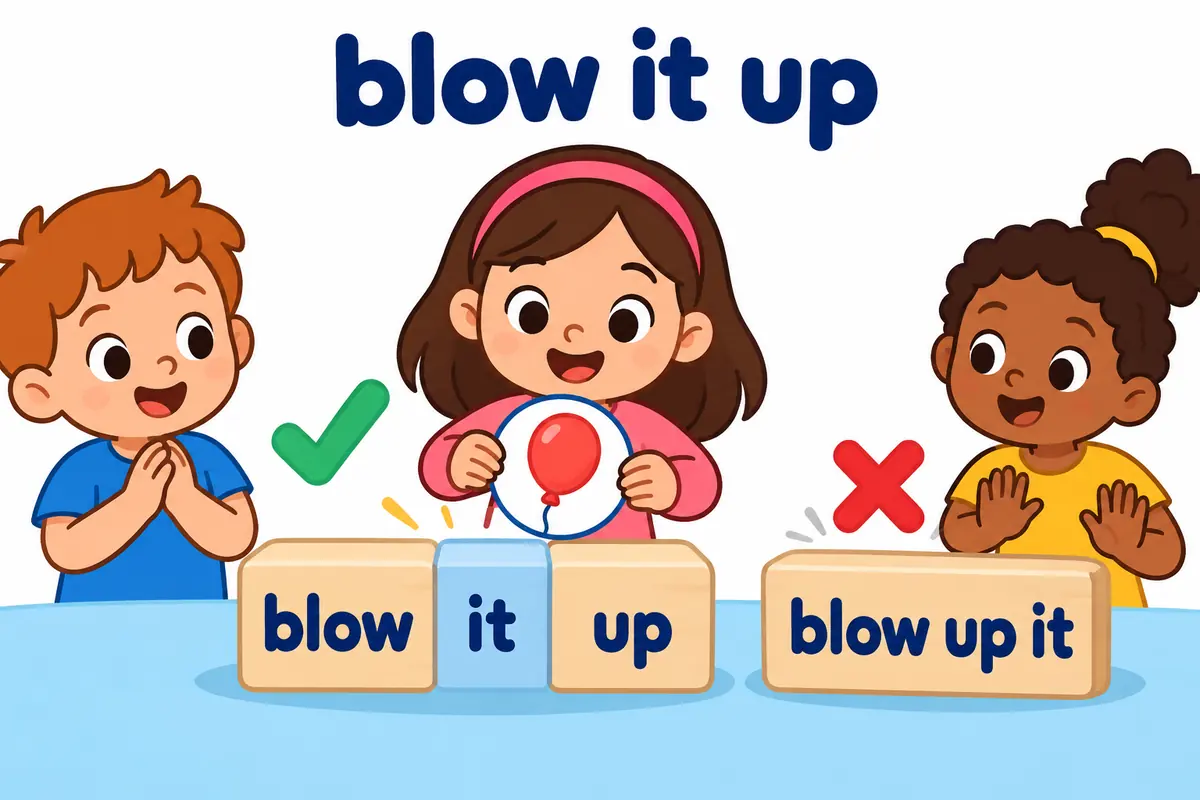
- A pronoun object must sit between the verb and the particle: blow it up, never blow up it.
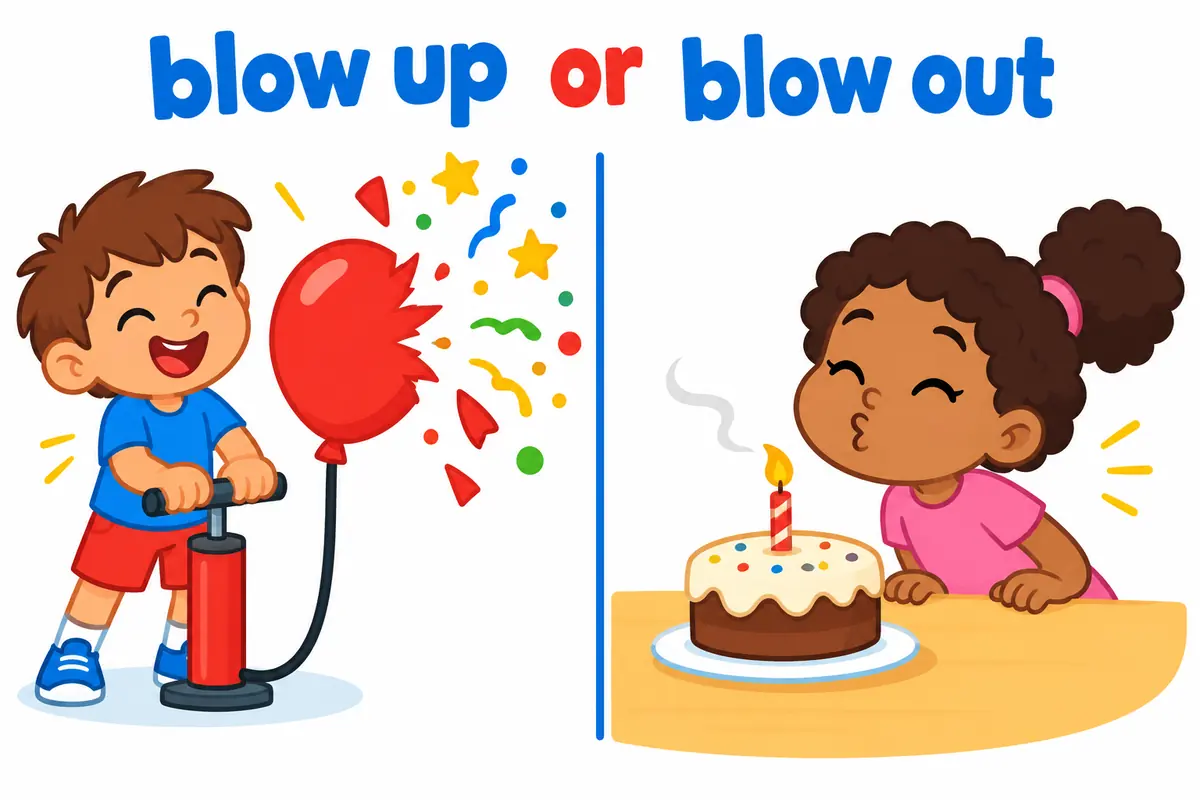
- The commonest error is confusing blow up with blow out, which means to burst or to extinguish.
What does blow up mean?
Blow up is a phrasal verb meaning to explode, to fill with air, to make something larger, or to become suddenly angry. The Cambridge entry for blow up records the explosion and the inflation senses, and context decides which one a reader hears. To explode is the single-word verb for the first sense, while to inflate covers the second and to enlarge covers the third.
| Sense | Plain meaning | Example sentence |
|---|---|---|
| Explode | Burst violently, often with damage | The tyre blew up on the motorway. |
| Inflate | Fill something with air | Help me blow up the balloons. |
| Enlarge | Make an image or text bigger | Blow up the photo for the poster. |
| Lose your temper | Become suddenly and visibly angry | He blew up at the referee. |
| Intensify | Grow suddenly more serious | The dispute blew up overnight. |
The limitation is worth stating plainly. Blow up is informal and physical, so it is the wrong verb for a calm, controlled increase; grow or escalate serve better when nothing bursts or loses control.
How do you use blow up in a sentence?
The explode, rage and intensify senses are intransitive, so nothing follows the verb. The inflate and enlarge senses are transitive and separable, and a pronoun object must sit inside the verb.
| Pattern | Example | What it signals |
|---|---|---|
| subject + blew up | The old gas tank blew up. | Intransitive explosion. |
| blew up at + person | She blew up at the driver. | Anger aimed at somebody. |
| blow up + object | Blow up the mattress. | Inflation, particle kept joined. |
| blow + object + up | Blow the image up twice. | Enlarging, particle separated. |
| blow + pronoun + up | Blow it up before the meeting. | A pronoun forces the split. |
The split is not optional with a pronoun: blow up it is impossible, so blow it up is the only grammatical form, and that one rule reveals which senses are separable and which are not.
Blow up in a sentence: examples across contexts
Blow up jumps between a kitchen, a news desk and a football pitch, and the sense changes with the scene. The nine sentences below keep the verb while moving the meaning.
| Context | Example sentence | Why this works |
|---|---|---|
| Home | We blew up forty balloons for the party. | Inflation, with a clear object. |
| News report | A gas cylinder blew up behind the shop. | Explosion reported without blame. |
| Workplace email | Please blow up the chart before the presentation. | Enlarging an image, politely asked. |
| Conversation | Dad blew up when he saw the bill. | Sudden anger, in informal speech. |
| Sports writing | The manager blew up at the fourth official. | Anger aimed at a person. |
| Photo studio | They blew the portrait up to poster size. | Separable particle with a clear measure. |
| Political report | The row blew up after the vote. | Intensifying, with a time marker. |
| Safety notice | Do not let the canister blow up in the heat. | Warning uses the intransitive sense. |
| Family scene | He blew the airbed up in the garden. | Inflation with the particle separated. |
Only the anger and explosion sentences leave nothing after the verb, which is the quickest way to tell the intransitive senses from the transitive ones. To erupt is the nearest single-word verb for the sudden-anger sense.
Blow up vs blow out
Blow up and blow out share a verb but point in different directions. Blow up bursts outward or grows; blow out bursts a tyre, extinguishes a flame, or ends with a sudden loss, and the two are swapped constantly by learners.
| Attribute | blow up | blow out |
|---|---|---|
| Core meaning | Explode, inflate, enlarge, rage | Burst, extinguish, widen outward |
| Typical object | A balloon, a photo, a temper | A candle, a tyre, a flame |
| Direction | Grows or bursts outward | Forces air or flame outwards and ends it |
| Anger sense | Yes, to blow up at someone | No |
| Idiom | A row blows up | A storm blows out |
Verdict: choose blow up for growth, explosion or temper, and blow out when something is snuffed, burst or widening, so the blow out pair is best told apart by what happens to the air. To implode is its inward opposite, because that verb collapses rather than bursts.
Word forms and grammar of blow up
Blow up inflects irregularly, because blow becomes blew in the past. The table lists the forms a reader will meet, including the hyphenated noun.
| Form | Part of speech | Example |
|---|---|---|
| blow up | verb, base form | Do not blow up the tyres too far. |
| blows up | verb, third person singular | He blows up over small things. |
| blew up | verb, past | The boiler blew up last winter. |
| blown up | verb, past participle | The photo was blown up for the wall. |
| blowing up | verb, present participle | They are blowing up balloons now. |
| blow-up | noun, hyphenated | The blow-up print hung in the hall. |
The noun blow-up, always hyphenated, names an enlarged photograph or a sudden quarrel, and the hyphen keeps it distinct from the two-word verb.
Common mistakes with blow up
Five errors cover most wrong uses of this phrasal verb, and each has one clear fix.
- Incorrect:
Blow up it before lunch.Correct: Blow it up before lunch. Rule: A pronoun object must sit between the verb and the particle. - Incorrect:
The candle blew up and went out.Correct: The candle blew out. Rule: Extinguishing a flame is blow out, not blow up. - Incorrect:
He blew up the balloon down.Correct: He blew up the balloon. Rule: A phrasal verb takes one particle, so never add a second. - Incorrect:
Prices blew up by two percent.Correct: Prices rose by two percent. Rule: A calm, measured increase takes rise or grow, not blow up. - Incorrect:
She blew up with the delay.Correct: She blew up over the delay. Rule: The anger sense takes at for a person and over or about for a cause.
Practice using blow up
Work through the six items, then read the reasons rather than only the answers.
- Fill the gap: The children ______ twenty balloons for the party.
- Choose the better word: The wind made the candle (blow up / blow out).
- Correct the error: Please blow up it for the poster.
- Build a sentence: use blow up at about a lost temper.
- Spot the register: which belongs in a safety notice — the canister went boom, or do not let the canister blow up in the heat?
- Fill the gap: The argument ______ overnight after the meeting.
Answers
- blew up — the past tense of blow is blew, and the balloons are being inflated.
- blow out — the wind extinguishes a flame, so the particle is out.
- Please blow it up for the poster. — a pronoun sits inside the verb.
- Model answer: The coach blew up at the players after the loss.
- Do not let the canister blow up in the heat — a notice keeps a calm, precise warning.
- blew up — the dispute intensified suddenly, which is the intransitive sense.
The bottom line
Use blow up in a sentence when something bursts, fills with air, is made larger, or loses control suddenly, and check first whether the verb needs an object. Two points settle most sentences: the explode and anger senses are intransitive, while the inflate and enlarge senses are separable, so a pronoun goes inside as in blow it up. Where something merely bursts, burst is the plainer choice.
Frequently asked questions about blow up
Is blow up one word or two?
As a verb, blow up is two words, and its forms are blows up and blew up. As a noun it is hyphenated, so a blow-up means an enlarged photograph or a sudden quarrel. Keep the space for the verb and the hyphen only for that noun.
What is the difference between blow up and blow out?
Blow up bursts outward, grows or rages, while blow out bursts a tyre, extinguishes a flame or widens outward. You blow up a balloon, but you blow out a candle. The direction of the air and what happens to the object are the reliable clues.
Can blow up mean to get angry?
Yes, and it is one of the commonest uses in speech. To blow up at somebody is to lose your temper suddenly and visibly with them, while to blow up over something names the cause. The anger sense is intransitive, so no object follows the verb.
Is blow up separable?
Only the inflate and enlarge senses are separable: you can blow the balloon up or blow up the balloon. The explode, anger and intensify senses are intransitive and take no object at all. With a pronoun, the split is compulsory, so you always say blow it up.
Have you ever wondered what it means to “blow up” in a conversation? When someone talks about something blowing up, they aren’t referring to an actual explosion. Instead, it’s a figurative expression used to describe when something becomes extremely popular, successful, or widely known in a short amount of time.
To further clarify, when a topic, idea, product, or even a person “blows up,” it experiences a sudden surge in attention, recognition, or interest. This can happen for various reasons, such as a viral social media post, a hit song, a trending hashtag, or a successful product launch. It’s a colloquial term often used in informal settings to describe rapid and widespread acclaim.
7 Examples Of Blow Up Used In a Sentence For Kids
- Blow up the balloon and watch it float in the air.
- Be careful not to blow up too many bubbles in your bubble gum.
- The wind can blow up the leaves and make them fly around.
- Do not blow up the birthday candles before making a wish.
- The sun can blow up into a big, bright fireball one day.
- We can use a bike pump to blow up our bicycle tires.
- Be careful when you blow up a balloon so it doesn’t pop in your face.
14 Sentences with Blow Up Examples
- Blow up the balloons for the college fest decorations.
- Don’t forget to blow up the air mattress for your friend staying over.
- The college library printer is jammed again; it might blow up soon.
- I accidentally spilled water on my laptop, and now I’m afraid it will blow up.
- We should blow up our study group chat with reminders about the upcoming exam.
- The chemistry lab experiment went wrong, causing the beaker to blow up.
- Blow up the inflatable pool for our rooftop party this weekend.
- The professor’s email inbox is about to blow up with assignment submission notifications.
- The debate about the new campus food options is about to blow up on social media.
- The social event planning committee needs to blow up the event poster on campus notice boards.
- The student council meeting is going to blow up with discussions on budget allocations.
- The online class discussion forum is about to blow up with comments on the latest lecture.
- The energy drink vending machine is faulty and might blow up if not fixed immediately.
- The queue at the college counselor’s office is sure to blow up during peak admission season.
How To Use Blow Up in Sentences?
To use “Blow Up” in a sentence, you simply need to remember that this phrasal verb means “to make something appear larger.”
For example, you can say, “She asked the printing technician to blow up the image so that it could be more visible when displayed in the gallery.” In this sentence, “blow up” is used to indicate the action of enlarging the image.
Another example could be, “The graphic designer decided to blow up the logo on the packaging to make it more eye-catching.” Here, “blow up” is used to describe the act of increasing the size of the logo.
When using “Blow Up,” it is important to remember that it typically refers to making something larger or increasing its size. You can use it in various contexts, whether talking about images, designs, or any other visual elements that need to be enlarged.
Practicing using “Blow Up” in different sentences will help you become more comfortable with incorporating this phrasal verb into your everyday communication. So, next time you need to emphasize making something appear larger, remember to use “Blow Up” in your sentence!
Conclusion
In conclusion, the phrase “blow up” can be used in various contexts to describe different actions or situations. It can refer to the literal explosion or bursting of an object, such as a balloon or a bomb, as well as to the sudden and rapid increase in size, popularity, or significance of something, like a social media post or a business venture. Additionally, “blow up” can also depict losing one’s temper or reacting aggressively to a situation, demonstrating the versatility and flexibility of this common expression in the English language.
Whether it’s used to describe a dramatic event, a sudden success, or an emotional outburst, the phrase “blow up” serves as a vivid and impactful way to convey a wide range of meanings and actions in everyday communication.


