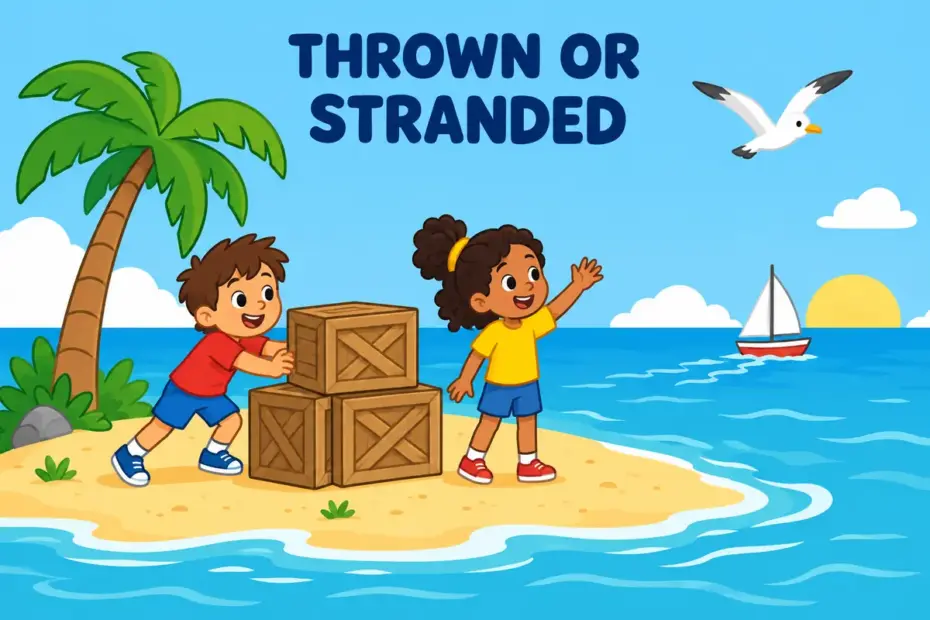
Cast away means to throw something away or to leave a person stranded, as sailors once were on a remote shore. To use cast away in a sentence, put the object after the verb or between cast and away: they cast away the broken nets.
Cast away at a glance
- Cast away is a phrasal verb built from the verb cast plus the particle away.
- It means either to discard something completely or to strand a person far from help.
- The discarding sense is transitive and takes a direct object.
- The stranding sense is most natural in the passive: they were cast away.
- The commonest error is adding a second away or putting a pronoun in the wrong place.
What does cast away mean?
Cast away is a phrasal verb meaning to throw something away as useless, or to leave a person helpless in a far-off place. The Cambridge entry for cast away records the discarding sense, and the stranding sense survives strongly in the noun castaway. The two meanings share one idea: something or someone is put out of reach and left there.
| Sense | Plain meaning | Example sentence |
|---|---|---|
| Discard | Throw something away as useless | They cast away the tangled fishing nets. |
| Strand | Leave a person helpless far from home | The crew was cast away on a rocky island. |
One honest limit matters: cast away is dramatic. For ordinary rubbish, throw away is the plainer and more natural choice, and cast away belongs to stories, history and strong emotion. The stranding sense resembles abandon, which also leaves someone helpless and far from rescue.
How do you use cast away in a sentence?
Separability is the key fact. Cast away is a separable phrasal verb, so the object may follow the whole phrase, as in cast away the nets, or sit between the verb and the particle, as in cast the nets away. A pronoun must sit inside: cast it away, never cast away it. In the stranding sense the passive is standard, as in the sailors were cast away.
| Pattern | Example | What it signals |
|---|---|---|
| cast away + object | They cast away the old nets. | Discard; object stays outside |
| cast + object + away | She cast the letters away. | Discard; object sits inside |
| cast + pronoun + away | He cast it away. | A pronoun must sit inside |
| be cast away on + place | The family was cast away on an island. | Stranding; usually passive |
| a castaway | She lived as a castaway for a year. | The noun for a stranded person |
Cast away in a sentence: examples across contexts
| Context | Example sentence | Why this works |
|---|---|---|
| Storytelling | The storm cast the sailors away on a lonely coast. | The stranding sense drives adventure. |
| Everyday conversation | Just cast away the broken bits and keep the rest. | The discard sense in a plain instruction. |
| News report | Fishermen were cast away after their boat lost power. | Passive stranding suits a factual report. |
| Environmental writing | Communities once cast away plastic without a thought. | The discard sense with a moral edge. |
| Historical account | The settlers were cast away on an uninhabited shore. | Formal stranding in the passive. |
| Novel | She cast away her old name and started fresh. | Figurative discarding of an identity. |
| Sport report | The coach cast away the cautious plan at half time. | Figurative discard of an approach. |
| Classroom task | Rewrite the sentence so the object sits inside the verb. | Practises separability directly. |
| Museum label | A castaway survived here for two winters. | The noun names a stranded person. |
Notice how the passive dominates the stranding rows: a person is almost always cast away by something else, a storm, a wreck or a war, and the sentence usually names that cause. At sea, the deliberate version of the act is to jettison cargo overboard to save the vessel.
Cast away vs cast aside
The nearest neighbour is cast aside, which also means to get rid of something but stresses a deliberate push to one side. Cast away throws something out for good or strands a person; cast aside sets something down and moves on.
| Attribute | Cast away | Cast aside |
|---|---|---|
| Core meaning | Throw out or strand | Push to one side or ignore |
| Object type | Rubbish, nets, or a person | Doubts, plans, or a person figuratively |
| Typical voice | Active or passive | Usually active |
| Consequence | Gone for good, or stranded | Set down but recoverable |
| Example | The crew was jettisoned from the sinking boat. | She cast aside her doubts and spoke. |
The verdict: use cast away when something is thrown out completely or a person is left stranded, and use cast aside when something is merely set down or disregarded for now. For everyday rubbish, throw away is the natural choice, and discard covers the same act in a slightly more formal voice.
Word forms and grammar of cast away
| Form | Part of speech | Example |
|---|---|---|
| cast away | base phrasal verb | Do not cast away the spare rope. |
| casts away | third person singular | He casts away every old sketch. |
| cast away | past tense, unchanged | They cast away the damaged sails last week. |
| casting away | present participle | She is casting away the torn pages. |
| castaway | noun | The castaway built a shelter from driftwood. |
| cast-off | different word | Do not swap it in; it means a discarded item. |
Common mistakes with cast away
- Incorrect:
He cast away the wrapper away.Correct: He cast away the wrapper. One away is enough. - Incorrect:
She cast away it.Correct: She cast it away. A pronoun goes between the verb and the particle. - Incorrect:
The team cast away its old captain.Correct: The team cast aside its old captain. Rejecting a person figuratively uses cast aside. - Incorrect:
A year later he cast away on an island.Correct: A year later he was cast away on an island. The stranding sense is passive. - Incorrect:
Robinson was a cast away.Correct: Robinson was a castaway. The stranded person is one noun.
The family of cast verbs is easy to tangle. Cast off releases a boat, cast aside sets something down, and cast away throws it out or strands a person, so the particle carries the meaning.
Practice using cast away
- Fill in the blank: The gale ____ the small crew away on a sandbank.
- Fill in the blank: Please don’t ____ these old photographs.
- Choose the better word: She (cast away / cast aside) her worries and stepped on stage.
- Correct the error: He cast away it into the bin.
- Build a sentence: describe a stranded traveller, using be cast away on.
- Spot the register: which suits a formal report, ‘cast away’ or ‘threw out’?
Answers
- cast: the past form is unchanged, so cast works.
- cast away: discarding old things is the base verb.
- cast aside: setting worries down uses cast aside.
- He cast it away into the bin: the pronoun goes inside.
- The traveller was cast away on a bare island for three weeks.
- cast away: the phrasal verb suits formal or dramatic writing.
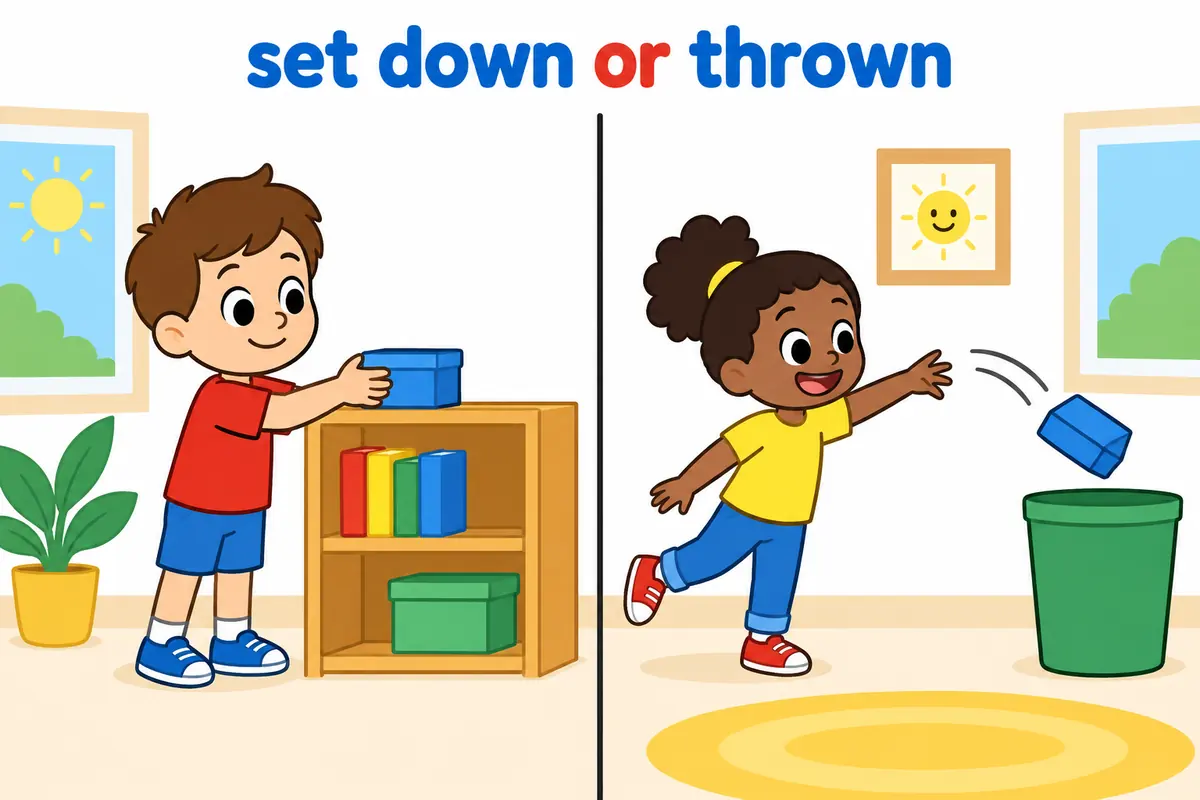
The bottom line
Cast away is a separable phrasal verb with two related senses: throw something out for good, or leave a person stranded far from help. Put a pronoun inside the verb, use the passive for the stranding sense, and keep cast aside for things set down rather than discarded. For plain rubbish, throw away reads more naturally.
Frequently asked questions about cast away
Is cast away written as one word or two?
As a verb it is two words, cast away, as in they cast away the nets. The stranded person, however, is a single noun, castaway, as in the castaway lit a fire. Only that noun form is written as one word.
What does cast away mean on a desert island?
On a desert island the phrase describes a person left helpless after a wreck or a disaster. It is almost always passive, as in the sailors were cast away on the shore. The image comes from a ship throwing its crew onto an unknown coast.
Is cast away separable?
Yes, it is separable in the discarding sense. The object can follow the whole phrase, as in cast away the nets, or sit inside, as in cast the nets away. A pronoun must sit inside, so cast it away is correct and cast away it is not.
What is the difference between cast away and cast aside?
Cast away means to throw something out for good or to strand a person, while cast aside means to set something down or ignore it temporarily. A rejected plan is cast aside and may return; rubbish is cast away and is gone. The particle decides the strength.
Have you ever used the phrase “cast away” in conversation but wondered what it truly means? “Cast away” is a common English expression that refers to getting rid of something or someone, often intentionally and decisively.
When you “cast away” something, you are essentially discarding, rejecting, or disposing of it. This action can have various implications based on the context in which it is used, ranging from literal physical removal to symbolic abandonment or rejection.
7 Examples Of Cast Away Used In a Sentence For Kids
- Cast away your worries and dance with joy.
- Let’s cast away all the unhealthy habits and choose to be happy.
- Cast away the old toys and make space for new ones.
- We can cast away our fears and be brave like superheroes.
- Cast away the sadness and fill your heart with laughter.
- When we cast away the trash, we are helping our planet stay clean.
- Let’s cast away our doubts and believe in ourselves.
14 Sentences with Cast Away Examples
- When preparing for exams, don’t let distractions cast away your focus.
- It’s important to cast away negative thoughts and believe in your abilities during presentations.
- Don’t cast away your textbooks after the semester ends; you might need them for future reference.
- It’s common for college students to cast away their health in pursuit of academic success.
- Always make time to cast away stress by engaging in activities you enjoy.
- Don’t let procrastination cast away your chances of completing assignments on time.
- It’s crucial to cast away toxic relationships that hinder your personal growth and well-being.
- Find ways to cast away financial worries by creating a budget and sticking to it.
- It’s easy to cast away the importance of networking, but it can greatly benefit your future career.
- Make it a habit to cast away negativity and surround yourself with positivity.
- Cast away self-doubt and embrace new opportunities for personal and professional growth.
- Don’t cast away valuable feedback from professors; use it to improve your academic performance.
- Take time to cast away online distractions and focus on your studies.
- Make an effort to cast away limiting beliefs that may be holding you back from reaching your full potential.
How To Use Cast Away in Sentences?
Cast Away is typically used as a phrasal verb that means to get rid of or discard something or someone.
To use Cast Away in a sentence, follow these steps:
-
Identify an object, idea, or person that you want to discard.
-
Place the main word Cast Away at the beginning of your sentence to indicate the action of discarding.
-
Add the object, idea, or person you want to discard immediately after Cast Away.
For example:
- Cast Away all negative thoughts to feel more positive and energized.
- It’s time to Cast Away all the old clothes cluttering your closet.
- The company decided to Cast Away their outdated business model and adopt a new approach.
Remember to always use Cast Away in the appropriate context and ensure that the sentence makes sense with the intended meaning of discarding something. By following these simple steps, you can effectively incorporate Cast Away into your everyday language.
Conclusion
In conclusion, “Cast Away” is a popular movie that captivates audiences with its gripping story of survival and resilience. The film showcases the incredible acting abilities of its lead, Tom Hanks, who delivers a powerful performance in a challenging role. The plot of “Cast Away” follows a man stranded on a deserted island, highlighting the human spirit’s ability to endure even in the most dire circumstances.
With its compelling storyline and strong emotional impact, “Cast Away” has become a classic in the genre of survival films. The movie’s theme of survival against all odds resonates with audiences, making it a timeless favorite. Whether it’s the iconic cast away scenes or the underlying message of hope and perseverance, “Cast Away” continues to be a compelling and memorable cinematic experience for viewers around the world.


