
Cast aside means to throw something away or to reject a person, rule or idea as no longer useful. To use cast aside in a sentence, name what is rejected: “The committee cast aside the earlier proposal.” The verb is separable, so cast the proposal aside works too.
Cast aside at a glance
- Cast aside is a transitive phrasal verb; its forms are casts aside, casting aside and the unchanged past cast aside.
- The particle is movable: cast aside the rule and cast the rule aside are both standard.
- A pronoun must sit in the middle, so write cast it aside rather than cast aside it.
- The passive is common in reports: the plan was cast aside.
- The commonest error is confusing cast aside with put aside, which means to save for later.
What does cast aside mean?
Cast aside is a phrasal verb meaning to discard an object, or to reject an idea, rule or person as no longer worth keeping. The Cambridge entry for cast aside records the sense of putting something out of use, and the image is deliberate: something is thrown to one side, not destroyed. Where a thing is simply thrown in the bin, discard is plainer, because cast aside often adds a judgement that the thing was once valued.
| Sense | Plain meaning | Example sentence |
|---|---|---|
| Discard an object | Throw away something unwanted | She cast aside the torn map. |
| Reject an idea | Dismiss a proposal as useless | The board cast aside the merger plan. |
| Abandon a person | Leave someone without support | He cast aside his closest ally. |
| Drop a rule or habit | Give up a practice | The team cast aside its strict routine. |
One limitation is worth stating plainly. Cast aside is not neutral the way discard is: it often suggests that the thing rejected had been useful and is now treated as refuse. For a neutral act of tidying, discard or throw away serves better, and for a plan stored for later, put aside is the right verb.
How do you use cast aside in a sentence?
Cast aside is transitive and separable, so the object may follow the phrase or split it. As with most phrasal verbs, a pronoun is fixed in the middle. The passive appears constantly in reporting, where the person doing the rejecting stays unnamed and the rejected thing takes the subject position.
| Pattern | Example | What it signals |
|---|---|---|
| cast aside + object | They cast aside the standing rule. | Standard order; the object follows the phrase. |
| cast + object + aside | She cast the letter aside. | Separable; the particle moves after the object. |
| cast + pronoun + aside | He cast it aside without a glance. | A pronoun must sit between verb and particle. |
| be cast aside | The proposal was cast aside. | Passive; common in reports and minutes. |
| cast aside + as + adjective | They cast the idea aside as unworkable. | Adds the reason for the rejection. |
A practitioner rule follows: when the object is short and the emphasis falls on the rejection, let the particle trail; when a pronoun stands in for the object, it can only occupy the middle. Coaches who abandon a plan mid-season usually cast it aside for a reason a reader expects to hear.
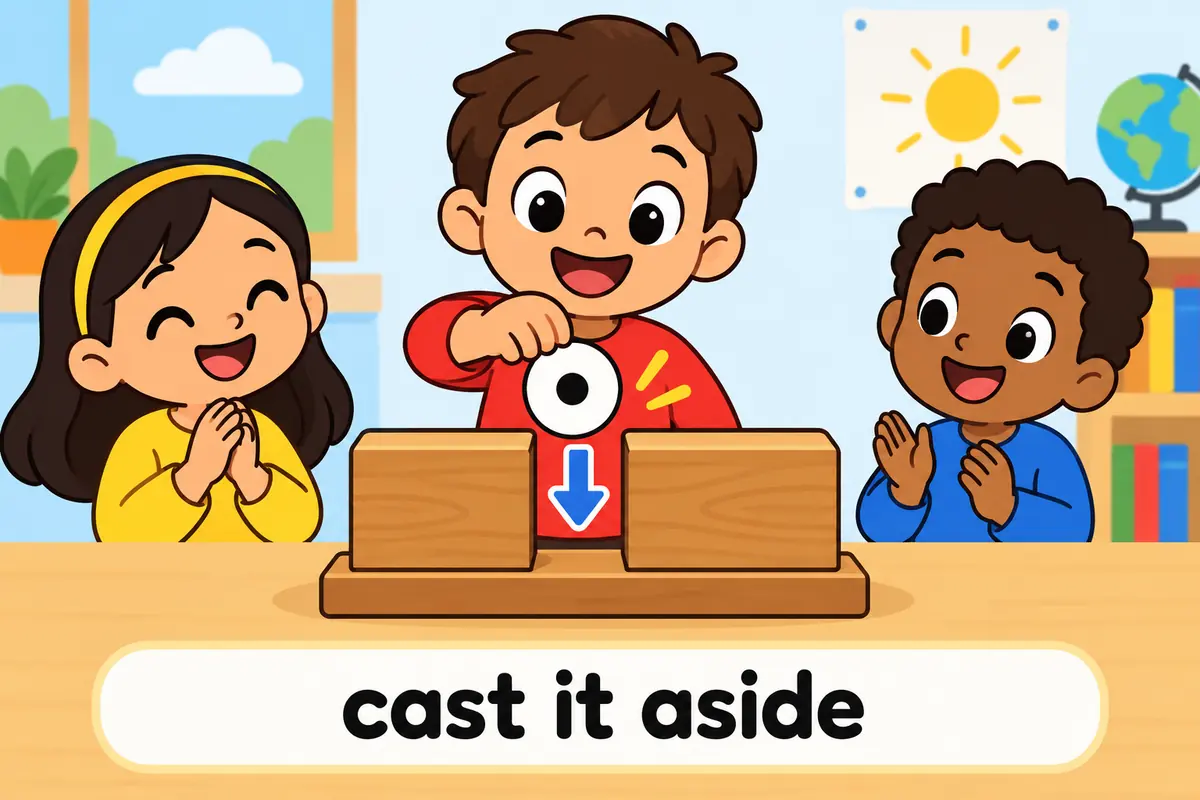
Cast aside in a sentence: examples across contexts
Cast aside moves from a physical object to a rule to a person without changing its shape. These nine sentences show the same phrasal verb doing different work and name who is doing the rejecting.
| Context | Example sentence | Why this works |
|---|---|---|
| Classroom | The pupils cast aside their worn worksheets at the end of term. | A concrete object makes the discard sense literal. |
| Workplace email | The board cast aside the merger plan after one meeting. | A decision as object shows the reject-an-idea sense. |
| News report | Long-standing safety rules were cast aside during the rush. | The passive keeps the actors unnamed. |
| Sports writing | The manager cast aside his cautious tactics at half time. | A strategy as object suits the register. |
| Literary criticism | The novel casts aside convention to follow one voice. | An abstract noun widens the sense to style. |
| Political speech | We must not cast aside those who built this town. | A person as object carries moral weight. |
| History essay | The reformers cast aside centuries of custom. | A long span makes the rejection feel sweeping. |
| Conversation | He cast aside my advice and bought the car anyway. | The everyday sense means to ignore a suggestion; rival claims were dismissed in the same debate. |
| Technical writing | The engineers cast aside the first design as unsafe. | The as phrase supplies the reason. |
Not every rejection implies waste. To jettison cargo is to throw something overboard under pressure, which is a more specific picture than casting an idea aside in a calm meeting.
Cast aside vs put aside and brush aside
Three phrasal verbs share the particle aside and mean different things. Cast aside rejects a thing as no longer useful, put aside sets a thing down or saves it for later, and brush a warning aside dismisses a concern without giving it weight. The particle moves in all three, but only cast aside carries the sense of treating something as refuse.
| Attribute | cast aside | put aside | brush aside |
|---|---|---|---|
| Core meaning | Reject as no longer useful | Save or set down for later | Dismiss a concern lightly |
| Typical object | A plan, rule or ally | Money, a book, a quarrel | A worry, a warning, a question |
| Keeps the thing | No | Yes, for later | Yes, but ignores it |
| Emotional weight | Often strong | Calm and practical | Cool and impatient |
| Register | Neutral to formal | Neutral | Neutral |
Verdict: put money aside to save it, brush a warning aside to ignore it, and cast a proposal aside only when it is genuinely being rejected.
Word forms and grammar of cast aside
Cast aside keeps the same form in the past, and the base verb cast is irregular in its other senses too. The table lists the forms and the two look-alike phrasal verbs built on the same base.
| Form | Part of speech | Example |
|---|---|---|
| cast aside | verb, base form | Do not cast aside a good idea too soon. |
| casts aside | verb, third person singular | She casts aside each draft without regret. |
| cast aside | verb, past tense | They cast aside the plan last week. |
| casting aside | verb, present participle | He is casting aside tired habits. |
| cast away | phrasal verb — different meaning | The storm cast the boat away onto rocks. |
| cast off | phrasal verb — different meaning | They cast off the ropes and sailed. |
Keep cast away and cast off away from this sense: cast away suggests being stranded, and cast off suggests loosening or abandoning, rather than rejecting something as useless.
Common mistakes with cast aside
- Incorrect:
He cast aside it without reading.Correct: He cast it aside without reading. Rule: A pronoun goes between the verb and its particle. - Incorrect:
Please cast aside your savings for a rainy day.Correct: Please put aside your savings for a rainy day. Rule: Save-for-later uses put aside, not cast aside. - Incorrect:
The rules were cast aside of the committee.Correct: The rules were cast aside by the committee. Rule: The agent of a passive takes by, never of. - Incorrect:
The team cast aside to its routine.Correct: The team cast aside its routine. Rule: The verb is transitive, so the rejected thing cannot be left out.
Practice using cast aside
Work through the six items, then check the reasoning rather than only the key.
- Fill the gap: The editor ______ the first draft and started again.
- Choose the better word: Keep some money (cast aside / put aside) for the trip.
- Correct the error: They cast aside it at once.
- Build a sentence: use be cast aside about a long-standing tradition.
- Spot the register: which fits a formal report — the proposal was cast aside, or we just tossed the proposal?
- Rewrite with a pronoun: The team cast aside the standing rule. Replace the object with it.
Answers
- cast aside — the editor rejects the draft, and the object follows the whole phrase.
- put aside — the money is saved for later, which is the put-aside sense.
- They cast it aside at once — a pronoun must sit between the verb and its particle.
- Model answer: The tradition was cast aside after only two seasons.
- The proposal was cast aside — a report prefers the passive to an informal tossed.
- The team cast it aside — the pronoun takes the middle position.
The bottom line
Use cast aside in a sentence when something is rejected as no longer useful, and keep the particle free to move around a noun or pronoun. Two details decide most sentences: a pronoun must sit in the middle, and put aside means to save for later while cast aside means to reject.
Frequently asked questions about cast aside
Is cast aside separable?
Yes. You can write cast aside the plan or cast the plan aside, and the meaning stays the same. Only a pronoun is fixed in the middle, so cast it aside is correct while cast aside it is not used in standard English.
What is the past tense of cast aside?
The past tense is cast aside, unchanged from the base form: the board cast aside the plan yesterday. English never uses casted here. The same single form works as the past participle, as in the idea has been cast aside twice.
What is the difference between cast aside and put aside?
Cast aside means to reject something as no longer useful. Put aside means to set something down or save it for later. The rejected thing is gone from the picture, while the put-aside thing is kept, so the two verbs rarely swap in a sentence.
Does cast aside always mean abandoning a person?
No. The verb most often takes an idea, rule or object as its object, as in the committee cast aside the plan. When the object is a person, as in she cast aside her ally, the rejection carries a stronger emotional charge.
Have you ever felt disregarded or dismissed? Being cast aside means being ignored or rejected, often causing feelings of insignificance or being unimportant.
When someone is cast aside, they can feel isolated and unvalued. This can happen in various situations, from personal relationships to professional environments. It’s a common occurrence that can have a significant impact on a person’s self-esteem and well-being.
7 Examples Of Cast Aside Used In a Sentence For Kids
- Cast aside the old toys and make space for new ones.
- It is important to cast aside litter and keep our environment clean.
- Let’s cast aside our worries and have fun playing together.
- Don’t cast aside your books after reading; keep them safe on the shelf.
- Remember to cast aside any negative thoughts and focus on the positive.
- We should cast aside our differences and learn to work together.
- It’s time to cast aside our fears and be brave like superheroes.
14 Sentences with Cast Aside Examples
- Cast aside all distractions and focus on your studies.
- Cast aside any negative thoughts and stay positive during exams.
- Make sure to cast aside procrastination and start working on your assignments.
- It’s important to cast aside self-doubt and believe in your abilities.
- Don’t cast aside the opportunity to join extracurricular activities for personal growth.
- Remember to cast aside any fears and approach your professors for help when needed.
- Never cast aside the chance to attend seminars and workshops for career development.
- Cast aside the temptation to party all night and prioritize your sleep schedule.
- Ensure to cast aside unnecessary expenses and manage your finances wisely.
- It’s crucial to cast aside unhealthy habits like binge-watching and dedicate time to study.
- Cast aside any feelings of competition and collaborate with your classmates for better learning.
- Don’t cast aside important deadlines and always submit your assignments on time.
- Make sure to cast aside any misunderstandings and communicate effectively with your peers.
- Remember to cast aside any biases and be open-minded towards different perspectives.
How To Use Cast Aside in Sentences?
To use “Cast Aside” in a sentence, you can follow these simple guidelines.
-
Identify the context: Determine a situation where something or someone is being ignored, rejected, or dismissed.
-
Choose the main subject: Decide what or who is being cast aside in your sentence. This could be an object, idea, person, or even a feeling.
-
Form a sentence: Construct a sentence that clearly communicates the act of casting aside. For example, “She decided to cast aside her old clothes and make room for new ones.”
-
Ensure clarity: Make sure that the sentence clearly conveys the idea of discarding, disregarding, or abandoning something.
-
Review and revise: Read the sentence aloud to see if it makes sense and effectively conveys the concept of casting aside.
-
Practice: Try using “Cast Aside” in different sentences to become more familiar with its usage and nuances.
Remember, “Cast Aside” is a powerful phrase that signifies the act of setting something aside or rejecting it. By following these steps and practicing, you can confidently incorporate this expression into your writing and conversations.
Conclusion
In life, we often encounter situations where we feel cast aside, neglected, or disregarded. Whether it’s in personal relationships, professional endeavors, or societal contexts, the act of being cast aside can leave one feeling hurt and unvalued. However, it’s crucial to remember that our worth is not determined by how others treat us or perceive us.
Instead of wallowing in the feeling of being cast aside, it’s important to focus on self-worth, self-care, and self-love. We have the power to break free from the constraints of being cast aside by nurturing our own sense of value and surrounding ourselves with people who appreciate and uplift us. By prioritizing self-compassion and inner strength, we can navigate through the challenges of feeling cast aside and emerge stronger, more resilient, and ready to embrace our worthiness.