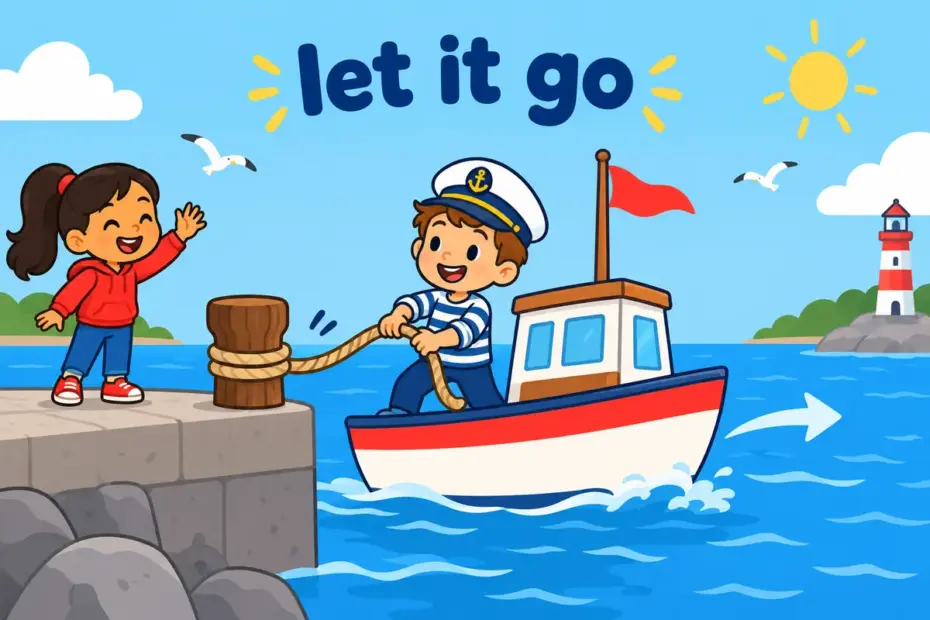
Cast off in a sentence usually means to untie a boat, to throw something away, or to set yourself free from a burden. The phrasal verb is separable, so a sailor casts off the rope or casts the rope off. A simple example is “The crew cast off at dawn.”
Cast off at a glance
- Cast off is a phrasal verb that is usually separable: cast off the rope or cast the rope off.
- Its forms are casts off, cast off and casting off; the past tense never adds -ed.
- The main senses are releasing a boat, discarding something, and freeing yourself from a burden.
- Usual collocations are cast off the lines, cast off old habits and cast off the moorings.
- In knitting, casting off is the final row that stops stitches unravelling.
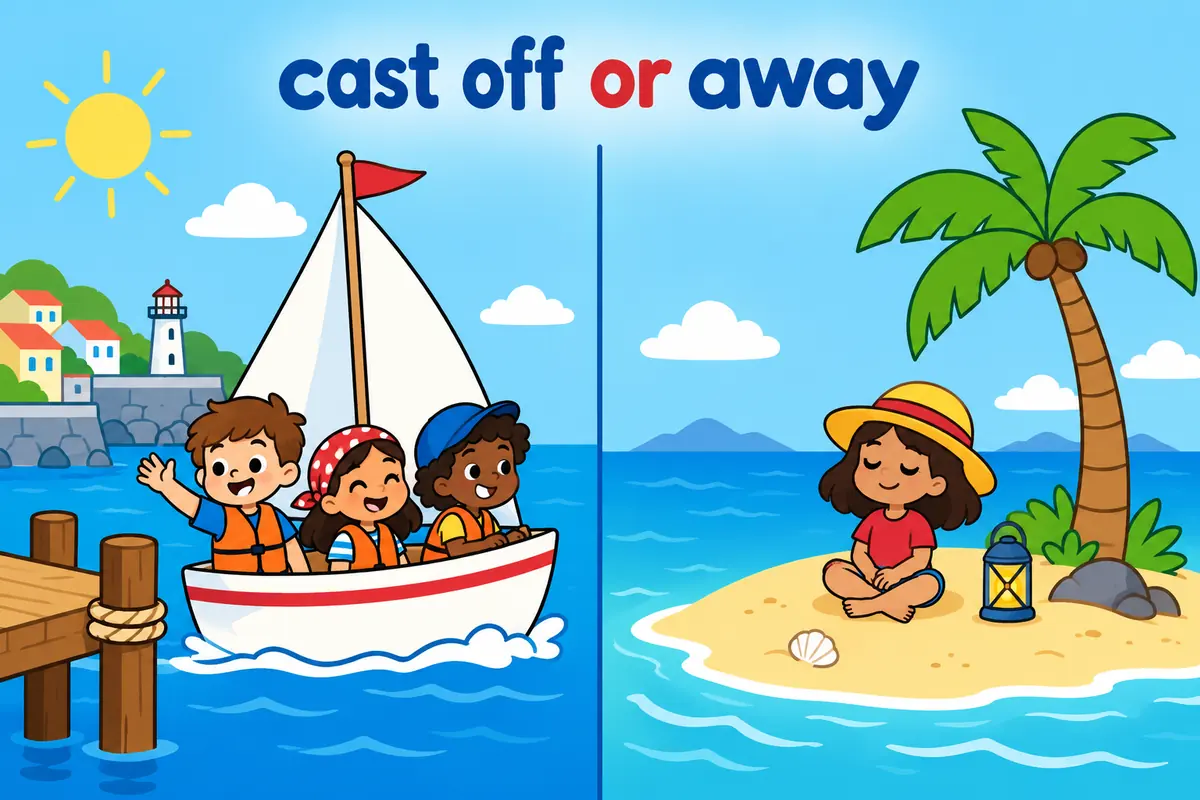
- The commonest error is confusing cast off with cast away, which means marooned or thrown away.
What does cast off mean?
Cast off is a separable phrasal verb with three living senses. The Cambridge entry for cast off records the boating sense and the wider sense of getting rid of something. A sailor casts off the mooring lines; a householder casts off clutter; a person can cast off a habit or a fear. Airlines jettison cargo to save weight, which is a narrower and more technical idea, and everyday speech prefers discard for rubbish.
| Sense | Plain meaning | Example sentence |
|---|---|---|
| Release a boat | Untie the lines so a vessel can leave | The ferry cast off from the quay. |
| Discard | Throw away something no longer wanted | We cast off the broken chairs. |
| Free yourself | Let go of a habit, fear or burden | She cast off her old worries. |
| Finish knitting | Work the last row so stitches are secured | Cast off the final row loosely. |
One limitation is worth stating. Cast off sounds odd about people in everyday modern speech: a person can be cast off in a literary or historical sentence, but abandon or reject is the plainer choice. The verb always implies a decisive release, not a routine action.
How do you use cast off in a sentence?
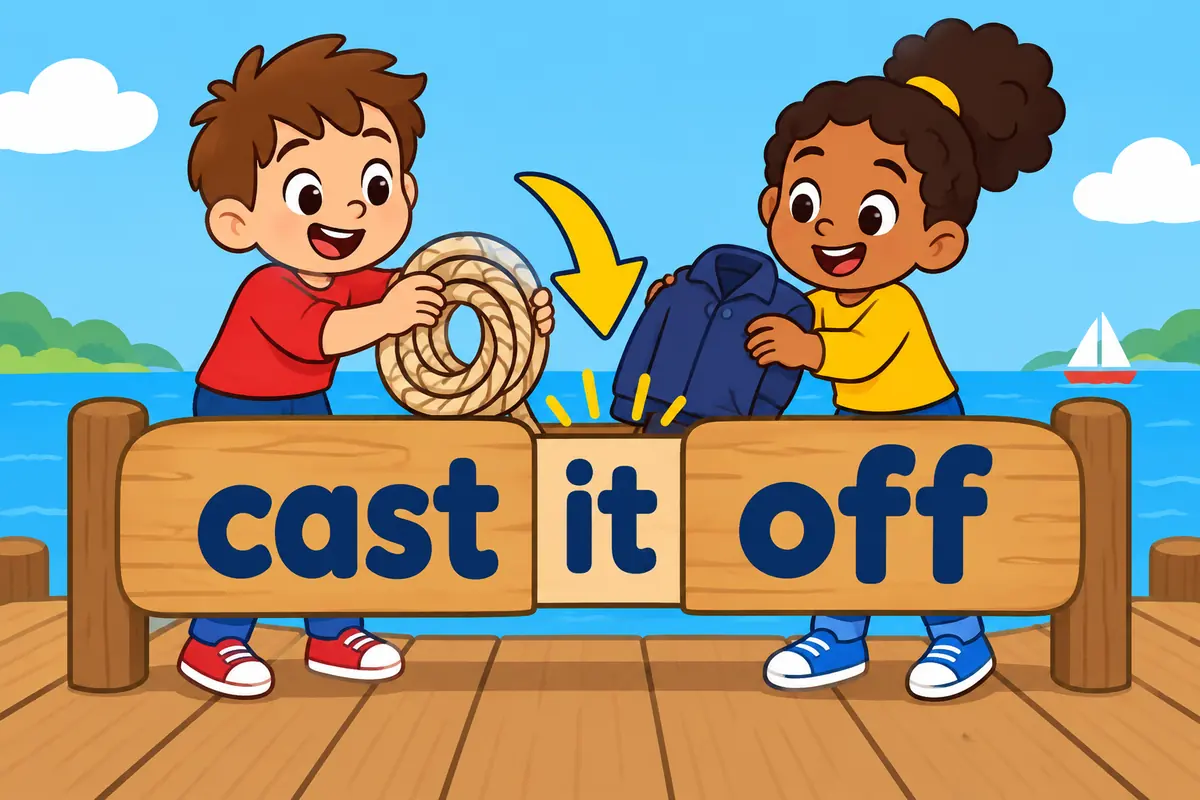
The object may sit between the verb and the particle when it is a noun: cast off the rope or cast the rope off. It must sit between them when it is a pronoun: cast it off, never cast off it. Five patterns cover the realistic uses.
| Pattern | Example | What it signals |
|---|---|---|
| cast off + object | The skipper cast off the lines. | The object follows the particle; neutral word order. |
| cast + object + off | The skipper cast the lines off. | The object moves before off; common with short nouns. |
| cast + pronoun + off | He cast them off before the storm. | A pronoun must sit between verb and particle. |
| cast off (no object) | The ferry cast off at six. | The boating sense allows an intransitive use. |
| cast off + abstract noun | She cast off her doubts. | Figurative release of a feeling or habit. |
Cast off in a sentence: examples across contexts
The verb changes register more than it changes meaning, moving from a knitting pattern to a history essay. Nine sentences show the same phrase at work.
| Context | Example sentence | Why this works |
|---|---|---|
| Sailing | The crew cast off the lines and eased into the channel. | The boating sense with a clear object. |
| Home | We cast off a decade of clutter in one weekend. | Uses the discard sense about possessions. |
| Knitting | Cast off the last row loosely so the edge stays soft. | The technical sense, in an imperative. |
| Conversation | Time to cast off that grudge and move on. | Figurative release of a feeling. |
| News report | The harbourmaster ordered the damaged trawler cast off. | Passive keeps attention on the vessel. |
| Historical writing | The colony cast off its rulers after decades of unrest. | A grand, literary use about people. |
| Poetry | Cast off the weight that anchors you. | Imperative and figurative, typical of verse. |
| Environmental writing | The reef was cast off by the current and drifted away. | The object is a natural thing, not a person. |
| Workplace | The manager cast off three outdated procedures. | A decisive image for removing old rules. |
Only the sailing and news entries keep a boat as the object, and only the knitting entry is a direct instruction. The rest stretch the phrase without breaking it.
Cast off vs cast aside and cast away
Cast off, cast aside and cast away all use the verb cast, but each one releases something different. Setting a plan down without destroying it is cast aside, while total loss or marooning is cast away.
| Attribute | cast off | cast aside | cast away |
|---|---|---|---|
| Core meaning | Release or discard | Set to one side, often temporarily | Throw away completely; maroon |
| Typical object | A rope, habit, clutter | A doubt, a plan, a person | Possessions, a person |
| Reversibility | Usually final | Often provisional | Final and total |
| Register | Neutral to literary | Neutral, slightly formal | Literary or nautical |
| Typical sentence | They cast off the lines. | She cast aside her fears. | The sailor was cast away on a reef. |
To drop something unwanted without ceremony is to shed it. Verdict: choose cast off for a boat leaving or a burden released, cast aside for something set down without destroying it, and cast away for total loss or a marooned person.
Word forms and grammar of cast off
Cast off does not take -ed, because the base verb cast is irregular. The hyphenated cast-off is a noun or an adjective meaning something discarded, while the verb stays open.
| Form | Part of speech | Example |
|---|---|---|
| cast off | phrasal verb, base form | The crews cast off together. |
| casts off | phrasal verb, third person singular | The dinghy casts off at noon. |
| cast off | phrasal verb, past | They cast off before sunrise. |
| casting off | phrasal verb, present participle | Casting off early saved the tide. |
| cast-off | noun or adjective, hyphenated | A cast-off jumper kept him warm. |
| casted off | non-standard past form | Use cast off, not casted off. |
Common mistakes with cast off
- Incorrect:
She casted off the rope.Correct: She cast off the rope. Rule: Cast is irregular; the past form is cast, never casted. - Incorrect:
He cast off it into the water.Correct: He cast it off into the water. Rule: A pronoun object goes between the verb and the particle. - Incorrect:
The team cast off aside the plan.Correct: The team cast the plan aside. Rule: Cast aside already carries its particle; never mix two. - Incorrect:
The island cast off him for a year.Correct: He was cast away on the island for a year. Rule: Marooning is cast away, not cast off. - Incorrect:
Please cast off your shoes at the door.Correct: Please kick off your shoes at the door. Rule: Cast off suggests a decisive release, not a routine action.
Practice using cast off
Work through the six items, then check the reasoning rather than only the answer.
- Fill the gap: The ferry ______ its lines and slid from the quay.
- Choose the better word: After the storm the sailor was (cast off / cast away) on a small island.
- Correct the error: He casted off his winter coat.
- Build a sentence: use cast off about a boat leaving at dawn.
- Spot the register: which belongs in a knitting guide — cast off the last row, or bin the last row?
- Rewrite with a pronoun: The crew cast off the ropes. Use them.
Answers
- cast — the past of cast is cast, identical to the base form.
- cast away — marooning uses cast away; cast off means the boat set out.
- He cast off his winter coat — casted is not a standard past form.
- Model answer: The crew cast off the lines at dawn and turned for open water.
- Cast off the last row — a knitting guide uses the technical term, not the casual bin.
- Model answer: The crew cast them off and turned for open water.
The bottom line
Use cast off in a sentence for a decisive release: a boat leaving its moorings, a household discarding clutter, or a person letting go of a burden. Two nuances decide most sentences: the particle moves to the right of a noun object but a pronoun stays between verb and particle, and cast away, not cast off, describes someone marooned. For mere rubbish, discard or abandon is plainer.
Frequently asked questions about cast off
Is cast off one word or two?
The verb is two words: cast off. The hyphenated cast-off is a different part of speech, a noun or an adjective meaning something thrown away, as in a cast-off shirt. Keep the verb separate and hyphenate only the noun and adjective form.
What does cast off mean on a boat?
On a boat it means to untie the mooring lines and let the vessel move away from the quay or dock. The crew cast off the lines before departure. The same phrase can appear with no object at all, as in the ferry cast off at six.
Can you separate cast and off?
Yes, when the object is a noun: cast off the rope or cast the rope off are both standard. A pronoun must sit between the two halves, so cast it off is correct and cast off it is not. With no object, the two words stay together.
What does casting off mean in knitting?
Casting off is the final step of a knitting project, working the last row so the live stitches are secured and the edge will not unravel. The phrase is used as a gerund, as in casting off the last row loosely, and is standard in every pattern.
Have you ever heard of the term “cast off” in knitting or crocheting? In crafting circles, to “cast off” is a common technique used to finish a project by securing the stitches and creating a neat edge.
When you “cast off,” you essentially remove the live stitches from your needle in a controlled manner. This process is crucial in completing your work, giving it a polished look, and ensuring that your project doesn’t unravel.
7 Examples Of Cast Off Used In a Sentence For Kids
- Cast off the old clothes that no longer fit you.
- We will cast off the boat from the dock and set sail.
- Remember to cast off any negative thoughts and make room for positivity.
- Let’s practice how to cast off a fishing line into the water.
- It’s time to cast off the worries and enjoy the day.
- The magician will cast off a spell during the show.
- The bird will cast off its old feathers and grow new ones.
14 Sentences with Cast Off Examples
- Make sure to cast off any negative influences in your life and focus on your studies.
- It’s time to cast off all the distractions and prioritize your academic goals.
- You need to cast off procrastination and start working on your assignments.
- Don’t forget to cast off any unnecessary expenses and save money for your future.
- It’s important to cast off self-doubt and believe in your abilities.
- You should cast off the old habits that are holding you back from achieving your full potential.
- Cast off the fear of failure and take risks to grow as a person.
- It’s time to cast off the burden of past mistakes and focus on moving forward.
- Remember to cast off any toxic relationships that are affecting your mental well-being.
- Don’t hesitate to cast off old study techniques that are not effective anymore.
- Make a conscious effort to cast off negative thoughts and replace them with positivity.
- Cast off the habit of comparing yourself to others and focus on your own progress.
- Remember to cast off the pressure to conform to societal expectations and live life on your own terms.
- It’s important to cast off the need for constant validation from others and learn to appreciate yourself.
How To Use Cast Off in Sentences?
To use Cast Off in a sentence, first, identify the context in which the term is being used. Cast Off can have multiple meanings, so understanding the specific usage is crucial.
If Cast Off refers to releasing or letting go of something, you can use it in a sentence like: “It’s time to cast off the old habits and embrace a healthier lifestyle.”
On the other hand, if Cast Off is referring to removing an item of clothing or a cover, you could use it in a sentence like: “She decided to cast off her coat as the sun started to warm up the day.”
Furthermore, if Cast Off is related to boating or sailing, you may use it in a sentence like: “The sailors were instructed to cast off the ropes and set sail towards the horizon.”
Remember to always ensure that the sentence structure is correct and that Cast Off is used appropriately in the sentence. Practice using the term in various contexts to become more familiar with its usage and meaning.
Conclusion
In conclusion, the phrase “cast off” can refer to various actions such as discarding, abandoning, or getting rid of something. It is often used to describe a physical act of throwing away or rejecting something, as well as a metaphorical act of freeing oneself from something unwanted or burdensome. The concept of casting off can apply to objects, relationships, habits, or beliefs that no longer serve a purpose or bring value.
Whether it’s casting off old clothes, casting off negative attitudes, or casting off toxic relationships, the act of letting go and moving on is a common theme in human experiences. By recognizing what no longer serves us and bravely casting it off, we create space for growth, healing, and new opportunities in our lives.