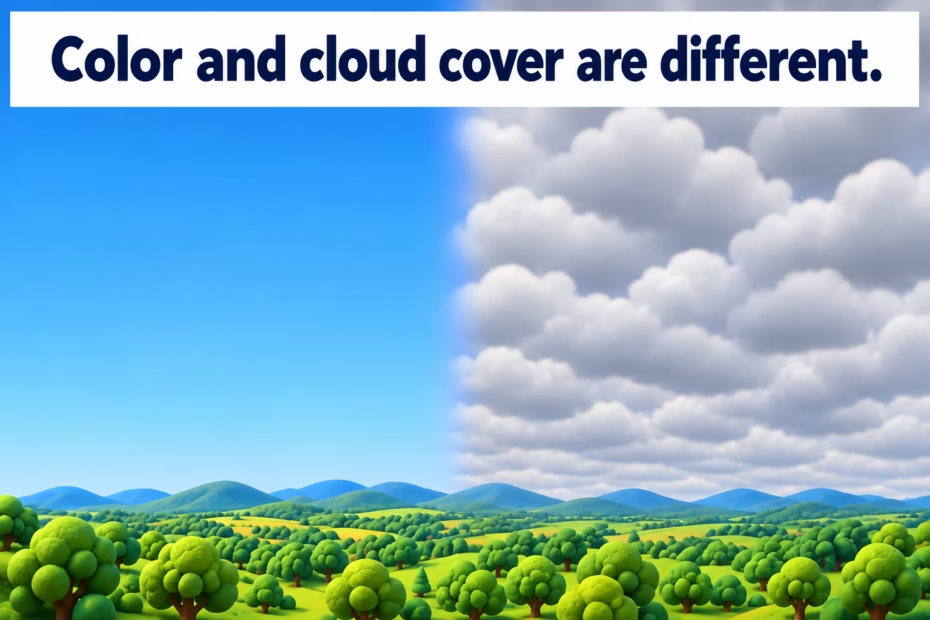
Choose sky adjectives by the feature you can observe. Blue and gray describe color; cloudy and cloudless describe cloud cover; hazy describes reduced clarity; and bright or dim describes the light. These qualities can overlap, but they do not mean the same thing. A sky can be blue with scattered clouds, pale and hazy, or bright while partly cloudy.

Choose a word for color, clouds, visibility, or light
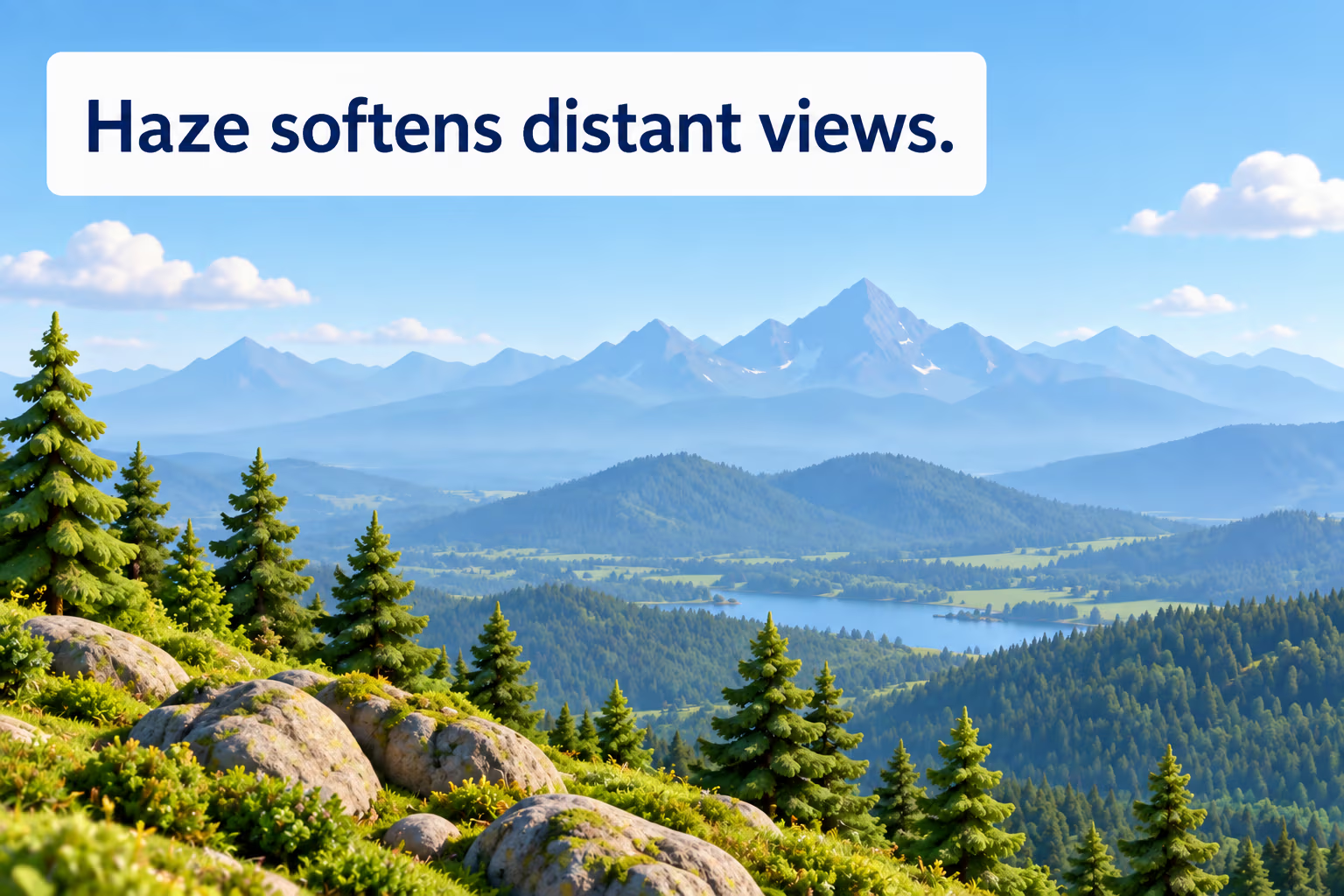
Use clear when the sky has no clouds, mist, or fog that limits the view; use cloudless when you specifically mean there are no clouds. Cloudy says clouds are present, while overcast usually means clouds cover the whole sky; in formal weather observations, it means the sky is completely covered by clouds or another obscuring phenomenon. Coverage describes how much of the sky is obscured, while gloomy describes a person’s impression. National Weather Service definition of overcast. Hazy describes air that is not clear, often because of fine particles or heat. A haze can soften distant outlines and subdue colors, so it is more precise than calling a distant view “foggy” when no fog is visible.
| Observable feature | Useful adjectives | Example |
|---|---|---|
| Color | blue, azure, gray, rose-colored | “A pale blue sky stretched above the hills.” |
| Cloud cover | clear, cloudless, partly cloudy, cloudy, overcast | “The sky was partly cloudy, with open blue patches.” |
| Visibility | clear, hazy, misty, smoky | “The hazy horizon softened the distant ridge.” |
| Light | bright, dim, golden, dusky | “Golden light edged the clouds at sunset.” |
These distinctions also help explain why dark is not a forecast: dark-looking clouds may be part of a dramatic scene, but color alone does not establish that a storm is occurring. Describe visible conditions first, then use weather terms such as stormy only when the scene or reliable weather information supports them. The National Weather Service describes forecast sky conditions by the fraction of the sky covered by opaque clouds, showing how cloud-cover words can have an observational meaning.
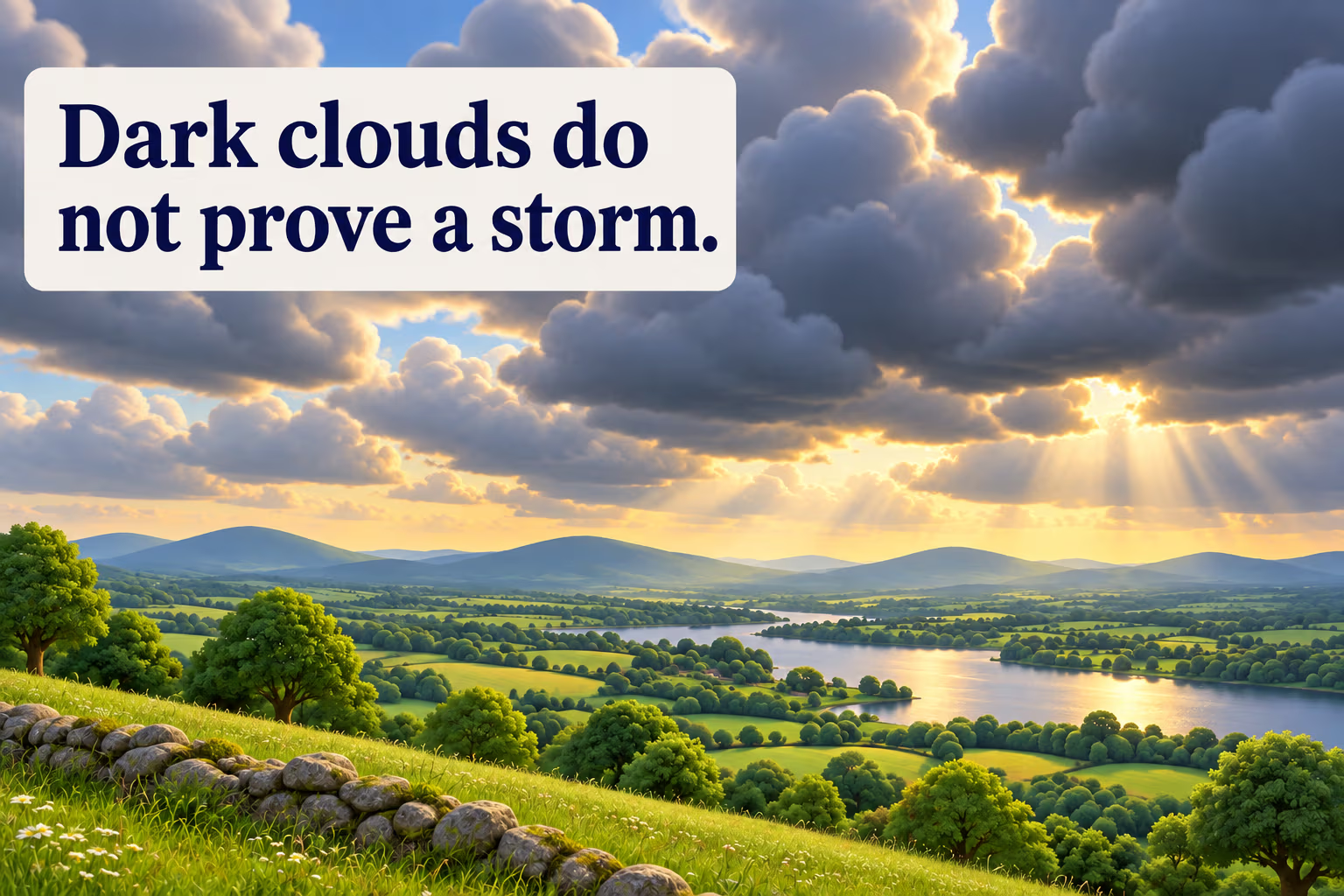
Color words can be literal or figurative. A blue sky appears blue because air molecules scatter shorter wavelengths of sunlight more strongly; near sunrise and sunset, sunlight travels through more of the atmosphere and the sky can appear red or orange. The word azure is a more specific color choice than blue, while golden may describe the warm light on clouds or the landscape rather than the sky’s entire color. Blue shades also differ: azure is a bright sky blue, cobalt is deep blue or greenish-blue, navy is dark blue, and royal blue is strong and bright. Use them for the shade you can see rather than as interchangeable names for an ordinary blue sky. azure, cobalt, navy, and royal blue.
Separate weather description from mood
Words such as serene, threatening, melancholy, and beautiful express a writer’s response to the scene. They can enrich creative writing, but they are not measurements of cloud cover, visibility, or weather. For a factual description, pair a visible detail with any interpretation: “Low gray clouds covered the western horizon, giving the scene a somber feel.” This makes clear what the sky looked like and what the observer felt.

The A–Z directory below is kept intact as a vocabulary resource. Its entries do not all function as interchangeable adjectives: some name a color, place, season, or cultural association; others suggest mood or evaluation. Check the intended meaning and grammar in context, and prefer a specific visible detail when accuracy matters. In the preserved introduction, black does not by itself establish a thunderstorm, and white does not mean cloudless; snow is only one possible setting for a pale sky. The later “synonyms” and “antonyms” tables are better read as literary alternatives and contrasting sky conditions: atmosphere names Earth’s gaseous envelope, firmament and celestial vault are literary expressions, and overcast, stormy, and hazy describe conditions rather than antonyms of sky. Cambridge definition of atmosphere; Cambridge definition of firmament.
The preserved A–Z entries mix adjectives, colors, place names, moods, phrases, and malformed or uncertain forms; the advertised “450+” count has not been verified. Use the list as a starting word bank and check each word’s meaning, grammar, and fit before using it as a factual description.
The sky is one of the most important elements in our landscape. It can be the backdrop for a beautiful sunset, or the source of light and life-giving energy. It can also be a place of awe and wonder, or a place of great calm and peace. No matter what our mood, the sky can provide the perfect setting. And because of its ever-changing nature, the sky can offer an endless supply of adjectives to describe it.
Here are just a few of the most popular adjectives for sky. Blue is perhaps the most common adjective used to describe the sky. It can be used to describe a deep, rich blue, or a light, airy blue. Other adjectives for blue skies include azure, cobalt, navy, and royal blue. Gray skies can be described as being cloudy, foggy, overcast, or stormy.
White skies are often associated with snow, but they can also be described as being clear or cloudless. And black skies usually indicate a thunderstorm or other inclement weather. So whatever your mood, there’s an adjective for sky that will perfectly suit your needs.
Adjectives For Sky
Looking for the perfect adjectives to describe the sky? You’ve come to the right place! Here are a few adjectives that can be used to describe different aspects of the sky.

For a clear sky, you might use adjectives like blue, bright, or sunny. If the sky is cloudy, you might describe it as cloudy, overcast, or gloomy. And if the weather is stormy, you might say that the sky is dark, dreary, or threatening. Whatever the case may be, there’s an adjective out there to describe it!
A
| Abundant | Affrighted | African |
| Agean | Alaskan | Alert |
| Alien | Alive | Amazing |
| Ample | Ancient | Angry |
| Arabian | Arched | Arctic |
| Arrowy | Artificial | Ashen |
| Assyrian | Australian | Autumnal |
| Awful | Azure |
B
| Banal | Bare | Beauteous |
| Beautiful | Benign | Benignant |
| Betwixt | Bitter | Black |
| Blackening | Bland | Blank |
| Blazing | Bleak | Blissful |
| Bloodied | Blown | Blue |
| Bluer | Boundless | Bounteous |
| Brazilian | Bright | Brightened |
| Brilliant | British | Broad |
| Broad Blue | Broken | Burning |
C
| Californian | Calm | Celestial |
| Certain | Cerulean | Chainless |
| Changeable | Changeful | Charming |
| Cheerful | Childish | Chilly |
| Churlish | Clean | Clear |
| Close | Cloud-Filled | Clouded |
| Cloudless | Cloudy | Cold |
| Colored | Colorless | Congenial |
| Constant | Cool | Crimson |
| Crisp | Crowded | Crystal |
| Curdled |
D
| Dainty | Dark | Darkened |
| Darkling | Day | Daytime |
| Dazzling | Dead | Deceitful |
| Deeper | Delightful | Dense |
| Depressing | Difficult | Dim |
| Dirty | Dismal | Distant |
| Dramatic | Dreamy | Drear |
| Dreary | Dripping | Dry |
| Dull | Duskish | Dusky |
E
| Eagle Eyed | Earthly | Eastern |
| Eastward | Elysian | Empty |
| Empurpled | Enchanted | Endless |
| English | Enigmatic | Enormous |
| Entire | Errorthe | Eternal |
| Ethereal | Etherial | European |
| Everlasting | Expansive |
F
| Fading | Faint | Fair |
| Faithless | Fake | Familiar |
| Famous | Farthest | Fathomless |
| Fictitious | Fierce | Fiery |
| Filthy | Fine | Fitful |
| Flaming | Flat | Flawless |
| Foggy | Fond | Foreign |
| French | Frequent | Fresh |
| Friendly | Frosty | Frowning |
| Frozen | Furthest |
G
| Garish | Gay | Genial |
| Gentle | Glad | Glaring |
| Gloomy | Glorious | Glowing |
| Golden | Gorgeous | Gracious |
| Grand | Gray | Great |
| Grecian | Green | Grey |
| Greyish | Grim |
H
| Happier | Hard | Harsh |
| Hawaiian | Hazy | Healthful |
| Healthy | Heavy | Heedless |
| Hereditary | Highest | Hollow |
| Holy | Hopeless | Horried |
| Hot | Huge | Human |
| Hungarian |
I
| Illimitable | Illumined | Immeasurable |
| Immense | Impending | Impenetrable |
| Impromptu | Inclement | Indian |
| Indulgent | Infinite | Inky |
| Instant | Insulted | Intense |
| International | Invaded | Inviolate |
| Invitingthe | Iranian | Irish |
| Italian |
J | K
| Jovial | Joyous | Keen |
| Kinder | Kindly | Kindred |
L
| Laden | Langit | Large |
| Leaden | Lighter | Lightsome |
| Limitless | Liquid | Lit |
| Literary | Livid | Lofty |
| Lonely | Louring | Lovely |
| Lovely Windy | Low | Lowering |
| Luminous | Lurid | Lustrous |
M
| Magnificent | Martial | Martian |
| Mediterranean | Melancholy | Mellow |
| Mental | Mid-Morning | Middle |
| Midsummer | Midwinter | Mighty |
| Miniature | Misty | Moist |
| Monotone | Monotonous | Moonless |
| Moonlit | Moral | Motherly |
| Mottled | Muddy | Murky |
| Musical |
N
| Naked | Narrow | Narrowed |
| Native | Neighbour | Nightly |
| Nocturnal | Northeast | Northern |
| Northwestern |

O
| Observable | Odious | Official |
| Olive | Ominous | Once Bright |
| Opal | Opalescent | Open |
| Opressive | Optical | Orange |
| Oriental | Outer | Overcast |
| Overheated |
P
| Pale | Pallid | Partial |
| Passionate | Passionless | Patchy |
| Paternal | Pathless | Patrimonial |
| Peaceful | Pearl-Grey | Pearly |
| Peculiar | Peerless | Pensive |
| Perfect | Petulant | Philosophical |
| Pink | Placid | Plaintive |
| Pleasant | Plue | Polar |
| Poplar | Prairie | Prophetic |
| Pure | Purple |
Q | R
| Quiet | Radiant | Ragged |
| Rainy | Real | Red |
| Refractive | Regal | Rich |
| Riddled | Rival | Roman |
| Rosy | Round | Rounded |
| Rude | Rueful | Russian |
S
| Sable | Sad | Sarcastic |
| Saudi | Scandinavian | Scholastic |
| Seamless | Serene | Shining |
| Shiny | Shrouded | Silent |
| Silken | Silvery | Simulated |
| Skittish | Skythe | Sleepy |
| Smiling | Smokeless | Smoky |
| Snowy | Sober | Sodden |
| Soft | Soggy | Solemn |
| Solid | Somber | Sombre |
| Southeastern | Southern | Southwest |
| Southwestern | Spacious | Spangled |
| Spanish | Sparkle | Sparkling |
| Speckled | Spectral | Sphered |
| Splendid | Spotless | Stagnant |
| Stainless | Star-Studded | Starlight |
| Starlit | Starred | Starry |
| Startled | Steadfast | Steady |
| Steely | Steepest | Stormy |
| Strange | Subterrene | Suburban |
| Sullen | Sun-Filled | Sunless |
| Sunlit | Sunny | Sweet |
| Swollen | Sympathetic |
T
| Tahitian | Tempestuous | Tender |
| Terrible | Thick | Thin |
| Thingsneither | Thirsty | Threatening |
| Thundering | Tinted | Tired |
| Toned | Trackless | Transient |
| Transparent | Triumphant | Tropic |
| Tropical | Troubled | Tumbled |
| Tumultuous | Tuneful | Turquoise |
| Tuscan | Twas | Tyrolean |
U
| Unchanged | Unchanging | Unclouded |
| Uncloudless | Unconcerned | Undimmed |
| Unfriendly | Uniform | Unimagined |
| Unknown | Unobstructed | Unpretentious |
| Unquiet | Unrelenting | Unrestful |
| Unscarred | Unspotted | Untranscended |
| Unused | Unyielding | Upper |
| Usual |
V
| Vacant | Vapory | Varied |
| Vast | Vaulted | Veiled |
| Verdant | Vernal | Vestal |
| Vibrant | Violet | Visible |
| Vivid |
W
| Warm | Washed | Washed Out |
| Watery | Weird | Westering |
| Western | Wet | White |
| Whole | Wholesome | Wicked |
| Wide | Wild | Wilful |
| Windless | Windy | Wintry |
| Worthy | Wretched | Yellow |
| Youthful |
The sky is a vast and awe-inspiring canvas that stretches above us, captivating our senses and evoking a sense of wonder. It’s a constant presence in our lives, changing colors and moods throughout the day and night. But have you ever stopped to think about the words we use to describe the sky? In this article, I’ll take you on a journey through the world of adjectives for the sky, exploring the various ways we can paint a picture with words. From brilliant blue to fiery red, from peaceful to stormy, let’s dive into the realm of describing words and discover the beauty of the sky in a whole new light.
When we gaze up at the sky, we are often left speechless by its breathtaking beauty. But sometimes, words are necessary to capture its essence and convey its magnificence to others. Whether it’s a clear, cloudless day or a star-studded night, the sky offers us a myriad of adjectives to choose from. In this article, I’ll be sharing some of the most evocative and descriptive words that can be used to paint a vivid picture of the sky. So, get ready to expand your vocabulary and learn how to truly do justice to the celestial wonders above us. Let’s dive in and explore the world of adjectives for the sky together.
How to Describe sky? – Different Scenarios

When it comes to describing the sky, there are countless scenarios to consider. Each scenario offers a unique opportunity to use descriptive words that capture the essence of the sky. Let’s explore some different scenarios and the adjectives that best describe them:
1. A Clear Day
On a clear day, the sky is a breathtaking canvas of endless blue. Here are some adjectives that can be used to describe a clear sky:
- Radiant: The sky is radiant, with its vibrant blue color shining brightly.
- Expansive: The clear sky seems to stretch on forever, creating a sense of vastness.
- Serene: Looking up at the clear sky can evoke a feeling of calm and tranquility.
2. A Cloudy Day
A cloudy day adds a layer of complexity to the sky, presenting an opportunity for different adjectives:
- Overcast: The sky is filled with thick clouds, creating a gray and gloomy atmosphere.
- Dramatic: The dark clouds create a dramatic backdrop, setting the stage for a stormy day.
- Majestic: The sky filled with fluffy white clouds can appear majestic, like a painting in motion.
Read: Describing Words for Dolls: Examples & Adjectives
3. Sunrise and Sunset
Sunrises and sunsets offer a spectacular display of colors and emotions. Here are some adjectives to describe these magical moments:
- Vibrant: The sky explodes with vibrant shades of pink, orange, and purple during a beautiful sunrise or sunset.
- Awe-inspiring: Witnessing a stunning sunrise or sunset can leave you in awe of nature’s beauty.
- Dazzling: The sky’s colors are dazzling, creating a mesmerizing spectacle that captures your attention.
4. Starry Night
On a clear, starry night, the sky becomes a captivating display of sparkling lights. Consider these adjectives to describe a starry sky:
- Twinkling: The stars twinkle in the night sky, creating a magical and dreamy atmosphere.
- Enchanting: The starry sky is enchanting, with its celestial objects casting a spell on all who gaze upon them.
- Vast: Looking up at the starry sky reminds us of the vastness and mystery of the universe.
Describing Words for sky in English

When it comes to describing the sky, there are a wide range of adjectives that can be used to capture its beauty and ever-changing nature. Whether it’s a clear blue day or a starry night, there are words that can bring the sky to life. Let’s explore some of these adjectives and their meanings:
- Clear: This classic adjective paints a picture of a cloudless expanse, often associated with a bright blue hue. It evokes a sense of unobstructed view and openness.
- Cloudy: This one speaks for itself, conjuring images of fluffy white wisps to dark, ominous storm clouds. It can imply anything from a peaceful, dappled sky to an impending weather event.
- Bright: This adjective brings sunshine and cheer to the sky. It can describe a clear, sun-drenched day or a vibrant sunrise/sunset with its fiery hues.
- Colorful: This broad term encompasses a rainbow of possibilities. It can refer to the subtle pastels of a dawn, the fiery oranges and reds of a sunset, or the dramatic purples and blues of a stormy sky.
- Majestic: This word evokes awe and grandeur. It suggests a vast, powerful sky that inspires reverence and respect. Think of towering mountains reflected in a sunset, or the swirling storm clouds above a vast ocean.
- Serene: This adjective implies a peaceful and calming sky. It conjures images of soft pastel hues, gentle clouds, and a sense of tranquility. Think of a clear summer evening with a star-studded sky.
- Vast: This word emphasizes the immense size and scale of the sky. It can describe a never-ending expanse that stretches beyond human comprehension. Think of looking out over a desert landscape or gazing up at a clear night sky.
- Ever-changing: This adjective captures the dynamic nature of the sky. It’s never static, constantly shifting with clouds, light, and weather patterns. It reminds us of the sky’s constant movement and the impermanence of its beauty.
- Enchanting: This word suggests a magical and captivating sky. It implies a sense of wonder and mystery, leaving the observer spellbound. Think of the aurora borealis dancing across the night sky or a breathtaking rainbow after a storm.
Read: Describing Words for Turkey: Synonyms & Examples
Adjectives for sky

Positive Adjectives for Sky with 12 Example Sentences
When it comes to describing the sky, there are countless positive adjectives that can capture its beauty and wonder. Here are twelve examples to expand your vocabulary:
- Clear – The sky is clear today, not a single cloud in sight.
- Bright – The sky is so bright and sunny, it puts a smile on my face.
- Vibrant – The sky at sunset is filled with vibrant hues of orange, pink, and purple.
- Breathtaking – Standing under a star-filled sky on a clear night is a truly breathtaking experience.
- Serene – The sky at dawn paints a serene and peaceful picture, as the world awakens.
- Expansive – Looking up at the sky from an open field, I am struck by its vast and expansive nature.
- Majestic – The sky during a thunderstorm is a majestic display of power and energy.
- Golden – The sky during sunrise casts a golden glow over the landscape, creating a magical atmosphere.
- Glorious – The sky after a rainstorm, with a rainbow arching across, is a truly glorious sight.
- Radiant – The sky on a clear summer night, adorned with a full moon, is radiant and mesmerizing.
- Heavenly – The sky filled with fluffy white clouds gives the impression of a heavenly paradise.
- Infinitesimal – Stargazing reminds me of the infinitesimal size of our planet in the vast expanse of the sky.
Negative Adjectives for Sky with 5 Example Sentences
Not every sky is filled with positivity and beauty. Sometimes, negative adjectives can help us describe the less ideal aspects of the sky. Here are five examples:
- Gloomy – The sky is gloomy and overcast, as the rain clouds move in.
- Dreary – On a cold winter day, the sky can appear dreary and gray.
- Stormy – A stormy sky, with dark clouds and lightning, signals a turbulent weather ahead.
- Hazy – During a hot summer day, the sky can become hazy and obscured by smog.
- Dull – The sky on a cloudy day can be rather dull and lackluster, without any interesting colors or textures.
Read: Positive and Negative Adjectives for Women: Empowering Descriptions
Remember, adjectives can help us paint a vivid picture of the sky and evoke specific emotions. Whether it’s a clear, bright sky or a stormy, gloomy sky, there are endless ways to describe this awe-inspiring part of our world.
Synonyms and Antonyms with Example Sentences

Synonyms for sky
When it comes to describing the sky, there are many words we can use to paint a vivid picture. Here are some synonyms that can help you capture the beauty and wonder of the sky:
| Synonym | Definition | Example Sentence |
|---|---|---|
| Firmament | The expanse of the heavens | The stars twinkled in the dark firmament above me. |
| Atmosphere | The gaseous envelope surrounding Earth | The clear atmosphere made for a perfect day at the beach. |
| Celestial Vault | The dome-like covering of the sky | The moon shone brightly in the celestial vault above. |
Each of these words brings a unique touch to our description of the sky. Whether we refer to the firmament, the atmosphere, or the celestial vault, we can transport our readers to a place of awe and wonder.
Antonyms for sky
On the other hand, when we want to describe a sky that is different from the typical blue and clear one, we can turn to antonyms that showcase contrasting conditions. Here are some antonyms for sky:
| Antonym | Definition | Example Sentence |
|---|---|---|
| Overcast | Covered with clouds, gloomy | The overcast sky matched my mood on that gray winter day. |
| Stormy | Characterized by storms, turbulent | Dark clouds and thunder signaled a stormy sky approaching. |
| Hazy | Filled with fine dust or water particles | The hazy sky obscured the view of the distant mountains. |
By embracing the use of antonyms, we can expand our descriptions of the sky and capture the diverse moods and atmospheric conditions that exist. From an overcast sky to a stormy one, these antonyms help convey a sense of realism and variety in our writing.
Through the use of synonyms and antonyms, we can enhance our descriptions of the sky and evoke specific emotions. This allows us to engage our readers and transport them to different scenarios where the sky plays a central role. Whether we choose synonyms to highlight the beauty of a clear day or antonyms to depict a stormy sky, adjectives help us create a rich and immersive experience for our readers.
Describing the sky can be a powerful tool for writers to create vivid imagery and evoke specific emotions in their readers. By using adjectives, synonyms, and antonyms, we can paint a picture of the sky that goes beyond the typical blue and clear one.
Throughout this article, we have explored various adjectives that can be used to describe the sky. From “vibrant” and “serene” to “dramatic” and “mysterious,” these words allow us to capture the essence of the sky and transport our readers to different scenarios where the sky plays a central role.
Additionally, we have discussed synonyms such as “firmament,” “atmosphere,” and “celestial vault,” which can add depth and richness to our descriptions. On the other hand, antonyms like “overcast,” “stormy,” and “hazy” provide contrast and help us describe skies that deviate from the norm.
By incorporating these adjectives, synonyms, and antonyms into our writing, we can engage our readers and make them feel as though they are experiencing the sky firsthand. So, go ahead and experiment with different words to bring your sky descriptions to life and captivate your audience.
Final verdict
In conclusion, the sky is truly a beautiful spectacle. It can be described using an endless array of adjectives, each of which capture a different aspect of its beauty. The next time you look up at the sky, take a moment to appreciate its intricacies and the ways in which it constantly changes. And if you’re ever at a loss for words, simply remember that there’s always an adjective for sky.


