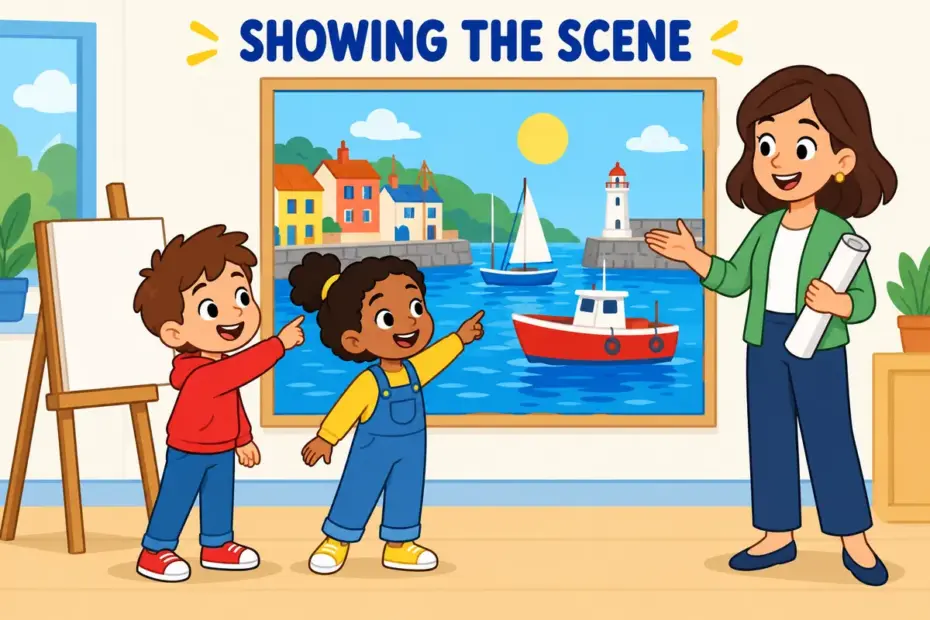
Depict means to show or represent something in a picture, story or description. To use depict in a sentence, name the source and what it shows, as in “The mural depicts a busy harbour at dawn.” The verb is transitive and appears in the passive very often.
Depict at a glance
- Depict is a transitive verb meaning to show or represent something.
- Its forms are depicts, depicted, depicting and the noun depiction.
- The two main senses are representing in an image and describing in words.
- The passive is common: a scene is depicted in a painting.
- The usual subjects are pictures, films, poems, reports and accounts.
- The commonest error is confusing depict with edict, a noun meaning an order.
What does depict mean?
Depict is a transitive verb meaning to represent something in a picture, or to describe it in words. The Cambridge entry for depict records both senses, and the difference matters in practice: the first shows a scene to the eye, the second paints it with language. Where a statement only stands for something rather than showing it, represent is the broader verb.
| Sense | Plain meaning | Example sentence |
|---|---|---|
| Represent in an image | Show something in art, film or a photograph | The tapestry depicts a hunting scene. |
| Describe in words | Portray something in speech or writing | The novel depicts life in a mining town. |
One limitation is worth stating plainly. Depict reports how something is shown, not whether it is true, so a report can depict a scene without endorsing it. The verb is also more formal than show, which is why a caption says the photo shows the crowd while an academic essay says the manuscript depicts the court.
How do you use depict in a sentence?
Depict always takes a direct object, and the object is the thing shown rather than the audience. Four patterns cover almost every real sentence, and the passive keeps attention on the artwork or text instead of on its maker.
| Pattern | Example | What it signals |
|---|---|---|
| depict + object | The photograph depicts a crowded market. | The direct object is the scene being shown. |
| depict + object + as + noun | Critics depict him as a reformer. | How the subject is characterised, often by others. |
| be depicted + in / on | The king is depicted on the coin. | Passive voice with the place where the image appears. |
| depict + how clause | The chart depicts how costs rose. | A clause used for an account rather than a single scene. |
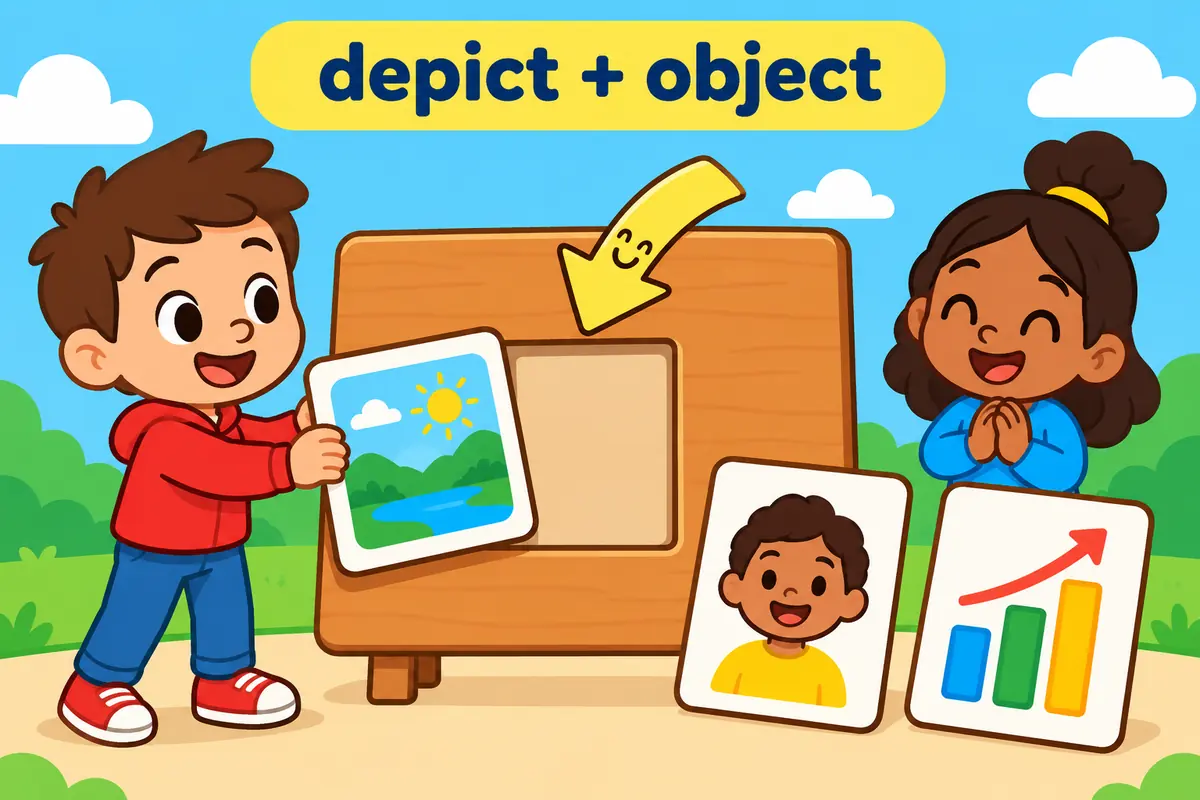
The practitioner rule is simple: if you can replace depict with show and keep the same object, the sentence works; if nothing is shown, another verb is needed.
Depict in a sentence: examples across contexts
Depict changes register more than it changes meaning. The nine sentences below hold the same verb while moving from a museum label to a news report, and each one names what is shown.
| Context | Example sentence | Why this works |
|---|---|---|
| Classroom | The picture depicts three children planting a tree. | A concrete scene a pupil can point at makes the verb clear. |
| Museum label | The vase depicts a chariot race in black and red. | Names the object and the scene, which is exactly what a label needs. |
| News report | The footage depicts the moment the bridge gave way. | An event framed as evidence, suited to reporting. |
| Film review | The director depicts village life without sentiment. | Names the maker as subject and the subject shown as object. |
| Academic prose | Earlier studies depict the process as a single step. | The as pattern reports how others characterise the subject. |
| Legal writing | The contract depicts the payment as a loan. | Formal framing of how a document characterises an act. |
| History essay | Court records depict a society already divided. | Treats a source as a window on a wider condition. |
| Advertisement | The poster depicts a family enjoying a seaside holiday. | The idealised scene is the point, not its accuracy. |
| Conversation | He depicts every setback as someone else’s fault. | The as pattern survives in speech because it reports spin. |
Notice that the last sentence uses the word to report a person’s framing rather than an image, which is the sense most common in conversation.
Depict vs describe and portray
Depict overlaps with two verbs and is interchangeable with neither. describe gives a verbal account, often of qualities, while portray stresses the character or likeness the account creates.
| Attribute | depict | describe | portray |
|---|---|---|---|
| Core job | Show a scene in an image or text | Give an account in words | Create a likeness or character |
| Typical subject | A picture, film, poem or report | A person giving an account | An actor, author or artist |
| Needs an image | Often, but not always | No | No |
| Usual object | A scene, event or figure | A person, place or process | A person or group |
| Register | Formal and academic | Neutral, everyday to formal | Formal and critical |
Verdict: choose describe for a plain account in words, portray when character is being shaped, and depict when an image or a framed scene is doing the showing.
Word forms and grammar of depict
Depict inflects regularly, and its past participle has its own page because it appears so often in captions. The table also lists the invented form learners reach for by mistake.
| Form | Part of speech | Example |
|---|---|---|
| depict | verb, base form | These panels depict the four seasons. |
| depicts | verb, third person singular | The cover depicts a storm at sea. |
| depicted | verb, past and past participle | The scene is depicted in warm ochre. |
| depicting | verb, present participle | A frieze depicting athletes rings the hall. |
| depiction | noun | Her depiction of rural life won the prize. |
| depicture | non-standard | Write depict or depict as a verb, never depicture. |
The participial form depicted is common in museum captions, so learners meet it before they meet the base verb. Keep the object after it: something is always depicted, never depicted about.
Common mistakes with depict
- Incorrect:
The painting depicts about a village fair.Correct: The painting depicts a village fair. Rule: Depict takes a direct object, so it never needs about. - Incorrect:
The film depicts that the war was pointless.Correct: The film depicts the war as pointless. Rule: Depict takes a noun phrase or an as phrase, not a that-clause. - Incorrect:
The artist depicted him like a hero.Correct: The artist depicted him as a hero. Rule: The fixed pattern is depict someone as something. - Incorrect:
The government issued a depict banning the march.Correct: The government issued an edict banning the march. Rule: An edict is a noun meaning an order; depict is the verb meaning to show. - Incorrect:
He depicted himself to be calm.Correct: He depicted himself as calm. Rule: After depict the linking phrase is as, never to be.
Practice using depict
Work through the six items, then check the reasoning rather than only the answer.
- Fill the gap: The oldest map ______ the river running through the town centre.
- Choose the better word: The teacher asked the class to (depict / describe) the experiment in writing.
- Correct the error: The poster depicts that everyone is happy.
- Build a sentence: use be depicted on about a queen shown on a coin.
- Spot the register: which belongs in a museum label — the vase depicts a harvest, or the vase shows a harvest?
- Rewrite in the passive: The mural depicts a market scene. Put the mural in the subject position.
Answers
- depicts — the map shows the river, so the transitive verb fits.
- describe — a written account is asked for, and describe is the neutral verb.
- The poster depicts everyone as happy — depict takes an as phrase, not a that-clause.
- Model answer: The queen is depicted on the silver coin.
- The vase depicts a harvest — a label prefers the precise formal verb.
- A market scene is depicted in the mural — the passive keeps the artwork in focus.
The bottom line
Use depict in a sentence when an image or a framed account is showing something, and always name that thing as the object. The two nuances that decide most sentences are these: depict takes a noun phrase or an as phrase and never a that-clause, and the verb reports how something is shown rather than whether it is true. For a plain verbal account, illustrate or describe is the safer choice.

Frequently asked questions about depict
Is depict a transitive verb?
Yes, depict is transitive, so it always takes a direct object naming the thing shown. You write the painting depicts a storm, because the storm is what is shown. The only common exception is the passive, where the object moves to the subject position, as in a storm is depicted in the painting.
Can depict take a that-clause?
No. Depict takes a noun phrase or an as phrase, so you write the film depicts the war as pointless, not the film depicts that the war was pointless. When you need a clause, use show or suggest instead. The as phrase is the standard way to give the slant the picture carries.
What is the difference between depict and describe?
Depict often implies a visual work showing a scene, while describe gives a verbal account of what something is like. A painting depicts a harbour; a witness describes the harbour in words. The two overlap when a text renders a scene, but describe is the neutral everyday choice and depict the more formal one.
How do you spell the past tense of depict?
The past tense and past participle are both depicted, formed by the regular -ed ending, with depicting as the present participle. The noun is depiction. There is no word depicture; that invented form appears in learner writing but never in standard English, so use depict or depicted instead.
Have you ever wondered how to effectively portray a scene or concept through words? Depicting means to represent or illustrate something through writing, painting, or other means of visual expression.
When authors depict a character’s emotions, or a painter depicts a landscape, they are vividly capturing and communicating their subject. This skillful art of depiction allows the audience to immerse themselves in the story or image being presented.
7 Examples Of Depict Used In a Sentence For Kids
- The picture depicts a colorful rainbow in the sky.
- The painting depicts a happy family playing together.
- The drawings depict different shapes like circles and squares.
- The storybook depicts animals living in the jungle.
- The cartoon depicts a funny character making everyone laugh.
- The mural depicts a beautiful scene of a garden full of flowers.
- The poster depicts children learning and studying in school.
14 Sentences with Depict Examples
- Depict your understanding of the topic through illustrations.
- Make sure to depict all the key points in your presentation.
- Use various colors to depict different categories in your chart.
- The graphs will depict the data trends over the past five years.
- Your project should depict your research findings accurately.
- Depict the timeline of events using a visual aid.
- The movie aims to depict the struggles of college students in a relatable manner.
- Your artwork should depict a message that resonates with young adults.
- The photographs should depict the diversity of cultures on campus.
- The assignment requires you to depict a scene from a famous literary work.
- The mural will depict different significant moments in the history of the college.
- Depict the impact of technology on education through your project.
- Ensure that your poster can effectively depict the message of your campaign.
- The infographic should depict the advantages and disadvantages of various study strategies.
How To Use Depict in Sentences?
Depicting Depict in a sentence can help to clearly illustrate and convey a message. Here’s a simple guide on how to correctly use this word:
-
Choose a subject: Think about what you want to portray or describe in your sentence. This could be a person, a scene, an emotion, or anything that can be visually represented.
-
Use the word “depict”: Place the word “depict” in your sentence where it makes sense. Remember, “depict” means to show or represent something through a visual image or description.
-
Provide context: Make sure to provide enough context in your sentence so that the reader can understand what is being depicted. This could include details about the subject, the setting, or the emotions involved.
-
Example sentence: “The artist used vibrant colors to depict a beautiful sunset over the ocean.”
-
Check your sentence: After writing your sentence, review it to ensure that “depict” is used correctly and effectively conveys your intended meaning.
By following these simple steps, you can easily incorporate depict into your sentences to create vivid and descriptive imagery. Practicing using “depict” in different contexts will help you become more comfortable with incorporating it into your writing.
Conclusion
In conclusion, the examples of sentences using the keyword “depict” clearly show its versatility in conveying various scenes, emotions, and situations. Whether describing a vivid painting, illustrating a character’s actions, or portraying a cultural norm, “depict” serves as a powerful verb in painting a detailed picture for the reader. Through its ability to vividly represent and bring to life a concept, “depict” enhances the reader’s understanding and engagement with the text.
These sentences spotlight the importance of using descriptive language to create visual imagery and evoke strong emotions within the reader. By employing “depict” in writing, authors can effectively capture moments, settings, and characters, allowing readers to immerse themselves in the story. Overall, the diverse examples demonstrate how the strategic use of the word “depict” can significantly enhance the storytelling experience and make the narrative more engaging and compelling.


