
Diatribe is a noun meaning a long, bitter and abusive attack in speech or writing. To use diatribe in a sentence, name the target with against: “The editorial was a diatribe against the new tax.” It is a strong, countable label and never a neutral word.
Diatribe at a glance
- Diatribe is a countable noun, so a diatribe and diatribes are both normal.
- The dominant pattern is a diatribe against a person, policy or idea.
- It implies length and bitterness, not a brief angry remark.
- The word suits published attacks as often as spoken ones.
- The commonest error is using diatribe for calm or favourable speech.
What does diatribe mean?
Diatribe is a countable noun meaning a long, bitter and abusive attack in speech or writing. The Cambridge entry for diatribe records that sense of a strong verbal attack, and the abuse is what separates it from an ordinary harangue delivered in public. Its cousin invective names the insulting language itself rather than the whole speech.
| Use | Plain meaning | Example sentence |
|---|---|---|
| Spoken attack | A long, angry denunciation | He launched into a diatribe against the referee. |
| Written attack | A published piece full of abuse | The column was a diatribe against modern schooling. |
| A habit of attacking | Repeated outbursts, countable | Her speeches became diatribes by the end. |
One limitation matters. A diatribe is more than strong criticism: it is abusive and one-sided, with no attempt at a fair hearing. Where the complaint is measured, use critique, rebuke or assessment, and reserve diatribe for the genuinely intemperate.
How do you use diatribe in a sentence?
Diatribe is countable and usually names its target with against. The noun works as the object of verbs such as launch into, deliver, publish and write, which is how the word stays connected to a single event rather than a general mood.
| Pattern | Example | What it signals |
|---|---|---|
| a diatribe against + target | She delivered a diatribe against the merger. | The standard arrangement, naming the target. |
| launch into + a diatribe | He launched into a diatribe about parking. | Stresses the sudden start of the attack. |
| a diatribe in + publication | His diatribe in the local paper upset readers. | Marks a written attack that appeared in print. |
| a diatribe against everything | The essay became a diatribe against everything modern. | Shows the target widening into a general rant. |
The preposition against is the one to remember, while about often replaces it when the subject is trivial and the tone is meant to be wry, as in a diatribe about parking. The plural diatribes is common when a writer wants to suggest a habit rather than one outburst.
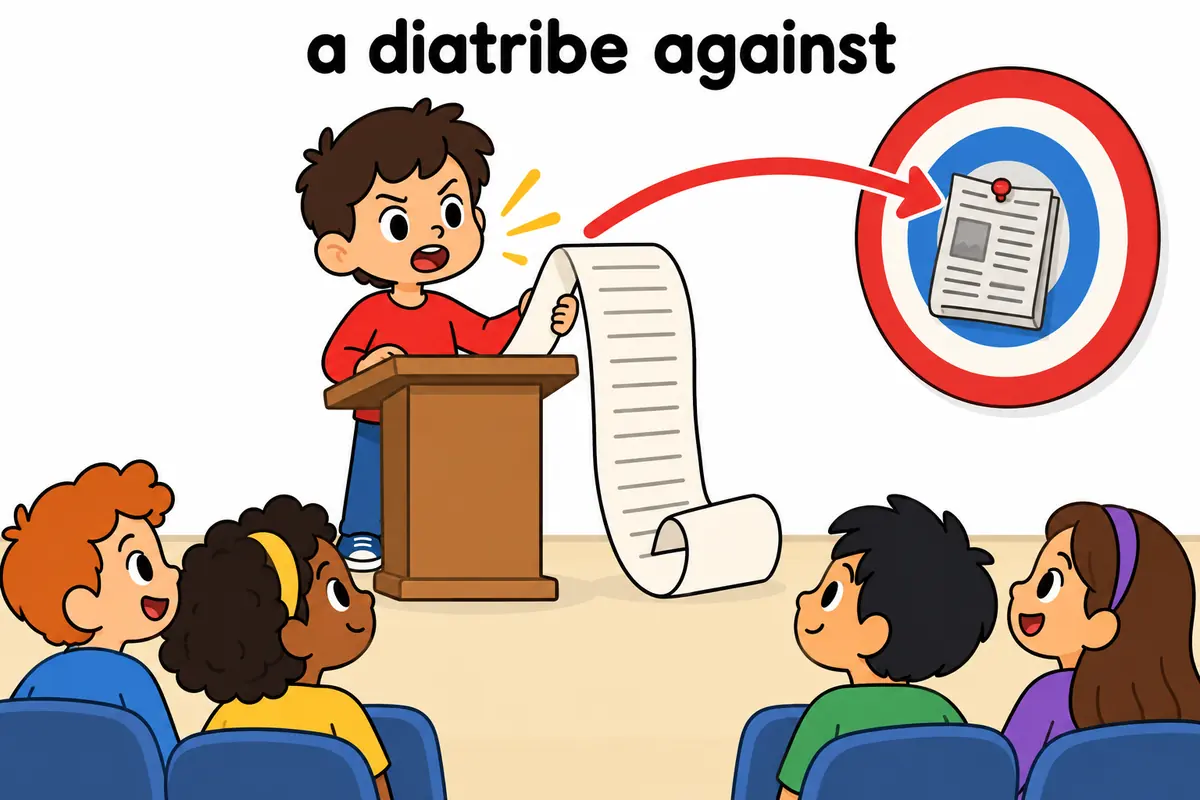
Diatribe in a sentence: examples across contexts
Diatribe keeps one meaning while the setting changes who is attacked and how public the attack becomes. The nine sentences below move from a family kitchen to a court report, and each one names a target.
| Context | Example sentence | Why this works |
|---|---|---|
| Politics | The senator’s diatribe against the budget ran to forty minutes. | The target is a policy and the length is made explicit. |
| Workplace email | His reply was a diatribe disguised as feedback. | The contrast shows the word’s judgemental force. |
| News report | Readers complained about the columnist’s diatribe on migration. | On marks the broad subject of a published attack. |
| Arts review | The critic’s diatribe against the director filled three pages. | Names a target and a length, both typical of the word. |
| Conversation | Grandad went off on a diatribe about the new bus timetable. | About keeps the tone wry and the target minor. |
| Academic writing | The preface reads as a diatribe against rival historians. | Shows the word can describe a written scholarly attack. |
| Court report | The judge described the letter as a diatribe, not evidence. | Contrasts bitter abuse with the neutral language of law. |
| Sports writing | Coaches traded diatribes through the press all season. | The plural suggests a habit rather than one outburst. |
| Online comment | The thread dissolved into diatribes within minutes. | Shows the word applied to digital, anonymous attacks. |
The court and arts sentences make the judgement of the word clearest, because both contrast it with a fairer form of comment. Only the family sentence uses about, which softens the target while keeping the attack intact.
Diatribe vs tirade
Diatribe and tirade are close enough to be swapped constantly. Both name long, angry attacks, but a tirade is usually spoken in the heat of the moment and aimed at whoever is present, while a diatribe is more deliberate, often written and aimed at a public target. A domestic rant sits at the informal end of the same family, while the published screed belongs to the same shelf of attack pieces.
| Attribute | diatribe | tirade |
|---|---|---|
| Usual channel | Often written and published | Usually spoken aloud |
| Degree of control | Deliberate and sustained | Emotional and heated |
| Typical target | A policy, group or rival thinker | A person present at the time |
| Implied intent | To denounce and persuade | To vent anger |
| Register | Formal and censorious | Neutral and dramatic |
Verdict: choose tirade for a spoken outpouring of anger at someone in the room, and diatribe for a sustained, often written attack on a public target.
Word forms and grammar of diatribe
Diatribe is a regular noun, and its plural diatribes appears as soon as a writer wants to suggest repeated attacks. The rare adjective diatribal is best avoided because it sounds invented, and polemic is the more established term for a written attack that argues a case.
| Form | Part of speech | Example |
|---|---|---|
| diatribe | noun, singular | The broadcast was a single long diatribe. |
| diatribes | noun, plural | His diatribes exhausted the newsroom. |
| diatribal | adjective, rare | Avoid; readers hear it as invented. |
| polemic | noun, written attack | The pamphlet was a polemic, not a report. |
| tirade | noun, spoken attack | The tirade lasted until the bell. |
Keep the noun countability in view. Because diatribe is countable, it needs an article or a plural, so the bare phrase gave diatribe is incomplete without a determiner.
Common mistakes with diatribe
- Incorrect:
She made a diatribe in favour of the plan.Correct: She made a speech in favour of the plan. Rule: A diatribe attacks a target; it cannot support one. - Incorrect:
He offered a calm diatribe on the report.Correct: He offered a calm critique of the report. Rule: Calm and diatribe contradict each other. - Incorrect:
Their diatribe against of the policy was published.Correct: Their diatribe against the policy was published. Rule: Against takes a direct noun, never against of. - Incorrect:
The manager gave a diatribe.Correct: The manager launched into a diatribe against the new rules. Rule: A diatribe needs a determiner and, usually, a target. - Incorrect:
His brief diatribe lasted two minutes.Correct: His brief rant lasted two minutes. Rule: Diatribe implies length; for a short outburst use rant.
Practice using diatribe
Work through the six items, then check the reasoning rather than only the answer.
- Fill the gap: The minister faced a ______ against the proposal in every newspaper.
- Choose the better word: Her calm, balanced essay was a (critique / diatribe) of the policy.
- Correct the error: He wrote a diatribe in support of the new library.
- Build a sentence: use a diatribe against about a proposed road.
- Spot the register: which belongs in a court report — the letter was a diatribe, or the letter was a proper go at them?
- Fix the phrase: rewrite The crowd heard diatribe from the steps.
Answers
- diatribe — the noun is countable and names an attack on the proposal.
- critique — calm and balanced rule out the abusive force of diatribe.
- He wrote a diatribe against the new library — a diatribe attacks a target rather than supporting it.
- Model answer: The residents’ group published a diatribe against the planned road.
- The letter was a diatribe — a court report keeps the formal noun.
- The crowd heard a diatribe from the steps — the countable noun needs a determiner.
The bottom line
Use diatribe in a sentence for a long, bitter attack that abuses its target rather than reasoning with it, and introduce that target with against. Two nuances settle most cases: the noun is countable, so it needs a determiner, and it is stronger and more deliberate than a tirade spoken in the heat of the moment. Where the criticism is fair-minded, a critique is the honest label.

Frequently asked questions about diatribe
How is diatribe pronounced?
Diatribe is pronounced with the stress on the first syllable, roughly DY-uh-tryb. The first syllable rhymes with sky, the middle one is a weak schwa, and the last rhymes with tribe. The word has three syllables in careful speech, though the middle one often almost disappears in fast conversation.
Is diatribe a formal word?
Diatribe belongs to formal and journalistic English, and it carries a strong judgement. Calling a speech a diatribe tells the reader that it was abusive and one-sided, not merely critical. In casual conversation, speakers usually reach for rant or go off on one instead, which sound far less weighty.
What is the plural of diatribe?
The plural is diatribes, and it usually suggests repeated attacks rather than one. A sentence such as his diatribes exhausted the newsroom presents a habit of bitter attacks. The singular a diatribe points to a single sustained piece or speech, which is the more common use overall.
Who typically delivers a diatribe?
Anybody can deliver a diatribe, but the word suits public figures, columnists, coaches and campaigners who attack a policy or rival at length. It is rarely used of a private complaint, because the noun implies a deliberate, sustained performance aimed at an audience rather than a quiet personal grievance.
Use diatribe in a sentence for a forceful, bitterly critical speech or piece of writing. “The review became a diatribe against the new design” emphasizes an attacking tone rather than ordinary disagreement. Diatribe is a noun, its plural is diatribes, and calling something a diatribe is an evaluation that needs supporting context.
Key facts at a glance
- Diatribe is a noun for strongly critical speech or writing.
- The plural is diatribes.
- Against commonly introduces the target of the criticism.
- A diatribe is more intense than a simple complaint.
- The label evaluates tone; it does not automatically prove the speaker wrong.
What does diatribe mean?
The Merriam-Webster diatribe entry identifies forceful, bitter criticism. In current ordinary usage, the noun can describe a spoken attack or a written passage. “The letter was a diatribe against the committee” identifies both form and target.
A writer choosing the label should consider the tone and content rather than the length alone. A long, reasoned criticism need not be a diatribe, and a short passage can still be intensely hostile. The word reports an evaluation of how criticism is expressed.
Diatribe in a sentence: original examples
| Context | Example | What is described? |
|---|---|---|
| Review | The review became a diatribe against the new design. | Written criticism |
| Meeting | His diatribe against the proposal interrupted the discussion. | Spoken criticism |
| Letter | The editor shortened the diatribe before publishing the letter. | A strongly critical passage |
| Plural | The narrator’s diatribes revealed his frustration. | Several critical speeches |
| Contrast | She offered a reasoned objection rather than a diatribe. | Different kinds of criticism |
These are invented language examples, not allegations about actual speakers. The surrounding description should justify the label if the sentence concerns a real person or text.

Articles, plurals, and common patterns
Use a diatribe for one unspecified speech or passage and the diatribe after it has been identified. “The speaker delivered a diatribe. The diatribe targeted the proposed schedule.” The plural is diatribes, without an apostrophe.
Natural verbs include deliver, launch into, write, publish, and respond to. Against introduces the target: “a diatribe against the policy.” About identifies a topic, but it may not communicate the attacking relationship as directly.
- The letter contained a diatribe against the changes.
- The character launched into a diatribe.
- Her response addressed the diatribe calmly.
- The editor removed several diatribes from the draft.
- The speech sounded like a diatribe against the plan.
Do not use the noun where a verb is needed: “He diatribe the proposal” requires a different construction. “He delivered a diatribe against the proposal” gives the sentence a verb and identifies the object of criticism.
Diatribe versus criticism, complaint, and rant
Criticism is a broad category that can include careful evaluation, disagreement, or fault-finding. Complaint expresses dissatisfaction. Diatribe emphasizes a bitterly attacking style. Rant commonly suggests heated or uncontrolled speech, but it is not a perfect substitute in every context.
“The review criticized the design’s weak hinges” reports a specific objection. “The review was a diatribe against the designer” adds a judgment about the style and target. Keeping those claims separate helps readers assess both the substance and presentation.
The label does not establish whether every factual claim is false. A speech can contain accurate information and still adopt an attacking tone. Conversely, calling a passage measured does not prove that its claims are correct. Evaluate tone and evidence separately.

How to use a strong label responsibly
- Identify the speech or piece of writing.
- Consider whether the tone is strongly attacking.
- Name the target with a suitable phrase.
- Distinguish tone from factual accuracy.
- Use a milder noun when it communicates the situation more accurately.
“The response was a diatribe” leaves the basis unstated. “The response became a diatribe against the committee, dismissing every suggestion with bitter personal attacks” explains the characterization. Use specific contextual evidence rather than adding adjectives such as angry merely to intensify the label.
For school practice, “The character’s diatribe against the rule disrupted the meeting” is a clear example. It establishes a noun, a target, and an effect without reproducing hostile language or turning the learner’s example into an attack on a real person.
Frequently asked questions
Is every complaint a diatribe?
No. A complaint can simply state dissatisfaction or identify a problem. Diatribe is a stronger word for bitterly attacking speech or writing. “The customer reported a broken handle” describes a complaint without establishing a diatribe. Choose the stronger label only when the tone and surrounding context support that characterization.
Can a diatribe be written?
Yes. The noun can describe written criticism as well as a speech. “The letter contained a diatribe against the proposal” gives a clear written example. Identify the form and target when useful, and remember that the label evaluates the attacking tone rather than merely the passage’s length or format.
Which preposition commonly follows diatribe?
Against commonly introduces the target, as in “a diatribe against the new rule.” About can identify the topic but may communicate the attack less directly. The appropriate choice depends on the sentence. “The speaker delivered a diatribe against the proposal” gives both a natural verb and a clear target.
Does calling something a diatribe mean it is false?
No. Diatribe characterizes the tone and style of criticism; it does not by itself determine whether every claim is true or false. A careful reader can examine the evidence separately from the attacking presentation. In factual writing, explain the basis for the label instead of using it to dismiss an argument automatically.
Conclusion
To use diatribe in a sentence, choose the intended meaning first, then add a context clue that makes that meaning clear. Match the grammar and spelling to the example rather than relying on the sound of the word alone.
Ever found yourself listening to a friend’s passionate rant or heated monologue that seems to go on forever? That’s called a diatribe.
A diatribe is a lengthy and often forceful speech or piece of writing that strongly criticizes or attacks someone or something. It can be filled with anger, bitterness, and harsh language, and is often aimed at expressing strong disapproval or venting frustration.
7 Examples Of Diatribe Used In a Sentence For Kids
- My teacher gave a diatribe about the importance of washing our hands.
- The principal’s diatribe reminded us to always be respectful to others.
- During assembly, we heard a diatribe about keeping our school clean.
- The librarian started a diatribe about returning our books on time.
- We had a diatribe from our art teacher about using our crayons carefully.
- The cook gave a diatribe about not wasting our food during lunchtime.
- Our sports coach ended practice with a diatribe about teamwork and playing fair.
14 Sentences with Diatribe Examples
- Diatribe against the unfair grading system lasted for hours after the exam results were announced.
- Student council meetings often turn into diatribes about the lack of facilities on campus.
- The heated diatribe between two friends about which political party is better divided the entire classroom.
- The professor’s unexpected diatribe on the importance of attending lectures left many students feeling guilty for skipping classes.
- During group presentations, there is always one person who goes on a diatribe about their classmates’ lack of effort.
- The constant diatribes about hostel food are a common topic of discussion among the students.
- The intense diatribe between roommates about cleaning schedules escalated into a full-blown argument.
- The debate competition turned into a diatribe as each participant tried to outdo the other with their arguments.
- The guest lecturer’s diatribe on the relevance of traditional education in today’s world sparked a lively discussion among the students.
- The professor’s unexpected diatribe about the importance of turning in assignments on time left many students feeling anxious.
- The class representative’s diatribe about the lack of transparency in the examination process resonated with many students.
- The student’s diatribe about the cost of textbooks led to a petition to lower prices at the college bookstore.
- The diatribe against the unfair treatment of female students in the college gained widespread support among the student body.
- The alumni’s diatribe about the decline in the quality of education at the college drew attention to the need for curriculum improvements.
How To Use Diatribe in Sentences?
Diatribe can be easily incorporated into sentences to add emphasis or criticism. Here are some helpful tips for beginners:
-
Understanding the Meaning: Before using the word diatribe, make sure you understand its meaning. It refers to a forceful and bitter verbal attack against someone or something.
-
Context Matters: Use diatribe when you want to describe a strong and aggressive speech or piece of writing that harshly criticizes someone or something.
-
Sentence Structure: Incorporate diatribe in a sentence where you are expressing strong disapproval or criticism towards a particular subject. For example, “The politician went on a lengthy diatribe against his opponent during the debate.”
-
Tone and Intent: Ensure the tone of your sentence matches the severity of the word diatribe. It is typically used in negative contexts, so make sure to use it appropriately.
-
Variety: Experiment with different ways to use diatribe in sentences to become more familiar with its usage. This will help you become more comfortable incorporating it into your language.
By following these simple guidelines, you can effectively use the word diatribe in your sentences to convey strong criticism or disapproval. Practice using it in various contexts to become more proficient in integrating it into your vocabulary.
Conclusion
In conclusion, the various sentences containing the keyword “diatribe” demonstrate a strong and often harsh or critical attack on a particular individual or group. As shown in the examples provided, a diatribe can be a lengthy, passionate speech or piece of writing that expresses strong disapproval or criticism. This word is commonly associated with a negative and aggressive tone, conveying intense emotions and disdain towards the subject being condemned.
The sentences exemplifying the use of “diatribe” underscore the power of words in conveying strong opinions and emotions. Whether in a formal speech, a written article, or a casual conversation, the term “diatribe” captures the essence of impassioned condemnation and serves as a reminder of the potent impact language can have in portraying intense disapproval or criticism.


