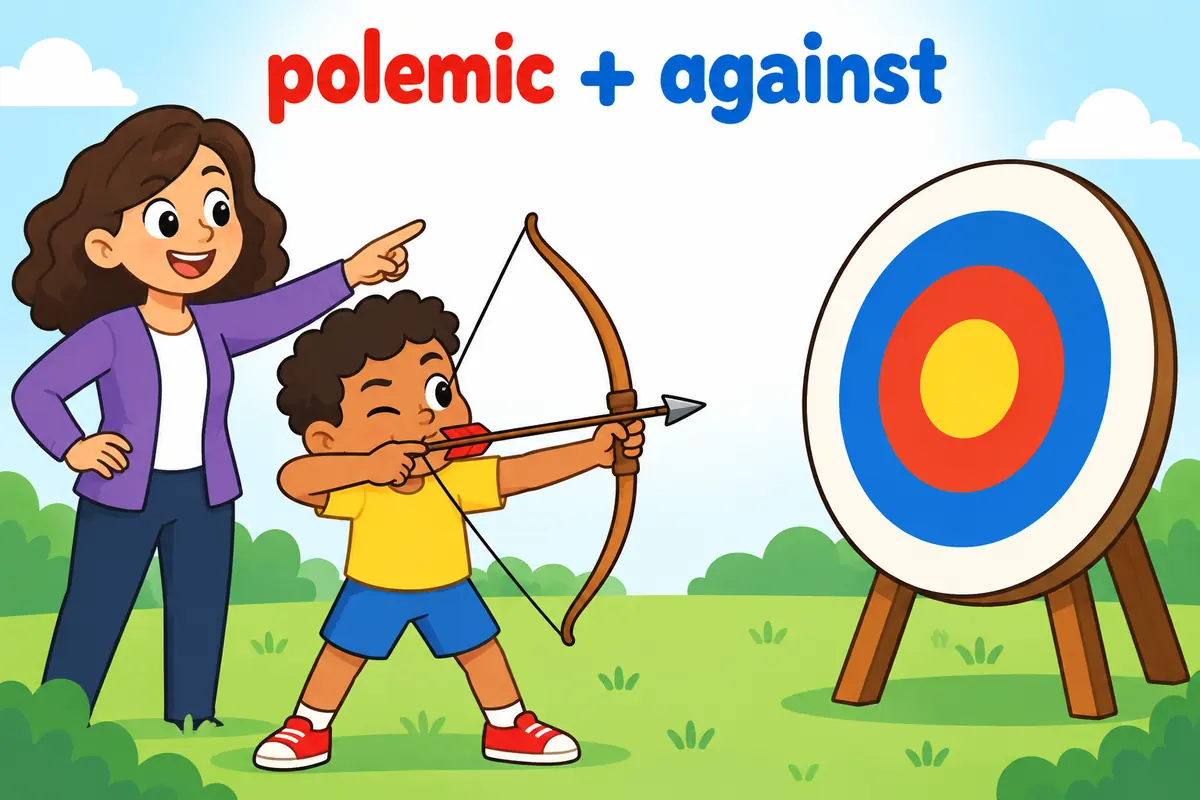
A polemic is a strong written or spoken attack on an idea, a policy or a public figure, and to use polemic in a sentence you normally pair it with against: “Her editorial is a polemic against standardized testing.” The noun is countable, so it needs an article such as a or the, or a plural.
Polemic at a glance
- Polemic is a countable noun; its forms are polemic, polemics, polemical, polemically and polemicist.
- The dominant pattern is a polemic against a person, a policy or an idea.
- Polemic belongs to formal, academic and journalistic writing rather than casual conversation.
- Usual verb partners are launch, publish, write and deliver.
- The commonest error is using polemic as an adjective where polemical is required.
What does polemic mean?
Polemic is a noun meaning a strong spoken or written attack on a belief, a policy or a person. The Cambridge entry for polemic records the attacking sense and its link to the adjective polemical. A narrower sense names argumentative writing as a genre, usually in the plural as polemics, as in a course on church polemics. Where a piece explains rather than attacks, contention or exposition labels it better, because polemic always carries opposition. The word is also the wrong choice for a small disagreement: a brief objection is an objection, not a polemic, and using the grand noun where a plain one fits overstates the case.
| Sense | Plain meaning | Example sentence |
|---|---|---|
| Attack piece | A forceful argument against a position | The pamphlet is a polemic against the new highway. |
| The practice | Argumentative writing as a genre | His career mixed polemics with careful history. |
| Adjective form | The related describing word is polemical | The review was polemical rather than balanced. |
How do you use polemic in a sentence?
The noun almost always follows an article and precedes against. The table below sets out the patterns that sound natural in formal prose.
| Pattern | Example | What it signals |
|---|---|---|
| a/the polemic against + target | The book is a polemic against state censorship. | The standard form; names the thing attacked. |
| launch or publish a polemic | She published a polemic against the merger. | The verb frames the act of releasing the attack. |
| a polemic directed at + target | His speech was a polemic directed at the board. | Emphasises aim rather than content. |
| polemics (plural) | Their debate turned to academic polemics. | The genre or practice, not one essay. |
| polemical + noun | A polemical essay changed the rules. | Use the adjective, never the noun, before a noun. |
Polemic in a sentence: examples across contexts
| Context | Example sentence | Why this works |
|---|---|---|
| Journalism | The columnist wrote a polemic against the fee increase. | Names writer, act and target in one line. |
| Academic writing | The chapter reads as a polemic against positivism. | Formal register fits the genre. |
| Book review | What begins as history becomes a polemic against nostalgia. | Signals a shift in the book’s purpose. |
| Political speech | Her address was a polemic against complacency. | Abstract target suits oratory. |
| Social media | The thread turned into a polemic against remote work. | Shows informal settings can carry it. |
| Workplace email | Please avoid a polemic and outline both options. | Nouns can name a writing style to avoid. |
| Classroom | The tutor asked for an argument, not a polemic. | Contrasts neutral analysis with attack. |
| Literary essay | Swift’s satire reads as a polemic against pride. | Connects a canonical name to the pattern. |
Polemic vs diatribe and screed
The nearest confusables are diatribe and screed, and each carries a different charge.
| Attribute | Polemic | Diatribe | Screed |
|---|---|---|---|
| Core meaning | A reasoned attack on a position | A bitter abusive outburst | A long tedious rant |
| Tone | Controlled, often scholarly | Heated and personal | Complaining and formless |
| Typical length | Article or book length | Usually a spoken speech | Often sprawling and repetitive |
| Usual target | A policy or an idea | A person | Anything the writer dislikes |
| Register | Formal essays and reviews | Rhetoric and public speech | Dismissive criticism |
Choose diatribe when the tone is abusive rather than argued, and screed when you want to signal that the writing is long and tiresome; keep polemic for a structured attack.
Word forms and grammar of polemic
| Form | Part of speech | Example |
|---|---|---|
| polemic | Noun (countable) | The essay is a polemic against waste. |
| polemics | Noun (plural) | He taught a course on Victorian polemics. |
| polemical | Adjective | The author’s polemical tone divided readers. |
| polemically | Adverb | She wrote polemically about the reforms. |
| polemicist | Noun (person) | The polemicist rarely conceded a point. |
| polemic essay | Non-standard | Incorrect: a polemic essay. |
The adjective is the form writers reach for most, which is why the dedicated polemical page answers a different question from this one.
Common mistakes with polemic
- Incorrect:
The article was very polemic.Correct: The article was very polemical. Polemic is the noun; the adjective is polemical. - Incorrect:
a polemic about the tax lawCorrect: a polemic against the tax law. The noun selects against, not about, for its target. - Incorrect:
She polemiced against the plan.Correct: She wrote a polemic against the plan. Polemic is not a verb; use wrote or published with the noun. - Incorrect:
an polemic against the warCorrect: a polemic against the war. The countable noun needs the article a, not an. - Incorrect:
The report is a polemic.Correct: The report is an analysis. Polemic implies a one-sided attack, not neutral explanation.
Practice using polemic
Work through the six items, then check the reasoning rather than only the answer.
- Fill the gap: The editorial is a polemic ______ the housing shortage.
- Choose the better word: The reviewer’s (polemic / polemical) style upset the author.
- Correct the error: Her book polemics against fast fashion.
- Build a sentence: use a polemic against about a proposed school closure.
- Spot the register: which belongs in a university essay, the treatise is a polemic against rent control, or the treatise is a total rant?
- Rewrite with the practice sense: One forceful essay dominated the debate. Use polemics instead.
Answers
- against. The noun pairs with against, and the housing shortage is the target.
- polemical. The adjective modifies style, so the noun polemic cannot stand before it.
- Her book is a polemic against fast fashion. Polemic is a noun, not a verb.
- Model answer: The parents’ letter is a polemic against the proposed school closure.
- The treatise is a polemic against rent control. A university essay avoids total and the slangy rant.
- The debate was shaped by academic polemics. The plural names the genre, not one essay.
The bottom line
Use polemic in a sentence when you mean a forceful written or spoken attack, and give it against plus a target. Two details decide most sentences: the word is a countable noun, so it takes a or the, and the adjective you probably want before another noun is polemical, not polemic. Reach for the plainer argument when no attack is involved.
Frequently asked questions about polemic
Is polemic a noun or an adjective?
Polemic is chiefly a noun, meaning a forceful attack on a position. The matching adjective is polemical, as in a polemical essay. Confusing the two is the usual slip: something is polemical, while an essay or a speech is a polemic. A small number of writers use polemic before a noun, but most editors replace it with polemical.
What is the plural of polemic?
The plural is polemics, and it usually means the practice or genre of argumentative writing rather than several separate attacks. A course in Victorian polemics studies a tradition of disputation. When you mean two distinct essays, write two polemics against the plan, which treats each as a countable item like any other noun.
Can polemic describe a person?
A person is called a polemicist, not a polemic. The word polemic names the piece of writing or the argument, so a writer produces a polemic and is described as a polemicist. Saying she is a polemic would confuse the work with the worker, and a careful editor would change it to polemicist.
Does polemic mean the same as controversy?
No. A controversy is a public disagreement involving several people, while a polemic is one person’s attack on a position. A polemic can start a controversy, and a controversy can prompt several polemics, but the words name different things. Use controversy for the dispute and polemic for the combative essay or speech.
Have you ever come across a fiery debate where strong opinions clash and emotions run high? This kind of intense argument is called a polemic. In discussions involving polemics, opposing sides vehemently express their contrasting viewpoints, often resulting in a heated exchange.
Polemics are characterized by their confrontational nature and divisive rhetoric, aimed at persuading others to adopt a particular stance while discrediting opposing arguments. This type of discourse can be found in various settings, from political debates to academic discussions, where passionate advocacy and forceful rebuttals are common.
7 Examples Of Polemic Used In a Sentence For Kids
- Polemic is a type of argument or debate.
- Some people like to have polemic discussions about their beliefs.
- Polemic conversations can help us learn about different opinions.
- It’s important to listen and respect others during a polemic conversation.
- We can learn new things by being open-minded during a polemic discussion.
- Polemic topics can be exciting to talk about with friends.
- Remember to be kind and patient during a polemic debate.
14 Sentences with Polemic Examples
- Polemic articles in the college newspaper often spark intriguing debates among students.
- The polemic discussion during the political science lecture divided the class into two distinct viewpoints.
- The polemic presentation on climate change prompted students to reconsider their attitudes towards environmental issues.
- After the professor’s polemic remarks, the classroom was abuzz with passionate arguments and counterarguments.
- Engaging in a polemic debate is a great way for college students to refine their critical thinking skills.
- The student council’s polemic debate over funding allocations for various clubs and organizations drew a large audience.
- The polemic literature professor challenged students to defend their interpretations of complex texts.
- Participating in a polemic panel discussion on social justice issues can broaden students’ perspectives.
- The polemic exchange during the philosophy seminar showcased the diversity of opinions within the class.
- The polemic conversation about campus policies highlighted the importance of student activism.
- The fascinating polemic between two guest speakers at the college symposium captivated the audience.
- The polemic blog post about educational reform generated heated discussions among students and faculty members.
- Attending a polemic workshop on gender studies can inspire students to challenge societal norms.
- The polemic film screening followed by a discussion session encouraged students to critically analyze media representations.
How To Use Polemic in Sentences?
To effectively use Polemic in a sentence, beginners must understand its meaning and proper usage. Polemic is a noun that refers to a strong verbal or written attack on someone or something. It is often used to express a controversial opinion or to provoke debate or argument.
Here is an example sentence using Polemic:
- The politician’s speech was filled with polemic as he criticized his opponent’s policies.
To incorporate this word into your writing, first identify a topic or issue that you feel strongly about. Then, construct a sentence that expresses your argument or criticism in a forceful and contentious manner, using Polemic to emphasize your point.
Remember to use Polemic judiciously and consider the tone and context of your writing. Avoid using Polemic if you are aiming for a more neutral or diplomatic approach. It is essential to be clear and concise in your expression to effectively communicate your argument.
By following these guidelines, beginners can confidently incorporate Polemic into their writing to convey strong opinions and spark discussion on various topics.
Conclusion
In conclusion, sentences with a polemic tone are argumentative and often express strong opinions or critiques. These sentences aim to challenge the status quo or provoke debate on a particular issue by using forceful language or rhetoric. By employing polemic sentences, writers can engage readers and cultivate discussions by presenting controversial viewpoints in a clear and impactful manner.
Whether in literature, public speeches, or social media posts, sentences with a polemic tone serve to incite thought and spark dialogue. While they may polarize opinions, these sentences are instrumental in shaping public discourse and driving change by bringing attention to pressing issues and fostering critical thinking. Overall, the use of polemic sentences can be a powerful tool for influencing perspectives and initiating conversations that challenge long-held beliefs or societal norms.


