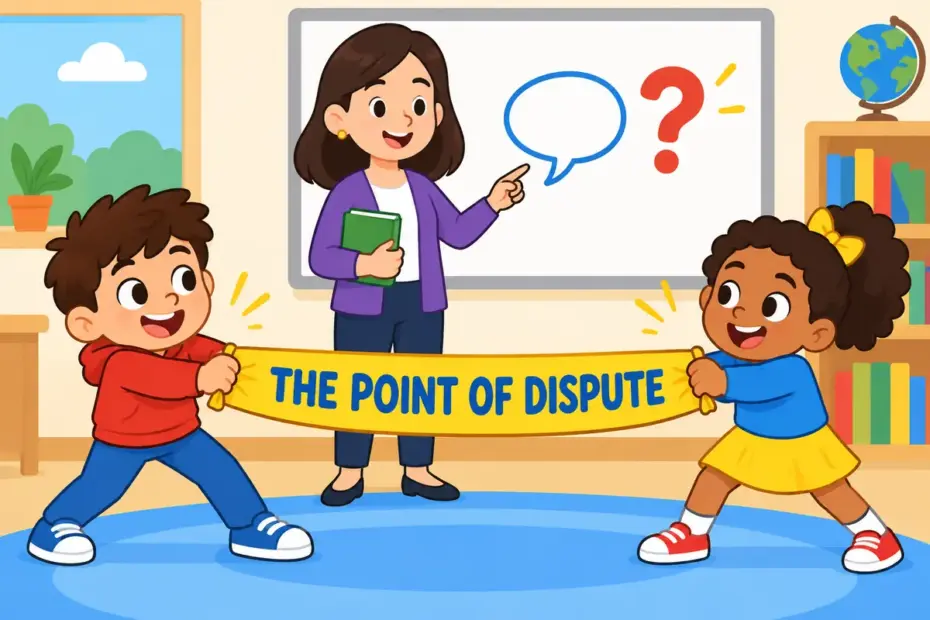
Contention means disagreement, a point argued for, or competition for a prize. To use contention in a sentence, decide which sense you need: “a bone of contention” is a quarrel, “her contention” is a claim, and “in contention” means in the running.
Contention at a glance
- Contention is a noun with three senses: dispute, argued claim, and competition.
- Its plural is contentions, and the related verb is contend.
- The fixed phrase in contention means competing for a place or prize.
- Contention belongs to formal, academic, legal and sports writing.
- The commonest error is confusing contention with content, which is unrelated in meaning.
What does contention mean?
Contention is a noun meaning heated disagreement or the point being argued for. The Cambridge entry for contention lists the argument sense and the competition sense, and the surrounding words tell you which one is meant. Where the dispute is settled in public, a dispute over pay is the plainer noun with the same quarrel at its centre.
| Sense | Plain meaning | Example sentence |
|---|---|---|
| Dispute | Angry disagreement between people | The fence became a source of contention. |
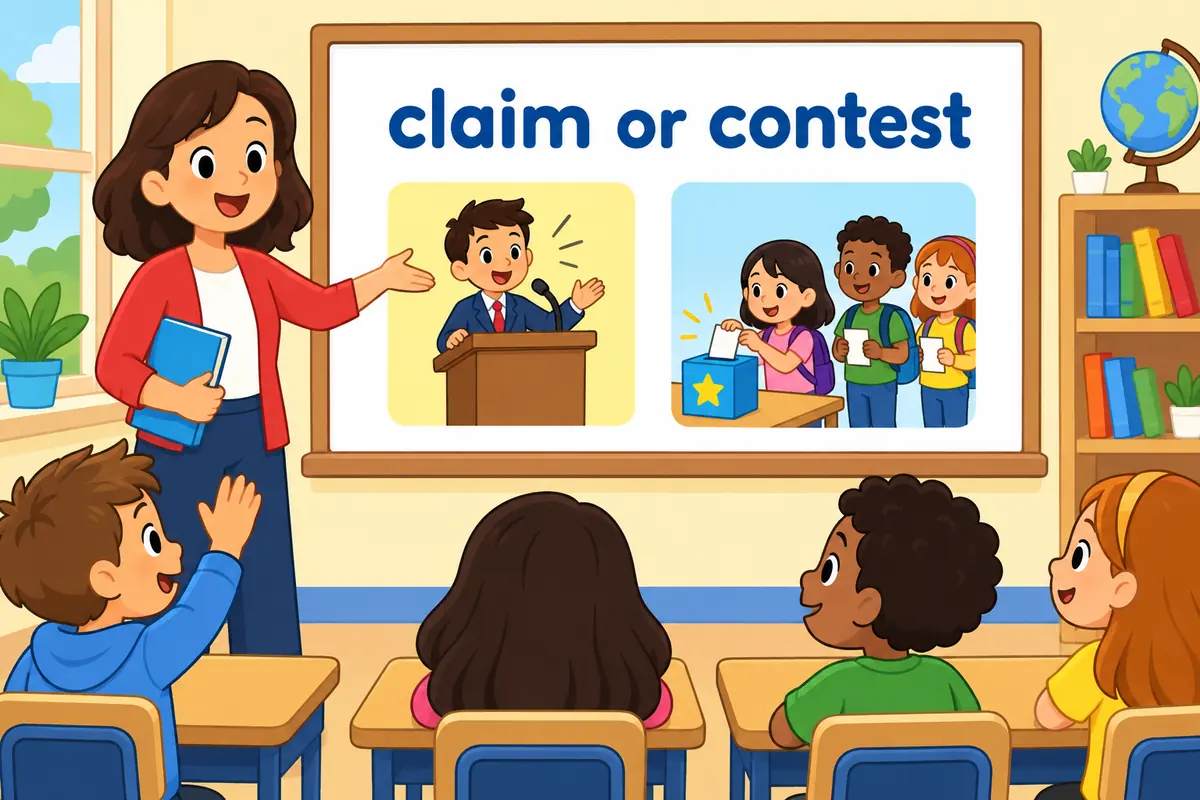
| Argued claim | A statement put forward as true | The author’s main contention is that the data was misread. |
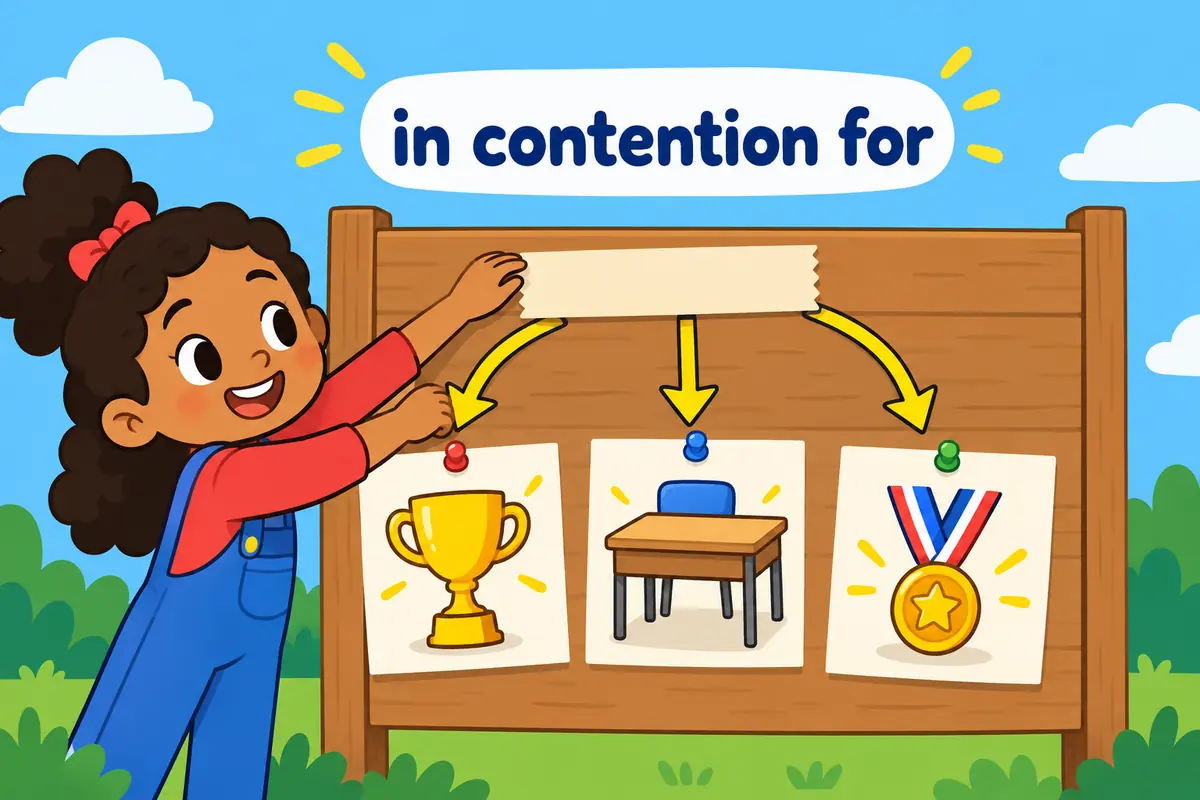
| Competition | Being in the running for a prize | Two riders are in contention for the title. |
How do you use contention in a sentence?
Contention is countable when it means a claim and uncountable when it means strife, and the fixed phrases below decide the sense. A legal writer who puts forward an argument is making a claim about the facts, which is the neutral twin of a contention.
| Pattern | Example | What it signals |
|---|---|---|
| be in contention for | The team is in contention for a medal. | The competition sense, with a prize named. |
| it is my contention that | It is my contention that the rule is unclear. | The formal claim sense, common in argument. |
| a point of contention | Pay remains a point of contention. | The dispute sense, focused on one issue. |
| a bone of contention | The boundary wall is a bone of contention. | A fixed idiom for a long-running quarrel. |
| contention between + parties | Contention between the two offices slowed the work. | Uncountable strife, with the rivals named. |
Contention in a sentence: examples across contexts
| Context | Example sentence | Why this works |
|---|---|---|
| Academic writing | Her central contention is that the evidence was overstated. | Presents a claim that the rest of the paper must support. |
| Legal writing | Counsel rejected the contention that the search was lawful. | Formal, precise and standard in court argument. |
| Sports report | The champion is still in contention after a late surge. | Uses the competition sense with a clear prize implied. |
| News report | Funding is the main point of contention between the two sides. | Ties the dispute sense to one named issue. |
| Workplace email | The shift rota has become a bone of contention on the floor. | The idiom signals a familiar, recurring quarrel. |
| Debate | There is sharp contention over how the money should be spent. | Uncountable use that captures sustained disagreement. |
| Business writing | Three suppliers are in contention for the contract. | Shows several rivals competing for one prize. |
| Feature article | For years the old mill was a source of contention in the village. | Places a long dispute in a specific setting. |
Contention vs argument
Both nouns concern disagreement, but argument covers the whole exchange while contention can also name a single claim or a place in a race.
| Attribute | Contention | Argument |
|---|---|---|
| Meaning | Dispute, a claim, or competition | A quarrel or a set of reasons |
| Typical phrase | in contention, a point of contention | have an argument, win an argument |
| Can name a claim | Yes, as in my contention that | Rarely, and never in the same fixed phrase |
| Register | Formal, legal and journalistic | General, from casual to formal |
| Competition sense | Yes, in contention for | No |
Use contention for a formal claim or a place in the running, and argue a point when you mean the whole exchange of reasons and replies.
Word forms and grammar of contention
Contention is a noun built on the verb contend; the forms below show the family and the false friend that shares its opening letters.
| Form | Part of speech | Example |
|---|---|---|
| contention | noun (singular) | Her contention surprised the panel. |
| contentions | noun (plural) | He listed three contentions in his reply. |
| contend | verb | Critics contend that the rule is too vague. |
| contentious | adjective | The proposal proved highly contentious. |
| contender | noun (a rival) | She is a serious contender for the post. |
| content | noun / adjective (unrelated) | The content of the letter was brief. |
The verb contend that the rule is vague reports the act of arguing, and a contender for the post is the person doing the competing.
Common mistakes with contention
The team is in contention of the cup.Write The team is in contention for the cup. The competition sense always takes for, not of.My contention is the rule is unfair.Write My contention is that the rule is unfair. The claim sense introduces a that-clause.We had a contention about money.Write We had an argument about money. For an everyday quarrel, argument is the natural noun.The contention of the box was heavy.Write The content of the box was heavy. Content means what something holds; contention does not.There was many contention in the room.Write There was much contention in the room. In the strife sense the noun is uncountable.Do not confuse the content of the speech with contention.Write Do not confuse the content of the speech with contention. The two nouns share a root but not a meaning.
Practice using contention
- Fill in the blank: The captain is still in ______ for a place in the final.
- Fill in the blank: It is my ______ that the figures were misread.
- Choose the better word: Parking is the main point of (contention / content) on our street.
- Choose the better word: They settled the (contention / argument) over dinner.
- Correct the error: Two teams are in contention of the trophy.
- Build a sentence: use contention to describe a long-running quarrel about a boundary.
- Spot the register: which belongs in a court filing, (a) They are fighting about the contract, (b) The claimant rejects the contention that the notice was valid?
Answers
- contention, because the phrase in contention for marks the competition sense.
- contention, because it is my contention that introduces a formal claim.
- contention, because a point of contention names a disputed issue.
- argument, because an everyday quarrel has a start and an end that argument fits.
- Two teams are in contention for the trophy, because the competition sense takes for.
- The boundary wall has long been a bone of contention, because the idiom names a recurring quarrel.
- (b), because the formal claim sense of contention belongs in a legal document.
The bottom line
Contention has three senses, and the phrase around it tells you which one is active: in contention means competing, my contention means a claim, and a point of contention means a quarrel. It is a formal noun at home in debate, law and reportage. For everyday disagreement, argument is the plainer and safer choice.
Frequently asked questions about contention
Is contention a formal word?
Contention leans formal. It appears in academic papers, legal filings and sports journalism, where its three senses each have a fixed phrase. In relaxed conversation it can sound stiff, and argument or disagreement will usually read more naturally. The idiom a bone of contention is the one use that stays common across registers.
What does in contention mean?
In contention means competing for a place or prize, as in the team is in contention for a medal. It names a real chance of winning, not a guaranteed result. The phrase usually takes for, so a newcomer is in contention for the post, and out of contention means the chance has gone.
What is the difference between contention and content?
Contention and content share a spelling but not a meaning. Content is what something holds, whether information in a letter or goods in a box, and it also means satisfied. Contention is about argument, a claim or competition. Only the opening letters connect them, so a reader should never swap one for the other.
Can contention be plural?
Yes, in the claim sense. A writer can list three contentions in a reply, meaning three separate points being argued. In the dispute sense the noun is uncountable, so there was much contention is correct and contentions would be wrong. In the competition sense the plural is rare but possible.
Contention is a term often used to describe a state of disagreement or conflict between two or more parties. It represents a situation where different opinions, interests, or beliefs clash, leading to a sense of tension or opposition.
In writing, contention can arise when authors present differing viewpoints or arguments within their work, aiming to persuade readers to align with a particular stance. This literary technique is commonly used to engage readers in critical thinking and to spark thoughtful debates on various topics.
7 Examples Of Contention Used In a Sentence For Kids
- The contention started when two friends wanted to play with the same toy.
- Please remember to raise your hand if there is a contention during class.
- Let’s learn to share and communicate to avoid contention with our friends.
- It’s important to listen to each other to resolve contention peacefully.
- When there is a contention, we should try to think of a solution together.
- Let’s practice patience and understanding when there is a contention.
- Remember, it’s okay to disagree, but we must respect each other during contention.
14 Sentences with Contention Examples
- Students often face contention when choosing a major that aligns with their interests and future career goals.
- There is contention among student groups regarding the scheduling of extracurricular activities during exam periods.
- The contention between students from different backgrounds can sometimes lead to misunderstandings in group projects.
- There is a lot of contention surrounding the issue of reservation policies in Indian universities.
- Debates in college often revolve around contention regarding the effectiveness of online learning versus traditional classroom settings.
- Contention arises when discussing the allocation of funds for various campus events and initiatives.
- Students may experience contention with professors over conflicting opinions on course material or assignments.
- The upcoming elections for student council have created a lot of contention among different political groups on campus.
- Contention can arise during class discussions when students have differing viewpoints on a controversial topic.
- The lack of clear communication within student organizations often leads to contention over decision-making processes.
- Managing time effectively can help reduce contention between academic responsibilities and personal commitments.
- The process of selecting representatives for student committees can lead to contention among those who feel their voices are not being heard.
- Some students feel a sense of contention when faced with the pressure to excel academically in a competitive environment.
- Addressing issues of contention within student groups requires open communication and a willingness to compromise.
How To Use Contention in Sentences?
To use Contention in a sentence, first, identify a point of disagreement or conflict between two or more parties. This can be a debate, argument, or difference of opinion on a particular topic. Once you have identified the opposing views, you can introduce the word Contention into your sentence.
For example, “There was a contention between the two political parties regarding the new policy.” In this sentence, Contention is used to highlight the disagreement between the political parties.
It’s important to note that Contention is often used in formal or academic writing to convey a strong disagreement or dispute. When using Contention in a sentence, make sure it is clear from the context what the disagreement is about and who the opposing parties are.
To strengthen your sentence, you can provide additional context or evidence to support the Contention being made. For instance, “The contention between the researchers was resolved after reviewing the latest data.”
In summary, to effectively use Contention in a sentence, pinpoint a disagreement, express it using the word Contention, and provide context or evidence to support the conflicting views. Remember to use Contention appropriately to enhance the clarity and impact of your writing.
Conclusion
In writing, sentences with contention often express opposing viewpoints or arguments on a particular issue. These sentences are crucial for presenting a balanced view and encouraging critical thinking by showcasing different perspectives. Whether they are used in essays, debates, or discussions, sentences with contention help readers or listeners consider multiple angles of a topic before forming their own opinions.
Mastering the skill of constructing sentences with contention can improve one’s ability to analyze complex issues thoroughly and engage in meaningful dialogue. These sentences facilitate a deeper understanding of diverse viewpoints and promote constructive discourse by highlighting the complexities and nuances of various arguments. They play a key role in fostering critical thinking and encouraging individuals to explore differing opinions in a respectful and open-minded manner.


