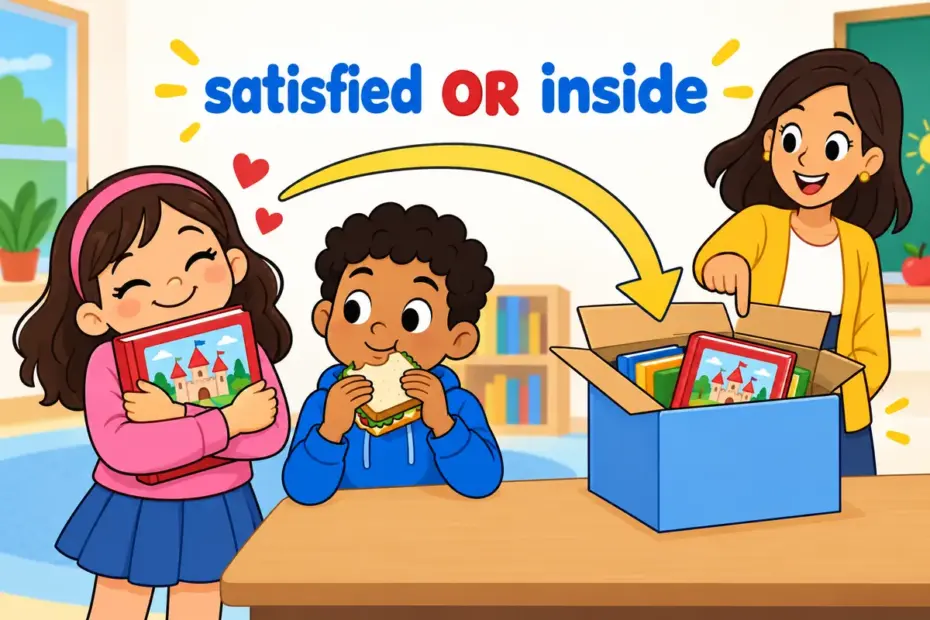
Content has two everyday meanings that share one spelling: the material held inside something, and the settled feeling of being satisfied. To use content in a sentence, first decide which meaning you need, because the noun and the adjective are pronounced differently: “The contents of the box were missing.”
Content at a glance
- Content is a noun meaning the material inside something, and an adjective meaning quietly satisfied.
- The noun stresses its first syllable (CON-tent); the adjective stresses the second (con-TENT).
- As a mass noun, content takes a singular verb, while contents names separate items.
- The dominant patterns are the content of something and content with something.
- The commonest error is writing contempt, a different word meaning scorn.
What does content mean?
Content is a noun meaning the material, ideas or information held inside something, and an adjective meaning quietly satisfied. The Cambridge entry for content keeps the two senses apart, and pronunciation is the quickest way to tell them: the noun is /ˈkɒn.tent/ and the adjective is /kənˈtent/.
| Sense | Plain meaning | Example sentence |
|---|---|---|
| Material inside | The substance or text held within something | The content of the email was a single warning. |
| Published material | Words, images or media made for an audience | She writes content for a language school. |
| Satisfied | Calm and not wanting more | He is content with a small flat. |
| Plural contents | The separate things inside a container | The contents of the safe were listed. |
Writers often reach for contention when they mean subject matter, but contention means an argument or a disputed claim, not material. For a wider set of options, contend, which means to argue or compete, and a contender are the person and the act, while neither carries a sense of material.
One limitation is worth stating plainly. Content never means excited or delighted; it names calm acceptance, so a content child is settled rather than thrilled. The singular mass noun also describes material as a whole, while the plural contents lists separate items, and neither word carries the scorn of contempt.
How do you use content in a sentence?
The pattern follows the meaning. The noun takes of or about, the adjective takes with, and the verb takes oneself with. Those prepositions are what separate a natural sentence from a translated one.
| Pattern | Example | What it signals |
|---|---|---|
| the content of + noun | The content of the report surprised the board. | Names the material held inside a thing. |
| content about or on + noun | She posts content about local history. | Names published material and its topic. |
| be content with + noun | They were content with the first offer. | Reports calm satisfaction with something. |
| be content to + verb | He was content to wait another week. | Reports willing acceptance of an action. |
| content oneself with + noun | We contented ourselves with a short reply. | Formal verb: settle for less than ideal. |
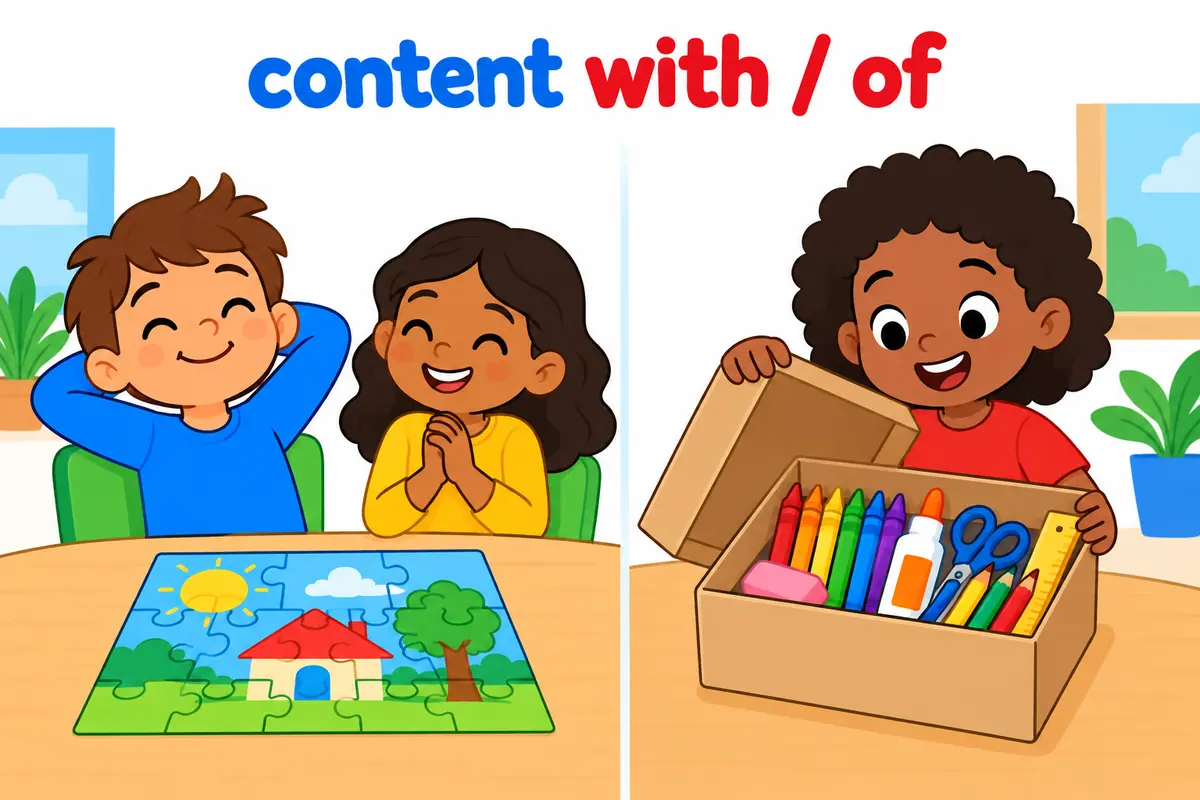
Content in a sentence: examples across contexts
Content changes register more than it changes meaning. The nine sentences below keep the same word while moving from a classroom to a marketing plan, and each one shows which sense is in play.
| Context | Example sentence | Why this works |
|---|---|---|
| Classroom | The teacher checked the content of every poster before the fair. | Uses the noun for material held inside a thing. |
| Workplace email | The team agreed that the content of the brief was clear. | Names the material a document carries. |
| News report | Protesters said the content of the bill had been hidden. | Keeps the noun neutral and factual. |
| Marketing | The brand published new content about recycling each week. | Uses the mass noun for published material. |
| Technical writing | Verify the content of the file before you upload it. | Treats content as a mass the reader can inspect. |
| Conversation | After the test she seemed content with her mark. | Switches to the adjective with with. |
| Academic writing | The chapter surveys the content of local archives. | Uses the noun in a formal subject position. |
| Parenting | He was content to read while the others played. | Uses content to plus a verb for willing acceptance. |
| Literary prose | The old gardener was content with very little. | Uses the adjective to suggest lasting calm. |
Notice that the adjective appears with with or to, while the noun keeps to of unless it is a list of items. That fork is the single most useful clue when you are reading quickly.
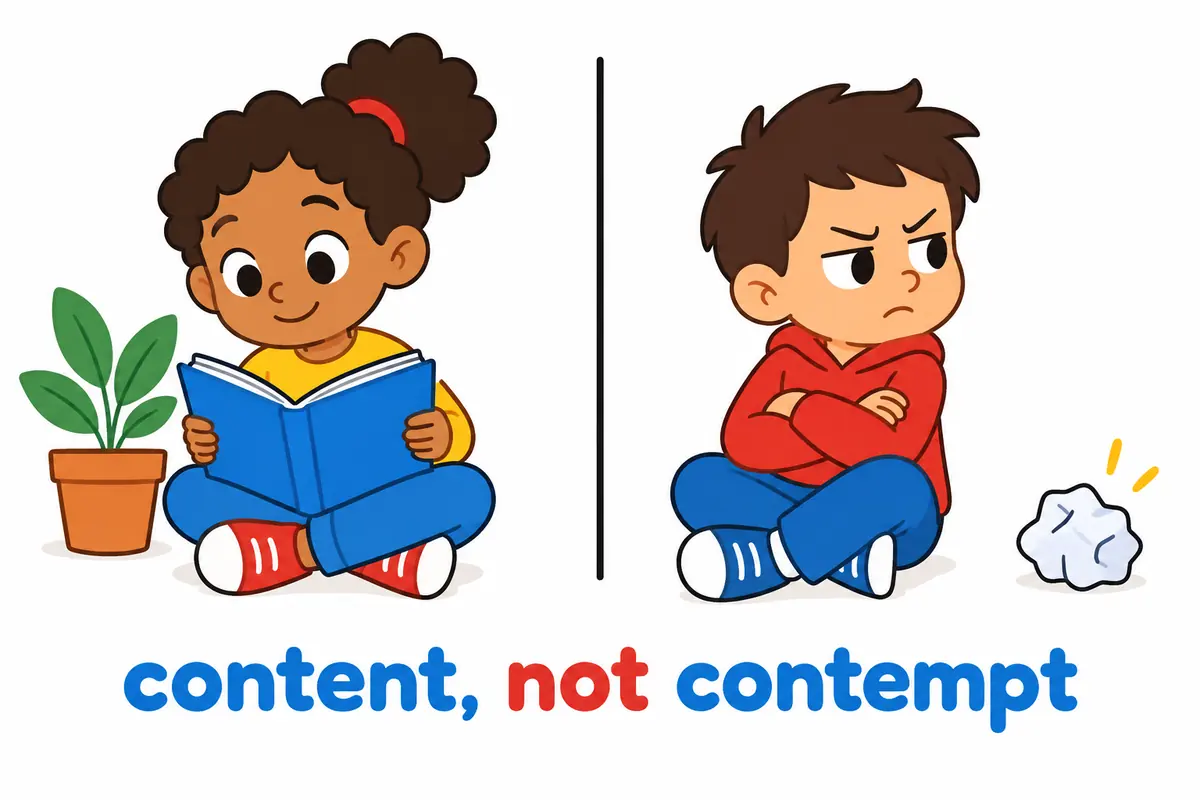
Content vs contempt
Content and contempt differ by two letters and by everything else. in contempt is a noun for the belief that someone is worthless, and it never means satisfied or material.
| Attribute | content | contempt |
|---|---|---|
| Meaning | Material inside, or satisfied | The belief that someone deserves no respect |
| Part of speech | Noun and adjective | Noun only |
| Feeling | Calm or neutral | Strongly negative |
| Typical pattern | the content of a page; content with the result | held in contempt; contempt of court |
| Spelling | Ends in -ent | Ends in -empt |
Verdict: choose content for the material inside something or for quiet satisfaction, and choose contempt only when the meaning is active scorn.
Word forms and grammar of content
Content is unusual because the same spelling serves as a noun and an adjective, and the related forms carry different senses. Keep the adjective contented and the adverb contentedly for a settled, lasting state; content alone is the shorter, plainer choice in everyday sentences.
| Form | Part of speech | Example |
|---|---|---|
| content | noun, mass | The content was removed overnight. |
| contents | plural noun | The contents of the safe were listed. |
| content | adjective | She looked content after the exam. |
| contented | adjective | A contented cat slept on the chair. |
| contentment | noun | He found contentment in a quiet routine. |
| contentedly | adverb | The child played contentedly alone. |
Common mistakes with content
- Incorrect:
The content of the shelves were empty.Correct: The contents of the shelves were empty. Rule: Mass content takes a singular verb; use contents for separate items. - Incorrect:
They held the report in content.Correct: They held the report in contempt. Rule: Content means material or satisfaction; the fixed phrase is in contempt. - Incorrect:
He is content of his salary.Correct: He is content with his salary. Rule: The adjective content takes with, never of. - Incorrect:
The lawyer will content the claim on Monday.Correct: The lawyer will contend on Monday. Rule: Contend means to argue and shares the root but not the meaning of content. - Incorrect:
She felt contented that he called.Correct: She felt content that he called. Rule: Before a that-clause, use content, not contented.
A final lookalike is portent, an omen, which shares the -ent ending but none of these senses.
Practice using content
Work through the six items, then check the reasoning rather than only the answer.
- Fill the gap: The ______ of the letter had been changed before it was sent.
- Choose the better word: After the long walk, the children were (content / contempt) to sit in the shade.
- Correct the error: The contents of the drawer was empty.
- Build a sentence: use content with about a classmate’s exam result.
- Spot the register: which belongs in a school report — the content of the report is accurate, or I was well content with my grade?
- Rewrite with the plural noun: The whole content of the basket was missing. Use contents instead.
Answers
- content — the material inside one letter is a mass, so the singular noun fits.
- content — the adjective takes with or to and means satisfied, while contempt is a noun for scorn.
- The contents of the drawer were empty — contents is plural and takes a plural verb.
- Model answer: She was content with her exam result — the adjective is followed by with.
- The content of the report is accurate — a school report stays formal and avoids the first person.
- The whole contents of the basket were missing — the plural names the separate items.
The bottom line
Use content in a sentence as a mass noun for the material inside something and as an adjective for calm satisfaction. The two decisive points are stress and preposition: the noun leans on its first syllable and takes of, while the adjective leans on its second and takes with. If the meaning you want is scorn, the word is contempt, not content.
Frequently asked questions about content
Is content countable or uncountable?
Content is uncountable when it means material as a whole, so you would write the content is ready, not the contents is ready. The plural contents is countable and names the separate things inside a container, such as the contents of a bag or a file.
Can content and contents be used the same way?
No. Content treats the material as one mass and takes a singular verb, while contents treats it as a list of separate items and takes a plural verb. The content of the essay is clear, but the contents of the essay include notes and a chart.
Why is content sometimes pronounced differently?
The pronunciation follows the job the word is doing. As a noun it stresses the first syllable, CON-tent, which covers material and published work. As an adjective it stresses the second, con-TENT, which covers the feeling of being satisfied. Stress alone tells a listener which sense is meant.
Does content ever mean happy?
Content comes close, but it describes calm satisfaction rather than excitement. A content person is settled and does not want more, which is why the word suits quiet scenes and not celebrations. For strong happiness, glad or delighted is the better choice.
Content refers to the substance or material contained within something. In the realm of writing, content often refers to the information or ideas presented in a piece of text.
When crafting content, it is essential to consider the message you want to convey and how you can effectively communicate it to your audience. Creating engaging and informative content is paramount in capturing the reader’s attention and delivering your message effectively.
7 Examples Of Content Used In a Sentence For Kids
- Content can be found in books.
- I am content when I play with my friends.
- Content can make us happy.
- We should always be content with what we have.
- The teacher will give us new content to learn.
- It’s important to listen carefully to understand the content.
- Reading stories can be a fun way to learn new content.
14 Sentences with Content Examples
- Content from the previous lecture can be found on the college website.
- Have you finished studying the content for tomorrow’s exam?
- I need to update the content of my presentation before submitting it.
- The library is a great place to find additional content for your assignments.
- Make sure to reference all the content you use in your research paper.
- The professor asked us to analyze the content of the novel we’re studying.
- The online platform offers a wide range of content for us to explore.
- I need to review the content of last week’s tutorial before the next one.
- The online content provided by our college is very helpful for self-study.
- We need to brainstorm ideas for the content of our group project.
- The content of the workshop on communication skills was quite informative.
- The content of the online course is updated regularly to keep it relevant.
- The content of the subject I’m studying is quite challenging but rewarding.
- I’m looking forward to discussing the content of the upcoming seminar with my peers.
How To Use Content in Sentences?
To use the word Content properly in a sentence, it is important to understand its meaning first. Content refers to the information or ideas that are presented in a piece of writing, a speech, a movie, etc.
When crafting a sentence with Content, make sure to clearly convey the meaning of the word. For example, “The content of the book was both informative and engaging,” demonstrates how the word is used to describe the substance or material within the book.
Remember to place Content appropriately within the sentence. It can be used as a noun, so ensure that it fits correctly within the structure of the sentence. For instance, “I enjoyed the content of the presentation,” correctly positions the word within the sentence to express the subject matter being appreciated.
Furthermore, it is essential to consider the context in which you are using the word Content. Ensure that the sentence is coherent and effectively communicates the intended message to your audience.
By following these guidelines and practicing more examples, you will become more comfortable using the word Content in your writing and conversations.
Conclusion
In conclusion, sentences with content are the building blocks of communication, conveying information and ideas in a clear and concise manner. They are essential for effective communication in writing and speaking, allowing individuals to express their thoughts and opinions with clarity and precision.
Whether in essays, articles, speeches, or everyday conversations, sentences with content play a crucial role in ensuring that messages are understood and information is effectively shared. By using sentences that are meaningful and informative, individuals can engage their audience and convey their intended message with impact and coherence. Thus, mastering the art of constructing sentences with content is fundamental for effective communication in various contexts.


