Explain is a verb meaning to make an idea, event or reason clear to another person. To use explain in a sentence, name the thing made clear and the listener who receives it: “She explained the rule to the new pupil.” The verb takes a direct object and puts the listener after to.
Explain at a glance
- Explain is a verb; its forms are explains, explained and explaining, and its noun is explanation.
- The core pattern is explain plus an object, as in explain the rule.
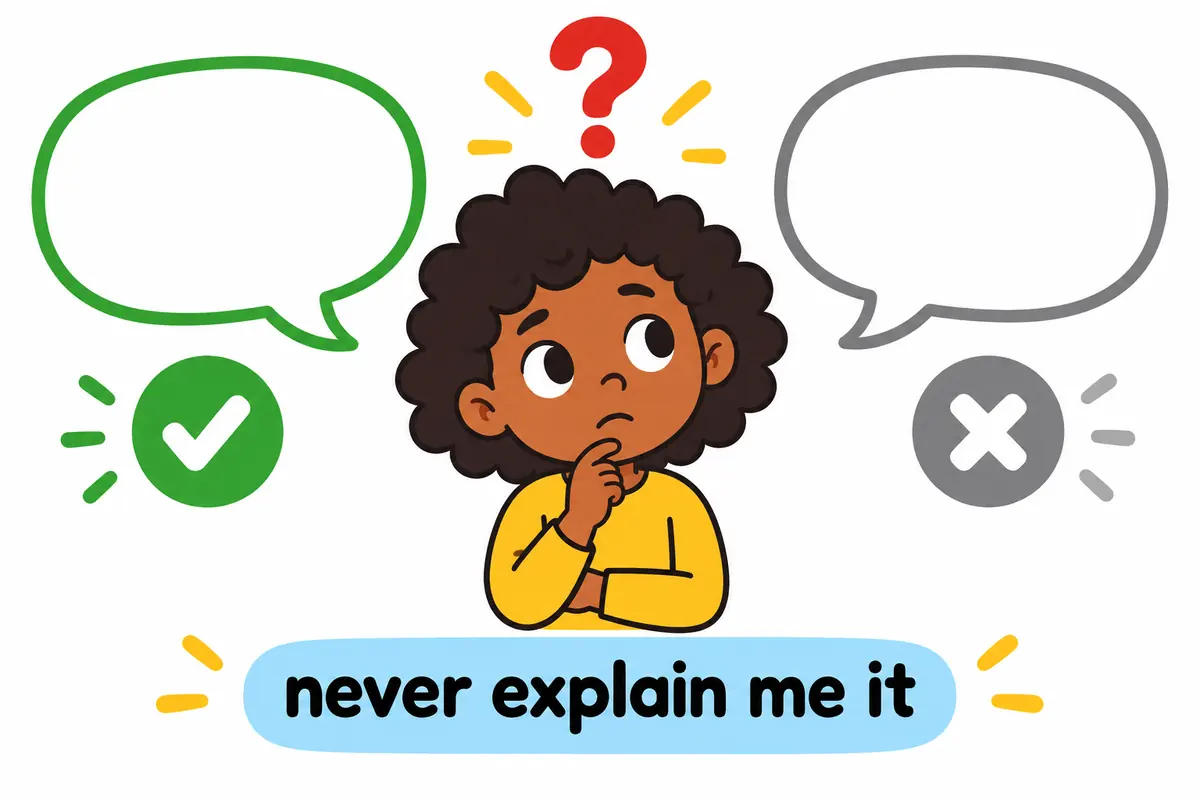
- A listener follows to: explain the rule to me, never explain me the rule.
- The verb also takes that-clauses and wh-clauses, as in explain that it was late or explain why it failed.
- The commonest error is dropping to before the person who receives the explanation.
What does explain mean in English?
Explain is a verb meaning to make something clear by giving details, reasons or instructions. The Cambridge entry for explain records the central sense of making something plain. Two related ideas sit close by: to define a term is to fix its exact meaning, which is narrower than explaining it, and when a message is merely unclear, clarify a point is the closer verb because it removes confusion rather than adding detail.
| Sense | Plain meaning | Example sentence |
|---|---|---|
| Make clear | Give details so something is understood | The teacher explained the rule in three steps. |
| Give a reason | Say why something happened | He explained why the train was late. |
| Account for behaviour | Justify your own actions | She was asked to explain herself. |
Explain is not the word for defending a choice. A person can explain an action without approving of it, and justify is the verb that argues the action was right.
How do you use explain in a sentence?
Explain rarely stands alone, and the pattern it takes decides where the listener goes in the sentence.
| Pattern | Example | What it signals |
|---|---|---|
| explain plus noun | The guide explains the process. | The topic being made clear |
| explain plus to plus person | She explained the map to the visitors. | The listener who receives it |
| explain plus that-clause | He explained that the office was closed. | A fact offered as the reason |
| explain plus wh-clause | Explain how the pump works. | The question being answered |
| explain away | She explained away the missing files. | Excusing something doubtful |
Explain in a sentence: examples across contexts
| Context | Example sentence | Why this works |
|---|---|---|
| Classroom | The teacher explained the water cycle with a diagram. | Names the topic and the method. |
| Workplace email | I will explain the delay to the client tomorrow. | Uses explain to plus person. |
| News report | Officials explained that the road would reopen by Friday. | Delivers the reason in a that-clause. |
| Technical manual | This section explains how to reset the device. | Answers a how question directly. |
| Everyday conversation | Let me explain why I was late. | Introduces a reason informally. |
| Academic writing | The study explains the pattern as a seasonal effect. | Explains something as something. |
| Customer service | The agent explained the refund process step by step. | Stresses clarity for a worried reader. |
| Recipe note | The recipe explains when to add the salt. | Pairs explain with a when-clause. |
| Sports coaching | The coach explained the drill to the new players. | Names the listener with to. |
| Safety briefing | The officer explained that the alarm was only a test. | Prevents unnecessary alarm with a fact. |
A diagram can illustrate a process while the surrounding text explains why it works, which is why the two verbs so often travel together.
Explain vs justify
Explain and justify both answer a question, but they answer different ones.
| Attribute | Explain | Justify |
|---|---|---|
| Core question | How does this work? | Why was this right? |
| What it does | Makes something understood | Defends a choice |
| Typical context | Teaching, news, manuals | Policy, ethics, management |
| What it implies | Neutral clarity | A defence is expected |
| Register | Broad and everyday | Formal and argumentative |
To justify a decision is to defend it, while to explain it is only to make it understood. Where a speaker merely paints what something looks like, describe the scene is the right verb, because description reports appearance and explanation reports cause.
Word forms and grammar of explain
| Form | Part of speech | Example |
|---|---|---|
| explain | base verb | Please explain the rule. |
| explains | third-person singular | She explains the method clearly. |
| explained | past tense | He explained the delay yesterday. |
| explaining | present participle | They are explaining the plan now. |
| explanation | noun | Her explanation was short. |
| explanatory | adjective | The explanatory note helped. |
| explain me it | non-standard | Write explain it to me, never explain me it. |
Its noun explanation keeps the same idea but behaves like a countable noun, as in a clear explanation.
Common mistakes with explain
- Incorrect:
Can you explain me the answer?Correct: Can you explain the answer to me? Rule: explain never takes two objects, so the listener follows to. - Incorrect:
She explained about the problem.Correct: She explained the problem. Rule: explain takes a direct object without about. - Incorrect:
He explained me that the shop was shut.Correct: He explained that the shop was shut. Rule: a that-clause follows explain directly, with no person in between. - Incorrect:
Please explain to me it.Correct: Please explain it to me. Rule: a pronoun object comes before to plus the listener. - Incorrect:
She explained with joy when she saw the gift.Correct: She exclaimed with joy when she saw the gift. Rule: do not confuse explain with exclaim, which means to cry out rather than to make something clear.
Practice using explain
- Fill in the blank: The technician ______ the fault to the manager.
- Choose the better word: The lawyer had to (explain / justify) why the fee was fair.
- Correct the error: Can you explain me this diagram?
- Build a sentence: use explain plus to plus a listener about a cancelled trip.
- Spot the register: which line belongs in a formal report? (A) He explained the figures to the board. (B) He explained the figures to his mates down the pub.
- Fill in the blank: The leaflet ______ how to recycle the box.
- Choose the better word: The diagram will (illustrate / exclaim) the process clearly.
Answers
- explained, because the topic follows the verb and the manager follows to.
- justify, because a fair fee must be defended rather than merely made clear.
- Can you explain this diagram to me? The listener must follow to.
- She explained the cancelled trip to her class, with the object before to plus the listener.
- A, because a formal report keeps a neutral, professional register.
- explains, because the leaflet answers a how question in a wh-clause.
- illustrate, because a diagram shows a process rather than crying out.
The bottom line
Explain in a sentence works best when the topic follows the verb and the listener follows to, as in explain the rule to me. The verb also accepts that-clauses and wh-clauses, which let a sentence carry a reason without a separate noun. Keep justify for defending a choice, and the pattern will stay clean.
Frequently asked questions about explain
What is a formal synonym for explain?
Elucidate, expound and explicate all mean to make something clear in formal writing. Elucidate suits difficult ideas, expound suits long arguments, and explicate suits close reading of a text. Each is narrower than explain, so use them when the register is academic and the subject is genuinely complex.
How do you use explain in the passive voice?
Put the explanation in the subject slot: the rule was explained to the class, or the delay was explained by the driver. The passive keeps attention on what was explained rather than who explained it. Keep to before the listener, because explain never takes two objects.
Is explained by or explained with correct?
Both appear, but explained by names the person or cause and explained with names the tool. The fall was explained by a loose cable means the cable caused it, while the lesson was explained with a model means the model was the aid. Choose by for cause and with for method.
What is the difference between explain and excuse?
Explain makes something understood, while excuse asks for forgiveness. Explaining a missed deadline describes what happened; excusing it asks the reader to overlook it. The two often appear together, as when someone explains a delay and then excuses it, but they carry different intentions.
Struggling to clarify a concept or idea? Let’s delve into the art of explanation. To explain something is to make it clear and easy to understand for others, whether it’s breaking down a difficult subject or providing details on a particular topic.
A well-crafted explanation can shed light on complex issues, educate others, and foster better understanding. Through effective communication and thoughtful breakdown of information, explanations serve as valuable tools in our daily interactions.

What Does “Explain” Mean?
Explain is a verb meaning to make an idea, event, reason, or process clear by giving relevant information. An explanation helps another person understand how something works, why it happened, or what a statement means; it does not simply list details.
- Part of speech: verb; its noun form is explanation.
- Core pattern: explain a topic, answer, rule, or process.
- Recipient: name the listener after to, as in “explain the rule to a classmate.”
- Common clause patterns: explain how, why, where, or that something happened.
Cambridge Dictionary gives the same central sense: make something clear or easy to understand by describing it or giving information. An explanation can clarify a procedure (“Mina explained the return process”) or a reason (“The guide explained why the trail was closed”). The details should fit the question and the listener’s background.
How Do You Use “Explain” in a Sentence?
Put the subject or issue being explained after explain; if you name the audience, add that person or group with to. Cambridge’s grammar guidance treats “explain the route to me” as the standard order.

| Pattern | Example | What follows “explain”? |
|---|---|---|
| explain + thing | Ravi explained the rule. | A noun phrase |
| explain + thing + to + person | Ravi explained the rule to his team. | The rule, then its audience |
| explain + how/why/where + clause | Ravi explained why the rule changed. | An embedded question |
| explain + (that) + clause | Ravi explained that the rule had changed. | A complete statement |
Use the tense that fits the event: “I explain the steps” describes a present or habitual action, “she explains the answer” agrees with a singular present-tense subject, “they explained the delay” uses the past tense, and “we are explaining the plan” uses the -ing form. The recipient remains in a to phrase in these patterns.
Why is “explain me the answer” usually incorrect?
In standard English, explain does not normally take the listener as an indirect object before the thing explained. Write “explain the answer to me,” not “explain me the answer.” By contrast, some verbs allow “tell me the answer,” so writers sometimes transfer that pattern to explain.
Should you say “explain about the problem”?
Usually, say “explain the problem” or “explain the problem to us.” Cambridge advises against explain about when the intended meaning is simply to give details; choose describe the problem if you mean to say what it is like. A preposition may still belong to another part of a sentence, as in “explain the disagreement about the schedule.”
When Should You Use “Explain How,” “Explain Why,” or “Explain That”?
Use explain how for a method or process, explain why for a reason, and explain that to report a statement or position. The words after the connector make the needed information explicit.
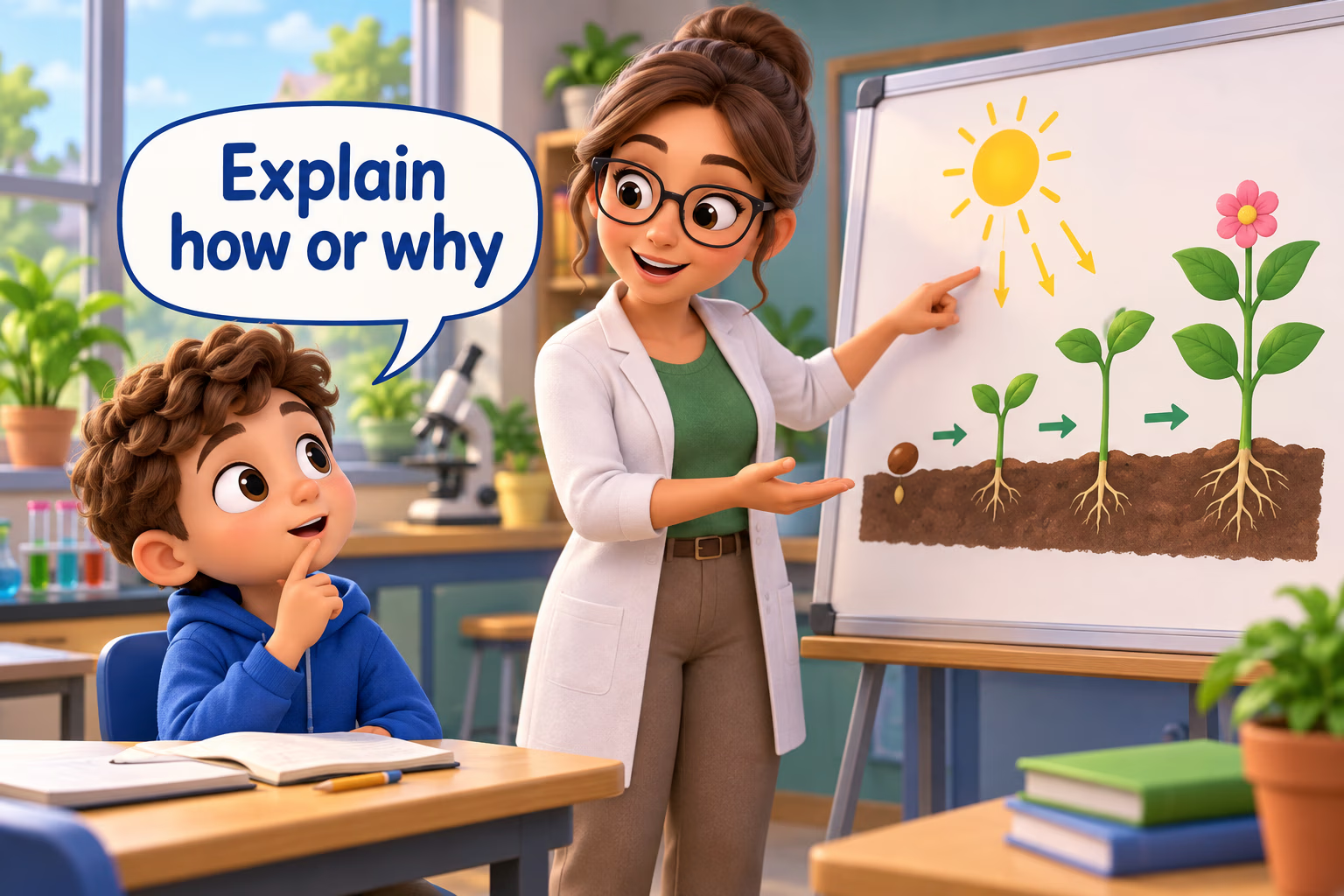
- How: “The coach explained how to adjust the bicycle seat.” This points to steps or a method.
- Why: “The coach explained why the seat should be level.” This asks for a reason.
- That: “The coach explained that the seat was too high.” This reports information; that is often optional.
Use a complete clause after that (“the seat was too high”), while a how clause can name the process (“how the brake works”). These clauses can also be combined with a recipient: “The coach explained to us how the brake works.” Keep the order clear so readers can tell which idea the explanation covers.
How Is “Explain” Different From “Describe”?
Explain makes meaning, causes, or steps understandable; describe tells what a person, place, object, or event is like. A single answer can do both: describe the visible parts of a diagram, then explain how those parts connect.
For example, “The report describes three dark bands in the image” reports observable details. “The report explains how those bands indicate a change in temperature” connects the details to a process or interpretation. Choose the verb that matches the reader’s question rather than using the words as interchangeable synonyms.
How Can You Make an Explanation Clear?
A useful explanation answers a specific question in an order the intended reader can follow. Before writing or speaking, identify the topic, the audience’s starting point, and the evidence or steps needed to make the answer understandable.
- Name the question: state the process, word, decision, or event you are addressing.
- Give the main answer first: include the key reason or result before side details.
- Break a process into steps: put actions in order and define unfamiliar terms.
- Connect claims to support: use an example, observation, or source when it helps the reader check the explanation.
- Check what remains unclear: ask whether the audience can follow the steps or distinguish fact from inference.
A long answer is not automatically a better explanation. If a reader asks where to submit a form, name the location and any required step first; background about the whole office may distract unless it helps the reader act.
What Do “Explain Yourself” and “Explain Away” Mean?
Explain yourself can mean clarify what you meant or give reasons for your behavior. “Could you explain yourself?” may sound demanding when it refers to someone’s conduct, so choose a more specific question—such as “What did you mean by that?”—when you only want clarification.
Explain away is a phrasal verb for offering reasons intended to make a problem or fact seem less serious. It can imply skepticism: “The spokesperson tried to explain away the missing records.” Do not use it as a neutral substitute for every instance of explain.
Frequently Asked Questions About “Explain”
What is the past tense of “explain”?
The simple past and past participle are both explained: “She explained the directions yesterday,” and “The directions were explained twice.” The present participle is explaining.
Can “explain” be used without an object?
Yes. “I can explain” is grammatical when the subject is clear from context. Add a direct object or a clause when readers need to know what will be clarified: “I can explain the delay” or “I can explain why the date changed.”
Is it “explain to me” or “explain me”?
For standard usage, place the thing first and use to before the listener: “Please explain the schedule to me.” Do not write “Please explain me the schedule”; Cambridge’s grammar entry specifically illustrates this pattern.
What noun comes from “explain”?
Explanation is the common noun: “Her explanation clarified the schedule.” Explaining can also function as a noun in some contexts, as in “Explaining the result took ten minutes.”
7 Examples Of Explain Used In a Sentence For Kids
- Explain why the sky is blue during the day.
- Can you explain how plants make their food?
- Please explain why we have seasons.
- Explain why we need to brush our teeth every day.
- Let’s explain how a caterpillar turns into a butterfly.
- Explain why we need to drink water every day.
- Can you explain how a seed grows into a plant?
14 Sentences with Explain Examples
- Can you explain how to calculate the GPA for this semester?
- Explain the process of applying for scholarships at our college.
- Could you explain the concept of market equilibrium in economics?
- Explain the steps to follow for submitting assignments online.
- Please explain the significance of the Indian Constitution.
- Explain the impact of globalization on the Indian economy.
- Can you explain the different types of student loans available in India?
- Explain the process of conducting a scientific experiment in the lab.
- Please explain the importance of time management for college students.
- Could you explain the basics of computer programming languages?
- Explain how to use the library resources for research projects.
- Explain the structure of a typical academic essay.
- Can you explain the importance of maintaining a healthy work-life balance in college?
- Explain the steps to follow for applying for internships during summer break.
How To Use Explain in Sentences?
Explain is used to clarify or make something clear to someone.
When using explain in a sentence, it is important to provide a detailed explanation of a concept, idea, or process. For example: “Can you please explain how to solve this math problem step by step?” In this sentence, the speaker is asking for a clear and detailed explanation of how to solve the math problem.
To use explain effectively, it is helpful to provide context before asking for an explanation. This can help the listener understand what information is needed. For instance, “Before I make a decision, could you explain to me the benefits of each option?” Here, the speaker is asking for an explanation of the benefits in order to make an informed decision.
When receiving an explanation, it is important to listen carefully and ask questions if anything is unclear. For example, “I didn’t understand the concept fully. Can you please explain it to me again?” By asking for further clarification, the listener can gain a better understanding of the topic being discussed.
In summary, explain is a word used to seek or provide clarification on a topic. By using it in a sentence effectively, one can ensure clear communication and understanding.
Conclusion
In conclusion, the sentences provided throughout this article highlight the importance of clarity and simplicity when explaining ideas or concepts. Clear and concise explanations help ensure that information is easily understood by the audience. Using straightforward language and examples can make complex concepts more accessible and digestible for readers.
By breaking down information into simple sentences that clearly explain key points, writers can effectively communicate their ideas to a wide range of people. Whether conveying a technical concept, describing a process, or presenting an argument, using sentences that explain with clarity can enhance comprehension and engagement with the written content. Ultimately, the examples presented demonstrate the power of clear and concise explanations in facilitating effective communication.


