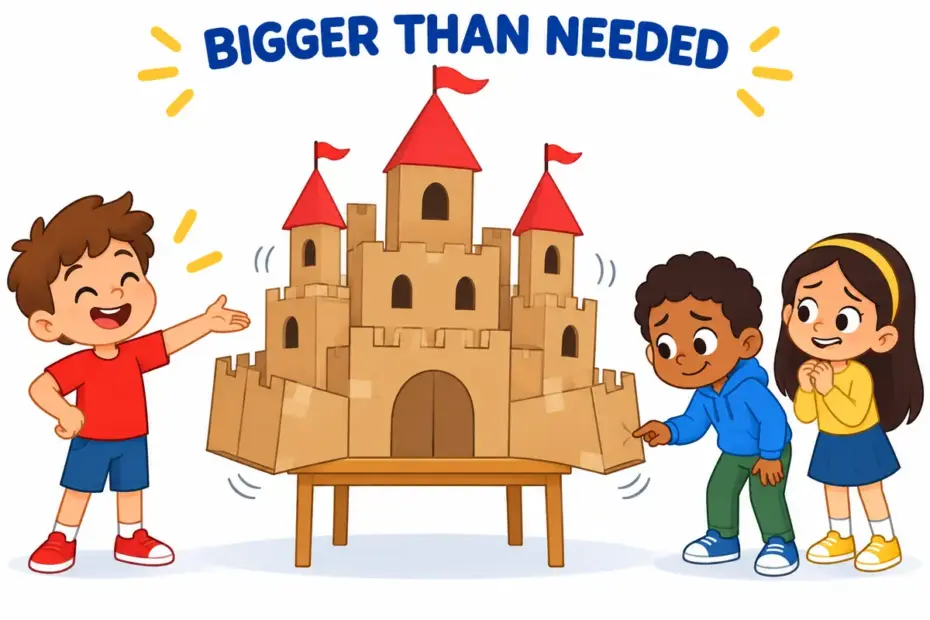
Grandiose describes something that looks or sounds magnificent but is often more showy than practical. To use grandiose in a sentence, place the adjective before the noun it judges: “The mayor unveiled a grandiose plan for a tower no one could afford.” The word usually carries disapproval, though architecture can be called grandiose with grudging admiration.
Grandiose at a glance
- Grandiose is an adjective; its adverb is grandiosely and its noun is grandiosity.
- The dominant pattern is grandiose + noun, as in a grandiose scheme.
- Typical nouns are plan, vision, claim, gesture, building and style.
- For plans and people the word is disapproving; for buildings it can be neutral.
- The commonest error is treating grandiose as a compliment when the sentence needs grand or impressive.
What does grandiose mean?
Grandiose is an adjective meaning impressively large or ambitious, usually with a hint that the scale is excessive, unrealistic or pretentious. The Cambridge entry for grandiose keeps the physical sense of great size close to the figurative sense of exaggerated importance.
| Sense | Plain meaning | Example sentence |
|---|---|---|
| Exaggerated importance | Claims or plans larger than reality allows | He sketched a grandiose scheme for a paper empire. |
| Impressively large | Physically grand in scale | A grandiose marble staircase swept down to the hall. |
| Pretentious in style | Language or taste that strains for effect | The speech was full of grandiose phrases that said little. |
Where the scale is genuinely admirable and the tone is warm, use the plainer ambitious project or impressive instead. Grandiose is the wrong choice when no criticism is intended, because the word quietly adds a judgement about excess.
How do you use grandiose in a sentence?
Grandiose keeps the grammar of a normal adjective, and the small set of patterns below covers almost every use.
| Pattern | Example | What it signals |
|---|---|---|
| grandiose + noun | a grandiose vision | Judges the noun that follows. |
| be + grandiose | The plan sounds grandiose. | Predicate adjective after a linking verb. |
| seem or feel + grandiose | The promise seemed grandiose. | An impression rather than a fact. |
| too grandiose for + noun | too grandiose for a school play | Sets a limit the thing exceeds. |
| grandiose about + noun | grandiose about his talents | Personal boast, nearly always negative. |
Grandiose in a sentence: examples across contexts
The examples range from city planning to personal boasts, and each note explains why the adjective fits.
| Context | Example sentence | Why this works |
|---|---|---|
| Business pitch | The startup promised a grandiose overhaul of the whole industry. | The scale exceeds what a small firm could deliver. |
| City planning | Critics called the tower grandiose and out of scale with the town. | Links the word to excess and disproportion. |
| Architecture | The station is grandiose, but its sweep is genuinely impressive. | Shows the rare admiring use for buildings. |
| Literary criticism | The novel reaches for a grandiose theme it never develops. | Judges ambition that outruns performance. |
| Conversation | His holiday plans always sound a little grandiose. | Gentle, familiar use of the judgement. |
| Film review | The finale is grandiose without being moving. | Separates spectacle from feeling. |
| Charity work | A grandiose pledge collapsed when the funding fell through. | Shows how the word foreshadows failure. |
| Classroom | The teacher called the title grandiose and asked for a simpler one. | Applies the word to a piece of writing. |
| Personal writing | He wrote a grandiose account of a very ordinary week. | Contrast makes the exaggeration plain. |
For a scale that commands respect rather than doubt, imposing building is the steadier choice, because it names size without suggesting vanity.
Grandiose vs grand
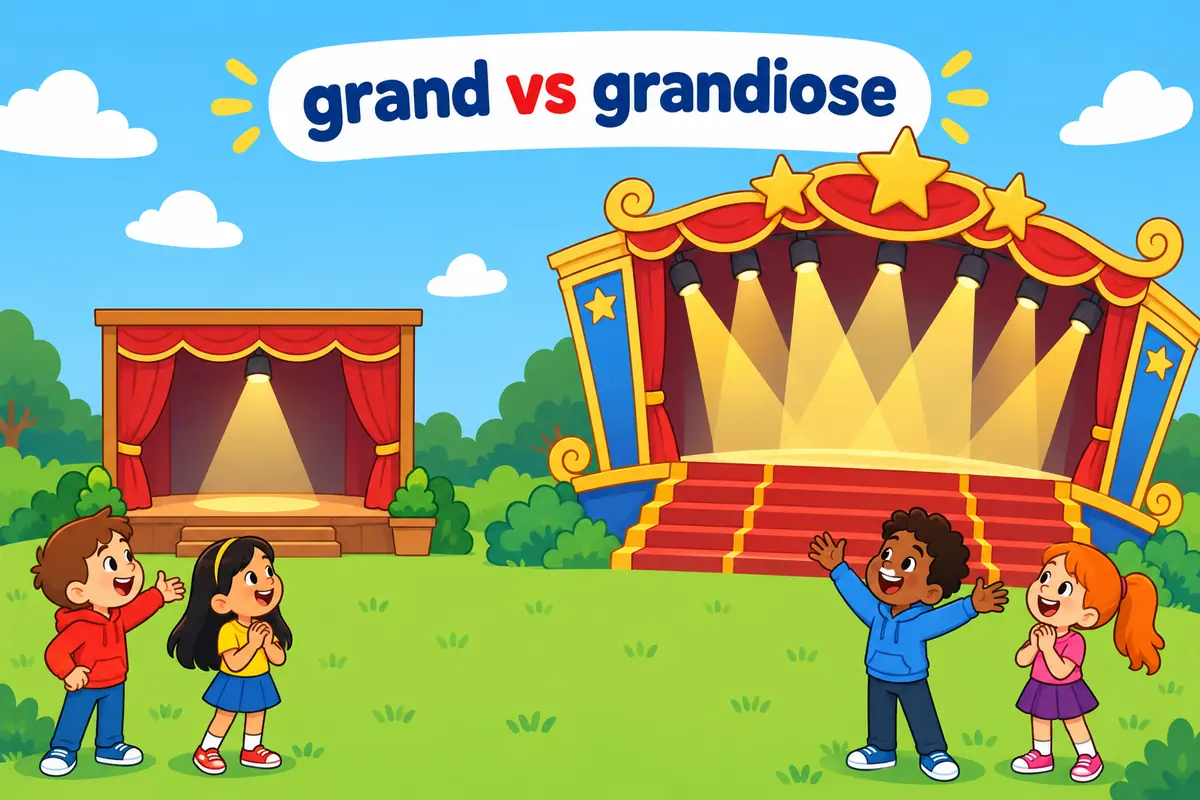
The pair look like siblings, but one praises and the other doubts, and the table keeps the split clear.
| Attribute | Grandiose | Grand |
|---|---|---|
| Core meaning | Impressive in a way that seems excessive | Impressive and dignified |
| Tone | Usually critical | Usually admiring |
| Typical nouns | Scheme, claim, gesture, style | Entrance, hall, occasion, finale |
| Implied doubt | Yes, the scale is probably unrealistic | No, the scale is accepted |
| Register | Formal and evaluative | Neutral and widely used |
Use grandiose when you suspect the grandeur is hollow, and grand occasion when you mean the occasion truly deserves the word.
Word forms and grammar of grandiose
| Form | Part of speech | Example |
|---|---|---|
| grandiose | adjective | a grandiose plan |
| grandiosely | adverb | He spoke grandiosely about his travels. |
| grandiosity | noun | the grandiosity of the proposal |
| grandeur | noun | the grandeur of the mountains |
| grandiloquent | adjective | a grandiloquent speech, meaning pompous in words |
The abstract noun grandiosity names the quality itself, while grandeur keeps a positive sense of real magnificence. The close adjective grandiloquent applies to pompous language rather than to scale, so a long speech is grandiloquent, not grandiose.
Common mistakes with grandiose
1. Stacking intensifiers. Incorrect: The palace is very grandiose beautiful. Correct: The palace is grandiose. Rule: grandiose already means very impressive, so the extra very is redundant.
2. Adverb instead of adjective. Incorrect: He spoke in grandiose. Correct: He spoke grandiosely. Rule: an adverb is needed after a verb, and grandiose is the adjective.
3. The noun in attributive place. Incorrect: Her grandiosity idea failed. Correct: Her grandiose idea failed. Rule: grandiosity is a noun, so the adjective grandiose must precede the noun.
4. Size instead of pretension. Incorrect: The cake was grandiose enough for two. Correct: The cake was large enough for two. Rule: grandiose judges excess or vanity, so a mere pretentious display of size is better described with large or generous.
5. Words, not scale. Incorrect: The minister gave a grandiose speech that lasted an hour. Correct: The minister gave a grandiloquent speech that lasted an hour. Rule: when the criticism is about pompous wording, grandiloquent is the precise adjective.
Practice using grandiose
- Fill in the blank: The developers announced a ______ plan for a tower twice the height of the town hall.
- Choose the better word: The cathedral front was ______ and truly impressive. grandiose or grand?
- Correct the error: The report described a grandiosity scheme for the harbour.
- Build a sentence: use grandiose + noun about a friend’s unrealistic business idea.
- Spot the register: which sentence suits a formal review? A. It was over the top. B. The design is grandiose and out of scale.
- Fill in the blank: He spoke ______ about his small part in the project.
Answers
- grandiose – the adjective precedes the noun plan.
- grand – the tone is admiring, so the critical word is wrong.
- The report described a grandiose scheme for the harbour – the adjective, not the noun, goes before scheme.
- His grandiose plan to open ten shops at once soon faded – grandiose judges the scale as excessive.
- B – a review uses the formal adjective where conversation prefers the idiom.
- grandiosely – an adverb is needed after the verb spoke.
The bottom line
Grandiose means impressively large or ambitious, usually with a hint that the scale is excessive or unreal. When you use grandiose in a sentence, place it directly before the noun it judges and remember the built-in edge: a grandiose plan is not merely bold, it is probably too bold. Reserve grand for scale you admire and grandiloquent for speech that is merely pompous.
Frequently asked questions about grandiose
Is grandiose always negative?
Not always. Applied to architecture or scenery, grandiose can simply mean impressively large, close to grand in scale. Applied to a plan, a claim or a person, it usually signals that the scale is excessive or unrealistic, and a hint of disapproval comes with it.
Can grandiose describe a person?
Yes, though it judges their manner rather than their worth. A grandiose person talks and behaves as if they matter more than they do, so the word appears in ordinary criticism as well as psychology. For a single boastful remark, pretentious is often the more precise adjective.
What is the noun form of grandiose?
The noun is grandiosity, which names the quality of being grandiose. Grandeur is a different noun that stresses real magnificence without the criticism. Choose grandiosity when the excess is the point, and grandeur when the scale is genuinely impressive. Both nouns share the root grand, but only grandiosity brings the criticism.
How does grandiose differ from grand?
Grand praises size or importance, as in a grand entrance. Grandiose keeps the scale but adds doubt or disapproval, so a grandiose entrance suggests showiness rather than real dignity. The extra syllable carries the judgement. For neutral praise, grand is the safer and more common choice.
Have you ever come across a sentence that seemed overly exaggerated or excessively boastful? This type of statement can be described as “grandiose.”
The term “grandiose” refers to language or behavior that is extravagant, exaggerated, or pretentious. When someone uses grandiose language, they often make claims that are more impressive or important than reality.
7 Examples Of Grandiose Used In a Sentence For Kids
- I saw a grandiose elephant at the zoo.
- The king’s palace was so grandiose and beautiful.
- The fireworks display was grandiose and colorful.
- My birthday cake was grandiose with lots of candles.
- The magician performed grandiose tricks on stage.
- The Taj Mahal is a grandiose monument in India.
- The puppet show had grandiose puppets and bright colors.
14 Sentences with Grandiose Examples
- With grandiose dreams of changing the world, the college students passionately discussed their start-up ideas.
- The annual college fest was a grandiose spectacle of music, dance, and talent competitions.
- As the students walked into the grandiose library, they were in awe of its vast collection of books.
- The college auditorium was filled with grandiose decorations for the graduation ceremony.
- The debate competition turned into a grandiose display of intellect and rhetoric skills.
- The students dressed in their grandiose traditional attire for the cultural festival.
- The college sports meet was a grandiose event with athletes from all over the country participating.
- The professors’ grandiose lectures often left the students inspired and motivated.
- The college canteen was transformed into a grandiose food festival during the cultural week.
- The college building stood tall and grandiose against the backdrop of the city skyline.
- The students presented their research findings in a grandiose symposium attended by eminent scholars.
- The college choir put on a grandiose performance that left the audience stunned.
- The students organized a grandiose charity event to raise funds for a noble cause.
- The college’s annual fashion show was a grandiose affair with models strutting down the runway in designer outfits.
How To Use Grandiose in Sentences?
To use the word Grandiose in a sentence, consider using it to describe something that is impressive, extravagant, or overly ambitious. For example, “The CEO presented a grandiose plan for expanding the company’s global reach.” In this sentence, grandiose is used to convey the idea of a lofty and impressive proposal.
When constructing a sentence with Grandiose, remember to place it in a context where it makes sense to use such a descriptor. This word is typically employed in situations where something is exaggerated or ostentatious, so choose your sentence carefully to capture this nuance.
Another example could be, “The groom’s grandiose entrance on a helicopter stole the show at the wedding.” Here, grandiose is used to emphasize the extravagant and attention-grabbing nature of the groom’s arrival.
To further enhance your sentence, consider using descriptive language that helps paint a vivid picture for the reader. Adjectives like “impressive,” “lavish,” or “magnificent” can complement Grandiose and enhance the overall impact of your sentence.
In summary, when incorporating Grandiose into your writing, aim to convey a sense of extravagance, grandeur, or ambition. By choosing the right context and supporting language, you can effectively communicate the idea of something that is impressive and grandiose.
Conclusion
In conclusion, sentences with grandiose language are characterized by their extravagant and overly exaggerated nature, often intended to impress or make a statement. These sentences use elaborate vocabulary and complex structures to convey a sense of importance or prestige, often resulting in a lofty or pompous tone that may come across as pretentious or overblown.
While grandiose sentences can be effective in certain contexts, such as literature or formal writing, they may be seen as excessive or unnecessary in everyday communication. It is important to strike a balance between eloquence and clarity when using grandiose language to ensure that the message is effectively conveyed without alienating the audience with overly ornate or flowery speech.


