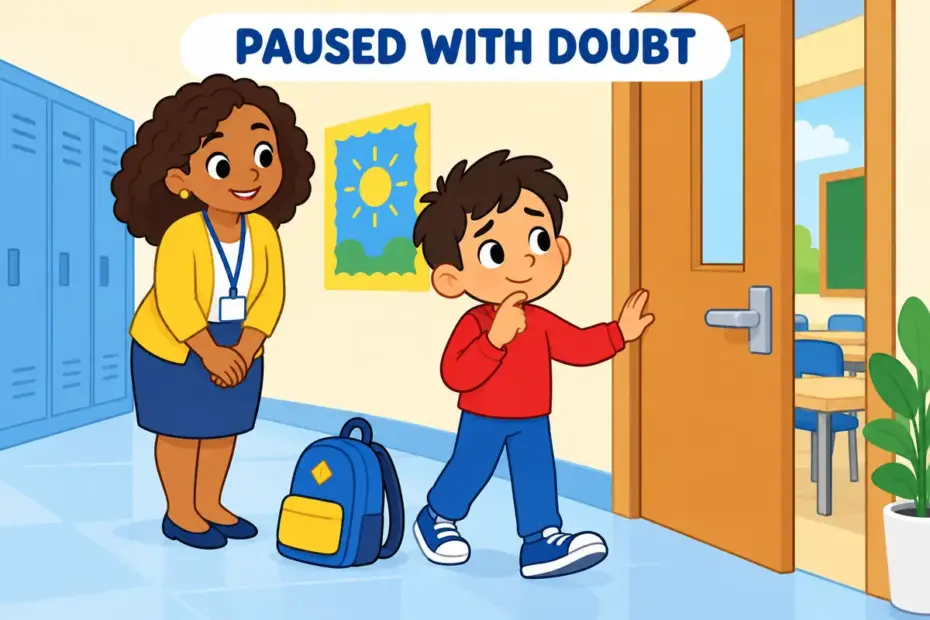
Hesitant means unsure and pausing before you act, often because of doubt or a small fear. To use hesitant in a sentence, place it after be and before about or to: “She was hesitant about signing.” It is an adjective, so it describes a person, a step or a voice rather than the action itself.
Hesitant at a glance
- Hesitant is an adjective meaning unsure, doubtful or slow to decide.
- Its usual frames are be hesitant, hesitant about + noun, and hesitant to + verb.
- The family is hesitate (verb), hesitation and hesitance (nouns) and hesitantly (adverb).
- A hesitant pause, a hesitant smile and a hesitant step are common collocations.
- The commonest error is hesitant to + -ing, as in hesitant to going, where English needs hesitant to go.
What does hesitant mean?
Hesitant is an adjective meaning doubtful or unsure, so that a person pauses before deciding. The Cambridge entry for hesitant gives the core sense of being not certain, and the examples below separate the doubt from plain unwillingness. A hesitant person has not yet said no; that is the thread running through every sense.
| Sense | Plain meaning | Example sentence |
|---|---|---|
| Doubtful | Unsure whether to proceed | She was hesitant about the offer, so she asked for a day to think. |
| Reluctant | Willing in principle but held back | He was hesitant to complain so soon after joining. |
| Faltering in manner | Done with pauses and uncertainty | He gave a hesitant answer and looked at his notes. |
One limit is worth stating. Hesitant does not mean shy or weak: a confident expert can be hesitant about poor data. It also differs from reluctant, because a reluctant person has decided against the action in their mind, while a hesitant one is still weighing it up. Where a whole plan is unsure, uncertain is the better adjective, because hesitant describes people and their steps.
How do you use hesitant in a sentence?
Hesitant works as a normal adjective, so it can follow a linking verb or stand before a noun. The preposition after it is the part learners get wrong, and the table below shows the frames that sound native.
| Pattern | Example | What it signals |
|---|---|---|
| be + hesitant | The board was hesitant but not opposed. | States doubt directly with a linking verb. |
| hesitant about + noun | She was hesitant about the move. | The doubt attaches to a thing or plan. |
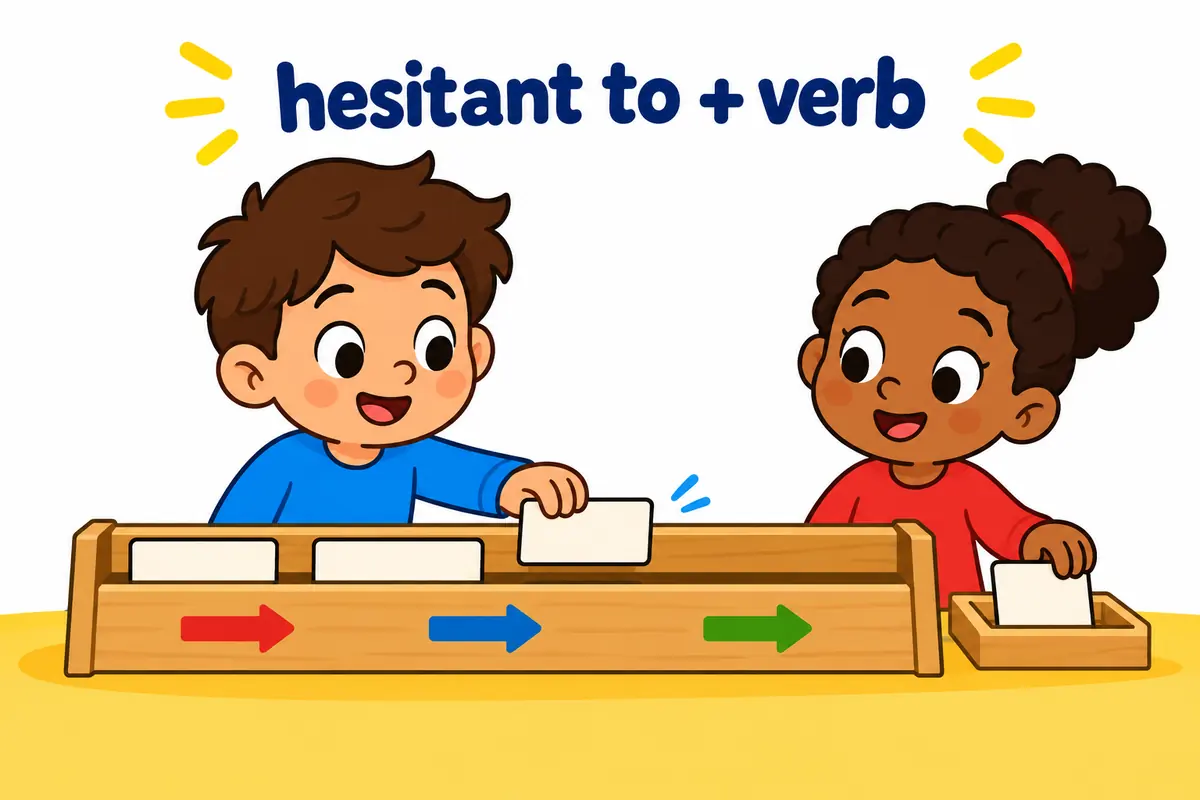
| hesitant to + verb | They were hesitant to sign the lease. | The doubt attaches to an action. |
| hesitant + noun | He answered with a hesitant nod. | Attributive use, describing the manner of a thing. |
| too hesitant to + verb | I was too hesitant to speak first. | Blames the pause for an inaction. |
Hesitant in a sentence: examples across contexts
These sentences keep the same adjective while moving from a classroom to a legal memo. Each row says who feels the doubt and what the hesitation is attached to.
| Context | Example sentence | Why this works |
|---|---|---|
| Classroom | Maya was hesitant to read aloud until the teacher paired her with a friend. | The doubt is attached to an action, so hesitant to is the right frame. |
| Workplace email | We are hesitant about the new deadline and would like to discuss it. | About plus a noun keeps the tone polite rather than defiant. |
| News report | Voters remain hesitant about the scheme, according to the latest poll. | The adjective reports a mood without claiming a firm rejection. |
| Legal writing | The witness was hesitant in her recollection of the date. | In plus a noun names the area where the doubt sits. |
| Conversation | He sounded hesitant, so I asked him again. | After a linking verb the adjective describes the person’s state. |
| Medical writing | Patients are often hesitant to report side effects. | The frame hesitant to plus verb fits a general pattern of behaviour. |
| Sports commentary | The captain looked hesitant before the final pass. | Describes a momentary pause visible to onlookers. |
| Academic prose | Historians have been hesitant about drawing a single conclusion. | About plus a gerund names the doubtful activity. |
| Customer service | A hesitant customer usually needs one more clear answer. | Attributive use labels the type of person without judging them. |
Hesitant vs reluctant
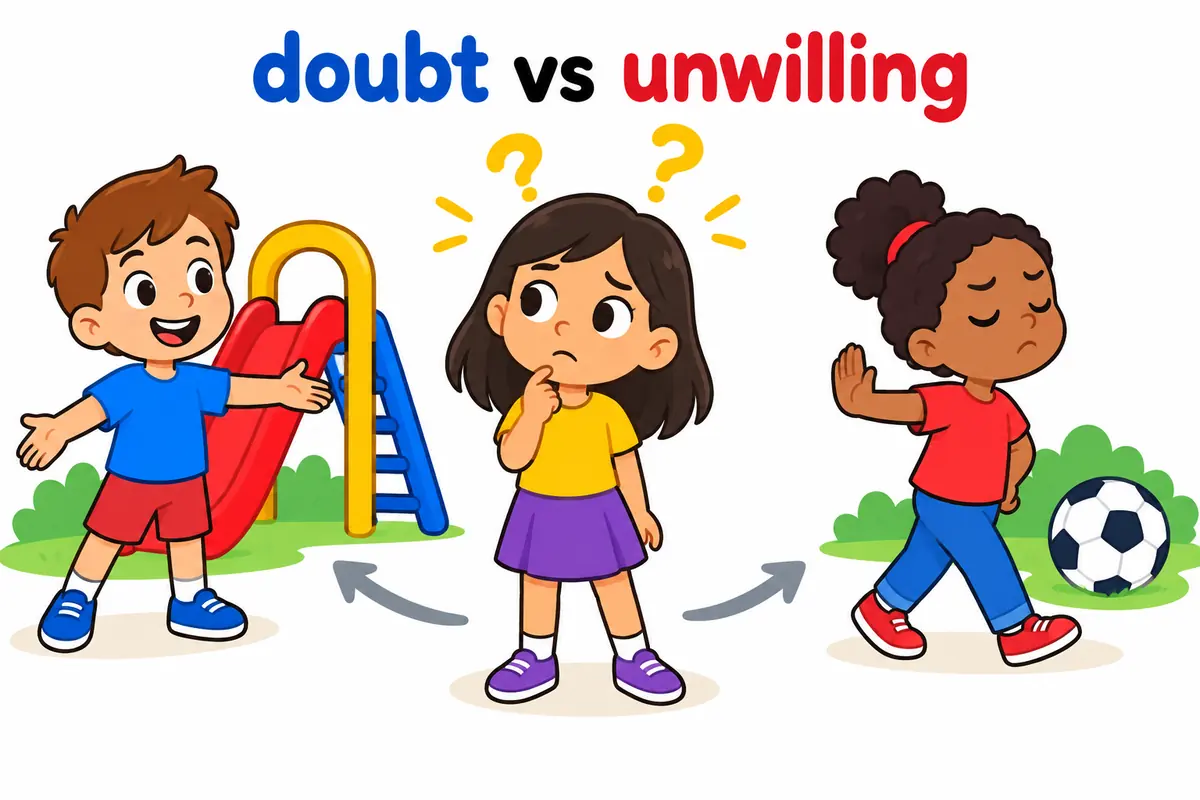
Hesitant and reluctant are close enough to be swapped by accident, but the difference is the state of the decision. A reluctant person has already leaned against the action; a hesitant one is still deciding. Doubt versus unwillingness is the whole distinction.
| Attribute | hesitant | reluctant |
|---|---|---|
| Core meaning | Unsure and pausing | Unwilling but yielding |
| Has the choice been made? | Not yet; still weighing it | Essentially yes, with regret |
| Typical feeling | Doubt | Resistance |
| Common pattern | hesitant about, hesitant to | reluctant to, reluctant acceptance |
| Likely response to evidence | Reassurance can remove it | Pressure is usually needed |
| Example | She was hesitant about the price. | He gave a reluctant agreement. |
Verdict: choose hesitant when the person still needs information, and reluctant when the decision is made but the enthusiasm is missing. Three near neighbours complete the picture: someone who is cautious plans ahead, a tentative offer is provisional in its terms, and an indecisive person cannot choose at all.
Word forms and grammar of hesitant
The verb hesitate sits behind the adjective, and its adverb hesitantly is the form that modifies an action. Watch the final row, because it is the mistake learners build by analogy with other adjectives.
| Form | Part of speech | Example |
|---|---|---|
| hesitant | adjective | The new member was hesitant at first. |
| hesitantly | adverb | She answered hesitantly and checked her notes. |
| hesitate | verb, base | Do not hesitate to ask for help. |
| hesitated | verb, past | He hesitated before the door and then knocked. |
| hesitation | noun | After a short hesitation she agreed. |
| hesitancy | noun, less common | The board showed real hesitancy about the cost. |
Common mistakes with hesitant
- Incorrect:
She was hesitant to going alone.Correct: She was hesitant to go alone. Rule: After hesitant to, use the base verb, never the -ing form. - Incorrect:
He was hesitant of the offer.Correct: He was hesitant about the offer. Rule: The noun follows about, not of. - Incorrect:
She was hesitated before answering.Correct: She hesitated before answering. Rule: Hesitant is an adjective; hesitate is the verb and needs no was. - Incorrect:
He replied hesitant.Correct: He replied hesitantly. Rule: An adverb modifies the verb replied, so use hesitantly. - Incorrect:
The plan was hesitant.Correct: The plan was uncertain. Rule: Hesitant describes people and their manner, not plans or things.
Practice using hesitant
Work through the six items, then check the reason beside each answer.
- Fill the gap: The team was ______ to launch before the tests finished.
- Choose the better word: She was (hesitant / reluctant) about the price and asked for a quote.
- Correct the error: He was hesitant of accepting the transfer.
- Build a sentence: use hesitant to + verb about a student who will not raise a hand.
- Spot the register: which fits a news report — voters remain hesitant about the plan, or voters are a bit iffy about it?
- Rewrite with the adverb: She gave a hesitant answer. Replace the adjective with hesitantly.
Answers
- hesitant — the adjective follows was and takes the frame hesitant to plus the base verb launch.
- hesitant — she still needs information, so the doubt of hesitant fits better than the unwillingness of reluctant.
- He was hesitant about accepting the transfer — the noun or gerund follows about, not of.
- Model answer: Ben was hesitant to raise a hand until the teacher smiled at him.
- Voters remain hesitant about the plan — a report keeps the formal adjective and avoids the slang iffy.
- She answered hesitantly — the adverb modifies the verb answered.
The bottom line
Use hesitant in a sentence when somebody is still deciding, and attach it with about for a thing and to for an action. The two facts that decide most sentences are that hesitant is an adjective, so it never replaces the verb hesitate, and that it signals doubt rather than a refused request. When the mind is already made up against the action, use reluctant instead.
Frequently asked questions about hesitant
Is hesitant an adjective or a verb?
Hesitant is always an adjective, so it follows a linking verb or sits before a noun. The verb is hesitate, which has the forms hesitate, hesitated and hesitating. That is why you write the driver was hesitant, not the driver was hesitated, because only the verb can take a past tense.
Why is it hesitant about and not hesitant of?
English pairs the adjective with about for a thing, a plan or an activity, and with to for a verb. So you say hesitant about the move and hesitant to move, but not hesitant of the move. The preposition of belongs to a different family, as in afraid of the dark.
Can you say hesitant to doing something?
No. After hesitant to, the verb stays in its base form, so the correct phrase is hesitant to do something. The -ing form appears only after about, as in hesitant about doing something. This split between about plus -ing and to plus base verb is the rule to memorise.
Does hesitant mean the same as shy?
No. Shy describes a settled personality, while hesitant describes a passing state in a particular moment. A confident speaker can be hesitant about one bad proposal and completely sure about the next. Treat hesitant as doubt about something specific, not as a label for a whole character.
Have you ever wanted to express uncertainty or indecision in your writing but weren’t quite sure how? Let’s explore the concept of “hesitant” in the context of constructing sentences that convey doubt or reluctance.
When incorporating the term “hesitant” into your writing, you are signaling a sense of hesitancy or unwillingness. This word, often used to describe moments of doubt or unease, can add depth and complexity to your sentences.
7 Examples Of Hesitant Used In a Sentence For Kids
- He was hesitant to try the new food.
- She felt hesitant about jumping into the pool.
- The little puppy was hesitant to meet new people.
- They were hesitant to speak in front of the class.
- The butterfly was hesitant to fly in the strong wind.
- The boy was hesitant to go on the big slide.
- She was hesitant to pet the sleeping cat.
14 Sentences with Hesitant Examples
- Hesitant to ask questions in class, some students may miss valuable insights from their professors.
- Students may feel hesitant to voice their opinions during group discussions for fear of being judged.
- Many students are hesitant to approach their professors for extra help or clarification on assignments.
- Some students are hesitant to participate in extracurricular activities due to the fear of not fitting in.
- Hesitant to explore new career paths, students may miss out on finding their true passion.
- College students often feel hesitant to seek mental health support despite facing high levels of stress and anxiety.
- Students who are hesitant to network with professionals may miss out on valuable career opportunities.
- Feeling hesitant to try new study techniques, some students may struggle to retain information effectively.
- Some students are hesitant to challenge conventional beliefs and think critically about different perspectives.
- Many students are hesitant to take risks in their academic pursuits for fear of failure.
- Hesitant to step out of their comfort zones, students may limit their personal growth and development.
- Being hesitant to apply for internships and job opportunities can hinder students’ professional advancement.
- Some students feel hesitant to express their creativity in fear of criticism from peers.
- Students are often hesitant to seek guidance from career counselors when considering their future paths.
How To Use Hesitant in Sentences?
Hesitant is used to describe a feeling of hesitancy or reluctance towards doing something. Here’s a guide on how to use it in a sentence:
-
Placement: The word hesitant can be placed anywhere in a sentence, but it generally comes before a verb or at the beginning of a sentence.
-
Subject and verb: When using the word hesitant, make sure to include a subject and a verb in the sentence. For example, “She was hesitant to speak in public.”
-
Punctuation: Use proper punctuation when using the word hesitant in a sentence. Commas can be used to separate the word hesitant from the rest of the sentence if needed.
-
Context: Make sure the sentence provides enough context for the reader to understand why the person is feeling hesitant. This will help clarify the meaning of the sentence.
-
Variation: You can use synonyms or related words to hesitant to add variety to your sentence. Words like reluctant, hesitant, or unsure can be used interchangeably.
By following these guidelines, you can effectively use the word hesitant in a sentence. Remember to consider the context and structure of your sentence to ensure clarity and coherence.
Conclusion
In conclusion, hesitant sentences often display uncertainty or doubt in communication. These types of sentences may include phrases like “I’m not sure,” “I think,” or “maybe,” signaling a lack of confidence in the speaker’s statements or beliefs. Hesitant language can indicate a cautious or tentative approach to expressing ideas, which can impact the clarity and persuasiveness of the message being conveyed.
It is important to be mindful of using hesitant language in our communications, as it can weaken the impact of our statements and convey a lack of certainty to others. By being more direct and assertive in our wording, we can enhance the clarity and effectiveness of our communication, helping to convey confidence and credibility in our message.


