Impartial means treating every side of a dispute by the same standard, without favouring one person or outcome. To use impartial in a sentence, apply it to a person or process that must stay fair: “An impartial referee settles the argument by the rules.” The adjective pairs naturally with remain, stay and be.
Impartial at a glance
- Impartial is an adjective; its adverb is impartially and its noun is impartiality.
- The dominant pattern is remain or stay impartial, often followed by between or in.
- The word belongs to law, journalism, education and public administration.
- Common partners are fair, neutral, independent and objective.
- The commonest error is confusing impartial with disinterested or uninterested.
What does impartial mean?
Impartial is an adjective meaning not favouring one side over another when a decision or judgement is made. The Cambridge entry for impartial records the fair-and-unbiased sense, and the word nearly always describes a person, a panel or a process rather than an object. Where the emphasis falls on having no personal stake, an unbiased account overlaps closely, but impartial stresses equal treatment of the sides.
| Sense | Plain meaning | Example sentence |
|---|---|---|
| Not favouring a side | Applying the same standard to everyone | The chair gave an impartial summary of both plans. |
| Free from bias | Not swayed by personal interest | An impartial adviser has nothing to gain from the result. |
| Neutral in judgement | Able to decide without prejudice | The panel reached an impartial decision within a day. |
Impartial does not mean uninterested. A referee can care about a match and still be impartial, because the word limits favouritism rather than feeling. It is also not quite neutral when neutral means taking no position at all, since an impartial judge still reaches a decision.
How do you use impartial in a sentence?
Impartial describes how a person or process behaves, so the sentence usually names who must be fair and in what matter. The five patterns below cover school, workplace and legal writing.
| Pattern | Example | What it signals |
|---|---|---|
| remain or stay + impartial | The umpire stayed impartial under pressure. | Holding a fair position over time. |
| an impartial + person or body | An impartial panel reviewed the marks. | Names the fair decision-maker before the issue. |
| impartial in + dispute | The teacher was impartial in the debate. | States the matter where equal treatment matters. |
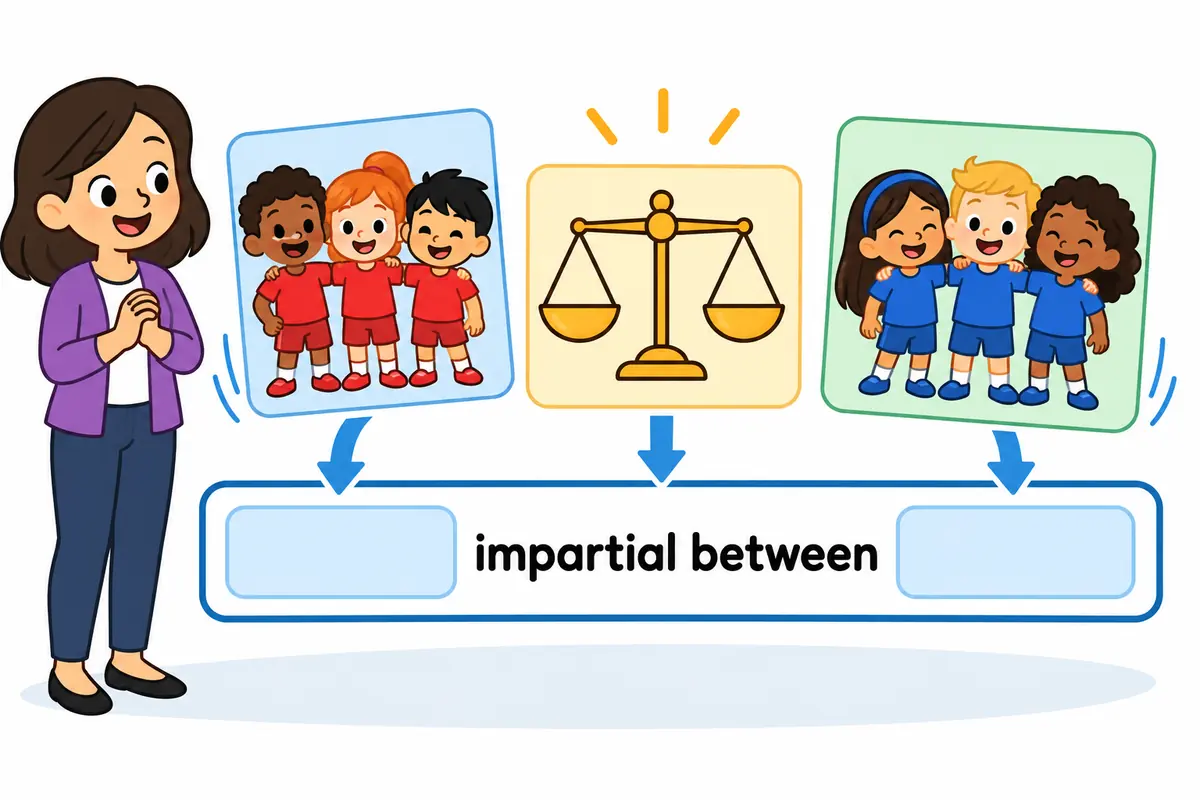
| impartial between + two sides | The editor stayed impartial between the two writers. | Names both parties kept in balance. |
| judge or decide + impartially | The case was heard impartially. | Uses the adverb after the verb it describes. |
A chair who must stay neutral in the argument still decides the question; impartial adds the duty of equal treatment to that calm position.
Impartial in a sentence: examples across contexts
Impartial moves easily between a classroom and a courtroom, and each setting below shows the same duty of even-handedness doing a different job.
| Context | Example sentence | Why this works |
|---|---|---|
| Classroom | The teacher gave an impartial account of the quarrel. | Shows equal treatment where children compete for fairness. |
| Workplace email | Please ask someone impartial to chair the review. | Names a fair chair without accusing the current one. |
| News report | The ombudsman promised an impartial inquiry. | Standard public wording for a trusted investigation. |
| Legal writing | A judge must be impartial between the parties. | States the legal duty of even-handedness. |
| Sports commentary | The replay showed an impartial decision by the referee. | Applies the word to a single contested ruling. |
| Academic writing | The study used impartial markers for both groups. | Signals the same standard applied to each set. |
| Local government | The committee stayed impartial during the fee debate. | Names the duty of office-holders in public business. |
| Everyday conversation | I tried to stay impartial when my friends argued. | The remain impartial pattern in ordinary speech. |
| Human resources | An impartial colleague read both applications. | Prevents the appearance of favouritism in hiring. |
The word almost never describes a thing, which is why an impartial table or an impartial building sounds strange. It belongs to the people and the rules that decide.
Impartial vs disinterested
Impartial and disinterested are close, and modern usage separates them by one clear test. In formal writing, disinterested can mean unbiased, but many readers now take it to mean bored, so impartial is the safer choice for a decision-maker.
| Attribute | impartial | disinterested |
|---|---|---|
| Core job | Treat both sides by one standard | Have no personal stake in the outcome |
| Typical subject | A person, panel or process | Usually a person or observer |
| Register | Neutral to formal | Formal and increasingly ambiguous |
| Common partner | remain impartial between | a disinterested observer |
| Risk of misuse | Suggests coldness if overused | Often misread as uninterested |
Where a decision is measured against evidence rather than people, an objective standard is the sharper term. Verdict: choose disinterested for a person with no stake and impartial for the standard applied to everyone involved.
Word forms and grammar of impartial
Impartial changes form like most adjectives, and its noun impartiality is common in rules and job descriptions. Do not confuse the adjective with impart, a verb meaning to give or pass on.
| Form | Part of speech | Example |
|---|---|---|
| impartial | adjective | The chair remained impartial throughout. |
| impartially | adverb | The complaints were handled impartially. |
| impartiality | noun | The code demands impartiality from every assessor. |
| partial | adjective, opposite | A partial account favours one side. |
| partiality | noun, opposite | The ruling showed no partiality. |
| impart | verb, different word | Teachers impart knowledge, not fair judgement. |
Common mistakes with impartial
- Incorrect:
She was impartial in the result, so she never checked it.Correct: She was uninterested in the result, so she never checked it. Rule: Impartial means unbiased, not lacking interest. - Incorrect:
The case was heard impartial.Correct: The case was heard impartially. Rule: Use the adverb to modify a verb. - Incorrect:
The board was known for its impartial.Correct: The board was known for its impartiality. Rule: The noun needs the -ity ending. - Incorrect:
A referee must stay impart toward both teams.Correct: A referee must stay impartial toward both teams. Rule: Impart is a verb meaning to give; the adjective is impartial. - Incorrect:
The review was martial and fair to everyone.Correct: The review was impartial and fair to everyone. Rule: Martial means connected with war or soldiers.
Practice using impartial
Work through the six items, then check the reason with each answer rather than only the key word.
- Fill the gap: A good chair stays ______ while both teams make their case.
- Choose the better word: The battle was described by a (martial / impartial) scholar with no side to defend.
- Correct the error: The referee judged the match impartial.
- Build a sentence: use remain impartial between about two classmates.
- Spot the register: which belongs in a formal complaint, The panel must be impartial, or I want someone who is not on your side at all?
- Rewrite with the noun: The panel treated everyone fairly. Use impartiality instead.
Answers
- impartial — the chair must apply one standard to both teams.
- impartial — the scholar has no side to defend, so martial is the wrong word.
- The referee judged the match impartially — the adverb modifies the verb judged.
- Model answer: The captain promised to remain impartial between the two friends.
- The panel must be impartial — a formal complaint avoids the confrontational second phrasing.
- Model answer: The panel showed impartiality toward everyone — the noun names the quality.
The bottom line
Use impartial in a sentence for a person or process that applies one standard to every side, and let remain impartial between or in carry the idea. Impartial is not the same as uninterested, because it limits favouritism rather than feeling, and its noun impartiality often fits formal rules better than the adjective.
Frequently asked questions about impartial
Is impartial the same as neutral?
Impartial and neutral overlap, but impartial describes how a decision-maker treats each side, while neutral can also mean taking no position at all. A referee must be impartial and still makes a ruling, so impartial fits decision-making better than neutral does.
What is the noun form of impartial?
The noun is impartiality, as in the panel’s impartiality was never questioned. The adverb is impartially, used after a verb such as judged or handled. Both forms keep the same root, and neither should be replaced by the adjective in a sentence that needs a noun.
Can a person be impartial and still care about the outcome?
Yes. Impartial limits favouritism, not feeling. A judge may care deeply about a case and remain impartial by applying the same rules to both sides. The word forbids letting personal interest decide the outcome, not having an interest in it.
Why do people confuse impartial with disinterested?
Disinterested once meant unbiased, which made it a close synonym of impartial. Many speakers now use disinterested to mean bored or lacking interest, so the older sense causes confusion. Impartial avoids that ambiguity and keeps the clear meaning of treating every side fairly.
Have you ever wondered what it means to be truly impartial in a situation? The concept of impartiality involves making decisions or judgments without bias or favoritism, ensuring fairness and objectivity.
Being impartial requires setting aside personal feelings or preferences to consider all sides or options equally. It involves maintaining neutrality and treating everyone with fairness and equanimity.
7 Examples Of Impartial Used In a Sentence For Kids
- Impartial means treating everyone fairly.
- It’s important to be impartial when playing games with friends.
- A good judge is always impartial and fair.
- We should try to be impartial when solving problems.
- Teachers should be impartial when giving out grades.
- Let’s all try to be impartial and include everyone in our games.
- Being impartial means not picking favorites.
14 Sentences with Impartial Examples
- It is important for college students in India to seek impartial guidance when choosing a major.
- When dealing with academic disputes, it is crucial for teachers to remain impartial.
- The selection committee for student council elections must be impartial in their decision-making process.
- Seeking impartial feedback from peers can help improve the quality of college assignments.
- Professors should strive to be impartial when grading student papers.
- It is essential for college professors to maintain an impartial attitude towards all students.
- Student disciplinary committees must be impartial in their investigations and decisions.
- When discussing controversial topics in class, it is important to present an impartial viewpoint.
- The college admissions process should be conducted in a fair and impartial manner.
- Peer mentors should provide impartial advice to freshman students adjusting to college life.
- Student counselors are trained to provide impartial support to students dealing with personal issues.
- It is essential for college debate moderators to remain impartial and unbiased in their judgments.
- When conducting research, it is important to analyze data in an impartial manner.
- College professors should encourage impartial discussions and debates among students.
How To Use Impartial in Sentences?
To use the word “Impartial” in a sentence, it is important to remember its meaning and how it can be applied correctly. “Impartial” refers to being unbiased, fair, or neutral in judgments and decisions, without favoring one side over another.
When constructing a sentence with the word “Impartial,” you want to ensure that you are describing a situation or person that is free from any form of bias. For example, “The judge delivered an impartial verdict after carefully considering all the evidence presented in court.”
It is crucial to remember that “Impartial” is often used in contexts where objectivity and fairness are key. You can use it in various scenarios such as describing the behavior of a referee in a sports game, a journalist reporting news objectively, or a panel of judges evaluating a competition.
To practice using the word “Impartial” in a sentence, try incorporating it into everyday conversations or writing exercises. Remember to pay attention to the context in which the word is being used and ensure that it accurately conveys the idea of being fair and unbiased.
Overall, by understanding the meaning of “Impartial” and how to apply it correctly in a sentence, you can effectively communicate ideas of neutrality and fairness in various situations.
Conclusion
In conclusion, impartiality is crucial in decision-making processes to ensure fair and just outcomes. When individuals or systems are impartial, they are unbiased and do not favor one side over another. This fairness allows for transparency, trust, and credibility in various settings, such as legal proceedings, journalism, and leadership roles.
By maintaining impartiality, individuals can uphold ethical standards and promote equality and justice. It is essential for impartiality to be practiced consistently to avoid conflicts of interest and ensure that decisions are based on facts and merit rather than personal biases. In a world where fairness and integrity are highly valued, impartiality serves as a cornerstone for building a society that is just and equitable for all.