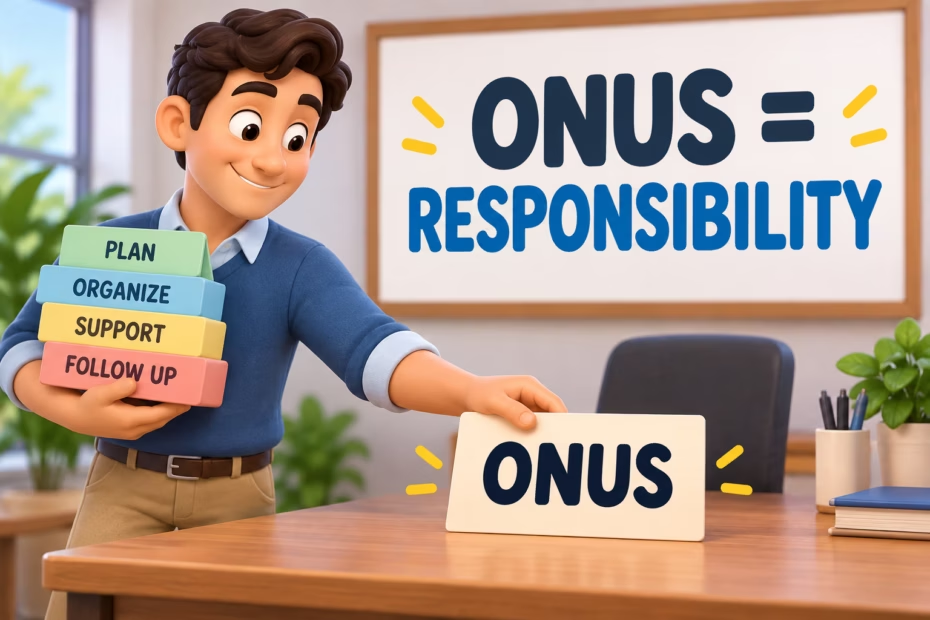
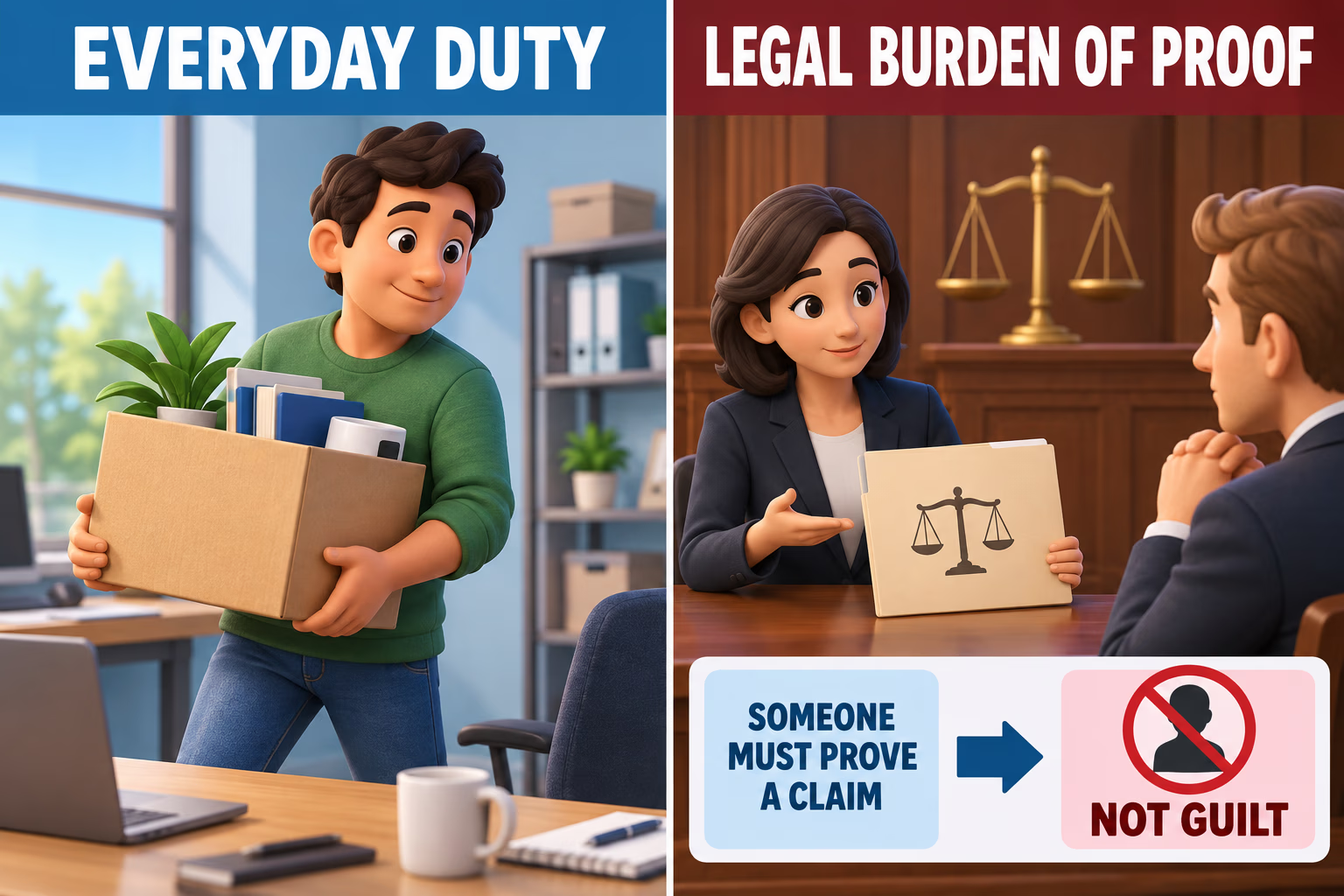
Quick answer: Onus is a formal noun for a duty, responsibility, or burden someone is expected to carry. A common pattern is “the onus is on [person] to [action].” In legal writing, onus can refer to a burden of proof, but the party responsible and the standard depend on the jurisdiction, issue, and governing rules.
Onus in a Sentence: Meaning at a Glance
- Onus usually names a responsibility or burden; it does not automatically imply blame.
- “The onus is on the coordinator to send the schedule” identifies who is expected to act.
- “Bear the onus” means to carry or accept the responsibility.
- In legal contexts, onus may refer to proof, but procedural rules distinguish different kinds of burden.
- The word is formal; in casual conversation, responsibility or duty is often clearer.
What Does Onus Mean?
Onus is a noun meaning a burden, obligation, or responsibility, often one that is difficult or unwelcome. Merriam-Webster also records a legal sense, “burden of proof,” while Cambridge Dictionary labels the word formal and defines it as responsibility or duty. Depending on the sentence, the word can carry a neutral sense of assigned work or a heavier sense of a burden someone must shoulder.
In U.S. pronunciation, onus is /ˈō-nəs/, roughly “OH-nuhs,” with two syllables. It is normally used as a singular noun: “the onus is,” “the onus was,” or “the onus will be.”
How Do You Use “The Onus Is on…”?
The most useful everyday pattern is “the onus is on [person or group] to [base-form verb].” Put the responsible person after on and the expected action after to: “The onus is on Lee to confirm the booking.” The onus is the duty; Lee is the person expected to do the action.

| Sentence pattern | Example | What it emphasizes |
|---|---|---|
| The onus is on [person] to [action] | The onus is on each editor to check the dates. | Who has the responsibility and what they must do. |
| [Person] bears or carries the onus | The organizer bears the onus of notifying every guest. | The person who accepts or carries the burden. |
| Place or put the onus on [person] | The policy puts the onus on applicants to submit current details. | Who assigns the responsibility and who receives it. |
| Shift the onus to [person] | The revised process shifts the onus to the vendor to confirm delivery. | A transfer of responsibility; use only when the sentence supports that idea. |
| The onus of proof | The filing discusses which party carries the onus of proof. | A formal legal or evidentiary burden; the rule must be checked in context. |
Although onus can begin a sentence (“Onus rests with the applicant”), it does not usually have to begin one. In ordinary modern prose, “the onus is on the applicant” is a clear and common construction. The original placement tip and examples below are retained as written; this note clarifies the pattern those examples already use.
When Does Onus Mean a Legal Burden of Proof?
In law, “onus” can name a party’s burden to establish a fact, but “burden of proof” is not always one simple obligation. Cornell Law School’s Legal Information Institute explains that U.S. legal usage often distinguishes the burden of production—bringing forward enough evidence for an issue to be considered—from the burden of persuasion—convincing the fact-finder under the applicable standard. Which party bears a burden and what standard applies depend on the jurisdiction, type of claim, issue, and procedural posture.
Federal Rule of Evidence 301 supplies one narrow example. In a covered U.S. federal civil case, unless a federal statute or another evidence rule provides otherwise, a presumption places a burden of producing evidence to rebut it on the opposing party; the rule says this does not shift the burden of persuasion from the party who originally had it. Federal Rule of Evidence 301 and Rule 302 illustrate why the precise allocation cannot be inferred from the word onus alone: state law governs the effect of a presumption on a claim or defense when state law supplies the rule of decision.
For example, “The court considered whether the presumption shifted the onus of producing evidence” describes a procedural question; it does not by itself say who ultimately has to persuade the fact-finder. This is an example of language use, not legal advice. A real case requires the controlling jurisdiction’s statutes, rules, and decisions.
What Is a Clear Example of Onus in a Sentence?
These examples show the ordinary sense, where onus points to a practical duty rather than a courtroom burden:
- The onus is on the project lead to send the revised timeline before Friday.
- Once the venue confirms the date, the onus is on the organizer to notify attendees.
- Each roommate shares the onus of keeping the common kitchen usable.
- The repair agreement puts the onus on the contractor to report any delay.
- When a source is unclear, the onus is on the writer to verify the quotation before publishing it.
In each sentence, the onus is an assigned responsibility. The sentence does not necessarily imply wrongdoing, a legal duty, or a burden of proof.
How Can You Correct the Original Placement Tip?
The earlier guide says that onus is “usually placed at the beginning of a sentence.” That is too narrow: its own examples repeatedly use “the onus is on…” after a subject or introductory clause. In a new sentence, put the word where it makes the responsible person and action easiest to understand—for example, “The onus is on the buyer to check the return window,” or “The buyer bears the onus of checking the return window.”
![A sentence formula reads “The onus is on [who] to [do what]” with the example “The onus is on Maya to send the file.”](https://www.startswithy.com/wp-content/uploads/2026/09/p611-inline-sentence-formula.avif)
The original article material that follows is preserved verbatim, including all 7 child-friendly examples, all 14 additional examples, and the original usage guidance and conclusion. The clarification above helps readers interpret the older placement tip without removing or rewriting the source.
Ever wondered what “onus” means in a sentence? The term “onus” refers to the responsibility or burden placed on someone to fulfill a task, duty, or obligation.
In legal terms, “onus” often indicates the burden of proof in a case, where one party is required to provide evidence to support their claims. Understanding how to use “onus” correctly in a sentence can help clarify who is responsible for specific actions or outcomes.
7 Examples Of Onus Used In a Sentence For Kids
- It is our **onus** to keep our classroom clean.
- We have the **onus** to be kind to our friends.
- The teacher said it is our **onus** to finish our homework on time.
- Taking care of our toys is our **onus**.
- We share the **onus** of taking turns during games.
- The **onus** is on us to listen carefully during class.
- We all have the **onus** to help keep the school garden beautiful.
14 Sentences with Onus Examples
- The onus is on you to complete your assignments before the deadline.
- As college students, the onus is on us to maintain academic integrity and avoid plagiarism.
- The onus is on the student to make wise decisions about their future career path.
- When it comes to group projects, the onus is on each team member to contribute equally.
- The onus is on the student to manage their time effectively and balance their studies with extracurricular activities.
- As college students, the onus is on us to take responsibility for our actions and decisions.
- The onus is on the individual student to seek help and support when facing academic challenges.
- In order to excel in college, the onus is on the student to actively participate in class discussions and activities.
- The onus is on the student to prepare thoroughly for exams and assessments.
- As college students, the onus is on us to engage in critical thinking and problem-solving skills.
- The onus is on the student to comply with the college’s rules and regulations.
- When working on group projects, the onus is on each team member to communicate effectively and collaborate with others.
- As college students, the onus is on us to seek out opportunities for personal and professional development.
- The onus is on the student to set academic goals and work towards achieving them.
How To Use Onus in Sentences?
To use the word “Onus” in a sentence correctly, follow these simple steps:
-
Understand the Meaning: Onus refers to a responsibility or obligation to do something.
-
Placement: Onus is usually placed at the beginning of a sentence, followed by the subject responsible for the duty. For example, “The onus is on you to complete the project.”
-
Tone: When using onus in a sentence, it is important to convey a sense of responsibility or burden that the subject must fulfill.
-
Examples: Here are a few examples of how you can incorporate onus into sentences:
- “The onus is on the students to study for the exam.”
- “As the team leader, the onus is on me to make sure the project is completed on time.”
- “The company bears the onus of ensuring the safety of its employees.”
-
Variations: You can also use onus in different tenses depending on the context of the sentence. For example, “The onus will be on you to make a decision.” or “The onus was on us to find a solution.”
By following these guidelines and practicing using the word “Onus” in sentences, you will become more comfortable incorporating it into your vocabulary effectively.
Conclusion
In conclusion, the onus of responsibility falls on individuals to act ethically. When the onus is on employees to follow safety protocols, workplace accidents can be minimized. Likewise, when the onus is on governments to protect the environment, sustainable practices can be promoted. Understanding where the onus lies can lead to more effective problem-solving and decision-making.
It is crucial for everyone to recognize and accept their onus in different situations to ensure positive outcomes. By acknowledging and embracing the onus of responsibility, individuals, organizations, and governments can contribute to a safer, more ethical, and sustainable world. Ultimately, recognizing and acting upon the onus we carry can lead to a more conscientious and harmonious society.

Onus, Responsibility, and Obligation: What Is the Difference?
Responsibility is the broadest everyday alternative. Obligation often suggests a requirement created by a promise, role, policy, or law. Onus emphasizes the burden or responsibility that rests on someone, and it often appears when a writer wants to identify who must act or explain something.
The phrase “onus of responsibility” can feel repetitive because onus already means a burden or responsibility. It is common enough to understand, and it appears in the preserved source text below; for concise new writing, “the onus is on the team” or “the responsibility rests with the team” is usually more direct.
Frequently Asked Questions About Onus
What does “the onus is on me” mean?
It means that I am the person expected to take responsibility or complete the stated action. For example, “The onus is on me to confirm the appointment” identifies who must confirm it.
Is “onus” the same as “burden of proof”?
Not always. In ordinary English, onus means a responsibility or burden; in legal contexts it can refer to a burden of proof. The exact legal meaning depends on the applicable law, including which party has a burden and whether the issue concerns producing evidence or persuading a fact-finder.
Is “onus” formal or informal?
Onus is formal. It fits essays, reports, policy writing, and careful discussion, while responsibility or duty often sounds more natural in casual speech.
Can “onus” be used without “on”?
Yes. You can say “bear the onus,” “carry the onus,” or “the onus of proof.” The pattern “the onus is on [person]” is common, but it is not the only grammatical construction.
The Bottom Line
Use onus for a responsibility or burden, most often in the frame “the onus is on [person] to [action].” In a legal sentence, treat “onus” as a general label and verify the governing burden and standard under the relevant jurisdiction and procedure.