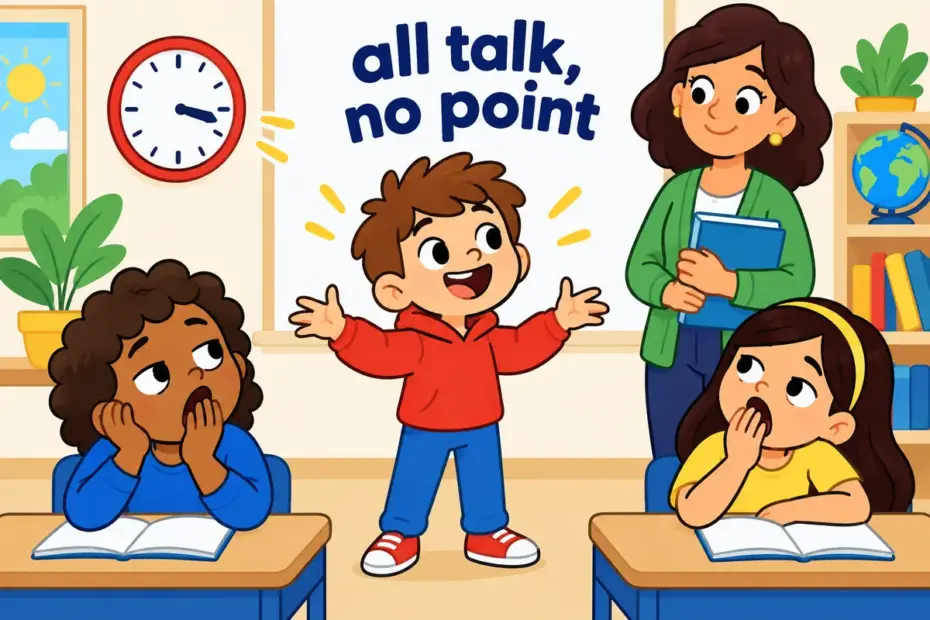
Prate means to talk at length in a foolish or empty way, and it is a rare, literary verb that scolds idle chatter. To use prate in a sentence, follow it with about or on: “The guests prated about the weather for an hour.” The word sounds old-fashioned, so it suits commentary and fiction more than conversation.
Prate at a glance
- Prate is an intransitive verb meaning to talk foolishly or at tedious length.
- Its forms are prates, prated and prating.
- The dominant patterns are prate about and prate on.
- Prate is rare and literary, and it is nearly always disapproving.
- The commonest error is confusing prate with prattle, or with the unrelated berate, abate, curate and grate.
What does prate mean?
Prate is an intransitive verb meaning to talk at length in an empty, foolish or tedious way. The Cambridge entry for prate records that sense of idle chatter, and the word is always a judgement: it does not describe how much someone speaks so much as how little the speech is worth. Where the talk is gentle and childlike rather than pompously empty, prattle is the kinder word.
| Sense | Plain meaning | Example sentence |
|---|---|---|
| Talk idly | Chatter without purpose or point | They prated about the weather for an hour. |
| Talk pompously | Speak as if every empty word mattered | The speaker prated about his own importance. |
| Talk at tedious length | Keep going long past interest | He prated on until the room emptied. |
One limitation is worth stating plainly. Prate is not a neutral word for talking, and it is uncommon enough in modern English that using it casually can sound affected. When the meaning is simply to speak, write talk or chat; choose prate only when you also mean to criticise the talk as empty.
How do you use prate in a sentence?
Prate never takes a direct object, so the topic always arrives through a preposition. Four patterns cover nearly every real sentence, and the second stresses the tedious length rather than the subject.
| Pattern | Example | What it signals |
|---|---|---|
| prate about + topic | The students prated about the holiday for an hour. | Names the empty subject of the talk. |
| prate on | He prated on while everyone checked the clock. | Stresses the length rather than the topic. |
| prating + noun | Her prating nonsense filled the whole journey. | Turns the verb into a describing participle. |
| prate of + topic, literary | The old men prated of better days. | A formal variant found mainly in older prose. |
Prate in a sentence: examples across contexts
Prate keeps its critical edge while the setting changes. The nine sentences below move from a classroom to a novel, and each one shows what the empty talk is about.
| Context | Example sentence | Why this works |
|---|---|---|
| Classroom | The pair prated about football until the teacher called the register. | Everyday subject, judged as pointless by the verb alone. |
| Workplace email | We prated about process for a week and shipped nothing. | Contrasts empty talk with a concrete result. |
| News report | Ministers prated about reform while the backlog grew. | Sets the talk against the neglected evidence. |
| Academic writing | Later critics prated of influence without citing a single source. | Uses the literary variant to mock empty authority. |
| Conversation | He prated on about his new car until I left the room. | Everyday use, with the on pattern showing fatigue. |
| Sports column | The pundits prated about courage as the side lost again. | Turns the verb on empty commentary. |
| Novel dialogue | Do stop prating and tell me what happened. | Shows the word used as an impatient command. |
| Diary entry | I prated to myself for an hour before the decision felt clear. | Extends the verb to private, pointless speech. |
| Editorial | A prating statement replaced any real policy. | Uses the participle to describe a document. |
Prate vs prattle and babble
Prate, prattle and babble all describe a stream of talk, and they divide by tone. Prattle is gentle and often affectionate, babble is confused or hurried, and plain chatter is neutral background talk.
| Attribute | prate | prattle | babble |
|---|---|---|---|
| Core meaning | Talk emptily and at length | Talk in a light, childish way | Talk in a confused rush |
| Feeling it carries | Disapproving | Gentle, often fond | Dismissive of the confusion |
| Typical speaker | A pompous or dull adult | A child or a happy adult | Anyone overwhelmed by words |
| Register | Literary and formal | Warm and informal | Neutral to critical |
| Common pairing | prate about politics | prattle about toys | babble with excitement |
Verdict: choose prate to criticise empty adult talk, prattle for a child’s light chatter, and babble when the words tumble out without order. For casual talk about people, gossip is the everyday verb.
Word forms and grammar of prate
Prate follows regular verb endings, and its most common derived form is the participle prating used as an adjective. Both the person noun prater and the adverb pratingly are rare.
| Form | Part of speech | Example |
|---|---|---|
| prate | verb, base form | Do not prate when you have nothing to add. |
| prates | verb, third person singular | He prates about the same subject every week. |
| prated | verb, past and past participle | They prated until the meeting ran over. |
| prating | verb participle and adjective | A prating speech followed the main address. |
| prater | noun, a person, rare | The chronic prater was eventually ignored. |
| pratingly | adverb, rare | He spoke pratingly of matters he barely knew. |
Common mistakes with prate
- Incorrect:
She prated the poem to the class.Correct: She recited the poem to the class. Rule: Prate is intransitive and takes no direct object, so it cannot mean to recite something. - Incorrect:
He prated the driver for being late.Correct: He berated the driver for being late. Rule: Berate means to scold someone, which is a different verb and a different meaning. - Incorrect:
The baby prated happily in the cot.Correct: The baby prattled happily in the cot. Rule: Prattle describes gentle childlike talk, while prate criticises empty adult speech. - Incorrect:
The storm finally prated in the evening.Correct: The storm finally abated in the evening. Rule: Abate means to die down or lessen and shares only a rhyme with prate. - Incorrect:
She prated about of the plan for an hour.Correct: She prated about the plan for an hour. Rule: Use one preposition, about or on, never both together.
Practice using prate
Work through the six items, then read the reasoning rather than only the answer.
- Fill the gap: The pundits ______ on about tactics until the final whistle.
- Choose the better word: The toddler began to (prate / prattle) about a cardboard box.
- Correct the error: He prated the whole report to the committee.
- Build a sentence: use prate about about a boring topic at a party.
- Spot the register: which belongs in a formal review — a prating speech of no substance, or a totally pointless speech?
- Change the meaning: The noise gradually lessened after midnight. Rewrite it with abate.
Answers
- prated — the pundits talk emptily, and the verb needs the preposition on.
- prattle — a toddler’s light talk is gentle, which is prattle rather than prate.
- He prated about the report to the committee — prate is intransitive and cannot take the report as an object.
- Model answer: Grandpa prated about the weather until everyone found a reason to leave.
- A prating speech of no substance — a formal review avoids casual intensifiers such as totally.
- The noise gradually abated after midnight — abate means to lessen, not to chatter.
The bottom line
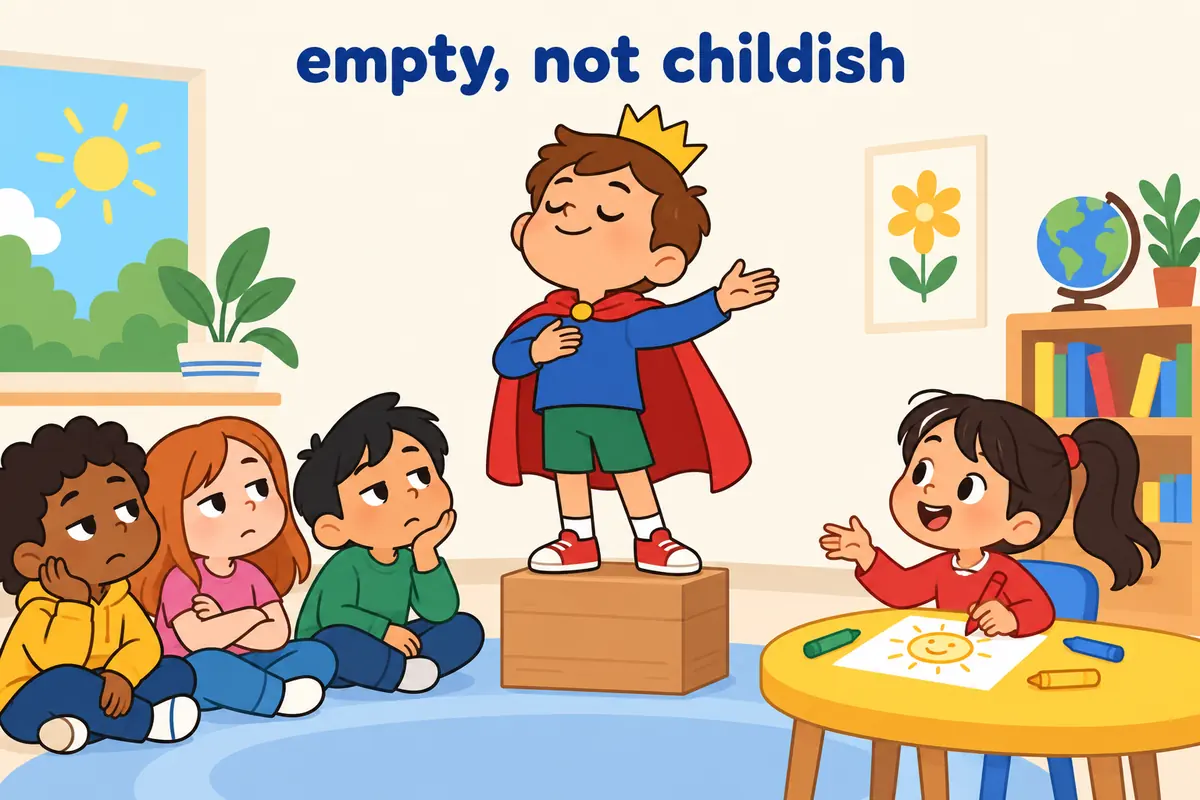
Use prate in a sentence when you want to criticise talk as empty and long-winded, and remember that the verb is intransitive, so about or on introduces the topic. Two nuances decide most sentences: the word is literary and uncommon, so in ordinary writing it can sound affected, and it always disapproves, never merely describes. Where the talk is warm or childish, prattle or chatter is the better choice.
Frequently asked questions about prate
Is prate a common word?
No. Prate is uncommon in modern English and appears mostly in older literature, satire and deliberately formal commentary. Using it in everyday writing usually draws attention to the word itself, so most speakers reach for talk, chatter or ramble unless they want that old-fashioned, critical tone.
What is the difference between prate and prattle?
Prate criticises empty, pompous adult talk, while prattle describes light and often charming chatter, usually by a child. The two verbs share a sound but not a mood: prate is a rebuke, and prattle is affectionate. If the talk is harmless and sweet, prattle is the correct choice.
Can prate take an object?
No. Prate is intransitive, so it never takes a direct object. The topic arrives through a preposition, as in prate about politics or prate on. A sentence such as he prated the report is wrong on two counts: the verb cannot be transitive, and the meaning would need recite or report instead.
Is prate formal or informal?
Prate sits at the literary and formal end of the range, with a slightly archaic flavour. It appears in fiction, essays and criticism far more often than in speech. That register is exactly why it stings in commentary: the elevated word makes ordinary chatter sound especially hollow.
Do you ever find yourself engaging in long-winded and idle chatter? This is commonly known as “prating,” which refers to the act of talking at length, often in a boring or meaningless way.
Have you ever been stuck in a conversation where someone just wouldn’t stop prating on and on, leaving you feeling exasperated and eager to escape? Prating can be a frustrating phenomenon, making it difficult to get a word in edgewise or maintain interest in the conversation.
7 Examples Of Prate Used In a Sentence For Kids
- Prate means talking too much.
- It is not polite to prate during class.
- Sometimes, adults like to prate for a long time.
- We should listen instead of prating all the time.
- When you prate too much, others cannot speak.
- Let’s be mindful of how much we prate.
- It’s important to give others a chance to prate too.
14 Sentences with Prate Examples
- Prate on important topics in your college lectures to gain a better understanding of the subjects.
- It is essential to prate with your classmates to exchange study materials and notes for upcoming exams.
- Don’t waste your time prating about irrelevant matters; focus on your academics instead.
- Join study groups where you can prate with your peers and enhance your learning experience.
- It is crucial to prate with your professors about any doubts or concerns regarding the coursework.
- Utilize the library as a quiet place to prate on your assignments and projects.
- Join extracurricular activities to prate with like-minded individuals and broaden your horizons.
- Use online forums and platforms to prate with students from different colleges and exchange knowledge.
- Attend seminars and workshops to prate with experts in your field and gain valuable insights.
- Set aside dedicated time to prate on your career goals and aspirations.
- Make use of online resources to prate on different study techniques and improve your learning efficiency.
- Networking events are a great way to prate with industry professionals and explore potential career opportunities.
- Don’t hesitate to prate with your seniors for guidance and advice on navigating through college life.
- Remember to prate with your family and friends for emotional support during stressful times in college.
How To Use Prate in Sentences?
Prate is a verb that means to talk at length, especially in a foolish or inconsequential way. When using prate in a sentence, it is essential to understand its meaning and how to incorporate it effectively.
Beginners should follow these steps to use prate correctly in a sentence:
-
Understand the Meaning: Make sure you understand that prate implies talking excessively or idly about trivial matters.
-
Choose the Correct Context: Select a situation where someone is talking incessantly or rambling on about unimportant things.
-
Formulate the Sentence: Construct a sentence where the word prate fits naturally. For example, “She would prate on for hours about her new shoes.”
-
Use Proper Grammar: Ensure that the sentence is grammatically correct and that prate is used in the right tense.
-
Variation: Experiment with different sentence structures to become more comfortable using prate in various contexts.
By following these steps, beginners can effectively incorporate prate into their vocabulary and improve their writing skills. Remember to practice using prate in sentences to become more confident in your ability to communicate effectively with this word.
Conclusion
In conclusion, the use of the keyword “prate” in sentences demonstrates the ability to communicate a sense of speaking at length, often in a tedious or repetitive manner. Whether describing someone who enjoys talking excessively or implying that one is engaging in gossip or idle chatter, the word “prate” adds a specific tone to sentences. It can convey a sense of annoyance, informality, or even playfulness, depending on the context in which it is used.
Overall, incorporating “prate” into sentences can help convey a nuanced meaning about the way individuals talk or interact with each other. By using this keyword effectively, writers can create vivid and engaging narratives that capture the essence of long-winded or trivial conversations, adding depth and personality to their writing.


