Salient means most noticeable or most important among the things around it. To use salient in a sentence, attach it to the point, feature or fact that stands out: “The report buried its most salient finding.” The adjective usually appears before the noun it describes.
Salient at a glance
- Salient is an adjective; its forms are the nouns salience and saliency and the adverb saliently.
- The core meaning is standing out as the most important or most noticeable among several.
- The usual nouns are point, feature, fact, issue, detail and difference.
- Salient belongs to academic, business and journalistic writing more than to conversation.
- The commonest error is treating salient as a synonym for relevant, which only means connected to the topic.
What does salient mean?
Salient is an adjective meaning most important or most noticeable among the surrounding options. The Cambridge entry for salient records both the importance and the noticeability sense. Two everyday senses dominate, and a technical sense survives in geography and anatomy.
| Sense | Plain meaning | Example sentence |
|---|---|---|
| Most important | The point that matters most | The salient weakness of the plan is its cost. |
| Most noticeable | The feature the eye catches first | A salient yellow stripe runs down the wing. |
| Projecting (technical) | Standing out from a line or surface | The salient corner of the site faces the road. |
One limitation is worth stating plainly. Salient does not mean relevant, and it does not mean true. A relevant detail is merely connected to the topic, while a salient one is the detail that matters most. Where a writer simply wants to flag importance, an important detail is the safer choice, and a merely noteworthy item is a notable feature.
How do you use salient in a sentence?
Salient is an adjective, so it normally sits before the noun it ranks and often implies a comparison with other candidates. Five patterns cover almost every real sentence.
| Pattern | Example | What it signals |
|---|---|---|
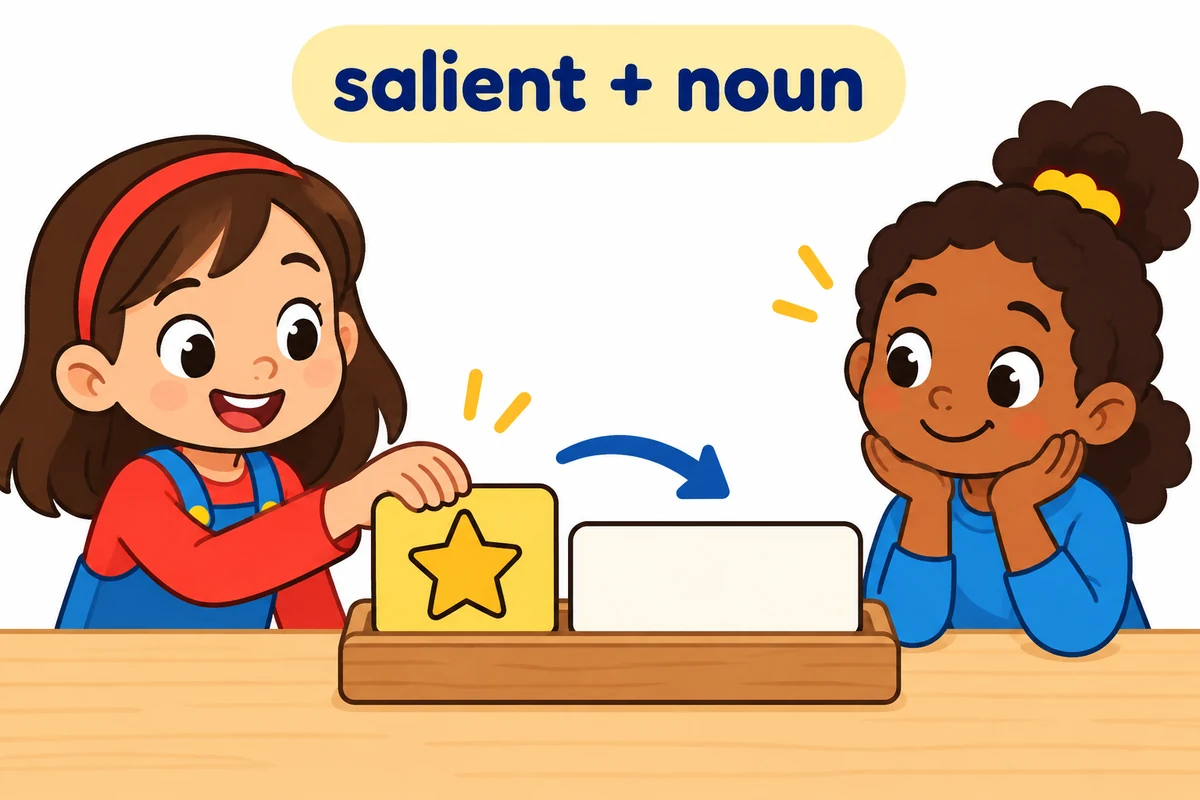
| salient + noun | The salient issue is funding. | The commonest position; the adjective precedes what it ranks. |
| the most salient + noun | The most salient difference is cost. | The superlative marks the single standout. |
| salient + point, feature or fact | She raised one salient fact. | Fixed collocations carry the meaning directly. |
| be salient to + noun | These details are salient to the decision. | Predicate use, almost always with to. |
| be salient in + noun | The clue is salient in the photograph. | Names the setting where the feature stands out. |
The adjective implies that other candidates exist, so it reads oddly without a comparison in mind. Where the point is eye-catching rather than important, a conspicuous detail is the better adjective, because conspicuous describes what is seen rather than what matters.
Salient in a sentence: examples across contexts
Salient keeps its ranking force across registers while the noun changes. The sentences below move from a classroom to a court judgment to a design review, and each one compares the standout item with the rest.
| Context | Example sentence | Why this works |
|---|---|---|
| Classroom | The teacher circled the salient fact on the board. | A simple action shows one fact ranked above the others. |
| Business email | Please keep the salient figures in the summary. | The adjective filters a list down to what matters. |
| News report | The most salient detail was the missing date. | The superlative names the single standout. |
| Academic writing | The paper isolates three salient variables. | Uses the importance sense in a technical register. |
| Legal writing | The judge noted one salient omission. | Ranks a gap above the other irregularities. |
| Conversation | The salient thing is that nobody called. | The everyday register keeps the ranking force. |
| Science writing | A salient ridge marks the specimen. | Uses the noticeability sense for a visible feature. |
| Design review | Colour is the salient difference between the two logos. | Compares two options and names the standout. |
| Sports commentary | The salient moment came in the final minute. | Picks one moment out of the whole match. |
Every example points at one item and quietly sets it against others, which is the test for using salient rather than plain important.
Salient vs relevant
Salient and relevant overlap in casual use and differ in one decisive way. Relevant says a detail connects to the topic; salient says it is the detail that matters most. The table sets the two side by side.
| Attribute | salient | relevant |
|---|---|---|
| Core job | Rank what matters most | Show a connection to the topic |
| Implies importance | Yes | No |
| Implies connection | Usually, among real options | Yes, by definition |
| Typical partners | point, feature, fact, difference | information, question, law, experience |
| Register | Academic and formal | Neutral |
| Comparison set | Several candidates compete | A single topic |
Verdict: use relevant information when a detail connects to the subject, and salient only when it is the detail that matters most among several. Where the meaning is standing out to the eye rather than mattering most, a prominent feature is the closer word.
Word forms and grammar of salient
Salient is an adjective that builds two nouns and an adverb on the same root. The noun saliency appears in psychology and design, and the table also marks the noun use that is technical rather than general.
| Form | Part of speech | Example |
|---|---|---|
| salient | adjective | This is the salient point. |
| saliently | adverb, rare | He saliently avoided the cost question. |
| salience | noun | The salience of the cost grew over time. |
| saliency | noun, variant | Saliency maps show what draws the eye. |
| salient | noun, technical | The troops held the salient for a week. |
| salienty | non-standard | Some learners write salienty; English uses salience or saliency. |
The adjective is the everyday form, the nouns belong to specialist writing, and the noun use of salient for a projecting part stays inside military and anatomical description.
Common mistakes with salient
- Incorrect:
That question is not salient to our discussion.Correct: That question is not relevant to our discussion. Rule: Relevant means connected; salient means most important. - Incorrect:
The report made several salient points, all equally useful.Correct: The report made one salient point and several minor ones. Rule: Salient ranks one item above the rest, so it resists a list of equals. - Incorrect:
The salient of the building faces north.Correct: The salient corner of the building faces north. Rule: In everyday use salient is an adjective; the noun is technical. - Incorrect:
Her salient argument convinced everyone because it was true.Correct: Her salient argument convinced everyone because it addressed the cost. Rule: Salient marks importance, not truth. - Incorrect:
He spoke saliently about the budget.Correct: He spoke clearly about the budget. Rule: Saliently is rare and awkward; plain adverbs fit better.
Practice using salient
Work through the six items, then check the reasoning rather than only the answer.
- Fill the gap: The ______ difference between the two plans is their cost.
- Choose the better word: Her name is (salient / relevant) to the case because she signed the form.
- Correct the error: The salient of the argument was easy to miss.
- Build a sentence: use the most salient + noun about a detail in a weather report.
- Spot the register: which belongs in an academic abstract — three salient variables, or three pretty big things?
- Rewrite with the noun: The cost is salient. Use salience instead.
Answers
- salient — cost is ranked above the other differences between the plans.
- relevant — the name connects to the case; the sentence does not rank it above other facts.
- The salient point of the argument was easy to miss — the adjective needs a noun in everyday use.
- Model answer: The most salient detail in the forecast is the arriving storm.
- Three salient variables — the first keeps the formal adjective and avoids vague praise.
- The salience of the cost grew as the deadline neared — the noun takes of or a possessive.
The bottom line
Use salient in a sentence when one point, feature or fact matters more than the others around it, and place the adjective before the noun it ranks. Two nuances settle most cases: salient implies a comparison, so it needs real alternatives, and it never means merely relevant. Where importance is all you mean, plain important is often the safer word.
Frequently asked questions about salient
Is salient a formal word?
Salient sits in academic, business and journalistic writing, where a list of points is being ranked. It does appear in careful speech, but a casual conversation more often uses the big one or the main one. The noun forms salience and saliency are more technical still.
What is the noun form of salient?
The main noun is salience, as in the salience of the cost grew. A variant, saliency, is common in psychology and design writing about attention. Both are uncountable in ordinary use, so they rarely take a plural. The adverb, saliently, exists but is awkward.
Can salient be used as a noun?
Only in technical writing. In military and anatomical description a salient is a part that projects outward, such as a bulge in a battle line. In everyday English salient stays an adjective. Using it as a noun in a general sentence reads as an error rather than a choice.
How do you pronounce salient?
Salient has three syllables with the stress on the first: roughly SAY-lee-unt, ending in a weak syllable. The related noun salience keeps the same opening stress and ends like -yence. Copy the rhythm from a dictionary audio clip, because the final vowel varies between speakers.
Have you ever struggled with making your writing engaging and impactful? One way to elevate your writing is by incorporating salient details. Salient, derived from the Latin word “salire” meaning to leap or spring, refers to the quality of being prominent or conspicuous.
In writing, a salient detail is one that stands out and captures the reader’s attention. By including salient details in your work, you can create a vivid and compelling narrative that draws readers in and makes your writing more memorable.
7 Examples Of Salient Used In a Sentence For Kids
- Salient means easily noticeable.
- My cat has salient green eyes.
- The elephant’s trunk is a salient feature.
- I found a salient red flower in the garden.
- The sun is a salient source of light.
- The moon is a salient object in the sky at night.
- Birds have salient wings for flying.
14 Sentences with Salient Examples
- The salient points from yesterday’s lecture are still fresh in my mind.
- It’s important to highlight the salient features of the research paper during your presentation.
- Understanding the salient concepts will help you ace the upcoming exam.
- The professor emphasized the salient differences between the two economic theories.
- Don’t forget to make note of the salient references for your assignment.
- It’s crucial to focus on the salient arguments when preparing for a debate.
- The salient topics covered in the textbook will be included in the upcoming test.
- Exploring the salient aspects of the case study will enhance your understanding of the topic.
- It’s essential to grasp the salient details of the project before starting your research.
- The salient points raised in the discussion will be taken into consideration for the group project.
- Highlighting the salient information in your notes will make revision easier before the exam.
- The professor encouraged us to analyze the salient themes in the literature we are studying.
- Understanding the salient arguments in the debate will help strengthen your position.
- The salient points made in the guest lecture were thought-provoking and informative.
How To Use Salient in Sentences?
Salient is an adjective that is used to describe something that stands out or is noticeable in a particular context. When using Salient in a sentence, it is important to place emphasis on the feature or characteristic that is being highlighted.
For example:
- “One salient feature of the new smartphone is its long-lasting battery life.”
- “The salient point of the presentation was the need for more sustainable practices.”
- “Her salient contribution to the project was recognized by her colleagues.”
When incorporating Salient into a sentence, try to make sure that it is clear what specific aspect is being emphasized or highlighted. This will help convey your message effectively and make your writing more impactful.
It is also helpful to vary your sentence structure and where you place Salient within the sentence to keep your writing engaging. Practice using Salient in different contexts to become more comfortable with incorporating it into your writing.
Using Salient effectively can help you communicate your ideas clearly and make your writing more engaging. Remember to always consider the context in which you are using Salient to ensure that it accurately reflects the point you are trying to convey.
Conclusion
In writing, sentences with salient information serve to highlight the most important points, guiding the reader’s focus and aiding comprehension. By emphasizing key details or ideas, these sentences effectively convey the core message of a passage. For instance, “The study’s findings revealed several salient factors that influenced the participants’ decisions” states that specific factors stood out as particularly significant in shaping the outcomes.
In complex texts, sentences with salient information play a crucial role in clarifying the main concepts and driving the narrative forward. They help to streamline the flow of information, making it easier for readers to grasp essential points without getting lost in unnecessary details. Understanding how to craft sentences that effectively highlight salient information is a valuable skill for writers looking to communicate their ideas clearly and concisely.


