Set apart in a sentence describes making someone or something clearly different from others, or keeping something for a special purpose. The phrasal verb is transitive and usually separable, so the object lands between the verb and the particle: “Her calm voice set her apart from the crowd.”
Set apart at a glance
- Set apart is a phrasal verb; its forms are set apart, sets apart, setting apart and the unchanged past set apart.
- Its two senses are to distinguish and to reserve something for a special use.
- The dominant pattern is set + object + apart + from.
- Typical subjects are a quality, a feature, a rule or a person making a choice.
- Register is neutral to formal, common in writing about character, design and selection.
- The nearest lookalike is set aside, which means postpone or save, not distinguish.
What does set apart mean?
Set apart is a phrasal verb meaning to make someone or something distinct, or to keep something for a special purpose. The Cambridge entry for set apart records both senses, and the difference is easy to hear: the first marks a difference, the second withholds something from ordinary use. Writers who only need the idea of difference often choose differentiate between two things, which is more technical and carries no sense of reserve.
| Sense | Plain meaning | Example sentence |
|---|---|---|
| Distinguish | Make one thing noticeably different from a group | Her patience set her apart from the other tutors. |
| Reserve | Keep something back for a special use | The school set a room apart for music practice. |
One limitation is worth stating plainly. Set apart does not mean better. A feature can set a product apart and still leave it weaker than its rivals, and a person can be set apart by a fault rather than a gift.
How do you use set apart in a sentence?
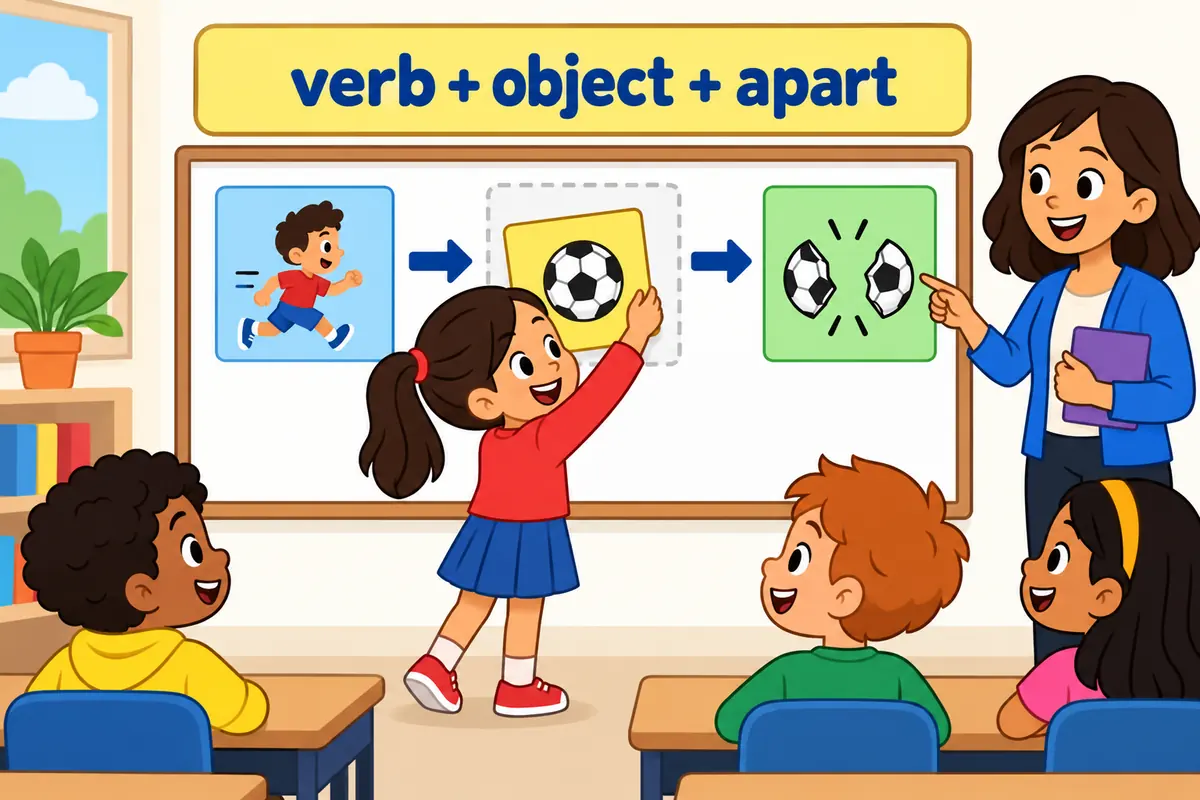
The object normally sits between set and apart: something sets somebody apart from the rest. The particle can also follow the object in formal writing, so both set the case apart and set apart the case appear, though the first is far more common. With the reserve sense the object almost always comes first.
| Pattern | Example | What it signals |
|---|---|---|
| set + object + apart + from | Her patience set her apart from the other tutors. | Marks a difference from a named group. |
| set + object + apart | The school set a room apart for music practice. | Reserves something for a special use. |
| be set apart | The chapel is set apart from the main hall by a low wall. | Passive voice, focusing on the boundary. |
| set apart + object | The will set apart a sum for repairs. | Formal and legal order, particle before object. |
| what sets + object + apart is | What sets the design apart is its simple frame. | Fronted clause, common in reviews. |
A near neighbour is set aside, which shares the verb but means to postpone or keep for later, so the two are rarely interchangeable.
Set apart in a sentence: examples across contexts
Set apart keeps the same shape while its subject moves from a classroom to a design studio. The nine sentences below each name the quality or rule doing the separating.
| Context | Example sentence | Why this works |
|---|---|---|
| Classroom | The teacher set the finished paintings apart so visitors could see them first. | Object before the particle, the everyday separable pattern. |
| Workplace email | Two features set our support team apart from the rest of the market. | Distinguishing sense with the required from. |
| News report | A single vote set the mayor apart from her two rivals. | Names the group she is measured against. |
| Sports writing | His training routine sets him apart from the squad. | A habit, not a talent, supplies the difference. |
| Product review | The folding handle sets the cooker apart from cheaper models. | One concrete feature carries the comparison. |
| Legal writing | The deed set the orchard apart for public use. | Reserve sense inside a formal instrument. |
| Academic prose | The study set apart two groups that shared the same diet. | A method separates the samples. |
| Conversation | What set that film apart for me was the silence at the end. | Fronted clause, the pattern that survives in speech. |
| Design writing | A warm grey sets the room apart from the white corridor. | Colour acts as the separating quality. |
Set apart vs set aside
The two phrasal verbs share the base set and are confused constantly. To separate two things is the plain alternative when no special quality or stored purpose is involved.
| Attribute | set apart | set aside |
|---|---|---|
| Core job | Make distinctly different, or reserve | Postpone, or keep for a later use |
| Typical subject | A quality, feature or rule | A person, committee or court |
| Common object | A person, style, case or room | A decision, time, money or land |
| Usual preposition | from | for |
| Register | Neutral to formal | Neutral to legal |
Verdict: choose set apart when a quality marks something out, and set aside when the idea is postponing or saving. Where the task is simply dividing things, reserve the plainer verb reserve a place for planning and separate for physical division.
Word forms and grammar of set apart
Set is irregular, so the past form does not add -ed: the past of set apart is simply set apart. The hyphenated set-apart appears only inside compounds such as set-apart seating, and many editors avoid it.
| Form | Part of speech | Example |
|---|---|---|
| set apart | phrasal verb, base | They set apart the best pieces for the show. |
| sets apart | verb, third person singular | Careful editing sets apart a good report. |
| setting apart | verb, present participle | Setting apart time to read helped her focus. |
| set apart | verb, past and past participle | The rule was set apart in the older code. |
| set-apart | compound adjective, hyphenated | A set-apart shelf held the trophies. |
Another member of the family, set forth, means to present something formally, which is a different job again.
Common mistakes with set apart
- Incorrect:
Her talent sets her apart the other singers.Correct: Her talent sets her apart from the other singers. Rule: The preposition from is required when a group follows. - Incorrect:
The team set apart their best player from the bench.Correct: The team set their best player apart from the bench. Rule: With a pronoun object the object goes before the particle. - Incorrect:
He is set apart than others.Correct: He is set apart from others. Rule: Use from, never than, after this phrasal verb. - Incorrect:
We set apart the meeting to next week.Correct: We set aside the meeting to next week. Rule: Set apart never means postpone; that job belongs to set aside. - Incorrect:
The design is very set apart.Correct: The design stands apart. Rule: This phrasal verb resists adverb intensifiers such as very.
Practice using set apart
Work through the six items, then read the reasoning rather than only the key.
- Fill the gap: A red badge ______ the guides ______ the other volunteers.
- Choose the better word: The judge (set apart / set aside) the ruling for review.
- Correct the error: Her honesty sets her apart the rest.
- Build a sentence: use set … apart from about a sibling with an unusual talent.
- Spot the register: which belongs in a school report — the choir was set apart by its timing, or the choir totally stood out?
- Rewrite in the passive: The family set the old piano apart for concerts.
Answers
- set … apart — the badge is the quality, the guides are the group, so from follows.
- set aside — the ruling is postponed, which is the reserve verb, not the distinction verb.
- Her honesty sets her apart from the rest — the group needs the preposition from.
- Model answer: Ravi was set apart from his brothers by his ear for music.
- The choir was set apart by its timing — a report avoids totally and the casual stood out.
- The old piano was set apart for concerts — the passive keeps the reserved object in focus.
The bottom line
Use set apart in a sentence when a quality marks somebody out from a group, or when something is reserved for a special purpose. The two decision points are separability, which lets the object sit before the particle, and the required from whenever a group follows. When nothing is distinguished and nothing is reserved, unite, separate or reserve usually fits better.
Frequently asked questions about set apart
Is set apart one word or two?
Set apart is written as two words when it works as a verb, as in they set the best seats apart. The hyphenated set-apart appears only in compounds such as set-apart accommodation, and even there many editors write it open. Use two words in every verb phrase.
Which preposition follows set apart?
The preposition is from, because the phrase names what something is measured against: the new rule set her apart from the older staff. A sentence can end at apart when the group is obvious, but once a group is named, from is not optional in careful writing.
Can set apart mean to reserve something?
Yes. Besides distinguishing, set apart means to keep something back for a special use, as in the family set a room apart for guests. This sense usually takes a thing rather than a person, and it often names the purpose with for after apart.
Is set apart the same as separate?
No. Separate is a plain verb for dividing things physically or conceptually, with no hint of special quality. Set apart adds the idea that the difference is meaningful or that something is reserved. A fence separates two gardens; a rare style sets one garden apart.
When it comes to writing engaging content, using phrases that “set apart” your writing can make a significant impact. The term “set apart” means to distinguish or differentiate something from others by highlighting its unique qualities or characteristics.
By incorporating sentences that “set apart” your writing, you can grab the reader’s attention, add depth to your content, and make it more memorable. This technique can help you stand out in a sea of information, leaving a lasting impression on your audience.
7 Examples Of Set Apart Used In a Sentence For Kids
- Set apart your colored pencils from your crayons.
- Let’s set apart the toys that belong in the toy box.
- We should set apart our shoes neatly in the shoe rack.
- Set apart the fruits and vegetables in separate containers.
- It’s important to set apart clean clothes from dirty ones.
- We can set apart the storybooks on one shelf.
- Make sure to set apart your school books in a special place.
14 Sentences with Set Apart Examples
- Set apart some time each day for studying and revision.
- It’s important to set apart funds for textbooks and other study materials.
- A well-organized study space can set apart serious students from the rest.
- Set apart a specific day each week for laundry and groceries to stay organized.
- Joining a club or society can help you set apart from the crowd in college.
- Set apart some time for extracurricular activities to maintain a healthy work-life balance.
- Developing good study habits can set apart top students from the average ones.
- Attending workshops and seminars can set apart your learning experience in college.
- Networking with professors and professionals can set apart your career opportunities.
- Set apart a quiet corner in the library for focused studying and research.
- Volunteering for community service initiatives can set apart your college applications.
- Set apart some time for physical exercise to maintain overall well-being.
- Building a strong portfolio can set apart your job applications after graduation.
- Prioritizing assignments and deadlines can set apart successful college students from the struggling ones.
How To Use Set Apart in Sentences?
Set Apart means to make something or someone different from the others in a distinct way. When using this phrase in a sentence, it is important to understand its meaning and how to properly incorporate it into your writing.
Here is how to use Set Apart in a sentence:
- Start by identifying the specific object or person that you want to differentiate from the rest.
- Then, use the phrase Set Apart followed by the subject to highlight the uniqueness or special qualities of the object or person.
- You can provide additional details to explain why the particular object or person stands out compared to others.
- Make sure to use correct grammar and punctuation to clearly convey your message.
For example:
- “The striking architecture of the Eiffel Tower sets it apart from other landmarks around the world.”
- “Her exceptional talent and dedication set her apart from the other candidates during the audition.”
- “The innovative design and high-quality materials set apart this smartphone from its competitors.”
By following these simple steps, you can effectively use Set Apart in a sentence to emphasize the uniqueness or distinction of something or someone.
Conclusion
In writing, sentences with “set apart” often highlight distinct characteristics or actions that distinguish someone or something from others. These sentences emphasize uniqueness or separation, indicating that the subject stands out or is different in some way. By using this phrase, writers draw attention to special qualities, traits, or accomplishments that set the subject apart from the rest.
Overall, sentences with “set apart” serve to underline individuality, superiority, or excellence. They signify a notable difference or distinction that elevates the subject above the ordinary. Whether describing personal attributes, achievements, or features of an object, these sentences aim to emphasize the exceptional nature of what is being discussed, making it clear that it is special or unique in a particular context.