
Set out is a phrasal verb with two everyday senses: to begin a journey, and to present a plan, rule or list of items clearly. It works without an object in “They set out at dawn,” and with one in “The report sets out three options.”
Set out at a glance
- Set out is a phrasal verb, and the past form is unchanged, as in “They set out early.”
- The journey sense takes no object: “We set out for the coast at six.”
- The presenting sense is transitive: “The contract sets out the payment dates.”
- The particle can move after the object in the arranging sense: “set the rules out.”
- Contracts, reports and news writing use set out far more than conversation does.
- The commonest error is choosing set out for a single object, where put fits better.
What does set out mean?
Set out is a phrasal verb meaning to start a journey, or to state and arrange information in an orderly way. The Cambridge entry for set out records both senses, and the subject decides which one is meant: people and vehicles set out, while documents, speeches and displays set something out. Where a traveller leaves on a long trip, depart is the more formal verb, and when the trip is figurative and ambitious, embark on a project is the natural choice.
| Sense | Plain meaning | Example sentence |
|---|---|---|
| Begin a journey | Leave a place in order to travel | We set out for the airport before sunrise. |
| Begin with a goal | Start an activity intending to do something | She set out to finish the course in a year. |
| Present clearly | State information in an orderly way | The manual sets out the safety steps. |
| Arrange for display | Put items in position for use | The staff set out the chairs for assembly. |
Set out is the wrong choice when nothing is launched or organised. A single object placed on a surface takes put: “Put the keys on the hook,” not “Set out the keys.” The verb never describes a permanent state, and it does not mean simply to own or hold something.
How do you use set out in a sentence?
Four patterns cover almost every use. The first two take no object, the last two take one, and the particle may sit before or after that object.
| Pattern | Example | What it signals |
|---|---|---|
| set out + for/to + place | We set out for the station at noon. | the start of a journey |
| set out to + verb | She set out to learn Spanish. | the start of a task with a goal |
| set out + object | The guide sets out the rules. | information presented in order |
| set + object + out | Please set the chairs out. | items arranged for use |
| set out + that / wh-clause | The report sets out what went wrong. | a full account in formal prose |
When the only idea is starting an action with no journey involved, begin and start are plainer than set out, and they never ask the reader to guess which sense is intended.
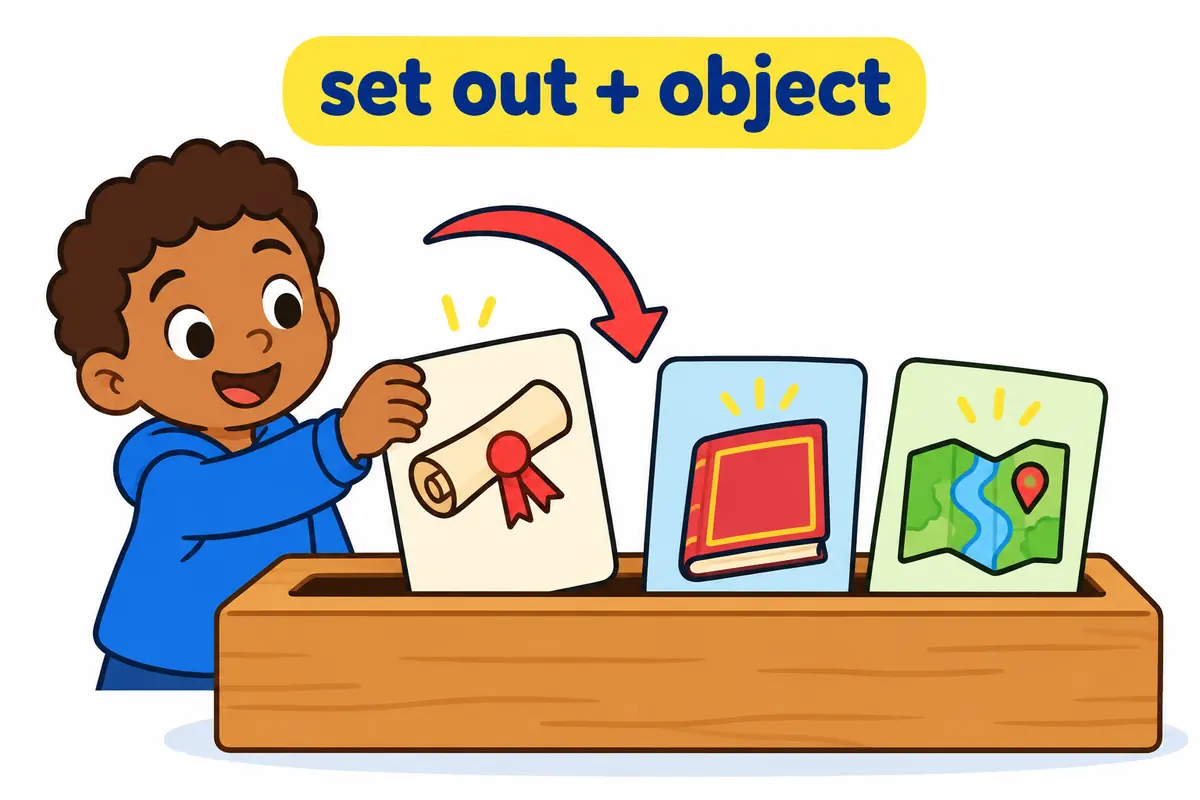
Set out in a sentence: examples across contexts
| Context | Example sentence | Why this works |
|---|---|---|
| Classroom | The teacher set out the paint pots before the children arrived. | The arranging sense with a clear time order. |
| Workplace email | Our timeline sets out who signs each document and when. | The presenting sense lists responsibilities in order. |
| News report | Rescue teams set out at first light to reach the stranded walkers. | The journey sense suits a time-pressured report. |
| Contract | Clause four sets out how refunds are calculated. | Formal presentation of terms, the strongest use of the verb. |
| Travel writing | We set out along the coast road with the windows down. | An intransitive journey with a named route. |
| Academic writing | The introduction sets out the method and the scope of the study. | It signposts the structure of formal prose. |
| Conversation | They set out to walk the whole trail in a week. | The goal sense in ordinary speech. |
| Sports report | The champions set out to defend their title in front of a home crowd. | The goal sense after a verb of intent. |
| Everyday instruction | Set the plates out on the big table. | The separated particle puts weight on the object. |
Set out vs set off
The pair looks interchangeable because both can start a journey, but their other jobs separate them.
| Attribute | Set out | Set off |
|---|---|---|
| Core journey sense | Begin a journey, often planned | Begin a journey, sometimes abruptly |
| Other common senses | Present or arrange information clearly | Trigger a reaction, an alarm or an event |
| Typical subject | a person, a team, a vehicle, a report | a person, a noise, an alarm, a chain of events |
| Register | common in reports and contracts | common in news and everyday speech |
| What it implies | an orderly beginning with a purpose | a trigger or a sudden departure |
These words overlap only on the road, so choose set out for a planned departure or a clear written account and set off for a sudden start or something that triggers a reaction. For arranging physical objects on a surface, lay out is often smoother than set out, because it names the display directly.
Word forms and grammar of set out
| Form | Part of speech | Example |
|---|---|---|
| set out (base) | phrasal verb | We set out at dawn. |
| sets out (third person) | phrasal verb | The policy sets out the rules. |
| setting out (present participle) | phrasal verb | Setting out early saves time. |
| set out (past) | phrasal verb | They set out last Friday. |
| set out to (infinitive) | phrasal verb + to | He set out to prove them wrong. |
The formal cousin set forth means much the same in the presenting sense, but it belongs almost entirely to legal and ceremonial writing, so keep it out of everyday sentences.
Common mistakes with set out
- Incorrect:
She set out them on the table.Correct: She set them out on the table. Rule: a pronoun object must sit between the verb and the particle. - Incorrect:
The smoke set out the alarm.Correct: The smoke set off the alarm. Rule: set off means to trigger something, and set out never does. - Incorrect:
The contract sets out clearly.Correct: The contract sets out the terms clearly. Rule: the presenting sense is transitive and needs an object. - Incorrect:
They have setted out early.Correct: They have set out early. Rule: set is irregular, so its past and past participle are both set. - Incorrect:
We set out from out of the harbour.Correct: We set out from the harbour. Rule: set out already carries the idea of moving outward.
One more particle to keep separate is set aside, which means to save for later or to cancel a decision, not to begin anything.
Practice using set out
Six tasks mix the journey sense, the presenting sense and the two common errors.
- The schedule ______ the dates for every exam. (fill in the blank)
- They ______ at five and reached the summit by noon. (fill in the blank)
- The smoke ______ the alarm. (choose: set out / set off)
- Correct this sentence: “She set out them on the counter.”
- Build a sentence with set out to describe a team starting a long project.
- Which sentence belongs in a contract? (A) Clause two sets out the delivery date. (B) Clause two sets off the delivery date.
Answers
- sets out — the presenting sense needs a third-person singular form here.
- set out — the base form follows they for a past action.
- set off — only set off means to trigger a reaction.
- She set them out on the counter — a pronoun object goes between verb and particle.
- The team set out to rebuild the bridge in a single summer — set out to plus a verb marks a goal.
- Sentence A — set out, not set off, states the terms of a contract.
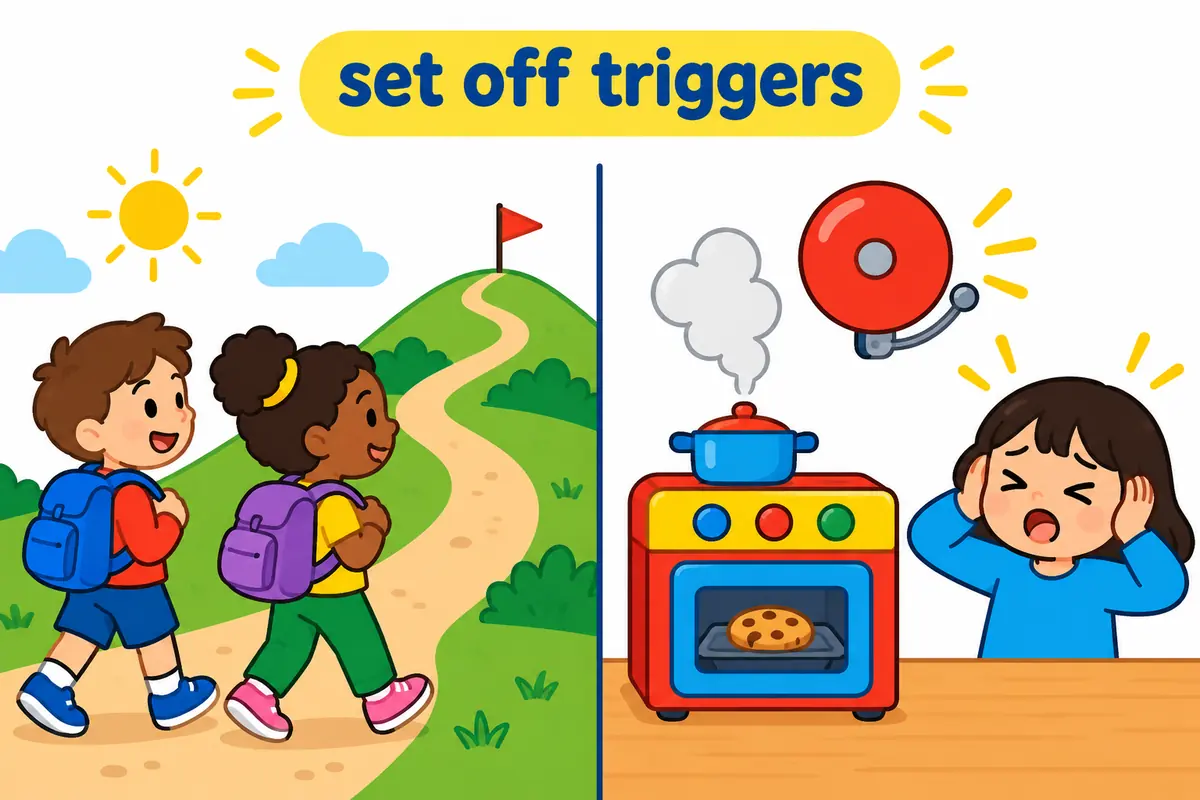
The bottom line
Set out covers two jobs that rarely collide: it launches a journey, and it lays information out in order. Check whether your sentence has an object, and the choice between the journey sense and the presenting sense follows. Keep the phrase away from sentences about one object placed on a surface. Used with that check, set out in a sentence makes either a departure or a clear plan unmistakable.
Frequently asked questions about set out
Does set out need an object?
Only the presenting sense needs an object. In the journey sense the verb stands alone: “We set out at dawn.” In the presenting sense it must have one: “The guide sets out the rules.” Ask whether information is being stated, and if it is, an object has to follow.
Can set out mean to arrange objects?
Yes. When you set out chairs, plates or papers, you place them in position for use. This arranging sense takes an object, and the particle may move after it: “Set the chairs out.” It is common in instructions and on printed signs.
Is set out formal or informal?
It sits in the middle. The journey sense is neutral and appears in speech and news. The presenting sense leans formal and is frequent in contracts, manuals and minutes. A friend would rarely say that a message sets out the rules, but a policy document often does.
What tense can follow set out?
The natural follow-up is the base verb after set out to, as in “She set out to win.” A gerund sounds wrong there, so “set out winning” fails. For a fixed future, pair the present with a time word: “We set out at six tomorrow.”
Setting out refers to the act of clearly stating or laying out a plan, goal, or intention. When someone sets out to do something, they are defining what they aim to achieve or accomplish.
This phrase is commonly used to express the beginning or initiation of a journey, project, or task. When one sets out, they are establishing a roadmap or direction for their actions and endeavors.
7 Examples Of Set Out Used In a Sentence For Kids
- Set out your crayons neatly on the table.
- We will set out on a nature walk today.
- Let’s set out the toys for everyone to play with.
- The chef will set out ingredients for our cooking class.
- We can set out our books before story time.
- Remember to set out your shoes by the door.
- The teacher will set out activities for us to do in class today.
14 Sentences with Set Out Examples
- Set out to the library early in the morning to get a head start on your research paper.
- Make sure to set out your study materials the night before to avoid rushing in the morning.
- It’s important to set out a clear schedule for the semester to keep track of assignment due dates.
- Set out to join a study group to maximize your understanding of difficult subjects.
- Don’t forget to set out a budget for the month to manage your finances effectively.
- Make a goal to set out to attend all your classes regularly for better academic performance.
- Set out to create a strong network of classmates and professors for support during your college journey.
- Ensure you set out to prioritize self-care and mental health amidst the academic stress.
- Set out to explore internship opportunities to gain practical experience in your field of study.
- Set out to attend career fairs and networking events to expand your professional connections.
- Don’t hesitate to set out to seek guidance from counselors or mentors for academic advice.
- Set out to participate in extracurricular activities to enhance your skills and meet new people.
- Set out to maintain a healthy work-life balance to avoid burnout during the semester.
- Always set out a backup plan in case things don’t go as expected during your college journey.
How To Use Set Out in Sentences?
To set out means to start or begin a journey, task, or process. When using this phrasal verb in a sentence, it is important to keep in mind its meaning and how it adds a specific intention to your statement.
For example, you can say: “I set out early in the morning to explore the city.” In this sentence, set out emphasizes the action of starting the journey to explore the city.
When using set out in a sentence, it is essential to place it after the subject of the sentence and followed by the specific action or journey that is being initiated. This structure helps to clearly convey your intention of starting something.
Here are a few more examples of set out used in sentences:
- She set out to achieve her goals despite the challenges.
- We set out to find a solution to the problem.
- The team set out on a mission to help those in need.
Remember that set out adds an element of purpose or determination to your sentence. It signifies the act of beginning something with a clear goal in mind. By understanding how to use set out in your sentences, you can effectively communicate your intentions and actions to others.
Conclusion
In conclusion, the examples of sentences with “set out” demonstrated how this phrase can be used to convey the idea of starting or arranging something in a clear and organized manner. Whether setting out a plan, a journey, or an argument, this phrase signals a deliberate and purposeful action. By using “set out” in sentences, one can effectively communicate intentions and goals to ensure clarity and precision in their writing or speech.
These examples illustrate the versatility and ease of incorporating “set out” into one’s vocabulary for expressing actions and objectives. Whether in academic writing, storytelling, or everyday conversations, using this phrase can enhance clarity and structure by succinctly conveying the act of beginning or arranging something with a specific purpose in mind.


