What Does “Specialized” Mean?
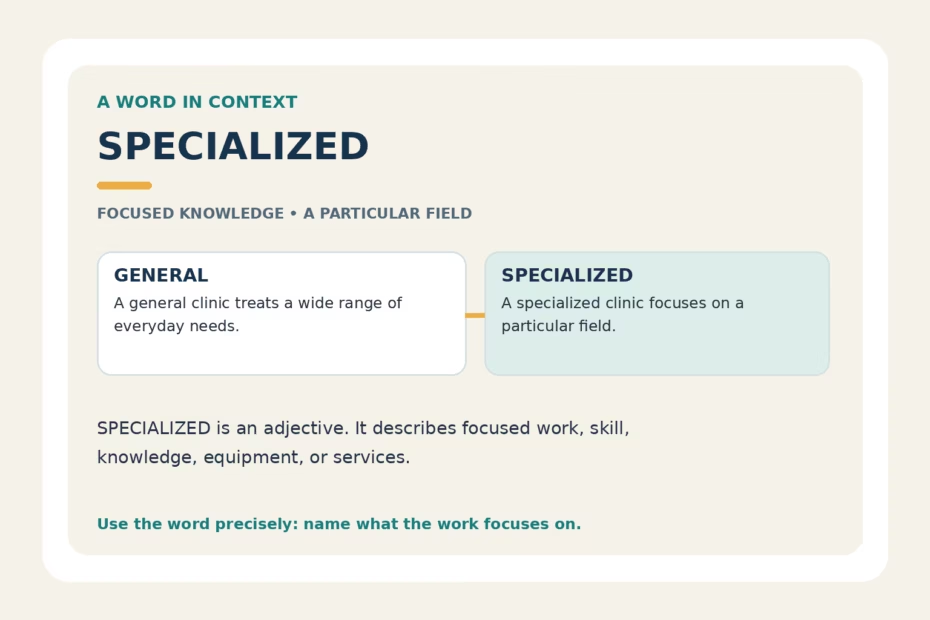
Specialized is an adjective for something designed, trained, equipped, or focused for a particular field, task, or group. A specialized clinic focuses on a defined area of care; specialized equipment is intended for a particular use; and specialized knowledge involves detailed understanding of a field. It is the past participle of specialize and can describe either a person’s expertise or a thing’s purpose.
The phrase “specialized sentence” is not a standard name for a sentence type in English grammar. This page uses specialized in ordinary sentences, showing what it describes and how to build a clear example. A sentence can be specialized in subject matter, but it is still classified by its grammar or purpose (for example, a declarative sentence or a complex sentence), not by the adjective alone.
How to Use “Specialized” in a Sentence
Place specialized before a noun when it describes that noun: specialized training, a specialized tool, specialized software. After a linking verb, it can describe the subject: Her training is specialized or The service became more specialized. In both positions, the reader should be able to tell what the expertise or purpose is.
| Sentence pattern | Example | What it shows |
|---|---|---|
| specialized + noun | The lab uses specialized equipment to measure air quality. | The equipment is intended for a particular task. |
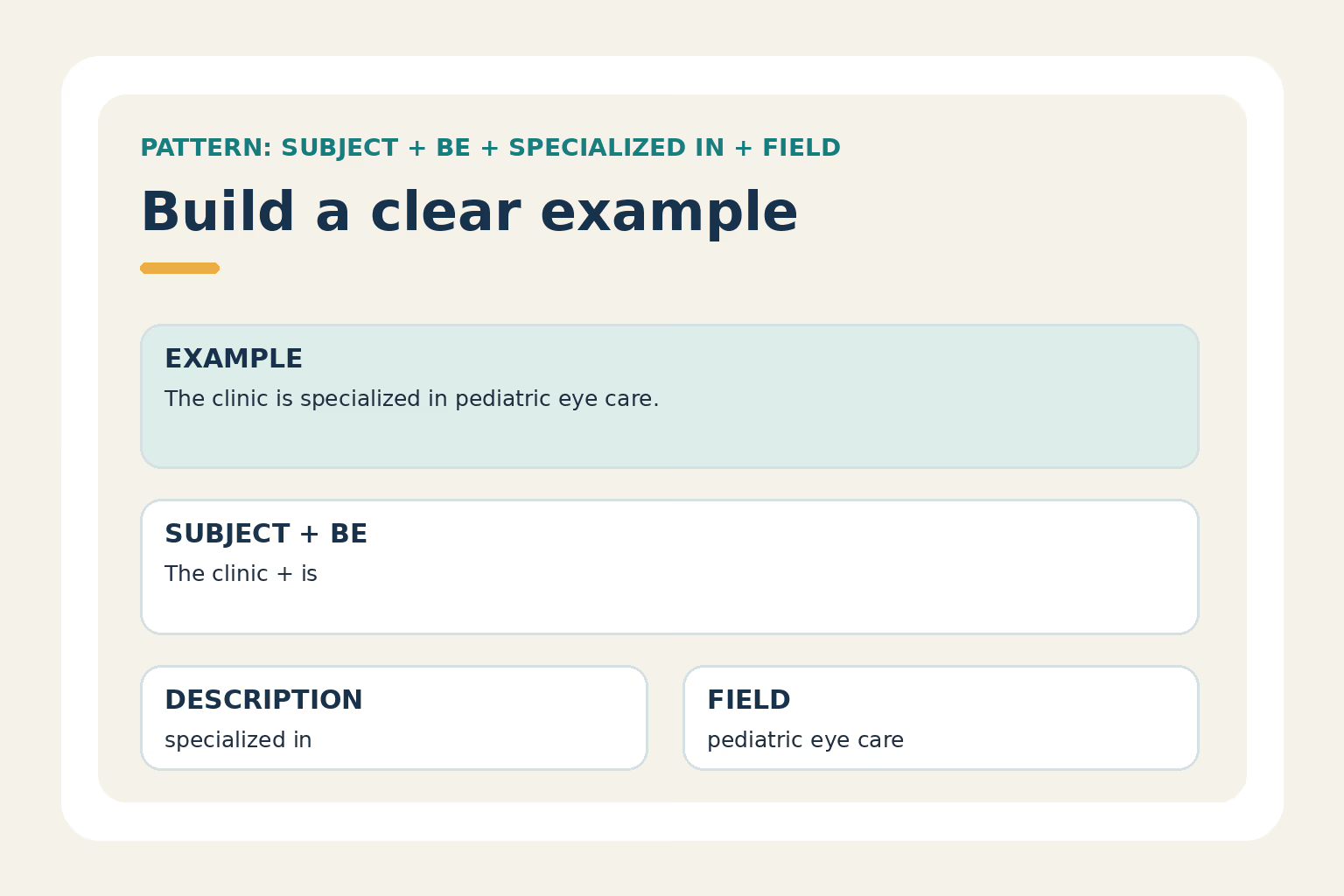
| be specialized in + field | Dr. Chen is specialized in pediatric eye care. | The preposition in introduces the field. |
| be specialized for + purpose or user | This keyboard is specialized for one-handed use. | For points to the intended purpose or user. |
| become / grow more specialized | As the team expanded, each role became more specialized. | The work grew narrower or more focused over time. |
| specialized knowledge of + subject | The archivist has specialized knowledge of early maps. | Of introduces the area of knowledge. |
Use the preposition that makes the relationship clear. Specialized in commonly introduces an area of expertise or activity; specialized for points to a purpose, need, or intended user. A noun can follow specialized directly when the adjective describes it: specialized services. For a specific sentence, check whether in or for matches what you mean.
Specialized, Specialize, Specialist, and Specialization
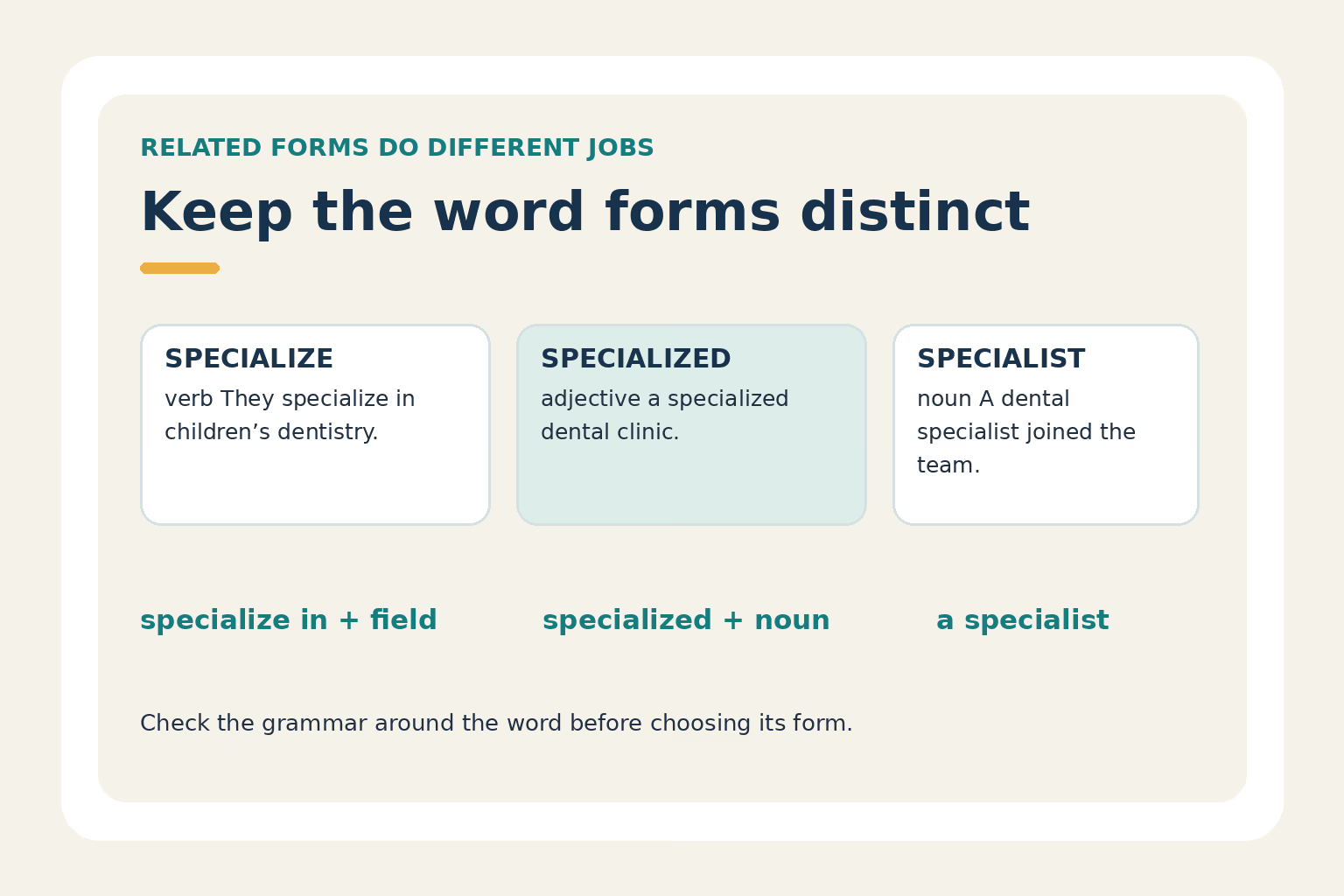
These related words share a root but cannot always replace one another. Specialize is a verb: a person, company, or system may specialize in a field. Specialized is an adjective: it describes the expertise, service, tool, or knowledge. A specialist is a person with particular expertise (or, in some fields, a thing designed for a narrow purpose). Specialization is the noun for the process or area of becoming or being specialized.
- Verb: “The firm specializes in restoring historic buildings.”
- Adjective: “The firm offers specialized restoration services.”
- Noun for a person: “A restoration specialist inspected the roof.”
- Noun for a field or process: “Her specialization is manuscript conservation.”
Use specialized when you need a describing word: specialized equipment, not “specialist equipment” if you mean equipment intended for a particular task. In some contexts, specialist equipment is also grammatical and means equipment for or used by specialists. Context determines the intended meaning.
Examples of “Specialized” in Different Contexts
- Medicine: “The hospital opened a specialized unit for patients with rare heart conditions.”
- Education: “The program provides specialized instruction for students learning to read.”
- Technology: “The researchers built specialized software to analyze satellite images.”
- Work: “After years in the field, Mina developed specialized knowledge of water systems.”
- Equipment: “The rescue crew carried specialized tools for working in narrow spaces.”
- Services: “The firm offers specialized advice to small museums.”
- Animals: “Some birds have specialized beaks that help them reach food in tight spaces.”
- Manufacturing: “The factory uses specialized machinery to make the delicate components.”
- Research: “A specialized vocabulary can make a research paper difficult for new readers.”
- Travel: “The guide arranged specialized tours for visitors interested in local architecture.”
- Sports: “The athlete followed a specialized training plan during recovery.”
- Conservation: “The archive needs specialized storage to protect fragile photographs.”
Make the Sentence More Specific
Specialized can sound vague if it is not clear what the specialization involves. Add the field, task, or intended audience when that information matters. “They use specialized tools” is grammatical, but “They use specialized tools to repair antique watches” gives the reader a concrete picture. The adjective does not by itself prove that a service is more effective, more advanced, or better than a general one.
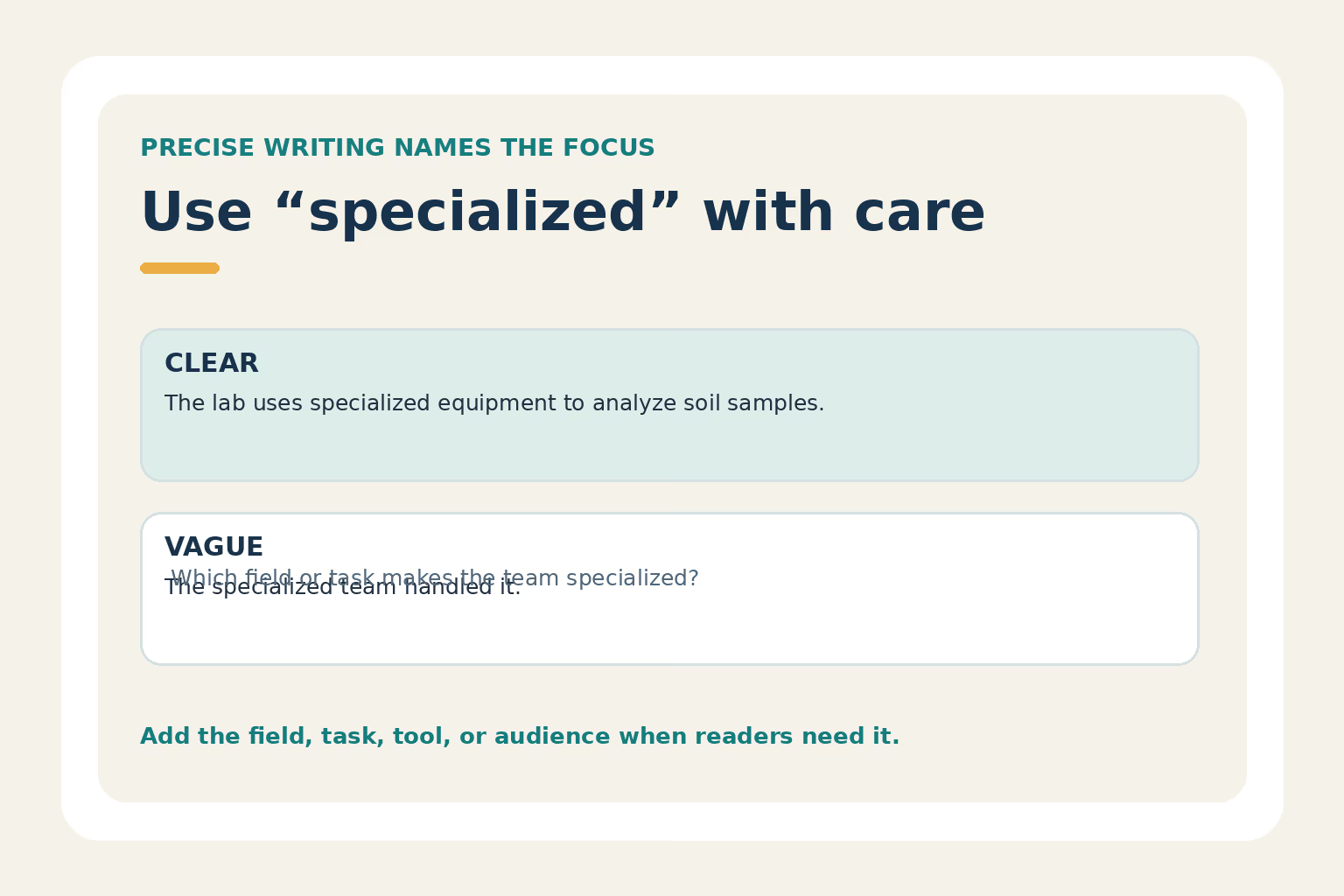
Try this quick editing sequence: identify what the adjective describes; name the field or use; then choose the most fitting preposition, if one is needed. For example, “The service is specialized” may become “The service is specialized in repairing vintage cameras.” If the point is intended use, write “These gloves are specialized for handling hot materials.”
Common Questions About “Specialized”
What is a simple sentence with “specialized”?
“The museum hired a specialized conservator to restore the painting.” Here, specialized describes the conservator’s particular training; the sentence has a subject (museum) and a verb phrase (hired).
Is “specialized” an adjective or a verb?
It is most often used as an adjective, as in specialized training. It is also the past-tense and past-participle form of the verb specialize, as in “The department specialized in public health.” Grammar depends on how it functions in the sentence.
Should I write “specialized in” or “specialized for”?
Use in for a field or area of expertise (“a lawyer specialized in tax law”) and for for an intended purpose or user (“equipment specialized for underwater work”). Some sentences allow more than one phrasing with a difference in emphasis.
Does “specialized sentence” mean a particular grammar type?
No standard grammar category is called a “specialized sentence.” You can describe a sentence as specialized in topic or vocabulary, but classify its structure with terms such as simple, compound, or complex.
Can I say “highly specialized”?
Yes. Highly modifies specialized to emphasize a narrow or advanced focus: “The lab needs highly specialized equipment.” Use the phrase only when that degree of focus is accurate.
Sources and Further Reading
- Cambridge Dictionary: “specialized” — adjective definitions and usage examples.
- Cambridge Dictionary: “specialize” — verb meaning and patterns.
- Oxford Learner’s Dictionaries: “specialized” — adjective entry and example usage.
- Purdue OWL: Sentence Fragments — guidance on complete clauses and sentences.

Do you know what a specialized sentence is? In writing, a specialized sentence is a type of sentence that conveys a specific topic or idea in a clear and concise manner by focusing on specific details.
These sentences are skillfully crafted to provide in-depth information on a particular subject, making them essential for technical writing, research papers, and other academic or professional documents. Let’s delve deeper into the intricacies of producing specialized sentences and explore how they enhance the clarity and coherence of your writing.
7 Examples Of Specialized Used In a Sentence For Kids
- Doctors are specialized in taking care of people when they are sick.
- Teachers are specialized in helping students learn new things.
- Policemen are specialized in keeping our cities safe.
- Chefs are specialized in cooking delicious food.
- Astronauts are specialized in exploring space.
- Construction workers are specialized in building strong buildings.
- Artists are specialized in creating beautiful paintings and sculptures.
14 Sentences with Specialized Examples
- College students have the option to take specialized courses in their chosen field of study.
- It is important to pursue a specialized degree that aligns with your career goals.
- Attending workshops and seminars can help students develop specialized skills.
- Many universities offer specialized programs in emerging fields like data science and artificial intelligence.
- Students can enhance their resumes by completing specialized certifications.
- Building a strong network within your specialized field can open up various opportunities.
- Specialized internships can provide valuable hands-on experience in your industry.
- Researching different specialized courses can help students make informed decisions about their academic path.
- Seeking mentorship from professionals in your specialized area can offer valuable insights.
- Joining clubs or organizations related to your specialized field can help you stay updated on industry trends.
- Participating in hackathons or competitions can showcase your specialized skills to potential employers.
- Utilizing online platforms to access specialized resources can supplement your classroom learning.
- Collaborating with peers on specialized projects can help deepen your understanding of the subject matter.
- Graduating with a specialized degree can give you a competitive edge in the job market.
How To Use Specialized in Sentences?
Specialized can be used in a sentence to emphasize or highlight expertise in a specific area. When incorporating the word “specialized” into a sentence, it is essential to provide context and clarity regarding the specific niche or field where the expertise lies.
Here are some examples of how to use specialized in a sentence:
-
“The hospital has a team of specialized doctors who focus on treating rare genetic disorders.”
-
“She pursued a degree in specialized marketing to enhance her skills in digital advertising.”
-
“The company offers specialized training programs for employees interested in advancing their careers.”
-
“The museum features a specialized exhibit dedicated to ancient civilizations.”
-
“He hired a specialized consultant to provide insights on improving operational efficiency.”
Remember, when using the word “specialized” in a sentence, it is crucial to provide details that help convey the expertise or focus of the specialization. By doing so, the message will be clear and effectively communicate the specific area of proficiency. With practice, incorporating specialized into your writing will become more natural, allowing you to express expertise in a concise and impactful way.
Conclusion
Specialized sentences are those that are tailored to a specific field, topic, or profession, using language and terminology relevant to that area. These sentences are designed to convey precise information, often requiring a certain level of expertise or knowledge in that particular subject to fully understand. By using specialized sentences, professionals can communicate complex ideas effectively within their respective fields, ensuring clarity and accuracy in their discussions and documents.
Whether in scientific research papers, legal documents, or technical manuals, the use of specialized sentences is crucial for maintaining professionalism and accuracy in communication within specialized fields. These sentences play a vital role in conveying specific information efficiently and accurately, enabling experts to share knowledge and insights effectively with their peers and the wider audience in their field. Through the use of specialized sentences, professionals can ensure that their ideas are communicated clearly, precisely, and in a way that is easily understood by others within their specialized domain.


