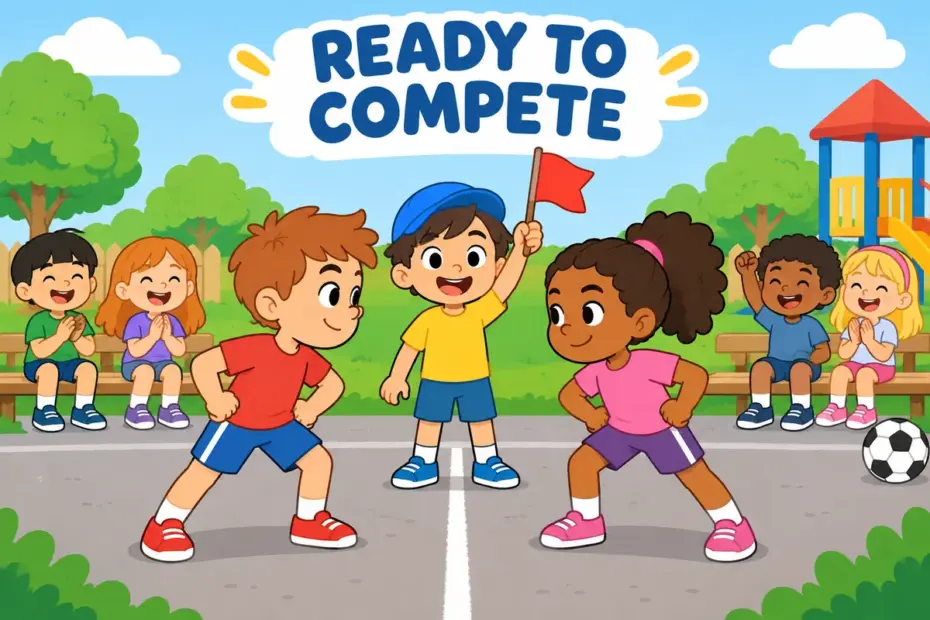
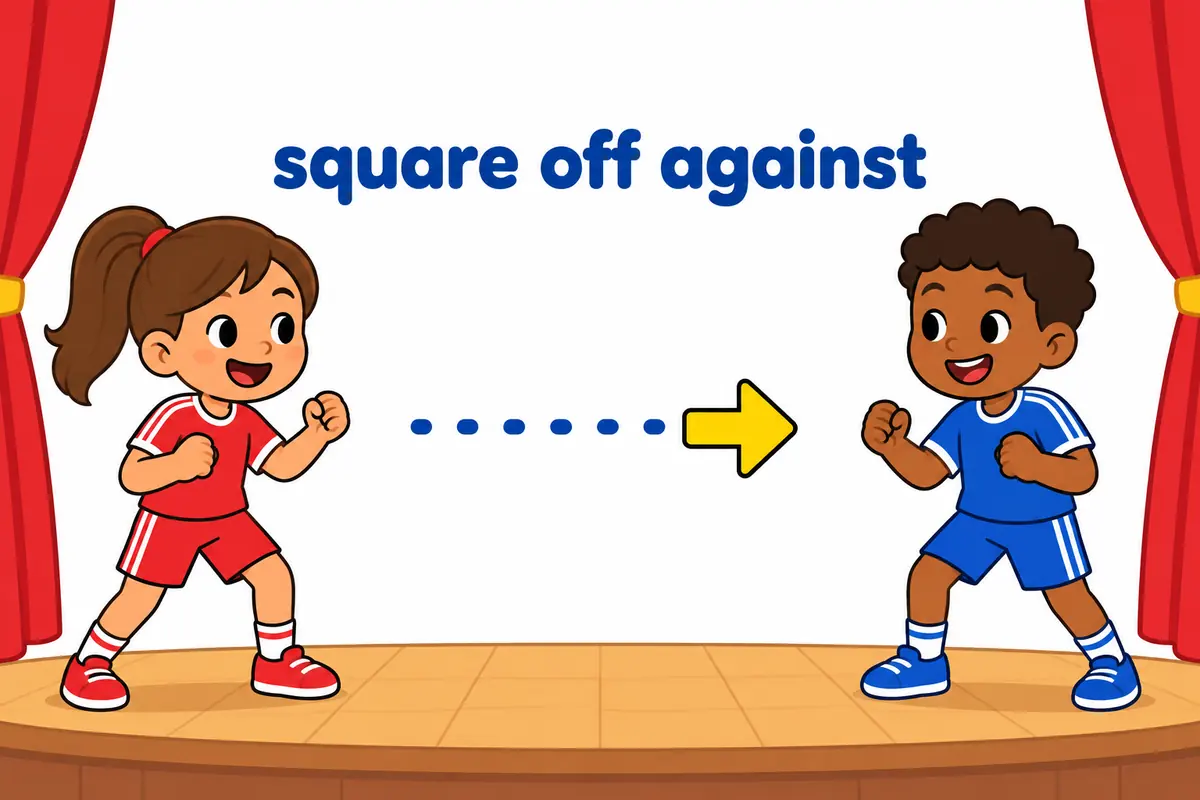
Square off is a phrasal verb meaning to take opposing positions and prepare to compete or fight. You use it in a sentence by naming the two sides and, usually, the preposition against: “The finalists square off against each other tonight.” The verb is intransitive, so it never takes the opponents as a direct object.
Square off at a glance
- Square off is an intransitive phrasal verb; its forms are squares off, squared off and squaring off.
- Its two senses are taking a fighting stance and meeting an opponent in a contest.
- The natural pattern is subject + square off + against or with + opponent.
- The verb appears most in sport, politics and news reporting.
- The commonest error is mixing it up with square up, which can mean to pay a debt.
What does square off mean?
Square off is a phrasal verb meaning to take up a position facing an opponent, either to fight or to compete. The Cambridge entry for square off records both the fighting sense and the contest sense, and the difference matters: the first describes a physical stance, the second a fixture or a debate. Where two people only disagree in conversation, confront an opponent is the plainer choice, because square off adds the picture of a contest about to begin.
| Sense | Plain meaning | Example sentence |
|---|---|---|
| Fighting stance | Adopt a posture ready to fight | The two men squared off in the car park. |
| Meet in a contest | Begin a match or debate | The teams square off in the final on Sunday. |
| Face in disagreement | Confront over an issue | The minister squared off against the union over pay. |
One limitation is worth stating plainly. Square off is the wrong verb when the encounter is cooperative: colleagues who cooperate on a project never square off, because the word assumes opposing sides.
How do you use square off in a sentence?
Name the participants and let the preposition carry the relationship. The verb needs no direct object, so the opponent always arrives after against, with or over.
| Pattern | Example | What it signals |
|---|---|---|
| subject + square off | The rivals squared off at midfield. | An expected contest, with the opponent left unstated. |
| square off against + opponent | The champion squares off against the challenger. | Names exactly who the subject will meet. |
| square off with + opponent | Shareholders squared off with management. | A more confrontational reading of the same clash. |
| be set to square off | The two sides are set to square off in court. | Signals an upcoming clash, common in news copy. |
| square off over + issue | The parties squared off over the budget. | Names the disputed topic rather than the person. |
The phrase is inseparable: you square off against somebody, never square somebody off. That fixed shape is what tells a reader the two sides are still apart.
Square off in a sentence: examples across contexts
The verb changes scene more than it changes meaning. These nine sentences keep the same phrasal verb while moving from a school debate to a live report, and each names the side being faced.
| Context | Example sentence | Why this works |
|---|---|---|
| Sports report | United and City square off in the derby on Saturday. | Two named teams plus a date is the standard fixture pattern. |
| Politics | The two candidates squared off over health spending. | Names the disputed issue with the over pattern. |
| Classroom debate | Our team squares off against the visitors after lunch. | Against clearly marks the opposing side. |
| Workplace | The designers squared off with sales over the launch date. | Shows an internal clash without naming a physical fight. |
| Legal writing | Both firms square off in court next month. | The place supplies the setting and implies litigation. |
| News headline | Rivals set to square off in final vote. | The be set to pattern signals a scheduled contest. |
| Gaming report | The top two players square off in the last round. | Positions the clash inside a tournament structure. |
| Conversation | I watched them square off across the table. | The object pronoun sits after watched, not after the verb. |
| History narrative | The admirals squared off before the storm broke. | Uses square off for the tense moment before battle. |
Notice that no sentence puts the opponent directly after the verb, which is the quickest test of a correct use.
Square off vs square up and duel
Square off is confused with three near neighbours, and the shared root of the first is the trap. duel names a formal single combat, while square up usually means to pay what you owe or to get ready to fight.
| Attribute | square off | square up | duel |
|---|---|---|---|
| Core job | Face an opponent in a contest | Pay a debt, or ready the fists | Fight one opponent formally |
| Needs a second party | Yes, after against or with | No, it can be a solo action | Yes, and equally matched |
| Usual subject | Teams, candidates, rivals | Customers, debtors, boxers | Two individuals |
| Register | Sport and news | Informal and colloquial | Formal or historical |
| Implied outcome | A contest about to start | A debt cleared | An honour settled |
Verdict: choose square off when two sides are about to compete, square up when money changes hands or fists are raised, and duel only for a formal single fight.
Word forms and grammar of square off
Square off inflects like a regular verb, but it never gains a direct object. The table also lists the noun and the non-standard form learners invent.
| Form | Part of speech | Example |
|---|---|---|
| square off | phrasal verb, base | The teams square off at noon. |
| squares off | verb, third person singular | She squares off against the champion. |
| squared off | verb, past and past participle | They squared off in the semi-final. |
| squaring off | verb, present participle | The rivals are squaring off again. |
| square-off | noun, informal | The debate became a verbal square-off. |
| square offed | non-standard | Wrong: The teams square offed yesterday. |
The same particle also appears in square up, but that verb belongs to the world of bills and fists rather than fixtures.
Common mistakes with square off
- Incorrect:
The two boxers squared off each other.Correct: The two boxers squared off against each other. Rule: The verb is intransitive, so the opponent needs a preposition. - Incorrect:
The coach squared the players off.Correct: The players squared off. Rule: Square off cannot be separated, so there is no object to place between verb and particle. - Incorrect:
We squared off the bill at the counter.Correct: We squared up the bill at the counter. Rule: Paying a debt belongs to square up, not square off. - Incorrect:
The two friends squared off to paint the mural.Correct: The two friends worked together on the mural. Rule: Square off implies opposing sides, so it is wrong for shared work. - Incorrect:
The sides will be squared off tomorrow.Correct: The sides will square off tomorrow. Rule: The verb is active and intransitive, so it resists the passive.
Practice using square off
Work through the six items, then read the reasoning with each answer rather than the key alone.
- Fill the gap: The finalists ______ against each other at three o’clock.
- Choose the better word: After dinner we (squared off / squared up) the bill with the waiter.
- Correct the error: The debate team squared off the visiting school.
- Build a sentence: use square off over about a disagreement between two clubs.
- Spot the register: which belongs in a news report — the boxers squared off, or the boxers had a square-off?
- Rewrite without against: The rookies square off against the champions. Keep the same meaning.
Answers
- square off — against introduces the opponent, exactly as the intransitive verb requires.
- squared up — a bill is a debt, and that sense belongs to square up.
- The debate team squared off against the visiting school — the opponent needs a preposition.
- Model answer: The two clubs squared off over the use of the training pitch.
- The boxers squared off — a report prefers the plain verb to the informal noun.
- The rookies square off with the champions — with carries the same competitor relationship.
The bottom line
Use square off in a sentence when two sides take opposing positions and prepare to compete, and give the opponent a preposition rather than a direct object. The two details that decide most sentences are these: the verb is intransitive, so it can never be separated, and it implies a contest, so shared work needs a different word such as challenge or join. For a fixture, the be set to square off pattern is the one editors reach for.
Frequently asked questions about square off
Is square off a phrasal verb?
Yes. Square off is an intransitive phrasal verb made of the verb square and the particle off, and the particle cannot be separated from it. Its forms are squares off, squared off and squaring off. Because it takes no direct object, an opponent can only follow a preposition such as against or with.
What is the difference between square off and square up?
Square off means to face an opponent in a contest or a fight, and it always involves a second party. Square up usually means to pay a debt, and it can also describe raising the fists. The two share the word square but belong to different situations, which is why the bill is squared up and the teams square off.
Can you square off with someone instead of against them?
Yes. Square off with is standard and slightly more confrontational than square off against. The against pattern states the matchup neutrally, as a fixture or a debate, while with suggests a personal clash. In business writing, against is the safer choice because it keeps the tone factual and avoids implying a quarrel.
Is square off used outside sport?
Yes. Square off appears in political reporting, legal writing and everyday speech whenever two sides are about to compete or argue. A courtroom, a boardroom and a school debating hall all produce square-offs, and the verb works in each. Only shared, cooperative activity falls outside its range.
Have you ever heard of the term “square off” but weren’t quite sure what it meant? Let’s delve into the definition of this common expression.
“Squaring off” typically refers to when two individuals or groups confront each other in a direct and often confrontational manner. This can be verbally, physically, or in a competitive setting, exemplifying a moment of contention or challenge.
7 Examples Of Square Off Used In a Sentence For Kids
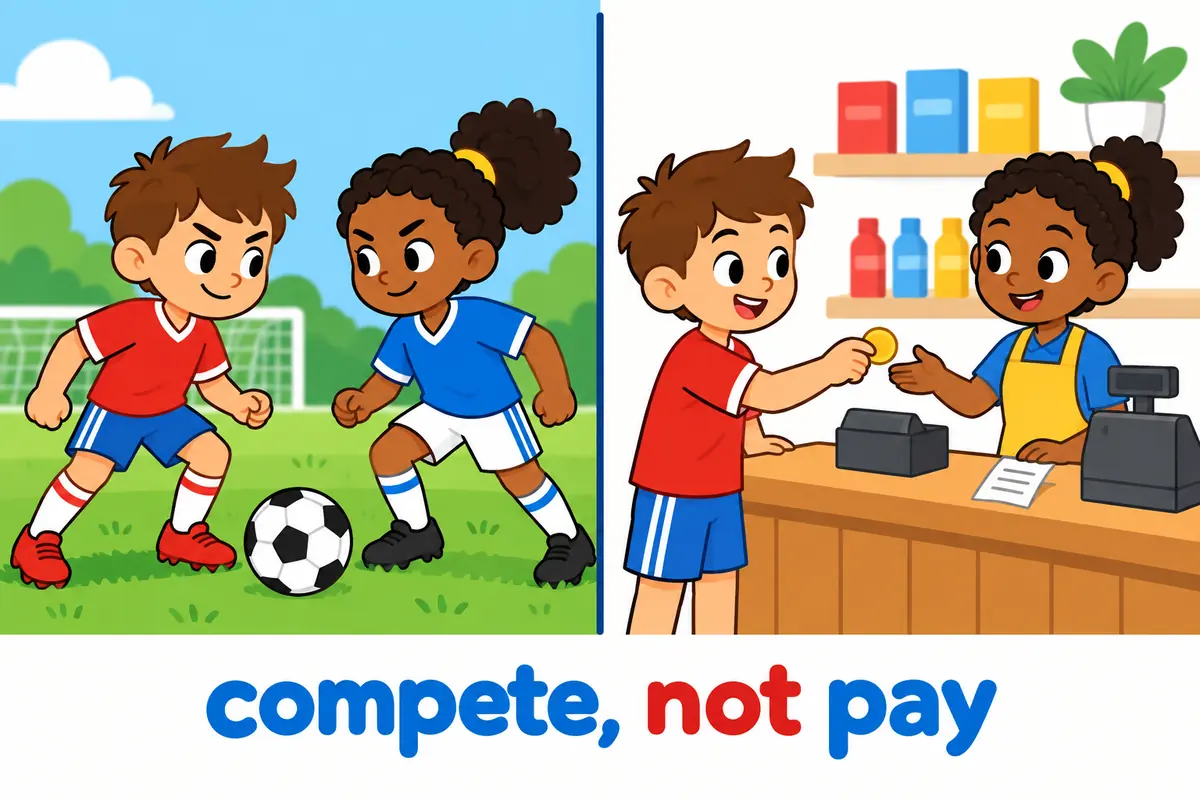
- Square off means to stand face to face.
- Let’s square off and have a dance competition.
- You can square off with your friend in a game of tag.
- We will square off and race to see who is the fastest.
- When we square off, we make sure to follow the rules.
- Don’t forget to shake hands after you square off.
- After we square off, we can all play together as friends.
14 Sentences with Square Off Examples
- The two cricket teams are about to square off in the final match of the tournament.
- The debate club members will square off next week to determine the best debater.
- The coding competition will have participants square off against each other to showcase their skills.
- The two dance crews are ready to square off in the college talent show.
- The quiz competition will see students square off to prove their knowledge.
- The football teams are going to square off on the field for the championship title.
- The drama society is planning to have actors square off in a theatrical showdown.
- The two best speakers in the literary club will square off in a public speaking contest.
- The quiz bowl teams from different colleges will square off in a regional competition.
- The chess club members will square off in a friendly tournament this weekend.
- The music bands are getting ready to square off in the battle of the bands event.
- The art society is organizing a drawing competition where students will square off with their creativity.
- The sports day will have athletes from various departments square off in multiple events.
- The fashion show will see aspiring designers square off to showcase their unique styles.
How To Use Square Off in Sentences?
Square Off is a smart chess board that allows players to enjoy a game of chess against a virtual opponent or a remote player. To use Square Off effectively, follow these steps:
- Set up the Square Off board by connecting it to the Square Off app on your smartphone or tablet.
- Select the game mode you want to play – local game against the AI, online game against remote players, or practice mode.
- Place your pieces on the board by tapping the piece you want to move and then tapping the square you want to move it to. The piece will automatically move on the physical board.
- Wait for your opponent’s move if you are playing an online game. Your opponent’s moves will be replicated on your physical board.
- Enjoy the game and strategize your moves to outmaneuver your opponent.
- Review your games by accessing the app’s history feature to see your past games and improve your chess skills.
Remember to charge the board regularly to ensure uninterrupted gameplay. With Square Off, you can experience the traditional game of chess in a modern and interactive way. Have fun playing and challenging your friends and family to exciting chess matches!
Conclusion
In conclusion, “square off” is a term commonly used to describe a confrontation or competition between two parties, often with a sense of direct opposition or rivalry. This can be seen in various contexts, such as sports matches, debates, or conflict resolutions where individuals or groups come face to face to compete or settle differences.
Whether it’s in the political arena, sports field, or business world, the concept of “squaring off” highlights the intense and competitive nature of human interactions. By understanding the implications of “square off,” we can better grasp the dynamics of conflicts and competitions that play out in different aspects of our lives.