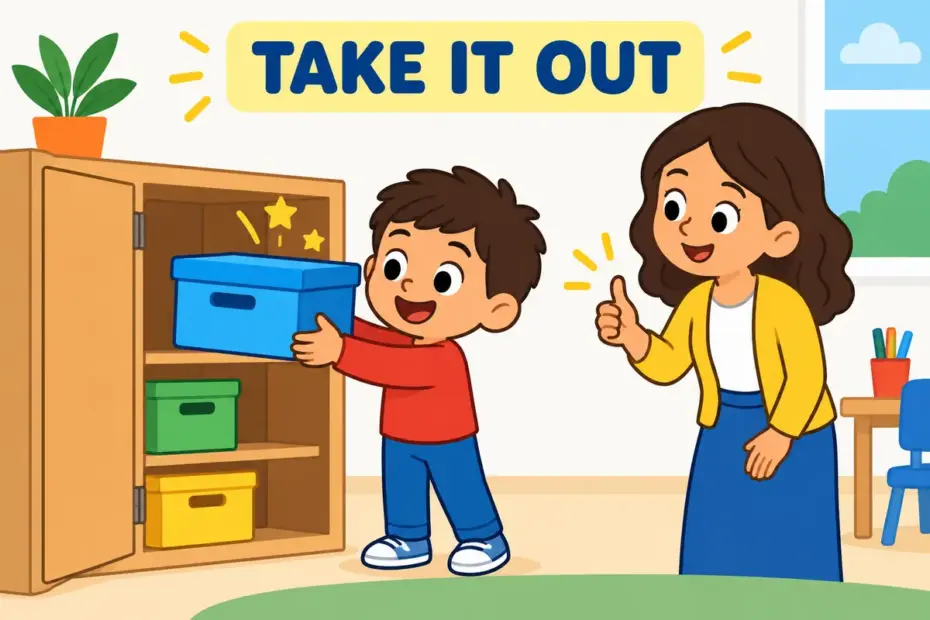
Take out means to remove something from a place, obtain a loan, or invite someone on a date. To use take out in a sentence, put the object after the phrase or between its two words: “take out the bins” or “take the bins out.” The verb is separable, so a pronoun sits in the middle.
Take out at a glance
- Take out is a transitive, separable phrasal verb; its forms are take out, takes out, took out, taken out and taking out.
- The commonest sense is to remove something from a place or container.
- A second sense is to obtain something on application, as in take out a loan or insurance.
- A third sense is to invite someone on a date, as in he took her out for dinner.
- When the object is a pronoun it must sit between the verb and the particle: take it out, never take out it.
- The noun form is takeout, and it means food bought to eat elsewhere.
What does take out mean?
Take out is a transitive phrasal verb meaning to remove something from a place, to obtain something on application, or to invite someone on a date. The Cambridge entry for take out records all three senses, which behave alike grammatically but differ sharply in meaning, so the object tells you which one is in play. Where the sense is simply to move something out of a container, remove is the single-word verb that covers it, and to obtain money formally you would usually withdraw cash.
| Sense | Plain meaning | Example sentence |
|---|---|---|
| Remove from a place | Move something out of a container or room | Please take the glasses out of the cupboard. |
| Obtain by applying | Arrange a loan, policy or service | They took out a mortgage on the flat. |
| Invite on a date | Ask someone to go somewhere with you | He took her out for dinner. |
| Remove a target | Neutralise a person or position | The unit took out the radio post. |
One limitation deserves stating plainly. Take out is informal in most of its senses, and in careful writing about removals the single-word verb remove often reads better. The phrase also carries a euphemistic military sense, so where that meaning would be ambiguous, a precise verb does the job more honestly.
How do you use take out in a sentence?
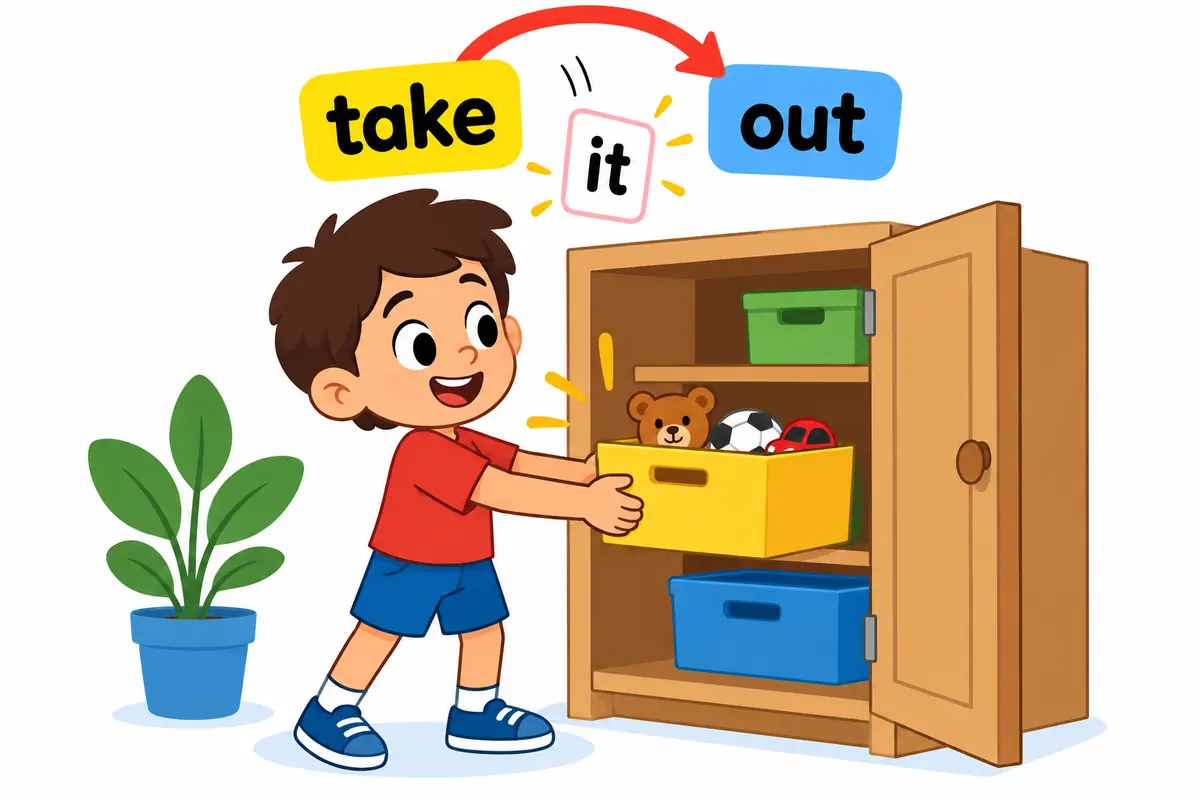
Take out is transitive, so it always needs an object, and it is separable, which means the object may follow the particle or slide between the verb and out. The particle never strands after a pronoun, so take out it is impossible; the order take it out is the only grammatical form.
| Pattern | Example | What it signals |
|---|---|---|
| take out + object | Take out the recycling. | Object follows the whole phrase. |
| take + object + out | Take the recycling out. | The same meaning with the particle last. |
| take + pronoun + out | Take it out. | A pronoun must sit between verb and particle. |
| take out + a loan or policy | She took out insurance. | The obtain-by-application sense. |
| take + object + out + to | He took her out to the cinema. | The invitation sense with a destination. |
The pronoun rule is absolute, and it is the fastest way to spot a learner in speech. For the removal sense, take away is separable in exactly the same way and means almost the same thing.
Take out in a sentence: examples across contexts
Take out keeps one grammar while its meaning shifts from household chores to banking. The ten sentences below show the removal, obtain and invitation senses at work.
| Context | Example sentence | Why this works |
|---|---|---|
| Classroom | Please take out your exercise books and open to page ten. | A school command in the removal sense. |
| Home | Could you take the bins out before the van arrives? | Separable order with the object in the middle. |
| Workplace email | We took out a maintenance contract for the new printer. | The obtain sense in a business register. |
| Banking | She took out a small loan to cover the deposit. | The obtain sense applied to money. |
| Conversation | They took the children out for pizza on Friday. | The invitation sense, clearly separable. |
| Restaurant | We got takeout because nobody wanted to cook. | The one-word noun for food eaten elsewhere. |
| News report | The airline took out an injunction against the strike. | Formal obtain sense with a legal object. |
| Diary | He took me out to the coast for the afternoon. | A pronoun sits between verb and particle. |
| Sports report | The defender took out the winger with a late tackle. | The informal remove-from-play sense. |
| Health writing | Dentists advise taking out sugary drinks from school menus. | Removal sense in a formal recommendation. |
Two senses open a door to neighbouring phrasal verbs: when the invitation is romantic, date names the activity, and ask out is the phrase for the moment of invitation itself.
Take out vs take away
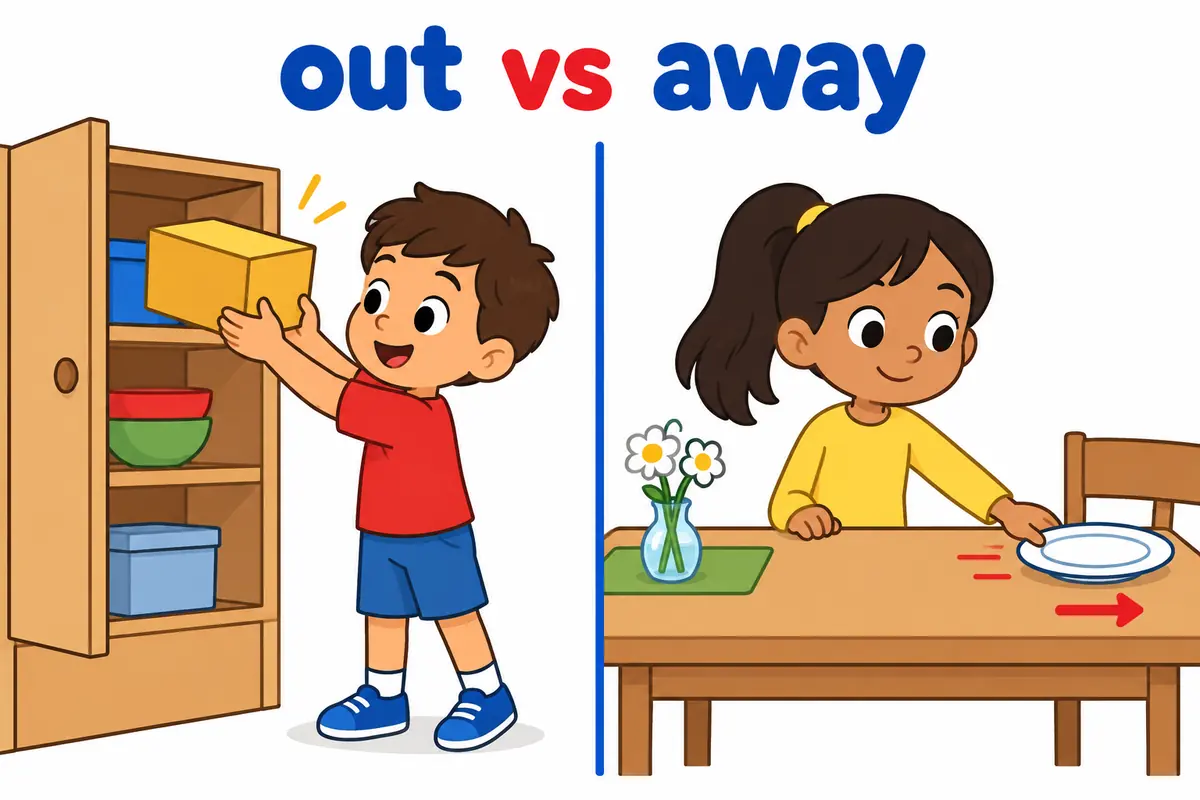
Take out and take away share a base verb and a removal sense, so the choice usually comes down to variety and regional habit rather than meaning. For a substance you pull from something by effort, extract is the more precise verb.
| Attribute | take out | take away |
|---|---|---|
| Removal sense | Move something out of a container or room | Move something from one place or person to another |
| Food noun | Takeout, common in American English | Takeaway, common in British English |
| Separability | Separable: take it out | Separable: take it away |
| Obtain sense | Take out a loan or policy | Not used for loans or policies |
| Typical focus | Out of an enclosed space | Off a surface or out of someone’s hands |
Verdict: choose take out for loans, policies and anything leaving an enclosed space, and take away when something is removed from a surface or from a person. To leave something untouched is the opposite idea, and keep is its plainest verb.
Word forms and grammar of take out
Take out inflects through the verb take, and the noun takeout is written as one word in most modern usage. The table also lists the particle that learners most often swap in by mistake.
| Form | Part of speech | Example |
|---|---|---|
| take out | phrasal verb, base form | Take out the plates. |
| takes out | third person singular | She takes out the rubbish each night. |
| took out | past tense | He took out a policy last year. |
| taken out | past participle | The bins have been taken out. |
| taking out | present participle | Taking out a loan costs money. |
| takeout | noun or adjective | We ordered takeout. |
Do not confuse take out with take off, which means to remove clothing or for an aircraft to leave the ground. The two share the verb but not the grammar, because take off is often used without an object.
Common mistakes with take out
- Incorrect:
Please take out it.Correct: Please take it out. Rule: A pronoun object must sit between the verb and the particle. - Incorrect:
I need to take out money from the cash machine.Correct: I need to withdraw money from the cash machine. Rule: For cash, withdraw is standard; take out suits loans and policies. - Incorrect:
We ordered a take out.Correct: We ordered takeout. Rule: As a noun, takeout is written as one word. - Incorrect:
She took out the meeting to next week.Correct: She put off the meeting until next week. Rule: Take out does not mean postpone; use put off or postpone. - Incorrect:
The plane will take out at noon.Correct: The plane will take off at noon. Rule: Take out is transitive; take off is the departure verb.
Practice using take out
Work through the six items, then check the reasoning rather than only the answer.
- Fill the gap: Could you ______ the rubbish before you leave?
- Choose the better order: The bins are heavy, so take (out them / them out).
- Correct the error: She took out it of the drawer.
- Build a sentence: use take out about a loan.
- Spot the register: which fits a message to a bank — I would like to take out a small loan, or I wanna take out some cash?
- Rewrite with the noun: We bought food to eat at home. Use takeout instead.
Answers
- take out — the removal sense with the object after the phrase.
- them out — a pronoun must sit between the verb and the particle.
- She took it out of the drawer — the pronoun belongs in the middle, not after out.
- Model answer: They took out a loan to buy the van — a loan is obtained by application.
- I would like to take out a small loan — a bank message avoids wanna and keeps the obtain sense clear.
- We got takeout — the noun for food eaten elsewhere is one word.
The bottom line
Use take out in a sentence for removing something, obtaining a loan or policy, or inviting someone out, and keep the object close to the phrase. Two rules decide the grammar: the verb is transitive, so it always needs an object, and it is separable, so a pronoun must sit between take and out. For a single-word alternative in formal writing, remove is usually the safer verb.
Frequently asked questions about take out
Is take out separable?
Yes. Take out is a separable phrasal verb, so the object may follow the particle or sit between the verb and out. Both take out the bins and take the bins out are correct. The one fixed rule is that a pronoun must go in the middle, giving take them out.
What does take out mean on a restaurant sign?
On a sign, takeout is a noun meaning food prepared in a restaurant but eaten somewhere else. The same word works as an adjective in a takeout order. The verb take out keeps its ordinary removal or obtain senses, so the sign uses the noun form.
Is it take out or takeout?
Both exist, but they do different jobs. The two-word take out is the phrasal verb, as in take out the rubbish. The one-word takeout is the noun or adjective for food eaten elsewhere. Match the form to the part of speech you need.
Can you say take out it?
No. Take out it is never grammatical because a pronoun object must sit between the verb and its particle. Write take it out instead. This rule holds for every separable phrasal verb, including take away, turn off and pick up.
Have you ever had a craving for some delicious food but didn’t feel like cooking or dining out? That’s when the concept of “take out” comes to the rescue.
In simple terms, “take out” refers to food that is prepared in a restaurant or establishment but is intended to be eaten elsewhere. This convenient option allows you to enjoy your favorite dishes without the hassle of cooking or staying at the restaurant.
7 Examples Of Take Out Used In a Sentence For Kids
- Take out your crayons and start coloring.
- Let’s take out our lunchboxes and eat together.
- Please take out your textbooks for the lesson.
- Can you take out your water bottle for a drink?
- Take out your jacket, it’s getting cold outside.
- We need to take out our pencils to write.
- It’s time to take out our toys and play together.
14 Sentences with Take Out Examples
- Take out your notes and begin preparing for the upcoming exams.
- Make sure to take out all the required documents before heading to the college fest.
- Remember to take out some time for yourself amidst all the lectures and assignments.
- It’s important to take out any unnecessary items from your bag to keep it organized.
- Don’t forget to take out your student ID card when entering the library.
- Always take out your earphones before entering the classroom.
- Before leaving for a group study session, take out your textbooks and notes.
- Remember to take out cash before heading to the college canteen.
- Make sure to take out your umbrella if it looks like rain.
- Before going to a college event, take out your phone to click some pictures.
- Take out your calculator for the math quiz.
- It’s a good idea to take out all the ingredients before starting to cook in the hostel kitchen.
- Before going to a movie night in the dorm, take out some snacks to share with your friends.
- Don’t forget to take out your laptop before the coding workshop.
How To Use Take Out in Sentences?
Take Out can be used in a sentence when referring to food that is prepared by a restaurant for consumption outside of the establishment.
Here is an example sentence using Take Out: “I am too tired to cook tonight, so I think I will order some take out from our favorite Chinese restaurant.”
When using Take Out in a sentence, it is important to remember to always include it before the name of the food or restaurant you are ordering from. This helps to clarify that you are referring to food that is being taken away from the restaurant.
Another example sentence could be: “Let’s order take out from the pizza place down the street for a quick and easy dinner.”
Remember that when using Take Out in a sentence, it is always helpful to specify what type of food you are ordering, especially if you have a specific restaurant in mind. This ensures that your order is accurately prepared and ready for pick up or delivery.
Overall, Take Out is a convenient way to enjoy restaurant-quality meals in the comfort of your own home, and using it in a sentence is a simple way to communicate your desire for food that is prepared to be consumed off-site.
Conclusion
In conclusion, “take out” can be used to refer to fetching food from a restaurant, removing an object from a particular location, or eliminating something from a list or equation. The term is versatile and commonly utilized in everyday language to signify various actions involving removal or extraction. Whether you’re ordering take-out for dinner, taking out the trash, or taking out a key component from a system, the phrase “take out” effectively communicates the act of taking something away.
Understanding the context in which “take out” is used allows for clear communication and effective conveyance of actions or intentions. By recognizing the multiple meanings and applications of this phrase, individuals can accurately express their needs, whether in a culinary, domestic, or academic setting, making “take out” a valuable and widely understood term in daily conversations.


