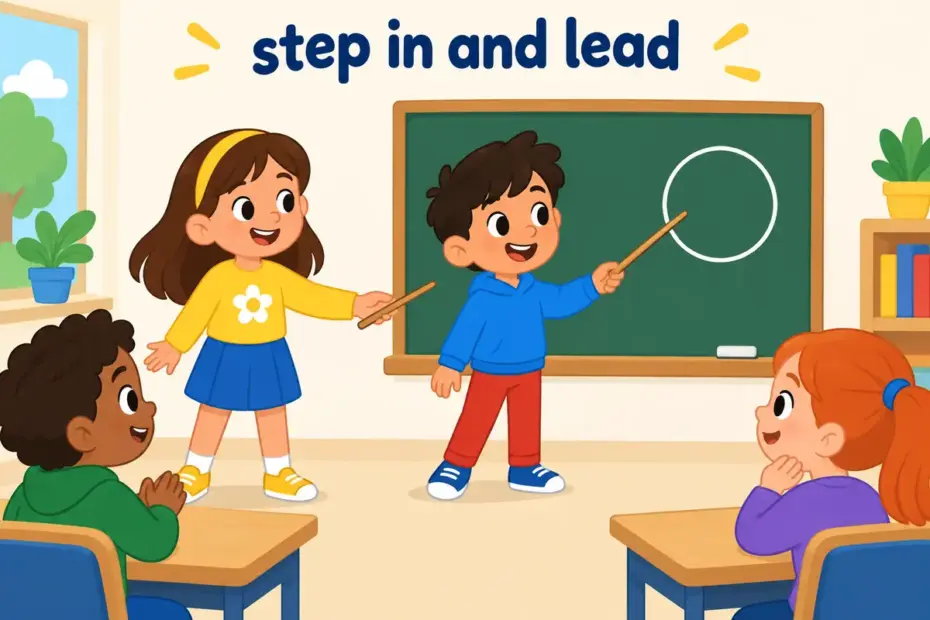
Take over means to assume control of a company, a country or a task from someone else, or to become the feeling that dominates. To use take over in a sentence, name what changes hands: “Maya took over the project in June.” It is separable, so she took it over puts the pronoun in the middle.
Take over at a glance
- Take over is a separable phrasal verb with the forms takes, took and taking.
- Its main senses are assuming control, relieving someone of a duty, and a feeling dominating.
- A noun object may sit after over or between take and over.
- A pronoun must sit between them, so it is take it over, never take over it.
- The related noun is written as one word, takeover, as in a hostile takeover.
- The commonest error is placing the pronoun after over and saying take over it.
What does take over mean?
Take over is a phrasal verb meaning to assume control of something from another person or group, or to begin to dominate. The Cambridge entry for take over records the senses of gaining control of a company and of becoming responsible for something. The three uses differ in what is taken: a business, a duty, or a mood.
| Sense | Plain meaning | Example sentence |
|---|---|---|
| Assume control | Succeed to power over a group or company | A rival chain took over the bakery. |
| Relieve of a duty | Begin doing a job someone was doing | I can take over the shift at six. |
| Dominate a feeling | Become the strongest emotion | Panic took over as the lights went out. |
An honest limit: take over implies that someone else had the role first, so it is wrong for a task nobody held. Where a person simply gains something new, acquire is the precise verb, and where force is involved, seize is stronger still. Take over does not by itself say whether the change was agreed.
How do you use take over in a sentence?
Take over is transitive and separable, so a noun object may follow over or sit between take and over, while a pronoun must sit in the middle. The source of the control is named with from. The frames below show each position.
| Pattern | Example | What it signals |
|---|---|---|
| take over + noun | The bank took over the smaller firm. | object after over, the neutral order |
| take + noun + over | The bank took the smaller firm over. | object between the parts, common in speech |
| take + pronoun + over | She took it over last month. | the only correct order for a pronoun |
| take over from + person | Nadia takes over from Tom on Friday. | names the person being replaced |
| be taken over by + group | The club was taken over by a new owner. | passive, focusing on the thing lost |
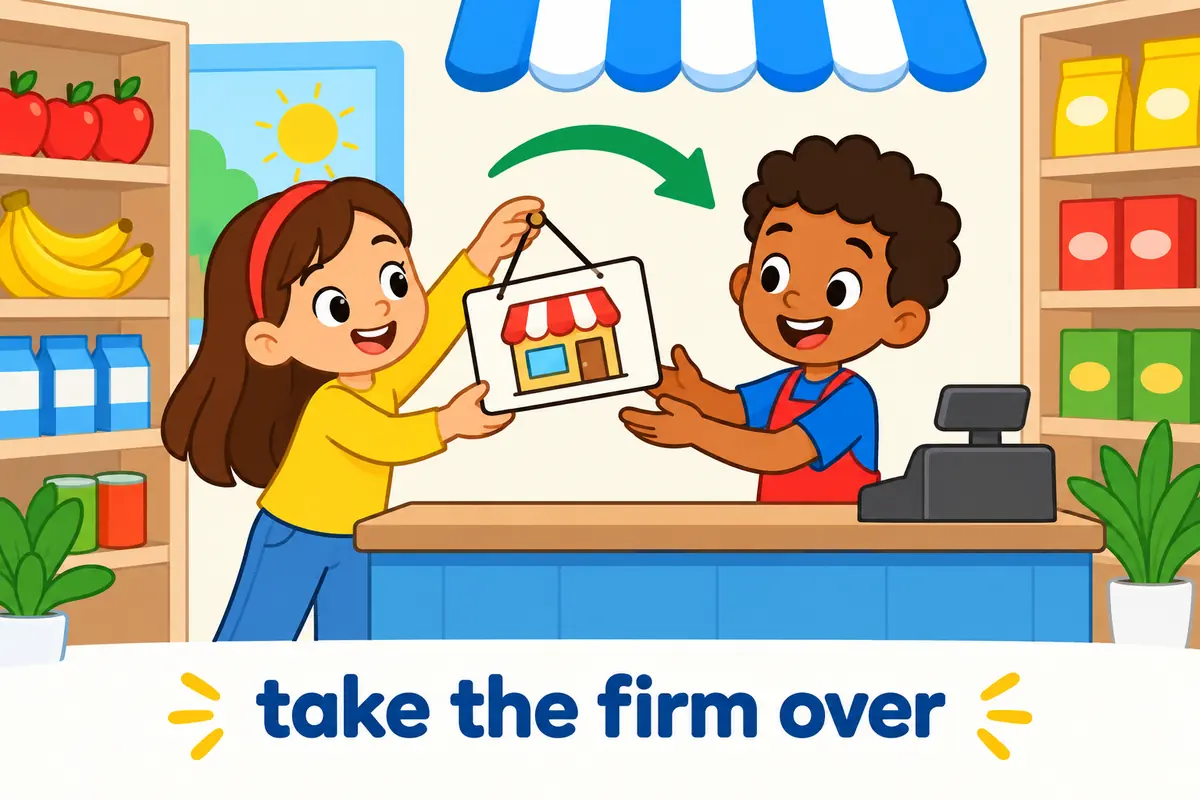
Take over in a sentence: examples across contexts
Take over moves easily between business, sport and everyday talk. Each example below names what changes hands and keeps the object in a natural position.
| Context | Example sentence | Why this works |
|---|---|---|
| Business news | The chain took over its closest rival last spring. | the corporate sense with a clear object |
| Workplace email | Can you take over the client calls while I travel? | a request to relieve someone of a duty |
| Classroom | Our teacher took over the science club this term. | a role assumed from a previous leader |
| Sports report | The substitute took over in goal after the injury. | the duty sense with a named position |
| Storytelling | Gloom took over as the rain set in. | the sense of a mood becoming dominant |
| Politics | A caretaker took over until the election. | temporary control with no force implied |
| Family talk | Grandma took over the cooking on Sundays. | an informal handover of a routine |
| Technology | The new system gradually took over the old one. | a process of replacing something |
| Aviation | The co-pilot took over the controls in the storm. | a precise handover of a duty |
| Retail | Officials moved in to take over the empty premises. | the occupation sense with a clear object |
Take over vs assume, seize and commandeer
Four verbs describe gaining control, and each carries a different amount of force and formality. Assume is the calm, formal choice; seize suggests sudden force; commandeer means to take something for official use.
| Attribute | take over | assume | seize |
|---|---|---|---|
| Core meaning | begin controlling something | take a role or power formally | grab control suddenly |
| Force implied | none by itself | none | strong |
| Typical object | a firm, a shift, a mood | office, control, responsibility | power, a building, a shipment |
| Register | neutral to business | formal | dramatic and formal |
| Agreement implied | often unstated | usually lawful | usually opposed |
Verdict: choose take over for an everyday handover of control, assume when a role is accepted in formal language, and seize when the taking is sudden or contested. Only take over fits a feeling that dominates, as in weariness took over.
Word forms and grammar of take over
The base verb carries the tense while over stays fixed, and the related noun fuses the two words into one.
| Form | Part of speech | Example |
|---|---|---|
| take over | phrasal verb, base | They will take over in September. |
| takes over | third person singular | He takes over the morning shift. |
| took over | past and past participle | She took over the team in May. |
| taking over | present participle | They are taking over the lease. |
| takeover | noun, one word | The takeover was announced on Monday. |
| take-off | noun, different meaning | The plane was cleared for take-off. |
| relinquish | verb, opposite | The founder relinquished control quietly. |
| handover | noun | The handover of duties went smoothly. |
Keep the opposite in view: to relinquish control is to give it up, and a handover is the act of passing it on. The noun form of the phrasal verb is the single word takeover, so never write take over as a noun. Note too that take off is a different phrasal verb about removing or leaving the ground, and the two share only the base verb.
Common mistakes with take over
- Incorrect:
She took over it in April.Correct: She took it over in April. Rule: a pronoun must sit between take and over. - Incorrect:
The firm announced a take over of its rival.Correct: The firm announced a takeover of its rival. Rule: the noun is one word, takeover. - Incorrect:
He will takeover the project.Correct: He will take over the project. Rule: the verb is two words, take over. - Incorrect:
The new manager took over of the department.Correct: The new manager took over the department. Rule: the verb takes a direct object with no of. - Incorrect:
I took over from the meeting.Correct: I took over the meeting. Rule: take over from names a person, not an activity. - Incorrect:
She took over a new hobby at the weekend.Correct: She took up a new hobby at the weekend. Rule: take over means gaining control; starting a hobby is take up.
Practice using take over
- Fill the blank: When the manager left, Amina ______ the whole team.
- Choose the better word: The army (took over / took up) the airport at dawn.
- Correct the error: The company will take over it next month.
- Build a sentence: use take over with a pronoun about a friend covering your paper round.
- Spot the register: which fits a news report — the group completed the takeover in May, or the group just grabbed the whole place?
- Choose the particle: the pilot handed the controls to the co-pilot, who (took over / took off).
Answers
- took over — Amina gained control of the team.
- took over — the army gained control; take up would mean starting an activity.
- The company will take it over next month — the pronoun sits between take and over.
- Model answer: When I was ill, my friend took it over for a week.
- The group completed the takeover in May — a report uses the one-word noun and a measured tone.
- took over — the co-pilot assumed the controls; take off is about leaving the ground.
The bottom line
Take over in a sentence means to assume control of something from someone else, to relieve them of a duty, or to become the dominant feeling. The two facts that decide most sentences are that the verb is separable and that a pronoun must sit in the middle, so write take it over and never take over it. Keep assume for formal acceptance of a role and seize for a sudden grab.
Frequently asked questions about take over
Is take over separable or inseparable?
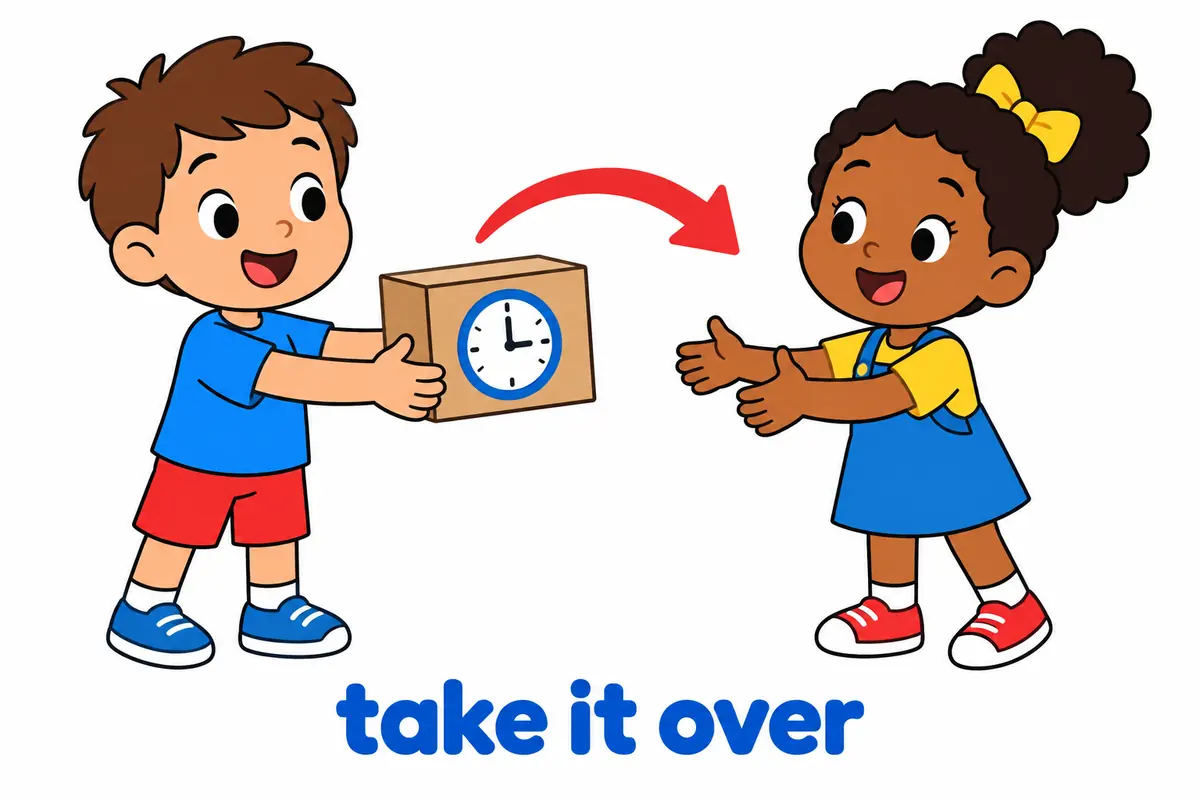
Take over is separable. With a noun object either order works, so take over the company and take the company over are both correct. With a pronoun, only the middle order works, giving take it over. The pronoun rule is the quickest test of whether a learner has the grammar right.
What is the past tense of take over?
The past tense is took over, using the irregular past form of take, as in she took over in May. The present participle is taking over, and the third person singular is takes over. Only the base verb changes, because the particle over always stays the same.
Is takeover one word or two?
The noun is one word, takeover, as in a hostile takeover. The verb is two words, take over, as in they will take over the firm. Writing the verb as one word or the noun as two are the two commonest spelling errors with this pair, so the part of speech should decide the spelling.
What is the difference between take over and assume?
Take over means to begin controlling something, usually from another person, and it suits everyday and business writing. Assume is more formal and often means to accept a role or responsibility lawfully. You take over a shift, but you assume office. Neither implies force, which is why seize is a different choice.
“Take over” refers to the act of assuming control or power over something. This phrase is commonly used to describe a person or group gaining authority or dominance over a particular situation, organization, or territory.
In a business context, “take over” can often refer to acquiring a company through a merger or buyout, leading to the new owners assuming control of operations. This term can also be applied more broadly to various situations where one entity supersedes another in influence or control.
7 Examples Of Take Over Used In a Sentence For Kids
- Take over the playground during recess.
- Let’s have a puppet show and take over the stage.
- We can pretend to be pirates and take over the ship!
- The teddy bears decided to take over the tea party.
- It’s time for the dinosaurs to take over the jungle gym.
- The superheroes are ready to take over the classroom.
- We can take over the sandcastle building competition.
14 Sentences with Take Over Examples
- The student government decided to take over the organization of the college festival.
- The student leader is planning to take over control of the debate club.
- The senior students are working together to take over the leadership of the college sports team.
- The assignment group had to take over the responsibility of completing the project.
- The student council will take over the management of the college canteen starting next semester.
- The new study group decided to take over the library study room for their late-night sessions.
- The engineering students are eager to take over the robotics team and showcase their innovative designs.
- The cultural club members are planning to take over the organization of the college cultural night.
- The academic group is determined to take over the top positions in the upcoming college exams.
- The student entrepreneurs are strategizing how to take over the local market with their business ideas.
- The drama club is excited to take over the college auditorium for their upcoming play rehearsals.
- The science enthusiasts are working hard to take over the science fair competition this year.
- The music club members will take over the college amphitheater for their musical performance.
- The computer science students hope to take over the programming competition and showcase their coding skills.
How To Use Take Over in Sentences?
Take Over is a phrasal verb that denotes the act of assuming control or responsibility for something or someone. It can be used in various contexts, such as in business, sports, or personal relationships.
Here are a few examples to help you understand how to use Take Over in a sentence:
- “After the manager’s resignation, Sarah will take over as the new team leader.”
- “The rival company plans to take over our business by acquiring a majority stake.”
- “The quarterback was injured, so the backup player had to take over the game.”
- “I’m feeling overwhelmed with work. Can you take over some of my tasks?”
- “The new CEO will take over the company’s operations next month.”
To use Take Over in a sentence, simply place it before the action or situation where one assumes control or takes charge of something. It is important to remember that this phrase implies a transfer of power, authority, or responsibility from one individual or group to another.
By understanding the meaning of Take Over and practicing its usage in different contexts, you can effectively communicate your ideas and intentions in both formal and informal conversations.
Conclusion
In conclusion, the concept of take over is commonly used in business and everyday situations to signify gaining control or dominance. In business, a company may take over another through acquisition or merger, while in personal relationships, a person may take over responsibilities or tasks from someone else. Understanding the implications of take over is important for navigating various situations where control or influence is shifted from one entity to another.
Whether it’s a company taking over a competitor, a new manager taking over a team, or a student taking over a project, the concept of take over underscores the transfer of authority or responsibility. It is crucial to approach take overs with clear communication, respect, and a willingness to adapt to new dynamics to ensure a smooth transition and successful outcomes.


